






Abstract
In this paper, we explore why users’ experiences with emerging supply chain technologies comprise inflated expectations followed by disappointment in the early stages of adoption, as per the Gartner Hype Cycle. We used “affordance theory” to study how managers perceive emerging technologies to explain their adoption experience. Affordance theory indicates that perceived benefits—and goals and constraints—depend on the interaction between technology and the users, not on the technology alone. First, we used the literature for two purposes: first, to obtain characteristics of blockchain, Internet of Things (IoT), and artificial intelligence (AI) as emerging technologies; and second, to itemize generic goals, affordances, and constraints in adopting any supply chain technology. Next, we asked 400+ supply chain managers to select those affordances, constraints, and goals that they viewed as pertinent to their organizations’ supply chains for whichever of these three technologies they were implementing. Finally, we compared the responses across technologies for individual respondents (who selected more than one technology) and within the pool of respondents. We found that respondents who selected more than one technology made distinct selections individually for the different technologies relevant to them. The pooled responses across all respondents, however, prioritized the aggregated goals, affordances, and constraints in the same way, regardless of the technology, the organization, or the network features of the supply chain. Overall, it appears that the characteristics of the technology do not inform user expectations at the early stages of adoption. This initial disconnect—between characteristics and expectation—may explain the “inflated expectations” followed by the early “trough of disappointment” with emerging technologies in the Gartner Hype Cycle, as users focus on obtaining the same benefits for the supply chain from any new emerging technology. Only subsequent shared experiences can lead to the long “slope of enlightenment.”
Keywords
INTRODUCTION
Supply chain management (SCM) technologies generate inflated expectations followed by a trough of disillusionment before experience adds reality to expectations, a process known as the Gartner Hype Cycle (Linden & Fenn, 2003). Indeed, “Emerging supply chain management technologies are often overhyped” (Hippold, 2021). Organizations have, though, benefited from supply chain technologies since the 1990s at least. Mature technologies such as Electronic Data Interchange (EDI), Enterprise Resource Planning (ERP), Advanced Planning and Scheduling (APS), and Radio Frequency Identifier (RFID) have been quite beneficial (Ahmad & Schroeder, 2001; Gaukler et al., 2007; Lee & Özer, 2007). Certainly, SCM has been “particularly impacted by the growth and development of information technology” (Sanders, 2005, p. 4). In our research, we focus on emerging technologies still in their early stages of adoption, investigation of which can have significant theoretical and practical implications. Practitioners could benefit from such a study by calibrating their expectations to avoid falling into the hype cycle and losing value for their organizations. From a research perspective, such a study would be of value to those interested in the adoption of supply chain technologies in general (e.g., Autry et al., 2010; Zhang & Dhaliwal, 2009) and emerging ones in particular (e.g., Pun et al., 2021; Wang et al., 2021). To this end, we seek to shed light on how practitioners perceive emerging technologies for adoption in their organizations’ supply chains in the initial stages of adoption, potentially explaining the phenomenon of inflated expectations followed by sharp disappointment.
As our theoretical lens, we use affordance theory. According to this theory, the benefits of any technology are realized only in the user context. We chose blockchain, the Internet of Things (IoT), and artificial intelligence (AI) as these technologies are still “emerging.” After compiling their characteristics, we extracted generic (1) organizational goals, (2) affordances (potential benefits), and (3) constraints (inhibitors) for technology adoption from the supply chain literature. We then surveyed practitioner‐members of the Chartered Institute of Procurement and Supply (CIPS) worldwide asking them to select any of the three technologies their organization was implementing. We asked them to indicate the goals, affordances, and constraints pertinent to their organization's supply chains for each selected technology. We then compared the individual and aggregated responses to see how the respondents identified the goals, affordances, and constraints.
Our findings were that the respondents prioritized goals, affordances, and constraints identically across the three technologies with their aggregated votes indicating priority. The aggregated votes were identical by technology despite individual responses being different for different technologies. The respondents’ collective prioritization was the same across technologies even when we split the respondent pool by sector, size, or different levels of the supply chain's globalization. Indeed, each subpool prioritized goals, affordances, and constraints, in the same way regardless of the technology. We propose that, in the early stages of technology adoption, supply chain professionals perceive emerging technologies as meeting all their main supply chain needs, independent of the technology itself. This blinkered perception leads to inflated expectations followed by early disappointment. There is no “interaction” between technology and the user, and the technology does not inform the affordances in the early stages of adoption. As such, user perceptions are based only on the supply chain needs, and adoption is motivated by technologies meeting these needs rather than by what the technology can do. The promise of meeting age‐old needs leads first to inflated expectations and, as adoption fails to meet these expectations, deep disappointment. Over time, the interaction between technology and its use in the supply chain can gradually grow with shared experiences in a “slope of enlightenment,” resulting in realizable benefits for the particular technology.
We contribute to the literature that overlaps information systems (IS) and SCM on the adoption of emerging technologies (Faraj et al., 2011; Gibson, 1979; Zammuto et al., 2007), positioning our study in the overall literature on adoption of supply chain technology. Factors affecting firms’ adoption of supply chain technology for internal assimilation and external diffusion with supply chain partners are examined by Zhang and Dhaliwal (2009), for example, but the technology that was investigated in that research is quite mature as the authors refer to ERP in the extended enterprise. Likewise, in a study on the technology acceptance model, Davis (1989) links intent of implementation (formed by perceptions of ease of use and usefulness) to implementation. Autry et al. (2010) also consider a broader set of established technologies with ERP, EDI, and warehouse management systems.
Our study in contrast focuses on emerging technologies for the supply chain and on how supply chain managers perceive them. Our resulting proposition is that the technology characteristics do not inform supply chain managers' expectations in the initial stages of adoption. This proposition contributes to affordance theory with a time‐and‐experience element, complementing Leonardi's (2013) shared affordances also in explaining the Gartner Hype Cycle.
We provide practical implications by offering possible explanation of the Gartner Hype Cycle regarding the hugely inflated expectations toward emerging technologies followed by widespread disappointment in the early stages of adoption. Our research has identified the prioritized goals, affordances, and constraints across various sectors and supply chains. Vendors of such technologies can use this prioritized list to successfully deploy these technologies in the supply chain rather than push for “silver bullets.” Likewise, our list provides managers with a starting point for reviewing any new technology for their supply chains rather than following the hype.
Section 2 provides the underlying theory and pertinent literature for the rest of the paper, and Section 3 outlines the methods and materials. Section 4 presents our findings, and Section 5 concludes with a discussion of these findings' implications and avenues for further research.
UNDERLYING THEORY AND PERTINENT LITERATURE
To investigate how supply chain practitioners perceive emerging technologies for their supply chains, we used affordance theory from the IS literature as our theoretical lens.
Affordance theory
The term “afford” refers to providing benefits, as in “the sun affords the planet warmth and light.” In ecological psychology, “affordance” is a neologism signifying the “complementarity of the animal and the environment” (Gibson, 1979, p. 127). Affordance theory provides a lens for investigating any setting where neither the human nor the technology is the dominant force that shapes the possibilities for action (Faraj et al., 2011; Leonardi, 2013). IS researchers have used this theory to frame users’ perceptions of any technology in terms of the interaction between the technology and the users’ processes shaping specific goals, affordances, and constraints (Strong et al., 2014). Following this perspective, each technology has distinct characteristics, and user groups form specific goals when using that technology (Leonardi & Barley, 2008). Accordingly, benefits (affordances) emerge when users embed the technology into practice and overcome constraints (e.g. Orlikowski & Scott, 2008; Zammuto et al., 2007). Affordance theory enables investigating such embeddedness of the users' processes, and can be helpful as a theoretical lens when researchers investigate the human–technology interaction for digital technologies (Majchrzak et al., 2016; Nambisan et al., 2017).
A vital notion in affordance theory is agency, defined as the capacity to carry out actions (Giddens, 1984). Two agencies are important in this context: human agency, the ability of people to undertake activities to achieve their desired goals; and material agency, “the capacity for nonhuman entities [technology in our setting] to act on their own” (Leonardi, 2011, p. 148, 2013; Strong et al., 2014; Volkoff & Strong, 2013). The interaction between the human and technology agencies gives rise to goals, affordances, and constraints. We explain these concepts in affordance theory next. Goals. Human agency is the ability to form goals (Giddens, 1984), so users, user groups, or organizations have goals that motivate action. The traditional approach to technology is unidirectional: People have goals and use the technology to fulfill those goals. But just as goals shape people's perceptions of technology, technology also shapes through the material agency the possible goals (Leonardi, 2011, 2013). The interaction of human and technology agencies provides opportunities to potential users to form their goals for the technology and to act based on these goals. Although the discussion in much of the literature above takes goals as intrinsic to users (or organizations) under a unidirectional approach from agency to goals to outcomes, our view is that human actors form goals only by interacting with technology. Affordances: Gibson (1979, p. 134) states, “what we perceive when we look at objects are their affordances, not their [intrinsic] qualities.” In the IS literature, Markus and Silver (2008) define affordance as “the possibilities for goal‐oriented action afforded to specific user groups by technical objects” (p. 622). Affordance is, then, the interaction between a user and the technology, both of which shape the perceived benefits and constraints together (Fayard & Weeks, 2007; Leonardi, 2011; Zammuto et al., 2007). Volkoff and Strong (2017) note that an affordance is “potential” and distinct from actualization. Affordances are also nested (Gibbons, 1979) and affordances may be individual, collective, or shared as the organizational or supply chain context shapes them (Leonardi, 2013). So, the level of granularity considered must match the research question (Volkoff & Strong, 2017). Constraints. Like affordances or goals, constraints are not the property of the technology per se. Instead, they are inhibitors in users achieving their goals through technology. Humans form perceptions of constraints when engaging with the technologies under consideration (Leonardi, 2011). Many authors include constraints within affordances, which they consider enabling or inhibiting. We consider affordances as enablers and constraints as inhibitors.
For example, consider RFID technology, which has the intrinsic properties of scanning and transmitting the data from the tag to a reader and then to a computer program (Lee & Özer, 2007). A goal‐oriented supply chain manager looking to track incoming and outgoing inventories can deploy RFID to enable affordances for that supply chain to gain visibility and reduce waste. The deployment has constraints, including the investments needed in infrastructure, integration with the existing IT infrastructure, and training.
In the supply chain literature, many researchers have approached technology via resource orchestration (Chadwick et al., 2015; Liu et al., 2016) to create competitive advantage and contingency fit (Daft & Lengel, 1986). Managers seek to configure their resources to create a competitive advantage (Hughes et al., 2018) or to enhance supply chain performance. Other researchers have used contingency theory to study (information) technology to meet the information‐processing requirements of organizations under uncertainty (e.g., Daft & Lengel, 1986; Keller, 1994). These theories are, however, unidirectional, in that, competitive advantage shapes goals, and goals dictate the choice and deployment of technology to achieve those goals.
Conceptual model
In this paper, we seek to understand how supply chain professionals perceive technology‐related organizational goals, affordances, and constraints. Using the affordance theory lens, we first need to expand agency—the capacity to carry out actions—considering the supply chain context. Human agency is too complex to consider only individuals or user groups in a supply chain. A supply chain comprises many organizations, so we need to bring in an organization agency to recognize the company's competitive setting—sector, size, and so on—in line with resource orchestration theory. Additionally, we propose a network agency of the company's different functions and external partners, including customers and suppliers. Such an agency depends on the network characteristics: A vertically integrated supply chain like that of Samsung Electronics, for example, is quite different from Apple's outsourcing. Finally, we consider a catch‐all “other agencies.”
Our research question is as follows: How do supply chain managers perceive emerging technologies for adoption in their organization's supply chain? We posit that the interaction of the above agencies with technology shapes organizational goals, affordances, and constraints. Our conceptual model (Figure 1) is: Technology × Organization × SC Network × Other agencies → [Goals, Affordances, Constraints].
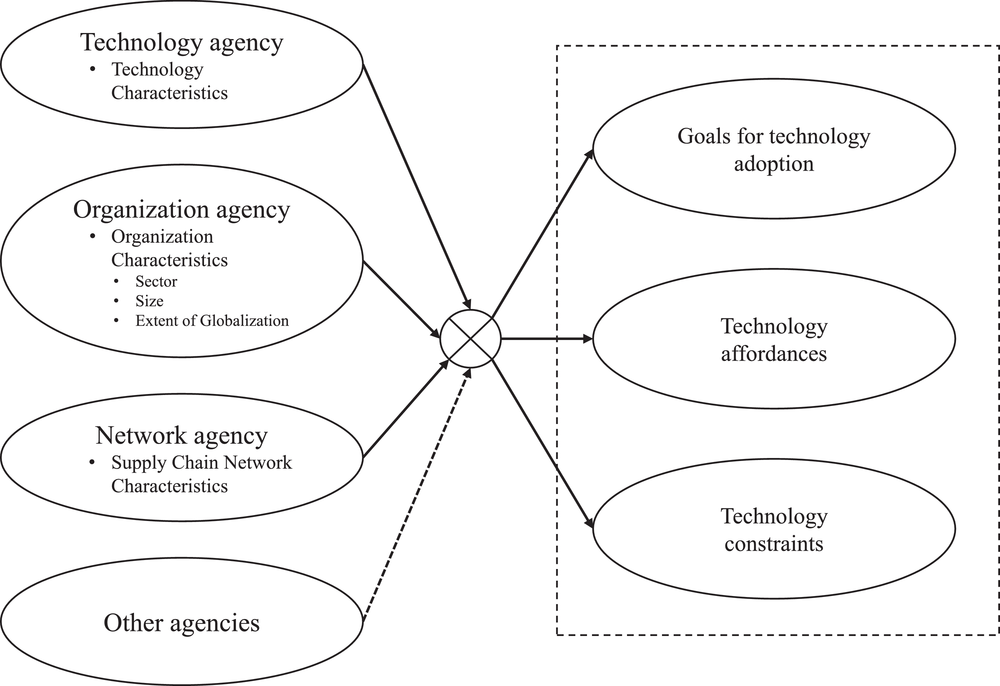
Conceptual model using an affordance theory lens. Different agencies—technology, the organization, the supply chain network, and other agencies—interact to form affordances and constraints regarding the technology and shape the focal organization's goals from the technology
In this model, different technologies will result in various—or differently prioritized—goals, affordances, and constraints, if these technologies are very different from one another. Different organizations and network configurations will interact with technology similarly and so we need to choose various emerging supply chain technologies to understand how different users, organizations, and networks form distinct priorities for generic goals for these technologies in the early stages of adoption. As these technologies become mature as organizations gain experience over time, there could be a further step of identifying actualized affordances or realized benefits. We leave this for future research, focusing only on perceived affordances in this paper.
Technologies
Our research refers to the Gartner Hype Cycle that the advisory firm Gartner Inc. uses to express adoption experience with emerging technologies (Figure 2). To identify suitable technologies that were still emerging at the time of research, we started with 10 technologies that Gartner identified as being particularly relevant for the supply chain. These technologies—in decreasing order of percentage according to supply chain managers reporting investment by their organizations—are (1) advanced analytics, (2) IoT, (3) RFID (tagging), (4) blockchain, (5) AI, (6) robotics and process automation, (7) chatbots, (8) intelligent things (robots), (9) augmented/virtual reality, and (10) digital twins (Klappich, 2020).
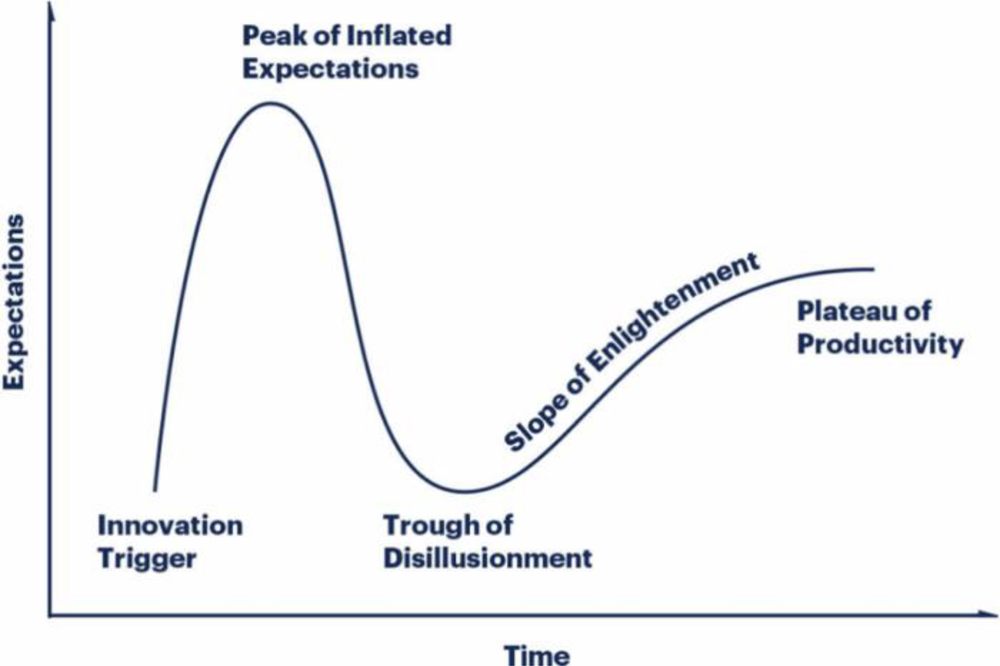
Gartner Hype Cycle expressing inflated expectations followed by disillusionment and the slow learning experience, eventually leading to productivity
We chose to focus on blockchain, IoT, and AI that are in the top five of Gartner's list. As for the other two in the top five, RFID technology is mature, and analytics includes applications unrelated to the supply chain and overlaps with AI. These three technologies are also quite different from one another in their supply chain application. IoT can enable asset performance management systems and allow information sharing across different devices in real time in supply chain operations (Guha & Kumar, 2018; Kumar et al., 2018). On the other hand, AI can provide a range of analytics (predictive and prescriptive) to improve supply chain performance, improve network designs, and enhance inventory management and instant decision making (Choi et al., 2018, 2021). Likewise, blockchain can enable the secure sharing of data across a supply chain network and its many different actors in a decentralized and transparent fashion (Sodhi & Tang, 2019). Vendors such as Oracle also focus on these technologies for the supply chain (Oracle, 2020).
Many sources expect blockchain and AI to produce trillions of dollars of business value in just a few years of widespread use (Bughin et al., 2017; Costello & Rimol, 2019). For example, the World Economic Forum believes that, by 2027, blockchain will store 10% of the global gross domestic product (GDP) (Tapscott & Tapscott, 2017); while researchers have demonstrated how blockchain can address some of the challenges of supply chains, including counterfeit and data exchange (Pun et al., 2021; Wang et al., 2021). Indeed, many companies and consortia—shipping company Maersk with its blockchain‐based platform, TradeLens, for example—have reported developing blockchain solutions or have deployed such a solution for their supply chain network (Groenfeldt, 2017; Hastig & Sodhi, 2020; Huillet, 2020).
Together, blockchain, IoT, and AI technologies can solve “complex problems of next‐generation computing” (Gill et al., 2019, p. 2), even though they have limitations (Daniels et al., 2018). An IoT‐enabled warehouse, for example, can facilitate efficient inventory monitoring and movement, using blockchain to share that information with external partners securely. AI can provide a platform of description, analysis, prediction, prescription, and autonomous decision making. These technologies are expected by scholars to play a significant role in digitally transforming the supply chain (Holmström et al., 2019). Similar claims are made by technology vendors such as Oracle (2020).
These technologies have intrinsic properties that distinguish them: Blockchain has properties that afford information decentralization and immutability. Likewise, IoT's properties afford autonomous device coordination and smart sensing, while AI makes advanced analytics possible. An overview of these technologies appears in the Supporting Information with further references. Considering the characteristics and deployment challenges (Table 1), we expect interaction with users to result in different goals, affordances, and constraints.
Technology characteristics
Generic goals, affordances, and constraints
We also sought industry reports, surveys, and findings published by consultancies (e.g., McKinsey, PwC, Accenture, and Deloitte) that would allow us to identify, for any supply chain technology generically, (1) organizational goals, (2) potential benefits (affordances in our theoretical lens), and (3) constraints regarding adoption. We searched for keywords such as “emerging technologies,” “digital,” “digital technologies,” and “digitalization” jointly with “supply chain,” “operations management,” “logistics,” and “procurement” in the Web of Science database. We limited the results to operations and SCM journals and generally focused on literature review articles. In this way, we obtained a corpus (Table 2) on emerging technologies from these practitioner publications and the academic literature.
Corpus of the practitioner and academic literature used
We followed Braun and Clarke (2006) and Sodhi and Tang (2018) in carrying out data familiarization, code generation, themes search, themes review, themes naming and definition, and report production. Consistent with recent thematic analyses in the SCM literature to identify themes and subthemes (e.g., Hastig & Sodhi, 2020), our focus was not to identify a gap in the literature. Instead, we sought to extract general goals, affordances, and constraints for technology adoption in the supply chain context, which we could use as items in surveying practitioners.
We identified themes and subthemes by researching back and forth in the corpus (Table 2) together and individually. The global themes were iteratively identified and refined based on the review of the literature as well as on in‐depth discussions among the research team. Two of the authors initially identified the themes by separately analyzing the literature and agreeing on the themes to include. Further analysis led to the refinement of these themes for each goal, affordance, and constraint. We labeled the elements extracted from the corpus as themes, which we use as items in our survey. We organized the items into higher level categories to provide context—although not for use in any analysis—enabling us to obtain generic goals, affordances, and constraints relevant to any supply chain technology, whether emerging or mature.
Goals
The thematic analysis of the corpus provided us with organizational goals for technology adoption for the supply chain in general (Table 3). Purely for context, we grouped these goals into four categories: (1) financial (operational costs and return on investment), (2) operational (efficiency, performance of existing systems, flexibility, productivity, errors and reworks reduction, and volume of output), (3) strategy (competitive advantage and consumer image of the organization), and (4) supply chain network (end‐to‐end connectivity and partner relationships) (Table 3).
Organizational goals identified using thematic analysis
Affordances
The thematic analysis provided us with the affordances that supply chain technologies offer, including those still emerging. We categorized the affordances into three groups: (1) financial (cost‐effectiveness), (2) operational (real‐time capability, agility, risk management, interoperability, mass customization, efficient decision making, and customer centricity), and (3) network (transparency, traceability, and end‐to‐end integration) (Table 4).
Perceived benefits or affordances
Constraints
Finally, we obtained constraints when considering emerging technologies for the supply chain. We categorized these constraints into five categories for descriptive reasons: (1) financial (technical set up cost, training cost, and ongoing support cost), (2) strategic (lack of sense of urgency, lack of technology vision in the organization, lack of organization‐wide coordination, and insufficient leadership support and involvement), (3) network (lack of supplier required skills, unknown risk, and regulatory risk); (4) technology‐related (performance measures, hard to integrate to existing processes and solutions, security concerns, technology immaturity, benefits being ambiguous, scalability, and lengthy development time), and (5) user‐related (lack of workforce skills and resistance to change) (Table 5).
Constraints identified using thematic analysis
METHODS AND MATERIALS
We sought to gather perceptions of supply chain practitioners regarding the adoption of emerging technologies through a survey and the analysis of the data at the individual and at different levels of aggregation.
Survey
We sought to survey supply chain managers with the goals, affordances, and constraints as items for the questionnaires. Our purpose was to obtain their perceptions of each of the three technologies regarding the different goals, affordances, and constraints for their organizations and supply chains. The international supply chain professional body, the CIPS, kindly supported this research in 2019 by providing us access to their members, who are supply chain professionals.
Survey design
The idea was that the respondents would first select which of the three technologies their organization had experienced. Based on their response, they would prioritize the goals, affordances, and constraints for the selected technologies. Given many items in the questionnaire, the CIPS requested we make the survey web based and design it as a poll for the respondents to select any items for goals, affordances, and constraints, if relevant to their organizations’ supply chains. The responses for each item are therefore binary—1 if selected, 0 if not. In addition, CIPS and the research team worked together to ensure the wording of the survey was consistent with the terminology used in practice.
Running the survey
The CIPS advertised the study to its members through a weekly email bulletin and made the survey link available online for 8 weeks. A total of 723 professionals opened the web‐based survey from the CIPS membership across the globe. The first question they saw was about their organizations’ plans for implementing each of the three technologies. The choices presented were technology (a) already in place for 3 years, (b) in place this year or next, (c) planned in the coming 3 years, and (d) not applicable. If the respondent clicked “not applicable,” the system would skip the questions for that specific technology—otherwise, it would present the items for selection for that technology—and then do the same for the next technology. If a respondent clicked “not applicable” as the response to all three technologies, they were screened out as a nonrespondent.
Familiarity of respondents with the technology
The screening described above ensured that each respondent had some understanding of the selected technology. We were also assured by the CIPS that their members had a high degree of technology familiarity from their experience in their organizations and at CIPS conferences, presentations, training, and white papers on emerging technologies. More tangibly, other practical studies on the status of advanced technology deployment in the supply chain using CIPS members point to familiarity among supply chain practitioners with deployment experience. In particular, in one CIPS‐sponsored study conducted around the same time as ours (Reid & Hopkins, 2020), over 30% of the CIPS respondents stated having adopted IoT over 5 years in their organizations. In addition, about 25% reported having adopted AI, and over 30% had adopted blockchain for 1 to 2 years. For these reasons, we were confident that the responding CIPS members would indeed be familiar with these technologies.
Response
Of the 723 people who clicked on the survey link, 318 clicked “not applicable” on all three technologies. The remaining 405 were retained as respondents, and these responded only for the technologies their organizations had plans to implement. Most selected only one or two technologies, although a few selected all three technologies. Respondents who selected more than one technology allowed us to compare their responses to the different technologies. In all, 158 of these respondents focused on blockchain, 330 on IoT, and 154 on AI (Table 6).
Number of respondents for each of the three technologies depending on their organizations’ plans for implementation (N = 405)
Nonresponse bias
The respondents have diverse backgrounds, with their diversity the same as that of the 318 nonrespondents whose organizations did not have any firm plans to implement any of these technologies, eliminating evidence of nonresponse bias. Moreover, our CIPS contact confirmed the 405 respondents’ profiles to be of similar diversity to their membership overall (Table 7).
Individual, organization, and network characteristics reported by respondents (and nonrespondents) with N = 405 respondents and 318 nonrespondents
Summary of data
The characteristics gathered from the respondents about their organization included the industry sector and size (annual turnover). While two or more respondents may be from the same company, given the large membership of the CIPS, the likelihood of any two of the 405 respondents being from the same company is small.
The network characteristics were about whether the supply chain was national, international (within‐country facilities but exporting to many countries), or global with facilities in multiple countries. We also asked about the number of countries the organization's internal supply chain spanned (Table 3).
Table 8 shows the specific industry breakdown for each private, public, and not‐for‐profit distribution. As shown, the respondents were from a variety of sectors and industries.
Industry breakdown of 405 survey respondents
Analysis
We analyzed the data at the individual level to see how the individual responses compared across different technologies for someone who responded to two technologies, and at the group level to understand how supply chain managers perceive the three technologies.
Individual‐level analysis
Here the unit of analysis is the individual respondent. Each respondent yielded three binary vectors for each of the technologies on which they elected to respond. The three vectors corresponded to goals, affordances, and constraints, with selected items indicated by 1 and the remaining by 0. For a respondent who selected two technologies, we compared the corresponding vectors—goals for one technology to goals for the other, and likewise for affordances and constraints. The measure we chose for comparison is Pearson's phi coefficient, also called the mean square contingency coefficient, denoted by ϕ. The phi coefficient is interpreted just like Pearson correlation with the match value between two binary vectors ranging from −1 to +1. We took the average value across all respondents who selected these two technologies for any pair of technologies.
Pool‐level analysis
The bulk of our analysis treated the entire pool of respondents as the unit of analysis. We counted for each item the “votes” it received from the respondents, whether or not a respondent selected an item pertinent to their organization. In this way we ranked affordances, goals, and constraints by the respondents for each technology, enabling us to produce a ranked list of affordances, goals, and constraints.
This poll yielded a prioritized list of the organizational goal, affordance, and constraint items for each of the three technologies—blockchain, IoT, and AI—in order of the number of respondents who noted the item as relevant for their organizations. Of course, the three technologies differ substantially in their characteristics and have different uses in the supply chain, causing us to expect different prioritization of affordances, goals, and constraints for each technology. Another difference is the way in which the organization or network characteristics interact with the technologies: Separate pools of respondents representing a different organization or network characteristics may rank affordances, goals, and constraints differently for the respective technologies.
We used Spearman's rank correlation to compare the relative priorities of the affordances across the different technologies. The correlation helped us understand how technology affects the priorities of affordances, indicating the level of interaction between user and technology. Additionally, we repeated the correlation analysis for the ranked lists of constraints and goals to compare the effect of technology in the interaction with the users, taken as a pool.
We repeated the same analysis by splitting the respondent pool by different organizational characteristics—the industry sector and annual revenues. Again, we used Spearman's rank correlation of the priorities across technologies for affordances, constraints, and goals. We carried out the same analysis for network agency (extent of globalization) and technology for their collective impact on how supply chain professionals prioritize affordances, goals, and constraints. As with the previous analysis for the user pool, the rank correlations allowed us to compare priorities across the three technologies.
RESULTS
First, we report the individual selections and their comparisons (Section 4.1) and then the aggregated votes for the goals, affordances, and constraints (Section 4.2). Second, we report the correlation results for the impact of technology on the affordances, goals, and constraints (Section 4.3). Third, we repeat the comparison for the effect of organization and technology characteristics together (Section 4.4), and finally for the network and technology characteristics (Section 4.5).
Individual‐level results
When we compared across technologies at the individual level, for goals, there were 114 comparable individual responses for blockchain and IoT, 60 for blockchain and AI, and 88 for AI and IoT. The average corresponding phi coefficients across all respondents were only mildly positive. The values suggest that a typical respondent had only slight overlaps between their responses regarding the selected goals for either technology in the pair. (We confirmed this interpretation by developing another measure, |A ∩ B| / |A ∪ B|, where A and B are the two binary vectors. The intersection and union refer to the selections.) We obtained similar results for affordances and constraints, indicating that a typical respondent's choices across any two technologies had only a tiny overlap of selections (Table 9).
Average value of Pearson's phi coefficient ϕ for “correlation” between any respondent's binary responses for any pair of technologies (standard error) and the number of respondents whose responses could be compared for both technologies in the pair
One implication of the results is that at least those respondents answering about multiple technologies are familiar enough to distinguish between the affordances for these technologies.
Pooled prioritization of goals, affordances, and constraints
Of the 158 respondents for blockchain technology, the number selecting any goal was 46–100, any affordance 38–112, and any constraint 21–94. Likewise, of the 330 respondents for IoT, the number selecting any goal was 122–234, any affordance 95–210, and any constraint 42–214. Finally, for the 154 respondents for AI, the number was 36–107, any affordance 41–103, and any constraint 22–98 (Table 10).
Number of goals, affordances, and constraints selected by respondents for each of three technologies (in decreasing order by blockchain votes; total respondents = 405)
Using the votes secured by each of the respective goals for each technology in turn (Table 10), we ranked all the goals, affordances, and constraints (Table 11): Regarding the goals, operational efficiency has the highest priority as reflected in the rank based on the most votes, followed by the competitive advantage and performance of the existing system. The respondents' votes collectively emphasize the affordance items in the network category. These are transparency, traceability, and end‐to‐end integration. At the same time, the top affordance still relates to the operational mechanisms these emerging technologies claim to provide—real‐time capability, agility, and risk management. Adopting these technologies is also perceived as strengthening the financial outlook through cost‐effectiveness. Regarding constraints for adoption, financial inhibitors rank high, with technical setup cost ranking the highest across the board. Other high‐ranking constraints pertain to the technologies themselves, with security, lengthy development time, and immaturity as the main issues impeding effective adoption for the supply chain. The respondents also highlighted a range of “strategic” constraints, for example, lack of coordination and leadership support and network constraints of supplier skills and regulatory risks. Finally, resistance to change as a user constraint is also one of the top challenges for emerging technologies deployment (Table 11).
Ranking reflecting priorities by respondents at a pool for all goals, affordances, and constraints for each of three technologies (ordered by blockchain ranks)
Idealized prioritization of affordances by technology
What priorities would we expect if the respondents were to fully integrate the technology characteristics with their supply chain needs in contrast to what we observed (Table 11)? The authors brainstormed on the affordances to come up with a possible answer. Our consensus view was that the affordances for the three technologies would be quite different from one another (Table 12). The differences show up in the correlations between our assigned ranks for different pairs of technologies. Indeed, for blockchain and IoT, the correlation is −0.38, between IoT and AI, 0.22, and between AI and blockchain, −0.56. In contrast, the equivalent correlations for the respondent numbers in Table 11 are 0.96, 0.89, and 0.82, reflecting a very similar perception of affordances across all three technologies.
Authors’ collective view of priorities and those observed (Table 11) for affordances for each of three technologies
Responses of those ranking one technology versus those ranking two or more
We recall that those familiar with more than one technology rank the goals, and so forth, differently across the three technologies, resulting in low correlations at the individual level (Table 9, Section 4.1). It is therefore possible that pooling those familiar with more than one technology (N = 175) with those familiar with only one (N = 230) is swamping any distinctions the former group may have. To address this, we repeated the analysis separately for both groups and found that the priorities were essentially unchanged in either pool (Table 13).
Ranking reflecting priorities by respondents pooled by familiarity with only one technology (N = 230) or with more (N = 175) for all goals, affordances, and constraints for each of three technologies (ordered by the median rank for each row)
We found that we no longer needed to separate the pool of those familiar with only one technology from those familiar with more than one.
Technology agency and prioritization
For all three sets of items—affordances, goals, and constraints—taken together as a pool, the practitioners prioritized the items nearly the same way for all three technologies. Indeed, the pairwise rank correlations between the three technologies—blockchain, IoT, and AI—across all 12 goals, 11 affordances, and 19 constraints are all close to 1 (Table 14).
Rank correlations of the aggregated respondent selections across the three technologies for goals, affordances, and constraints
p = 0.0000 for all entries, except one with p† = 0.0002.
The rank correlations being statistically the same across the technologies implies that the relative priorities for affordances—and similarly for constraints and goals—are not impacted by the emerging technology regarding supply chain practice. In other words, the affordances are prioritized the same way for all three technologies, even though the technologies’ characteristics are all very different from one another; the same holds for constraints and goals, respectively.
Organization and technology agencies
We considered the size and the industry sector of the respondents' organizations and technology to see if these factors, along with technology, affect the priorities reflected in the ranking of goals, affordances, and constraints.
Sector and technology
There were 232 respondents from the private sector and 131 from public‐sector companies. We did not include the remaining 42 respondents from charities or not‐for‐profit sectors in the sector‐comparison analysis due to smaller respondent numbers. After splitting the pool of respondents and then tallying their votes and ranking the goals, affordances, and constraints as before, we found Spearman correlations to be high across the three technologies irrespective of the sector being private or public. There were also high correlations between the public‐ and private‐sector votes across blockchain items (ρ = 0.8149), IoT items (ρ = 0.8809), and AI items (ρ = 0.8790) for goals, affordances, and constraints. Each of the six subpools of respondents—two sectors' three technologies—prioritized affordances, constraints, and goals the same way. We conclude, therefore, that sector and technology together do not appear to be a factor in shaping the priorities (Table 15).
Rank correlations of aggregated respondent selections across the three technologies for goals, affordances, and constraints by sector
p = 0.01 at least for all entries, except one with p† = 0.05.
Size and technology
We split the respondents into two pools by size, 188 from “small” companies with an annual turnover of less than US$36 m (including 107 from companies with turnover below $10 million), and 217 from the remaining “large” companies (turnover >US$36 million, including 110 from companies with turnover exceeding $500 million). Again, Spearman correlations across the six subpools of respondents were high, whether across the pools or the three technologies. There was a high correlation between the small and large companies for blockchain (ρ = 0.9084), IoT (ρ = 0.9714), and AI (ρ = 0.8659) across all the goals, affordances, and constraints showing that size and technology do not appear to shape the rankings (Table 16).
Rank correlations of the number of respondent selections across the three technologies for goals, affordances, and constraints by organization size
p = 0.01 at least for all entries.
Network and technology agencies
We investigated the impact of the network using data on two characteristics about the extent of globalization of the supply chains in the respondents' organizations: the extent of the national/global nature and the level of internationalization in the internal supply chain.
National versus global supply chain and technology
We split the respondents into two pools: 147 from companies with national supply chains and 258 from the remaining companies with their supply chains spread internationally (primarily sales) or globally (physical facilities in other countries). For both pools, we tallied up the votes of the respondents to rank the items in the six subpools.
The Spearman correlations across the three technologies were high, whether for companies with national supply chains or with global. The correlations between the companies with national and those with global/international supply chains were quite high for all the goals, affordances, and constraints. The high correlations for blockchain (ρ = 0.8181), IoT (ρ = 0.9187), and AI (ρ = 0.8704) indicate the same prioritization across the two subpools of respondents (Table 17).
Rank correlations of the number of respondent selections across the three technologies for goals, affordances, and constraints by supply chain being national or global
p = 0.01 for all entries, except p* = 0.05.
Number of countries in supply chain
We split the respondents into two pools: 181 companies with “less global” supply chains in six or fewer countries, and 170 from “more global” companies in seven or more countries, with many exceeding 20 countries. Then, for each of the six subpools, we computed the ranks of the items and the ranked correlations.
Once again, Spearman correlations across the three technologies were high, whether for “less global” or “more global” companies. There is a high correlation between the small and large companies for blockchain (ρ = 0.8754), IoT (ρ = 0.9024), and for AI (ρ = 0.8518) across all the goals, affordances, and constraints. The global footprint of the supply chains of the respondents’ organizations similarly does not appear to be a factor in shaping the respondents’ priorities (Table 18).
Rank correlations of the aggregated respondent selections across the three technologies for goals, affordances, and constraints by the extent of globalization
p = 0.01 for all entries.
In summary, technology does not inform the respondents' pooled prioritization of generic goals, affordances, and constraints for emerging technologies, nor does the organization or network. The nearly unchanged priorities remained, despite the technologies being very different in their characteristics and intended use. The fact that individual selections across technologies only weakly match also reflects these differences.
DISCUSSION
To shed light on the “hype” cycle of new supply chain technologies, we sought to understand how supply chain professionals perceive emerging technologies such as blockchain, IoT, and AI in the early stages of adoption. In addition, we looked for affordances—perceived benefits—resulting from the interaction of technology and users, including individuals, organizations, and supply networks. This interaction means that diverse user groups would perceive different benefits, inhibitors, and goals for their respective organizations.
Taking this approach, we first identified organizational goals, affordances, and constraints from a thematic analysis of practitioner and academic literature on supply chain technologies in general, whether emerging or mature. Using these “generic” goals, affordances, and constraints as items, we surveyed supply chain managers to find out which items were relevant for their organizations' supply chains for the technologies with which their organization already had some experience.
Our findings suggest that the prioritization of goals, affordances, and constraints appears fixed. We have proposed that technology does not inform the adopters regarding prioritization in the early stages of adopting emerging supply chain technologies. It takes time and (shared) experience to interact with technology sufficiently to inform the prioritization. At the early stages, uninformed goals, affordances, and constraints result in inflated expectations followed by deep disappointment. Later, with affordances becoming informed with experience, the organization can commence a period of obtaining benefits.
Implications for theory and further research
Using the survey data, we compared responses at the individual and the aggregated pool levels. The individual‐level comparisons with only weakly positive Pearson phi correlations across technologies indicated that respondents do distinguish between technologies.
For the pooled analysis, we summed up the respondents' selections to rank each technology's goals, affordances, and constraints by “votes” received to reflect priorities at the pool level. We then compared these priorities across technologies for different subpools of respondents: by different technologies, organizations, and levels of internationalization in the supply chain network to see what might impact the rankings. No matter how we split the pool further—by technology or by different organizational or network characteristics—the ranking of individual goals, affordances, and constraints remained the same. To account for this, we offer the following proposition: At an early adoption stage for emerging supply chain technologies, the technology—even considering the type of organization or supply chain network—does not shape the priorities for goals, affordances, and constraints for professionals.
Proposition 1 implies that whatever does shape the priorities must be in the “other agency” category, perhaps something to do with the very nature of generic SCM in the view of supply chain professionals. Whatever the source of affordances, at early‐stage adoption, the technology under consideration is not informing the users' priorities or expectations. The uninformed affordances (and goals and constraints) lead to unrealistically high expectations regarding realized benefits. Disappointment naturally follows when benefits are not actualized—indeed, they cannot be realized—thus leading to the trough in the hype cycle. Over time, supply chain professionals gain experience within the organization and other organizations to develop shared affordances (Leonardi, 2013). The affordances then become more informed, and a more realistic set of expectations are adopted.
A salient question is how users (interacting with emerging technology in the early stages) develop affordances that appear informed at the individual level but uninformed when aggregated. A possible answer is that the signal from individuals is noisy, in which case aggregation brings out the accurate signal. We recall that practitioners familiar with more than one technology rank the goals, affordances, and constraints of the three technologies differently. Yet, with votes aggregated, their rankings of goals, affordances, and constraints become similar across the three technologies and akin to the rankings of the pool of practitioners familiar with only one technology. In aggregate, then, the technologies do not appear to inform the priorities of goals, affordances, and constraints at this early stage.
An alternative explanation of the lack of any observed interaction between technology and user groups could be that the respondents knew only little about these emerging technologies and gave the same responses across different technologies (with random noise). As we screened the respondents for each technology in our questionnaire, this was likely not the case with only 175 among the 405 respondents selecting more than one technology (Table 2). CIPS members in another study were shown to have early‐stage experience with these three technologies, as we mentioned earlier.
An alternative explanation could be that our generic goals, affordances, and constraints are just too generic: We have 11 goals, 12 affordances, and 19 constraints from a broad literature review as generic items. From these 42 items, the respondents selected the ones they felt applied to their setting for their chosen technology. If all the items were too high level, we would see a much closer match between responses at the individual level than the match we observed.
We have reasonable grounds to propose the following answer to our research question: Supply chain professionals have a fixed set of priorities regarding goals, affordances, and constraints in the early stages of adopting emerging technology, and these priorities are unaffected by the technology.
At least four research opportunities stem from our work. First, affordance theory needs a time‐and‐experience element in the interaction that shapes affordances. This aspect can be empirically investigated, potentially using Leonardi's (2013) shared assurances work as a starting point. Future research could also explore implementing new technologies in phases to cover subsets of items in the prioritized lists of affordances, constraints, and goals to ensure acceptance and assimilation with existing roles and routines.
Second, if technology and user groups are not shaping this prioritization, we need to understand what else forms the priorities. We put a place‐holder by way of “other agencies” (Figure 1). One way to investigate that may be to understand the respondents’ responsibilities in their organization vis‐à‐vis the technologies they are adopting. The respondents were operations‐level supply chain managers, charged with specific responsibilities, working with many functions within the organization, and interacting with others at their level in other organizations. Regardless of the type of organization or supply chain, the very nature of SCM may well determine the priorities.
Third, further research could refine the proposed conceptual model by revisiting published case studies, empirical studies of critical success factors, and conceptual models with the prioritized lists of affordances, constraints, and goals (Table 18). Doing so could help link the literature on technology adoption to the supply chain.
Finally, further research could study failed technology projects for the supply chain. Volkoff and Strong (2013) have classified their diagnostic mechanisms into (1) inherent nature of affordances as enabling and constraining simultaneously, (2) absence of perceived affordances, and (3) incomplete or inappropriate opportunities to realize affordances. Our work can provide a starting list for diagnosis criteria via the fixed priorities in the early stages.
Implications for practice
We propose that the same priorities of goals, affordances, and constraints are set in the early stages of adoption, regardless of the emerging supply chain technology (Table 19). Our research sheds light on the Gartner Hype Cycle, wherein the unrealistic expectations for emerging technologies precede a period of disappointment. We recall that the hype cycle suggests that those who adopt new technologies—AI, Blockchain, and IoT—may find themselves at the bleeding rather than at the leading edge of technology, or in other words, land themselves in costly and disappointing implementations.
How supply chain professionals perceive any emerging technology for the supply chain during an early stage of adoption: Lists in decreasing priority
The fixed priorities of goals, affordances, and constraints in adopting emerging technologies have good and bad news for practitioners. Considering the bad news first: a fixed list of priorities (Table 19) could worsen the situation if vendors used these as selling points to senior managers, whatever the new technology. Rather than users being merely uninformed in the early stages of adoption, they would therefore be “disinformed,” setting the stage for even more inflated expectations and more profound disappointment, at least initially.
There is good news, too, for evaluating technology and diagnosing failing or failed implementations. Using these affordances, goals, and constraints as a starting point, the adopting organization could avoid the “deep disappointment” phase in the hype cycle by investing in a generic evaluation process for any supply chain technology using the prioritized lists (Table 19) as a starting template. Such a process would also allow for comparisons across competing technologies. In addition, the process would support a phased implementation approach to inform affordances consciously. The same applies to diagnosing technology implementation projects that did not realize expected benefits in the world of large implementations, of which there is no shortage of such incidents.
To conclude, our research used an affordance lens to explore how supply chain professionals view emerging supply chain technologies, and we have proposed an explanation for the real‐world phenomenon of the Gartner Hype Cycle in the real world.
