






Abstract
The present study focuses on the Mediterranean Sea migration crisis and investigates the effectiveness of search and rescue (SAR) operations alongside measures to reduce the number of deaths of migrants at sea. It also describes the stakeholders involved in SAR activities. The paper first analyzes secondary data and the results of 24 in‐depth interviews in order to develop an analytical framework, which is then complemented by a system dynamics model to explore the complexity and interactions among stakeholders in SAR operations. The study shows that the death toll at sea can be reduced by enhancing cooperation among stakeholders by providing legal migration pathways under certain conditions and by engaging in more effective migrant detection and interception at sea. Lastly, raising potential migrants’ awareness about the risk of death during the sea crossing should be seen as an additional measure, while SAR activities should be maintained to prevent loss of life at sea.
INTRODUCTION
In 2019, the global number of forcibly displaced people reached its highest figure yet: 79.5 million individuals. According to the United Nations High Commissioner for Refugees (UNHCR) (2020a), this number—which includes refugees, internally displaced people, and asylum seekers—is primarily the result of conflicts and human rights violations. At some point in their journeys, a large portion of these people finds themselves at sea. Migration 1 by sea (MBS) is a form of migratory flow whose urgency and complexity are exacerbated by the risky conditions under which people attempt sea crossings. Representative cases include the mass exodus of Rohingya and Bangladeshi migrants across the Bay of Bengal and the Andaman Sea (UNHCR, 2015a), the movement of Vietnamese boat people throughout the 1980s, the Cuban balseros (rafters) phenomenon, the large departures of Albanians and Haitians in the 1990s, and the Mediterranean Sea crisis, which peaked in 2015 with around one million people crossing the sea to Europe, primarily through Greece, Italy, and Spain (UNHCR, 2020b).
The international community has called for a humanitarian response to mitigate the negative effects associated with MBS and avoid the loss of life at sea. Such efforts have typically been carried out by a wide array of entities. For example, in the Mediterranean Sea, these entities included humanitarian organizations (e.g., Sea‐Watch), national coast guards (e.g., the Italian navy with their “Mare Nostrum” operation), the participants of the European Naval Force in the Mediterranean (EUNAFOR MED) security operation “Sophia,” the European border control agency Frontex, and commercial ships, especially at the beginning of the crisis 2 and again more recently. In various capacities, these entities perform the search and rescue (SAR) activities 3 that constitute the main operational aspect of the humanitarian response to MBS.
To date, the literature on SAR has mostly focused on the allocation of resources to specific operational procedures (e.g., Basdemir, 2000; Razi & Karatas, 2016). Meanwhile, studies on MBS in general, and the Mediterranean Sea case in particular, have concentrated on aspects ranging from the impact of MBS on tourism (Pappas & Papatheodorou, 2017), humanitarian organizations’ SAR operations (Cusumano, 2017a,2017b, 2018), whether these operations increase the attempted crossings (Cusumano & Villa, 2019), and the implications of migratory policies on the migrants’ journeys (Squire et al., 2017).
The urgency and need to investigate MBS—and specifically, the complexity of SAR operations within this context—became evident during our interactions with experts at conferences, fora, and other events. These interactions, which are described in Section 3, contributed to the formulation of the following research questions: (1) Who are the stakeholders involved in maritime SAR operations in the MBS context? (2) How do they interact with respect to disaster management? (3) How do these interactions impact SAR operational effectiveness? (4) What additional factors influence SAR operational effectiveness in the MBS context? (5) Which measures enhance SAR operational effectiveness within the MBS context?
To address these questions, we developed an inductive case study centered on the Mediterranean Sea crisis as it reflects the operational complexity of MBS, the involvement of multiple stakeholders, and a high rate of sea incidents related to loss of life. The research utilizes secondary data and in‐depth interviews with parties involved in SAR operations in the context of MBS. We performed additional descriptive and quantitative analysis through the use of system dynamics (SD), which is suitable for modeling complex and uncertain systems that involve a variety of stakeholders (Besiou et al., 2011; Van Wassenhove & Besiou, 2013).
The paper's contribution is twofold: On the one hand, it expands the scientific humanitarian operations literature on the mostly unexplored areas of SAR and disaster operations in the MBS context. On the other hand, it provides practical recommendations based on verifiable hypotheses, which will hopefully lead to better disaster management and a reduction of loss of life at sea. This study's insights into planning and assessing operational responses to MBS emergencies can be of value to stakeholders (e.g., governmental entities, private companies, humanitarian organizations) engaged in such crises.
Section 2 discusses the disaster management and SAR literature, followed by the description of the research design in Section 3. The analysis of the Mediterranean Sea case is presented in Section 4. Section 5 develops the SD model and presents the results of the simulation analyses. Section 6 concludes the paper, outlines its limitations and suggests directions for further research.
DISASTERS AND SAR OPERATIONS MANAGEMENT CONTEXT
In the context of the growing number of worldwide disasters (Guha‐Sapir et al., 2017), academics and emergency management practitioners have turned their focus to the area of humanitarian relief (Apte, 2010; Kovács & Spens, 2007). Although effective disaster management is imperative to such efforts, there are several challenges in this regard. For one, disaster management involves multiple stakeholders who often possess diverse goals (e.g., Balcik et al., 2010; Van Wassenhove, 2006). This may result in coordination and collaboration challenges—studies have called for further research in improving coordination among the stakeholders (Altay & Green, 2006; Galindo & Batta, 2013)—within a dynamic and resource‐restrained operational environment, where accurate information is essential for operational success (Kovács & Spens, 2007; Van Wassenhove, 2006). In terms of the supply chain, various sources of uncertainty constitute another challenge that hinders operational effectiveness—whether those be the uncertain nature and impact of a disaster (e.g., when and where it will strike), the degree of donor‐provided financial aid, the supply of relief items, etc. Decision‐making is complex and challenged by the rapid changes of the emergency situation (Altay & Green, 2006).
The disaster relief supply chain is also affected by policymakers (i.e., governments), who determine the access of relief aid organizations to the affected population (e.g., Balcik et al., 2010; Thomas & Fritz, 2006). Governments and their agencies have become involved in all disaster management phases (i.e., mitigation, preparedness, response, and recovery) (Duran et al., 2013). Local and international humanitarian organizations are also involved in all phases and experience challenges in terms of coordinating their logistics operations (Kovács & Spens, 2009; Van Wassenhove, 2006). Security forces are employed in disaster response, primarily through military operations that have evolved to encompass humanitarian assistance (Rietjens et al., 2007). Private enterprises can provide relief aid through partnerships with humanitarian organizations (Thomas & Fritz, 2006). Vendors, donors (Ergun et al., 2010), and the media also play an important role in influencing the operations of humanitarian organizations (Van Wassenhove, 2006).
Within this complexity, the SAR literature has primarily focused on asset allocation and positioning. Existing studies have examined different types of assets deployed for SAR activities or the location of stations for conducting efficient operations. For instance, Pelot et al. (2015) focused on rescue vessels in the Atlantic Canadian region, with the aim of covering SAR incidents to the best possible extent depending on their severity. Similarly, Basdemir (2000) followed a maximal covering location approach for the Air Force stations in the Mediterranean regions of Turkey, while Abi‐Zeid and Frost (2005) applied search theory to develop a support tool for the Canadian Forces in deploying SAR resources to improve operational success. Due to the substantial amount of existing research, we refer to the studies of Razi and Karatas (2016), Afshartous et al. (2009), and Karatas (2020) for a more comprehensive review of the SAR literature. Karatas (2020), in particular, usefully categorizes the literature in terms of the management of boats, aircraft, and mixed fleets employed in SAR activities.
In the specific case of SAR and MBS, Cusumano (2017a,2017b) described the operations of humanitarian organizations in the Mediterranean Sea and argued that the code of conduct imposed by the Italian authorities in July 2017 has hindered their activities (Cusumano, 2017a). Cusumano (2018) highlighted that the organizations’ humanitarian principles can be jeopardized by the decisions of other stakeholders (e.g., the European Union [EU]’s support of the Libyan coast guard as a means of tackling the high influx of migrants). Humanitarian organizations at sea have also been stigmatized by policymakers and media for assisting smuggling activities—although these charges have been dismissed at court processes—constituting another challenge for them to conduct SAR activities (Cusumano & Villa, 2021). The media's framing of their SAR operations is also linked to the political stance related to migratory arrivals (Cusumano & Bell, 2021).
Meanwhile, the study by Cusumano and Villa (2019) investigated whether the SAR activities conducted by humanitarian organizations acted as a “pull factor” in the Central Mediterranean. It found no evidence for this case, and instead identified weather conditions and Libya's political instability as the main drivers for the crossings. Nevertheless, the study called for further research due to its data limitations. Squire et al. (2017) examined the implications of EU policies on migratory journeys and called for the enhancement of legal pathways. Meanwhile, studies by Harris et al. (2018) and Skinner et al. (2018) followed a system of systems approach to understand the role of unmanned aerial systems in the detection of sea crossings and provision of SAR in the Mediterranean Sea crisis. Carrera and Cortinovis (2019) recently contributed to the literature by examining how the current controversies related to migrant disembarkation have substantially weakened SAR capabilities in the Central Mediterranean. The authors reiterated the need for a European approach to SAR and migration.
This sampling of articles underlines some of the challenges that shape disaster management operations in the context of MBS (see Table 1 for an illustration of the key findings in the literature). These challenges follow not only from the inherent differences among the parties involved in SAR operations (e.g., their mandates, funding, and resource availability) but also from the multilayered and dynamic interactions between SAR operations and other external actors or stakeholders. Given this complexity, it is important to examine the polyadic relations among parties engaging in SAR. The present study sheds light in this direction.
Key findings of literature review
RESEARCH DESIGN
The case study approach
The research follows a case study approach, which is used to advance theory when there are limited or no previous constructs (Yin, 2014). We chose this method because it allows a researcher to study events that involve heterogeneous evidence, for example, documents and interviews (McCutcheon & Meredith, 1993; Yin, 2014). The case unit of analysis (Yin, 2014) is the polyadic interactions among groups of stakeholders engaged in SAR operations, while the research focus is on SAR operational effectiveness, which is defined as the ratio of rescued migrants to the number of those attempting sea crossing.
At the first stage of the study, the authors’ interactions with experts in various events benefited the formulation of the research questions and the broader understanding of the MBS crisis—particularly in the Mediterranean Sea case. Two of the authors participated in the panel debate “Rescue at Sea,” held in 2016 during the International Association of Maritime Economists (IAME) annual conference, which provided insights into the legal, humanitarian, and operational complexity of responses related to migration crises. The authors’ attendance in the fora “SHAred Awareness and DE‐confliction in the MEDiterranean Sea” (SHADE MED) (third, fourth, fifth, and seventh edition), organized by EUNAFOR MED, contributed to their primary understanding of naval and onshore operational activities in the Mediterranean Sea case. Many attendees to the SHADE MED were involved in the crisis, including security forces, 4 humanitarian organizations, commercial shipping associations, and a minority of academics. This study also benefitted from interactions with participants of the course “Migration and Human Rights,” organized by the United Nations Interregional Crime and Justice Research Institute (UNICRI), which discussed policy, legal, and long‐term development aspects related to displacement crises.
Primary data collection and analysis
Given the paper's exploratory character and interest in actors’ experience (Bonoma, 1985), the researchers collected the primary data through semistructured interviews, conducted with stakeholders associated with the operational response to migration and SAR activities. As in other studies dealing with theory development, we focused on open‐ended questions that might produce qualitative information (Pedraza‐Martinez et al., 2011). The interviews carried out for this study were with nine humanitarian workers from eight different humanitarian organizations conducting SAR, three humanitarian organizations involved in global displacement crises, six migrants, one national coast guard involved in SAR, one navy officer, one security expert, and three commercial shipping associations. We followed the principle that sample adequacy occurs when data saturation can be observed (Guest et al., 2006).
To obtain interviews with migrants at reception facilities and national coastguards, we sought official permission from the corresponding national ministries, and one of the authors personally visited a reception facility. The interviews were conducted between September 2017 and August 2018. We sent an introductory letter about the project to potential respondents by email or other electronic means. The letter described the study and offered the option of answering the questionnaire in written form, via phone, or by analogous means. This procedure was followed for each participant, except for the migrants. In their case, we sent the letter and the questionnaire to the responsible ministry in order to gain permission to enter the reception facility and conduct interviews.
We used a slightly different base questionnaire for each stakeholder (see Supporting Information). The content of the base questionnaire is grounded on topics of importance that we identified during our interaction with experts and participation in the events, as described in Section 3.1. The questions focused on each actor's involvement in the migration crisis, the SAR response, their challenges, and suggestions for solutions. In total, 25 participants completed the interviews. Nevertheless, we excluded one migrant from the final sample as this migrant did not sign the provided consent form to ensure their anonymity. Apart from seven interviews that we received in written format, all nonmigrant interviews were recorded with the participants’ permission, and the transcriptions were sent back to them for approval. Regarding the migrant participants, recording was prohibited within the reception facilities; thus, we interviewed two migrants individually but completed the others in groups of two and three due to the time constraints imposed by the authorities. We assured all participants that their anonymity would be preserved.
The research team met after the completion of each interview to discuss its key findings and update the base questionnaire when necessary. One of the authors performed a manual analysis of the interviews during the first stage of the research. This was complemented with a thematic analysis using the NVivo data analysis software, which entailed a keyword search to observe repetitions and add value to the analysis (QSR International, 2020). Subsequently, we compared the interviews’ findings with the content of the transcripts and the existing literature in order to avoid missing any important constructs. This process was repeated until the authors reached a consensus regarding the consistency of the findings. The main themes that arose during the analysis referred to operational challenges, resources, expertise, cooperation among the stakeholders, the involvement of additional stakeholders, the importance of policymakers within the crisis, drivers of migration, border control, migratory regulatory framework, illegal actors, and suggestions for dealing with the MBS crisis. A detailed description of the interview findings is provided in Section 4.2. We reached a saturation stage after 18 interviews.
The application of system dynamics
As the key objective of the study is to reduce the death toll at sea within the MBS context, we applied the SD methodology to the Mediterranean Sea case in order to represent the complexity of rescue activities within MBS crises, study the interactions among the parties involved in SAR events that determine the SAR operational effectiveness and evaluate four practical recommendations derived from the interviews and literature. Although SD has already been applied to disaster operations management (e.g., Goncalves, 2008), this article is the first to utilize it within the context of SAR operations linked to MBS.
We chose this methodology to gain a better understanding of the behavior of a system (Forrester, 1961) that is complex and involves multiple forms of feedback (Sterman, 1989). Furthermore, SD is particularly suitable for examining the implications of different actions on the system (Besiou et al., 2014; Sterman, 1989; Van Wassenhove & Besiou, 2013). To study the four practical recommendations, we conducted simulations using the Powersim software (Powersim Software AS, 2020). For the simulations, we used data from the IOM's Missing Migrants project (IOM, 2020), which is described in detail in Section 5. For the simulations dealing with the importance of cooperation (Section 5.3.2.), we gathered additional information in February 2021 from another humanitarian worker involved in SAR operations. The study's research roadmap is presented in Figure 1.
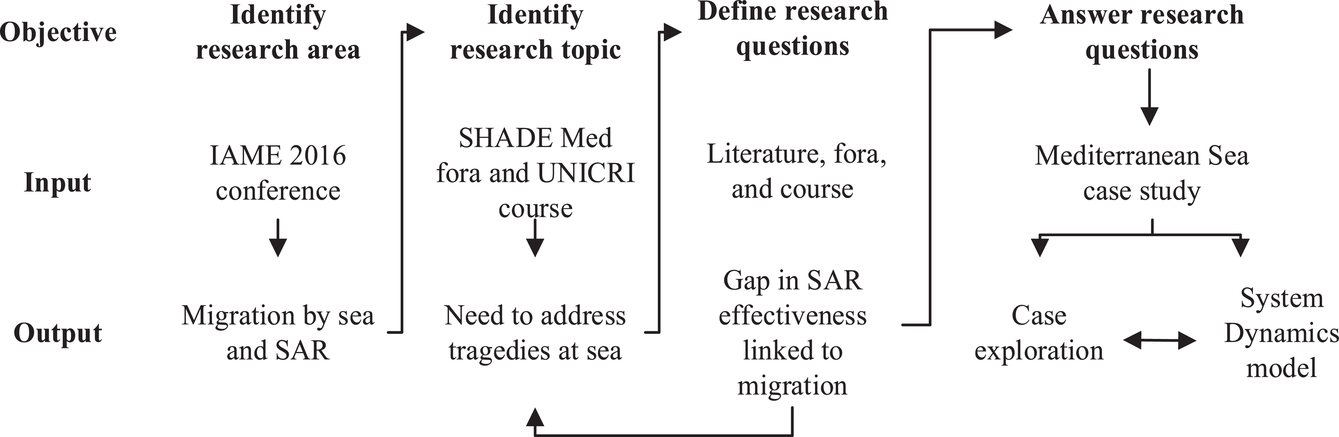
Research roadmap, following Pedraza‐Martinez et al. (2011)
MIGRATION BY SEA IN THE MEDITERRANEAN
This section describes the case study on MBS in the Mediterranean: It presents the contextual details of the case, the operational response of the key stakeholders at sea, and the main interview findings.
Humanitarian crisis and operational response
Hundreds of thousands of migrants attempt to cross the Mediterranean Sea into Europe each year, primarily in response to political instability, war, persecution, and poverty. Amidst the limited number of legal pathways into Europe, criminal networks of human smugglers have arisen to fill the void (UNHCR, 2015c): 80% of migrants crossing from Africa have turned to such illegal actors 5 (Reitano et al., 2014), often becoming victims of abuse in the process (UNHCR, 2015b). Dismantling these networks is particularly challenging (Aziz et al., 2015), as they rapidly respond to the control measures imposed by border authorities by adapting sea crossing practices and changing migration routes (Europol‐Interpol, 2016). Despite the elusiveness of smuggling activities, authorities have identified three main migration routes across the Mediterranean Sea (IOM, 2017) that attract unsafe and overcrowded boats (UNHCR, 2018): the eastern route, from Turkey to Greece; the central route, mostly from Libya to Italy; and the western route, from Morocco to Spain. Figure 2 illustrates the multiple systems within the migration system that relate to migration at sea (Panel a). It also summarizes the development of migration across the Mediterranean in recent years (Panel c) and illustrates the migration hotspots in the Mediterranean (panel b). The high influx of migrants in 2015 was reduced in the eastern route following the EU–Turkey deal of 2016, turning Libya into the main embarkation point (UNHCR, 2017). Deaths peaked in 2016, notwithstanding the decline in the total number of crossings, and remained high in 2017, as the closure of the shorter Balkan migration route resulted in the switch to longer and more dangerous alternatives (IOM, 2017). In 2018, most migrants crossed into Europe via Spain as a result of various factors (e.g., increased interceptions by Libyan authorities) (UNHCR, 2019).
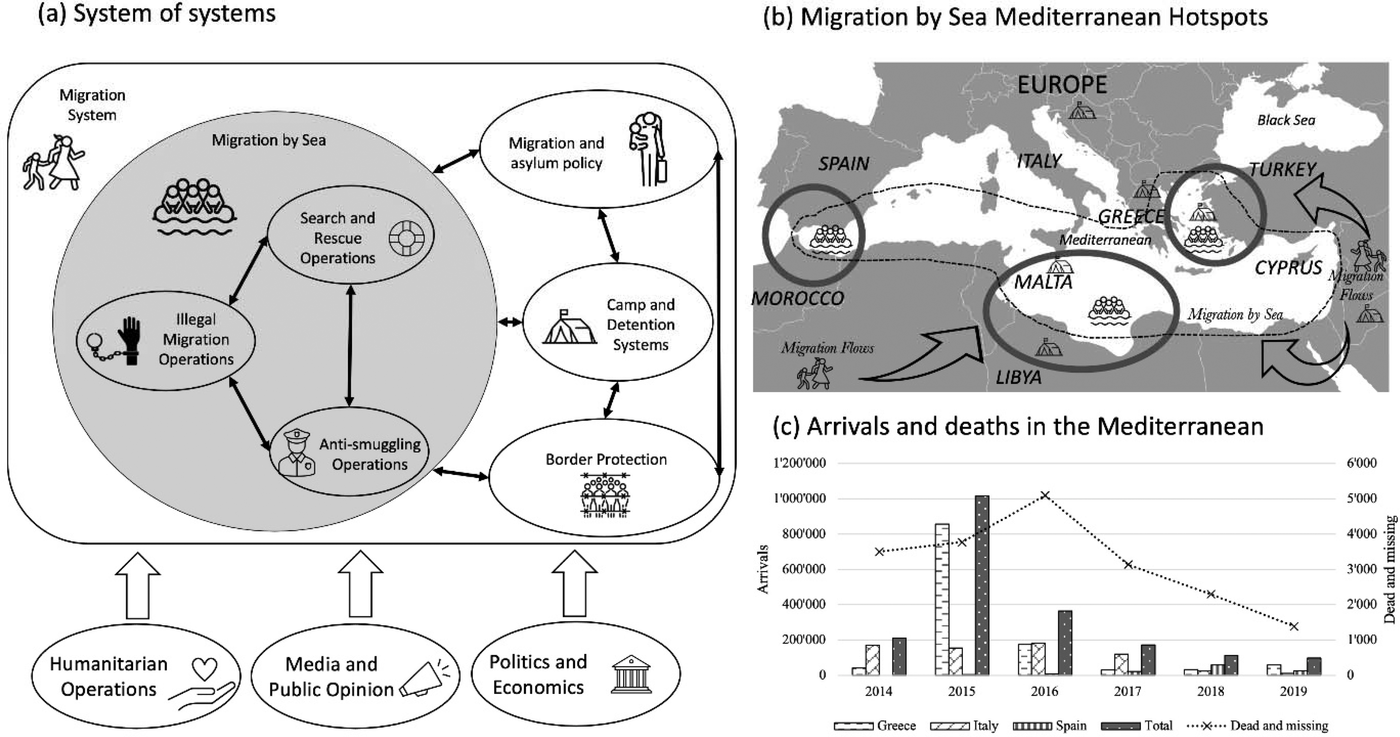
Migration across the Mediterranean Sea: (a) system of systems; (b) migration hotspots; (c) arrivals (histogram left axis) and dead and missing migrants (dotted line right axis). Source: authors and UNHCR (2020b)
The high number of sea crossings and the associated tragedies prompted a first response from Italy in the form of a naval security and humanitarian SAR operation in 2013 called “Mare Nostrum” (Ministero Della Difesa, n.d.); however, this was concluded after one year as other EU member states refused to contribute to the operation (Cusumano, 2017b). Subsequently, Frontex strengthened its border surveillance operations, and in 2015 the EU established the European Union Naval Force Mediterranean (EU NAVFOR Med), also known as “Operation Sophia,” in the Central Mediterranean with the mandate of tackling the activities of the illegal networks and providing training to the Libyan coast guard (European Union, 2016). The operation ended in March 2020, and its mandate has been integrated into the EU NAVFOR Med operation “IRINI.” The North Atlantic Treaty Organization (NATO) responded to the crisis in 2016 with the operation “Sea Guardian” in the eastern route, aiming primarily to counter terrorism and build maritime situational awareness (NATO, 2016). National authorities also set up operational responses, which often included SAR in their mandates but primarily served as counterterrorism and antismuggling operations. Most notable among these responses is Italy's naval counter‐piracy and surveillance operation “Mare Sicuro,” which began in 2015 and extended its scope in 2017 to include Libyan territorial waters. This operation was partially incorporated in the new Assistance and Support Bilateral Mission in Libya (MIASIT), which was launched in 2018.
Humanitarian organizations have been involved with SAR activities in the crisis since the beginning. They have accounted for a high share of SAR operations alongside commercial ships, which conducted up to 24.4% of such activities in the Central Mediterranean in 2014 (Guardia Costiera, 2018) before the involvement of humanitarian organizations and the beginning of “Operation Sophia.” In 2018, the majority of humanitarian organizations began withdrawing from operations in the Central Mediterranean (UNHCR, 2018) due to the more inflexible position taken by the Italian government toward humanitarian organizations attempting to carry out SAR activities off Libya's coast, as well as the larger role taken by the Libyan coast guard in intercepting migration attempts and the IMO's approval of the Libyan SAR zone in 2018. Since the second half of 2018, stakeholders have struggled to conduct SAR activities due to the limited willingness of European countries to allow migrants’ disembarkation at their ports 6 and humanitarian organizations’ inability to return rescued migrants to Libya in view of the latter country's documented instability and reported human rights violations. This has resulted in a decrease of arrivals in Europe through the Central route, an increase in the risk of death during the crossing, and uncertainty for commercial ships (UNHCR, 2019).
Interview findings and discussion
Operational resources and expertise
Because the Mediterranean Sea is a large area, SAR operations do not always have guaranteed asset availability. The operational resources and expertise differ among the parties involved in SAR activities, even within the same group; this is also reflected in the character and duration of their missions. Given their ships’ capacities and capabilities, humanitarian organizations can either conduct SAR or search and secure 7 operations. Of course, funding constitutes a challenge for most humanitarian organizations and acts as a barrier to deploying other operational assets (e.g., searching airplanes). Moreover, funding is linked to the mission's timeframe, particularly for smaller organizations due to their dependence on volunteer work. Larger humanitarian organizations, which employ professional staff, have stronger logistical support and workforce expertise for dealing with legal and operational challenges, especially when external factors command immediate adaptation to operational changes. This is seen, for instance, when authorities must unexpectedly sail to a different port of safety, thereby influencing both the time the migrants need to spend at sea and the lead‐time for the redeployment of a SAR asset.
Humanitarian organizations often rely on merchant ships for additional capacity at the Mediterranean Sea; however, commercial vessels impose two key challenges. The first relates to embarkation procedures that are hampered by the ships’ inadequacy in boarding large numbers of people, who are often exhausted and in need of medical assistance, despite seafarers being trained for SAR operations in accordance with legal conventions. The second relates to the limited number of crew members and SAR equipment available for SAR operations. The crew is also at risk of experiencing posttraumatic stress disorder due to the distressing circumstances characterizing SAR events. Commercial ships should not be relied upon for mass SAR operations and do not constitute a sustainable solution to the crisis.
On the other hand, security forces have shown their competence and expertise in effectively conducting SAR operations, although their staff can also experience posttraumatic stress disorder. Given the heterogeneity of each SAR event and the importance of other factors (e.g., weather), different security actors can be called to the incident. Coast guards have often proven the suitability of their ships and the competency of their staff during SAR operations, which are particularly challenging because of the modus operandi of illegal actors and the nature of the crafts they use.
In general, illegal actors rely on cheap, overloaded dinghies that often lack engines, crew, and lifejackets. There are three general reasons for the low quality of the used watercraft: (1) how the term “distress at sea” is seen in the EU, which requires SAR assistance even without the risk of sinking; (2) the illegal actors’ reliance on SAR activities that will be performed by European countries and humanitarian organizations; and (3) illegal actors’ efforts to maximize profits by exploiting all space available on the watercraft. In addition to these watercraft, smugglers have also deployed sailboats, which are more challenging to detect, especially in cases of distress at sea. Finally, as long as the migratory flows remain, the smugglers will continue their activities. Illegal actors treat their members as expandable; thus, eliminating their illicit activities requires the complete disruption of their business models, whose high profitability can attract more sophisticated criminal groups.
Cooperation and coordination
Cooperation and coordination among and within stakeholder groups constitute important operational challenges; fortunately, there are various methods of information exchange and collaboration. In the case of humanitarian organizations, these include regular meetings, real‐time information exchange, support at sea, and joint operations. Nevertheless, there are more systematic improvements that can be made to foster closer collaboration and information sharing. To this end, one of the interview participants initiated the establishment of a humanitarian organization coordinating system with the purpose of ensuring constant capacity availability at sea, namely by transferring rescued migrants onto a ship with better capacity or one that was already on route to a port. However, this initiative was stalled mainly for operational reasons, such as crew rotation and Italy's code of conduct, which prohibits the transfer of rescued migrants from one organization's ship to another.
Meanwhile, security forces exhibit a high degree of cooperation. For instance, the Greek coast guard not only works in tandem with Frontex but also cooperates with Turkish and Italian security forces. As for the cooperation between security forces and humanitarian organizations during a SAR operation, the interviews reported cases that highlighted that the latter's requests for assistance were rebuffed by the former. This issue may stem from the potential divergence in goals and missions among the parties involved in the SAR event. For instance, some humanitarian organizations are reluctant to share information with the security forces for two reasons: (1) tackling the smugglers’ activities does not fall within their mandates and (2) they fear that the information will be distributed to the Libyan coast guard. The operational costs at sea are thus increased by the limited cooperation stemming from their conflicting goals and agendas.
Additional stakeholders and suggestions for solving the crisis
Most of the interviews confirmed that managing the attitude of the general public and the position of the media is a challenge for humanitarian organizations, particularly in relation to their funding. As smaller organizations rely on donations obtained from the public, a loss of media focus on the crisis or negative campaigns by other stakeholders regarding humanitarian organizations’ operations lead to funding limitations. Funding is also linked to the region a crisis takes place in: The high number of migrants disembarking on European soil has turned into a concern for the public. To address such concerns, Italian policymakers have enforced the aforementioned code of conduct, which some humanitarian organizations interpreted as policymakers’ attempts to signal their own efforts in addressing the crisis. It should be noted that after the code of conduct was adopted, some humanitarian organizations experienced a decline in collaboration with the security forces, but this could also be related to the change in Italy's political climate.
Another issue with substantial consequences for SAR operations was the provision of resources and training to the Libyan coast guard through the operation “Sophia,” which began in June 2018 for the purpose of conducting SAR activities in the newly established Libyan SAR area. This initiative has encountered opposition from humanitarian organizations, which argue that the Libyan coast guard contains various militias. While the Libyan coast guard has assisted in SAR operations, there have been other reported circumstances that have confirmed these fears; this poses a significant threat to humanitarian organizations. Humanitarian organizations often exceed their safety capacity so as to avoid the intervention of the Libyan coast guard, which would then transfer the survivors to Libya without respecting the nonrefoulement 8 principle as the migrants’ safety in the country is disputed. Disembarkation to Libya is also a concern for merchant ships that want to ensure the safety of their crews and the migrants on board.
The interviews also described the involvement of two additional stakeholders: the so‐called engine‐fishers and lobby groups. The former is typical civilians who aim to collect the boats’ engines used for the crossings. Despite the humanitarian organizations’ uncertainty about these groups’ relation to illegal actors, there have been no reported incidents to clearly delineate the connection. In fact, some cases where engine‐fishers assisted during a SAR event have been noted by humanitarian organizations. Participants mentioned lobby groups as exerting indirect influence over SAR operations, namely by creating opposition to disembarkation in ports of safety or shifting the political debate. Table 2 distinguishes between the parties involved in SAR activities and the other stakeholders that are engaged in MBS phenomena but do not operate at sea.
Stakeholders involved in MBS crises
The interviewees also suggested solutions for addressing the crisis. Several indicated that humanitarian organizations’ rescue assistance at sea is only a short‐term response; addressing the broader problems driving migration requires long‐term development, which is time‐ and resource‐intensive. Some argued that policymakers should expand the provision of alternative legal migratory pathways while acknowledging the need for burden‐sharing between European countries. In any case, humanitarian organizations highlight the fact that policymakers should always ensure the migrants’ disembarkation at a port of safety. Linked to this, interviewees were conflicted about the involvement of Libya—a country that allows the arbitrary detention of migrants and criminalizes migration—in interception and SAR operations.
THE SYSTEM DYNAMICS MODEL OF THE MEDITERRANEAN SEA CASE
This section illustrates the SD methodology applied in the Mediterranean Sea case study. We then use the SD model to study four recommendations that emerged during the interviews and existing literature: The legal migratory framework should be improved by promoting alternative legal migration pathways that would allow migrants, and most notably asylum seekers, to arrive in Europe without having to be smuggled across the Mediterranean Sea. Cooperation should be enhanced among stakeholders (excluding smuggling networks) within the MBS crisis and in SAR activities. Potential migrants should be informed about the probable risks of the migratory journey. The sea crossing interceptions can and should be performed by the countries of embarkation.
Recommendation 1 has also been discussed in existing reports (e.g., UNHCR, 2019); however, its implications for SAR operational effectiveness have not yet been systematically studied. Recommendation 3, also mentioned in one of the interviews, relates to the IOM's campaigns Aware Migrants (IOM, 2021) and Migrants as Messengers (Dunsch et al., 2019), with the latter showing that raising awareness in Senegal about the journey's risks can reduce the intention to migrate in an irregular manner.
The system dynamics model
We used causal loop diagrams to explain the interactions among the system's variables (Sterman, 2000), as presented in Figure 3. The specific direction of the connecting lines describes the effect direction among the variables, while the signs (+) and (−) at the end of the lines show this effect. In particular, the variables change in the same direction in the case of (+), while the opposite happens in the case of (−). The system encompasses the subsystems of key parties involved in SAR events, which are described in Figure 4. The system's feedback loops can be either balancing (i.e., B) or reinforcing (i.e., R).
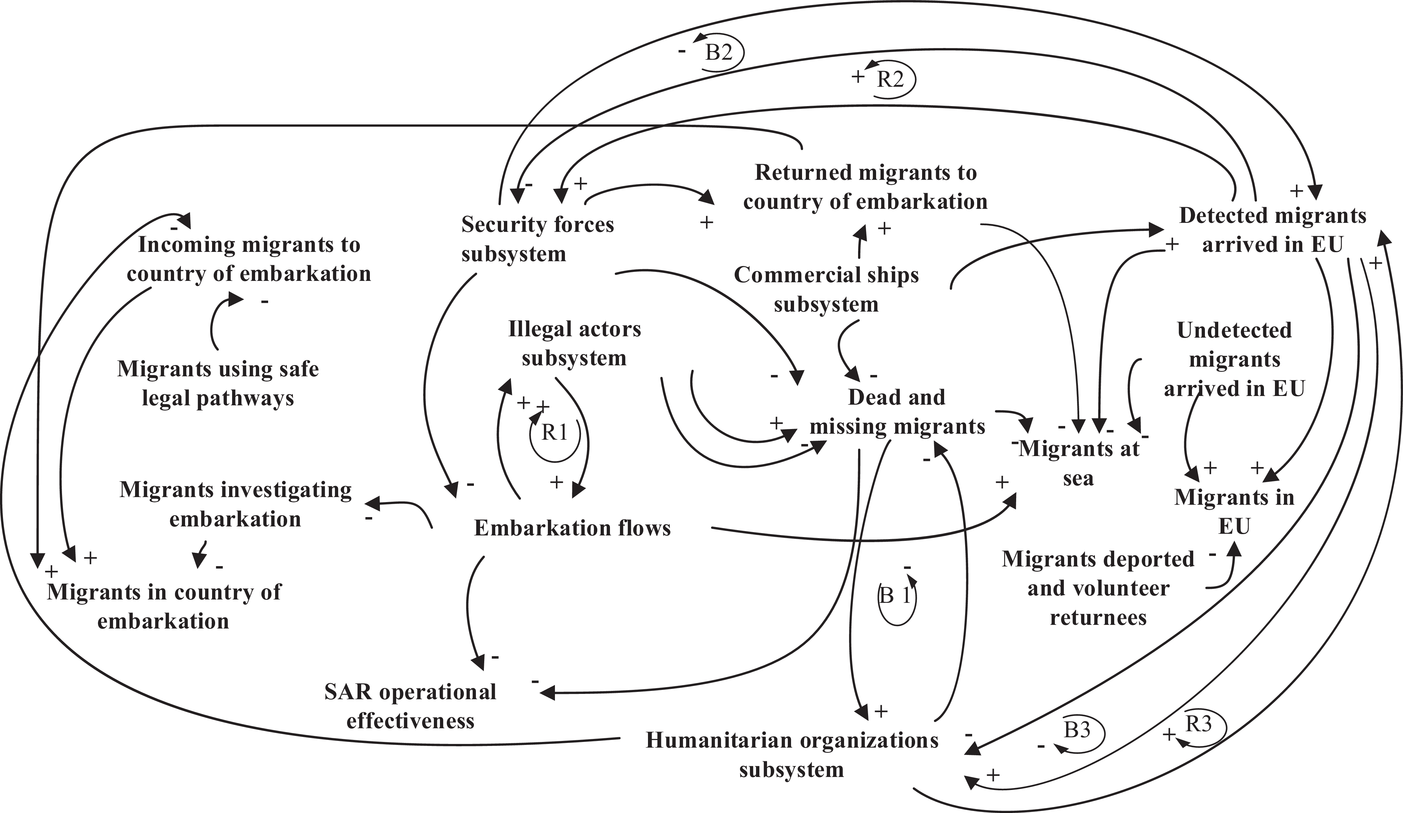
Causal loop diagram of the Mediterranean MBS phenomenon
On the left‐hand side of Figure 3, we observe the migrants in the country of embarkation, whose number increases by the number of people arriving at the embarkation country (i.e., incoming migrants to the country of embarkation). The incoming migrants to the country of embarkation are reduced by the migrants who use legal migration corridors (i.e., migrants using safe legal pathways). The migrants planning to attempt the sea crossing (i.e., migrants investigating embarkation) reduce the migrants in the country of embarkation. The migrants embarking on their sea journey (i.e., embarkation flows) reduce the migrants in the country of departure—this is illustrated in the middle‐left side of the diagram. The embarkation flows, which exert a negative influence on SAR operational effectiveness, are reduced by the security forces subsystem through border control policies. The illegal actors subsystem has a positive feedback loop (i.e., R1) with the embarkation flows since the former can increase the number of migrants attempting the crossing (which consequently increases the illicit profits of this party), as shown in Figure 4.
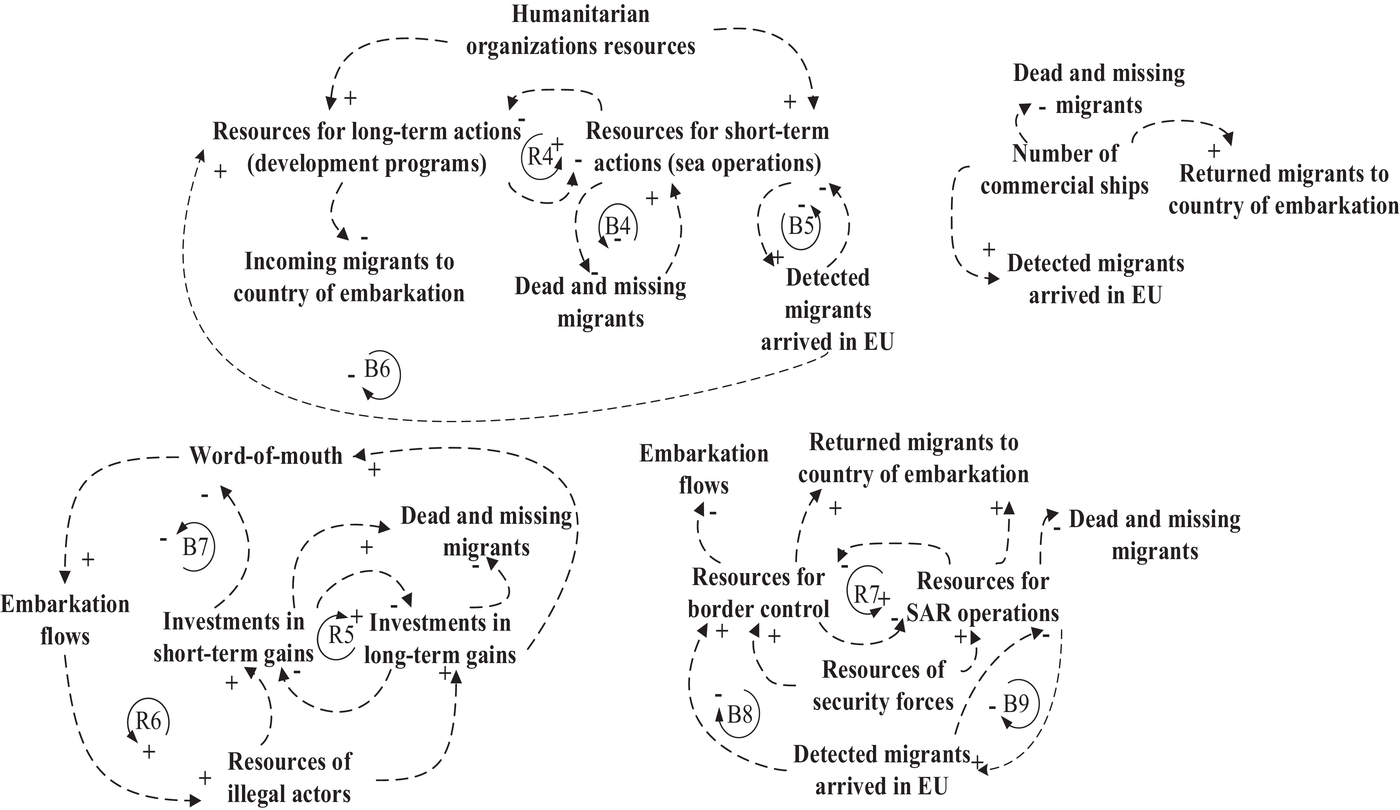
Causal loop diagrams of subsystems
The embarkation flows positively influence the number of migrants at sea (see right‐hand part of the diagram). The outcomes of the sea crossings are fourfold, and all lead to a reduction of migrants at sea. One possible case is the occurrence of dead and missing migrants, which negatively impacts SAR operational effectiveness. The illegal actors subsystem increases the number of dead and missing migrants when the quality of resources provided to the migrants is poor. The prevalence of dead and missing migrants is also decreased by the security forces subsystem and the commercial ships subsystem because of SAR operations. Lastly, we observe a feedback loop (i.e., B1) between the dead and missing migrants and the humanitarian organizations subsystem, as those organizations reduce the death toll at sea through SAR operations, while the occurrence of deaths at sea increases their budget through donations (see Figure 4).
The second possible outcome of the sea crossings can be returned migrants to the country of embarkation. Their number can be increased by the commercial ships subsystem (following SAR activities) and the security forces subsystem (following SAR or interception operations). It is important to mention that humanitarian organizations operating in the Mediterranean Sea view Europe as the only safe place to disembark rescued migrants and refuse to return them to embarkation countries like Libya.
The other two outcomes refer to the arrival of migrants on European soil (i.e., migrants in the EU), either as undetected (i.e., undetected migrants arrived in the EU) or as detected (i.e., detected migrants arrived in the EU), both of which have a positive effect on the migrants in the EU. The number of detected migrants arrived in the EU increases due to the security forces subsystem, the commercial ships subsystem, and the humanitarian organizations subsystem. The security forces subsystem has a twofold feedback loop relationship (see Figure 4) with the detected migrants arrived in the EU: increases in the latter increase the amount of resources allocated to border control interceptions (i.e., R2) and decrease the resources allocated to SAR missions (i.e., B2). We also observe a twofold feedback loop between the humanitarian organizations' subsystem and the number of detected migrants who arrived in the EU. Particularly, increases in the detected migrants arrived in the EU have a negative impact on the SAR resources (i.e., B3); on the other hand, increases the resources allocated for development actions aimed at reducing the flows from the country of origin—this is illustrated in the negative connection between the humanitarian subsystem and incoming migrants to the country of embarkation (i.e., R3)—see Figure 4. Finally, the number of migrants in the EU decreases in accordance with the number of migrants deported and volunteer returnees to non‐European countries.
The causal loop diagrams of the subsystems referred to in Figure 3 are provided in Figure 4. At the upper part of the figure, humanitarian organizations have a specific budget (i.e. humanitarian organizations resources) that is forwarded to resources for long‐term actions (development programs)—this refers to actions that will tackle the problematic context driving the migration and thus decrease the number of incoming migrants to the country of embarkation—and resources for short‐term operations (sea operations), which refer to SAR activities—therefore, a constraint exists between the two variables (i.e., R4). The resources invested in SAR operations create a feedback loop with the dead and missing migrants (i.e., B4) and the detected migrants arrived in EU (i.e., B5). The detected migrants who arrived in the EU create a loop (i.e., B6) with the resources for long‐term actions (development programs).
At the right‐hand part of the graphs in Figure 4, the engagement of the commercial maritime sector in the MBS crisis is observed. The number of commercial ships involved leads to a decline in the dead and missing migrants but also to a rise in the returned migrants to the country of embarkation and the detected migrants arrived in the EU. At the left bottom part, the illegal actors have a specific budget (resources of illegal actors) which can be used for investments in short‐term gains and investments in long‐term gains. The former relates, for instance, to the usage of low‐quality or unsafe boats provided to migrants, while the latter involves the provision of higher quality resources to migrants (R5). Investments in short‐term gains and investments in long‐term gains will have a negative and positive impact on the dead and missing migrants and word‐of‐mouth accordingly. The latter positively influences the embarkation flows, which increases the resources of illegal actors; loops B7 and R6 are created, as shown in Figure 4. At the right bottom part of the diagram, the resources of security forces are allocated to border control interceptions (i.e., resources for border control) and resources for SAR operations (R7). The former is positively impacted by the detected migrants arrived in the EU, while the latter is negatively impacted. The resources for border control reduce the embarkation flows. The resources for SAR operations reduce the number of dead and missing migrants and increase the number of detected migrants arrived in the EU; loops B8 and B9 are created. Finally, both resources increase the number of returned migrants to the country of embarkation.
Model used for the analysis and main assumptions
This subsection develops the simplified version of the stock and flow model used to analyze the implications of the four recommendations presented above. Since migrants constitute the key stakeholder in the MBS phenomenon, we modeled the security forces, commercial ships, humanitarian organizations, and illegal actors subsystems at an aggregate level. The model does not include stakeholders that do not operate at sea (e.g., policymakers, media) or factors that drive migration flows (e.g., root causes and the migratory regulatory framework). Future research should examine those groups and factors to better understand their role in MBS. The model begins with the incoming rates, migrants in the country of embarkation, and migrants investigating embarkation. Since the number of undetected arrivals in Europe is unknown (Collyer & King, 2016), we only included the detected sea arrivals and refer to them as migrants in the EU.
We ran simulations for the year 2016 to validate the model. The year 2016 was chosen because, despite seeing fewer crossings compared to 2015, it was still the deadliest year so far. The IOM's Missing Migrants project (IOM, 2020) offered monthly and yearly aggregate data regarding the number of sea crossings, interceptions, deaths, and sea arrivals in Europe, which were also used to calculate the death ratio (i.e., dead migrants over the number of crossings) and the interception ratio (i.e., the number of intercepted divided by the number of crossed). We performed the analysis for weekly flows on a 52‐week time horizon with a time step of 0.5 weeks. For the sake of simplicity and data accuracy, we did not consider repeated crossing attempts made by migrants who had originally been intercepted. We then conducted a simulation analysis to check the model's validity by reproducing the real numbers—these numbers are provided in Table 2 under 2016—of dead and missing, arrived in the EU, and intercepted migrants; the results are then presented in Table 2 base model.
In the next stage, we altered the base model. Particularly, we modeled the SAR resources (estimated in the Supporting Information) as a graphical function of the ratio of dead and missing migrants to migrants in the EU, as presented in the Supporting Information. The death rate was also modeled as a graphical function of SAR resources. In total, we performed 16 different simulation scenarios in order to test which functions produced the results that best matched reality. Notably, we observed an almost exponential relationship between SAR resources and the ratio of dead and missing migrants to migrants in the EU—a ratio increase translates to an increase in SAR resources. As for the death rate, it showed a slow reduction at the beginning and reduced faster as the SAR resources increased.
The SAR resources model was used to examine recommendations 1, 2, and 3. To investigate recommendation 4, we had to modify the SAR resources model since it did not account for migrants that tried to cross the Mediterranean Sea multiple times after their return to the country of embarkation, as observed in practice (e.g., Brito, 2019; Tabachnick, 2020). We modeled this probability of multiple crossing attempts using a fixed percentage referred to as the reattempt ratio. To counteract the lack of detailed data about the reattempt rates for the Mediterranean Sea crisis, we simulated different scenarios using three reattempt ratios (i.e., for 5%, 50%, and 100%, implying that 5% of the returnees cross again, etc.), while reducing the values of the incoming rate, migrants in the country of embarkation, migrants investigating embarkation, and migrants at sea assigned at the beginning of each simulation, as illustrated in the Supporting Information. We then recalibrated this new model altered SAR resources model for each scenario. Table 3 illustrates how the calibrated SAR resources and altered SAR resources model are comparable in terms of the total number of migrants in the EU, dead and missing migrants, intercepted migrants, and attempted sea crossings and therefore can be used as a baseline.
Model validity results
In addition to replicating historical results, we also assessed dimensional consistency and extreme conditions in order to check the model's structural validity (Sterman, 2000). For the former, we checked the units of measurement for all variables as well as their underlying equations. For the latter, we assigned extreme values to certain variables to observe whether the simulation produced realistic outputs. Particularly, when assigning zero values to the incoming migrants, migrants in the country of departure, migrants investigating embarkation, and migrants at sea, we observed no dead, intercepted, and arrived in EU migrants. When assigning a 100% interception ratio, we observed no dead migrants or EU arrivals. Lastly, we further examined recommendations 1, 2, and 3 using the altered SAR resources model. The models show similar behaviors, and our findings remain robust.
Simulation results
The expansion of alternative legal pathways
One can expect that expanding alternative legal pathways for migrants will at least safeguard those who genuinely need international protection, as they will not be required to undertake dangerous sea crossings. This process would ensure the safety of migrants, in contrast to stricter control regimes that can promote riskier migratory paths even as they decrease the flows on specific routes. To check the effect of such provisions on the MBS system, we performed what‐if analyses to account for different percentages of migrants (e.g., 5% of migrants in the country of embarkation) using legal pathways.
As illustrated in Figure 5, the model indicates that the provision of alternative legal pathways ensures the safety of migrants while decreasing the number of people who reach Europe illegally. When comparing different percentages of people arriving in Europe legally, it should be noted that the number of missing and dead migrants slightly increases before decreasing rapidly as the number of people using legal pathways increases despite the expected reduction of sea crossing attempts. This can be explained by the link (see Section 5.2.) between the available SAR resources and the ratio of dead and missing migrants to migrants in the EU. The decrease in the number of dead and missing migrants and the increase in the number of migrants in the EU will result in a decrease in SAR‐related resources. This, in turn, will result in a slight increase in deaths. However, for larger flows of people arriving in Europe legally, the reduction in the risk of dying while crossing is high enough to reduce the total death toll. The model indicates that while for high percentages of migrants arriving in the EU via legal pathways, the resources spent on SAR operations can be reduced; this should not be the case for lower percentages. Therefore, to reduce loss of life, stakeholders should continue to provide SAR resources at sea alongside legal options for migrants in need of international protection.
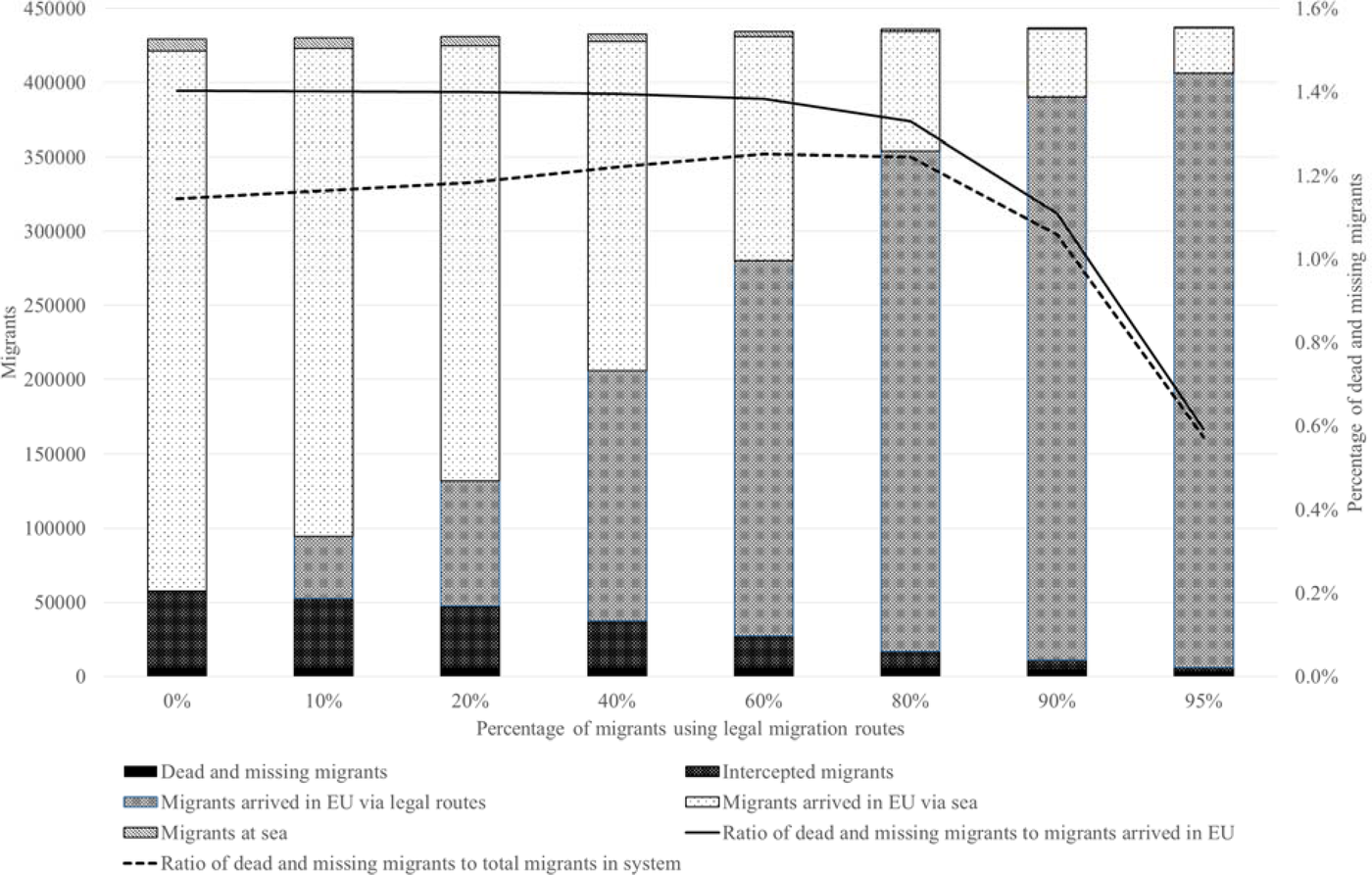
The implications of providing legal alternative routes. Number of migrants (right axis) and the ratio of dead migrants to migrants in the EU and total (left axis), by scenario and representing the percentage of migrants crossing legally
When comparing the change in the ratio of dead to total migrants in the system for the three scenarios used to model the percentage of migrants that reattempt crossing (see Section 5.2. concerning the altered SAR resources model), it is worth noting that the higher the number of migrants that reattempt crossing, the lower the initial increase in dead and missing migrants as the number of migrants that use legal pathways increases (see Supporting Information).
The importance of cooperation within MBS crises
According to the interview results, operational effectiveness increases when there is cooperation among the parties involved in SAR events (e.g., in terms of sharing assets, information, and expertise) and depends on the goals of the involved parties. We assume that an honest cooperation—one not hindered by conflicting goals of those stakeholders operating at sea—will translate to a better use of available SAR resources and, consequently, to a reduction of life loss incidents at sea. We investigate the consequences of cooperation, which are represented in the model as the ability to save the same number of people at lower costs (i.e., at different percentage reductions in the relationship between SAR resources and death rate assuming the same number of deaths). Figure 6 indicates a reduction in the number of dead and missing migrants through cooperation enhancement. The analysis also shows that increased cooperation could potentially result in a reduction of SAR resources. This occurs as a result of the relative increase in the number of migrants arriving in the EU and the decrease in the death ratio.
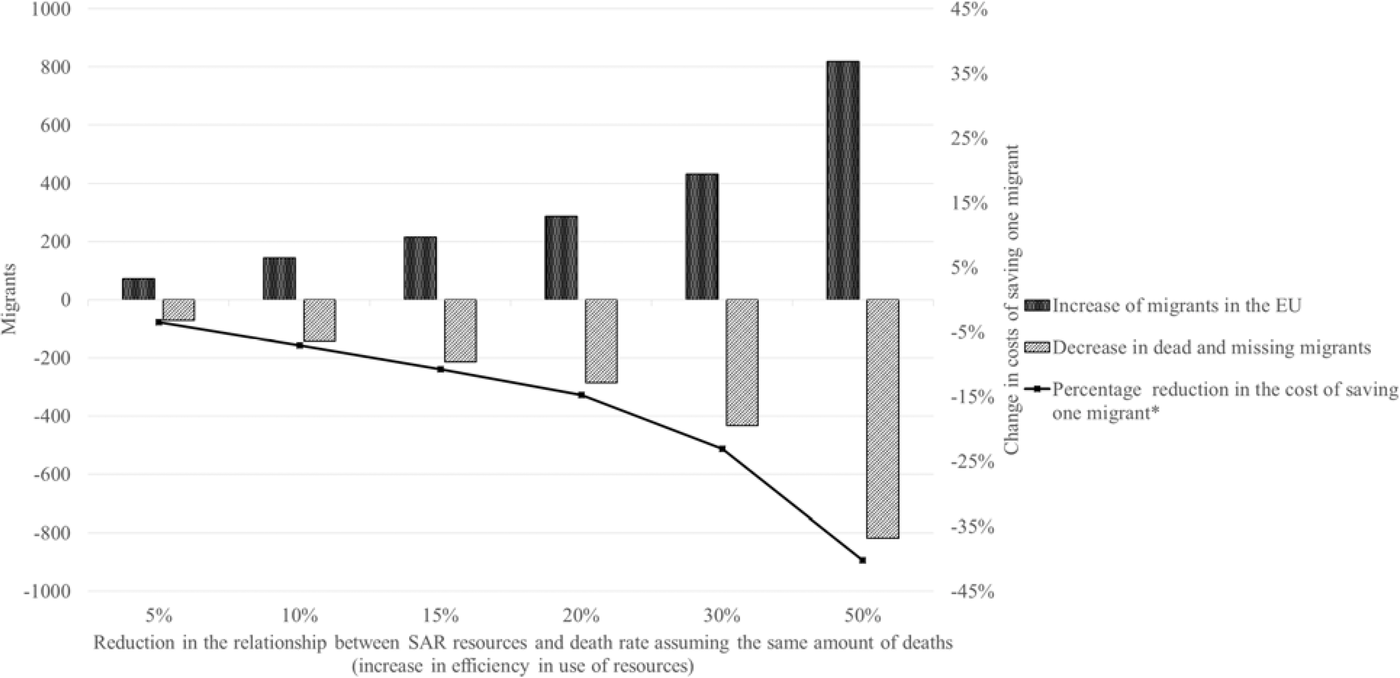
Implications of cooperation enhancement on SAR operational effectiveness. Change in migrants in the EU, in deaths and missing migrants (left axis), and in costs of saving a migrant (right axis) following a change in use of resources as a result of increased cooperation. *assuming that the change in saving migrants is the same as the change in people surviving
Raising awareness among potential migrants about the risks of sea crossing
Regarding the implications of informing potential migrants about the risk of life loss at sea, the model accounts for this issue by assessing how the incoming migrants to the country of embarkation perceive the deaths that have already occurred at sea 9 —in other words, if the deaths act as a deterrence for the crossings. We conducted simulations for three cases, namely when deterrence rates are linked: (1) only with weekly deaths, (2) only with cumulative deaths, and (3) with weekly and cumulative deaths. The simulations accounted for different deterrence rates ranging from 1:1 or 100% (which would imply that the death of one migrant causes one migrant not to cross) up to unrealistic values such as 1:8000 or 800,000% (one death deters 8000 people). Cumulative deaths act as a stronger deterrence factor than weekly deaths. The analysis shows that for cases (1) and (3), the number of deaths stabilizes at a deterrence rate of 1:16. Although all three cases above lead to a decline of deaths at sea as the deterrence rate increases, under no circumstances does the death toll reach zero. We also analyzed this recommendation using the altered SAR resources model, which we expanded by assuming that the migrants that have been intercepted, and who could have observed a tragedy at sea, will also be equally deterred by the weekly deaths. Although it could be argued that the hardship in the country of embarkation (e.g., Libya) acts as a major push factor for the migrants to make the crossing regardless, it can also be assumed that some migrants may still be deterred. Also, in this case, there is no deterrence rate that completely prevents deaths at sea.
These findings should not be perceived as evidence for the existence of a “pull factor” since (a) migration decisions are complex and multifaceted, (b) there does not seem to be empirical evidence that the decision to board a ship is the result of SAR operations at sea (Cusumano & Villa, 2019), and (c) our model does not examine all the determinants of migration choices (e.g., change in the migrants’ motivation or their migration capabilities; see for a detailed discussion, e.g., Kent et al., 2020). This study argues that raising awareness about prospective migrants’ potential risks at the country of origin should be seen as an effective additional measure to reduce migration tragedies at sea, while SAR operations should be maintained to prevent loss of life at sea.
Interceptions of sea crossings
The policy of migrants being intercepted by security forces from the countries of embarkation, particularly Libya, has been controversial. Beyond the issues associated with training and arming security forces in a country devastated by an ongoing civil war, and the consequences this has on SAR operations, there is also a high possibility that intercepted migrants will attempt the crossing again after being returned to the country of embarkation. The implications of interceptions at sea on the number of dead and missing migrants are illustrated in Figure 7. The analysis shows that a noticeable decrease in this number is only possible in the case of a high interception rate of the attempted crossings and a considerably low repeat rate. The findings also suggest that a higher interception rate prompts a higher number of new attempts at sea crossings. More effective interception policies (i.e., reducing migrants’ crossing capabilities by, for instance, increasing border surveillance in departure countries) do not appear to change the underlying circumstances that form the basis for migration in the first place. Besides, considering reports about arbitrary detention, torture, and other inhumane abuses in the detention camps of some countries of embarkation, the drive to embark might actually be heightened by providing support to local security forces (Carrera & Cortinovis, 2019).
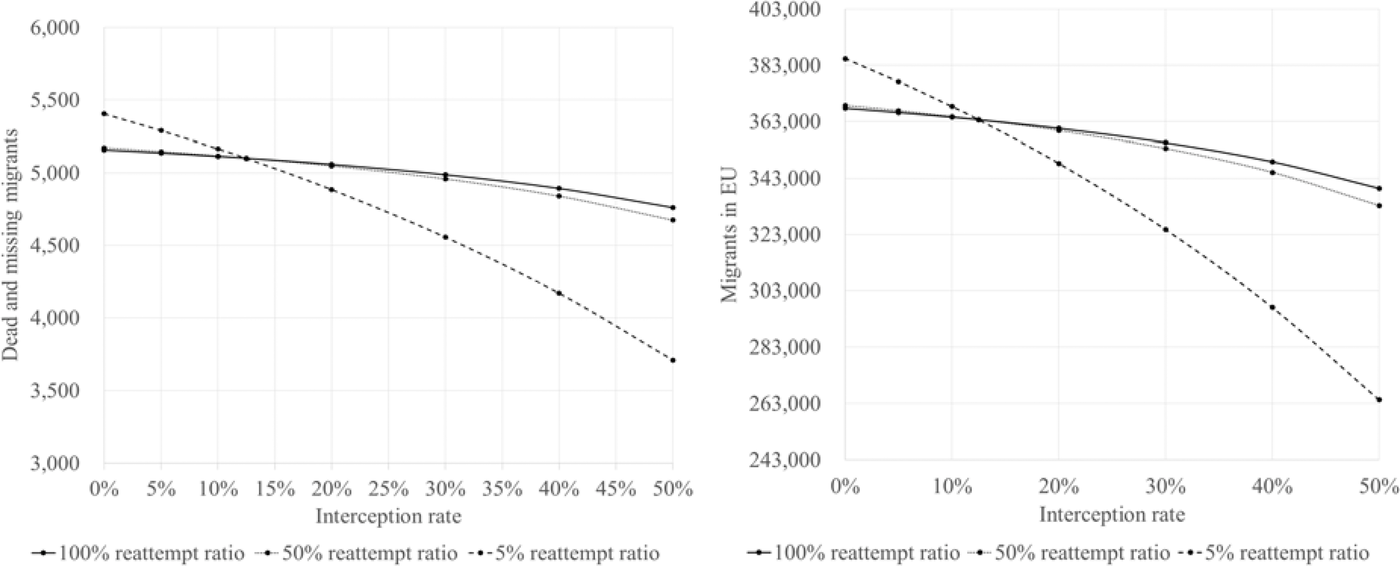
Implications of interception policies at sea on dead and missing migrants (left panel) and migrants in EU (right panel)
CONCLUSION AND DIRECTIONS FOR FURTHER RESEARCH
This article deals with MBS, one instance of the global displacement crisis, which is characterized by migrants attempting to cross the sea, often in precarious conditions, that result in a significant loss of human lives. Aiding people in distress at sea is an obligation under international law and is often perceived as a moral duty. However, the terms of such assistance remain contentious. As a result, operational responses have often been inconsistent, ineffective, and generally inadequate to deal with the scale and complexity of migration by sea. This article focused on the complex operational dynamics of the Mediterranean Sea migration crisis and the effectiveness of SAR operations, as well as the potential measures that could reduce the number of migrant deaths at sea. The study proposed an SD model built atop an analysis of secondary data and in‐depth interviews with key stakeholders such as humanitarian organizations, commercial shipping associations, national coastguards.
At first, the article provided a list of stakeholders involved in SAR operations and their respective goals while representing their interactions in a structured analytical framework. We then used the model to explore four recommendations, which have been the subject of intense political and academic debate, arising from the interviews. First, it allowed us to investigate the implications of expanding legal migration pathways. Developing such pathways provides assistance to migrants who genuinely need international protection. Our analysis shows that legal migration pathways reduce the risk of death while migrating and can result in a substantial reduction in the death toll under certain conditions. However, it also showed that the reduction in SAR resources associated with an increasing number of migrants in Europe could cause the number of deaths at sea not to decrease as expected. It appears that the relationship between SAR resources and migrants arriving in Europe is critical in understanding the number of deaths at sea. Further research is needed to better comprehend how SAR resources affect the MBS death toll. The model suggests that legal migration pathways should still be complemented by SAR operations in order to prevent the deaths of migrants who will still attempt sea crossings.
Second, the model allowed us to evaluate the impact of interception policies. These can reduce the number of deaths occurring at sea, as migrants are prevented from leaving the territorial waters of, or brought back to, the country of embarkation. It should be stressed, however, that in the Mediterranean Sea crisis, interceptions by the armed forces or the coast guard of the country of embarkation can imply returning migrants to countries where extensive human rights violations have been reported. This is potentially at odds with the 1951 Refugee Convention and the nonrefoulement principle.
Third, the paper analyzed the effects of stakeholders’ enhanced cooperation on SAR operational effectiveness. The model showed that better cooperation reduces the death toll at sea, as expected, but might result in a reduction of operational resources available for SAR, especially in the absence of programs aimed at receiving the migrants in the countries of arrival.
Finally, the study evaluated the implications of informing prospective migrants about the risk of death during sea crossings. The analysis indicates that although the number of deaths at sea acts as a deterrence for prospective migrants, the death toll will not be reduced to zero. In addition, using deaths as a deterrence to migration raises substantive moral objections. This is the fundamental flaw with the “pull factor” argument. Even if our model could be modified to account for the heterogeneity of the migrant population and the complexity of migration incentives (UNHCR, 2019), any potential reduction in sea crossings cannot justify abdicating the moral obligation of rescuing life at sea, as coded in a long history of maritime international law and customs. More research is required on this issue to complement recent empirical evidence (Cusumano & Villa, 2019) concerning the lack of a correlation between migrants’ decision to embark on a sea crossing and the presence of SAR operations at sea.
It should be noted that the SD model focuses on the migrant subsystem. Other studies should expand the analysis to include the other subsystems mentioned in the paper and develop complementary models to describe the migration systems on land (e.g., networks to the country of embarkation, the arrival and disembarkation processes at the port, the onward migration journeys, the management of camps hosting displaced people, etc.). The acquisition of more and better operational data—for which there is an urgent need in MBS studies—may justify a further refinement of the proposed model.
On that point, this analysis opens several avenues for further research. The proposed framework could be refined through the study of other MBS cases, which would greatly enhance the understanding of MBS globally. Within each MBS case, researchers could explore the interaction among stakeholders—both at sea and on land at different operational and strategic levels. Future research should also focus on how to achieve cooperation in the context of MBS, as the level of cooperation impacts the operational response and its associated costs. Moreover, the literature has largely neglected the role of illegal actors within MBS. All these aspects could be interestingly modeled via SD or agent‐based models. Further research should also look at humanitarian organizations’ resource use (e.g., in terms of area coverage, weather conditions, and dollars per life saved) by means of historical data or in‐depth case studies. We hope that our efforts here will stimulate research on this urgent and complex topic and thereby inspire efforts to lower the costs of crisis management, improve SAR operational effectiveness in the MBS context, and ultimately, reduce the human death toll.
Footnotes
ACKNOWLEDGMENTS
The authors would like to thank the department editor, the senior editor, and the anonymous reviewers for their insightful comments and suggestions that improved the present study. The authors would also like to thank the interviewees for participating in the study.
1
According to the United Nations (UN,  ): “The UN Migration Agency (IOM) defines a migrant as any person who is moving or has moved across an international border or within a State away from his/her habitual place of residence, regardless of (1) the person's legal status; (2) whether the movement is voluntary or involuntary; (3) what the causes for the movement are; or (4) what the length of the stay is.” The paper follows the inclusive definition of the International Organization for Migration (IOM), which includes refugees (IOM, 2019; Meaning of migrants, 2020).
2
3
SAR operations are defined in the 1979 SAR Convention as “The performance of distress monitoring, communication, co‐ordination and search and rescue functions, including provision of medical advice, initial medical assistance, or medical evacuation, through the use of public and private resources including co‐operating aircraft, vessels and other crafts and installations.” (SAR Convention, 1979 as amended by resolution MSC. 70(69) Annex: chapter 1, paragraph 1.3.3).
4
“Security forces” is used as an umbrella term in the study to include authorities (e.g., navy, coast guards, military, Frontex) that deal with security or border control activities, among other things.
5
The term “illegal actors” is used in the study as a broader term that encompasses smugglers and traffickers. When necessary, the paper distinguishes between these two stakeholders.
6
7
Search and secure refers to the case where migrants cannot be brought safely into the existing rescue boat and larger vessels are called to the incident location to provide help; the term was mentioned in one interview with a humanitarian organization.
8
9
Potential migrants can be informed about the tragedies at sea by other migrants who have attempted the sea crossings or by information campaigns (e.g., Dunsch et al., ). Deaths can deter people from migrating as has been in the case of work‐migrant flows from Nepal to the Persian Gulf countries (Shrestra, 2019).