






Abstract
Vaccination is a very effective measure to fight an outbreak of an infectious disease, but it often suffers from delayed deliveries and limited stockpiles. To use these limited doses of vaccine effectively, health agencies can decide to cooperate and share their doses. In this study, we analyze this type of cooperation. Typically cooperation leads to an increased total return, but cooperation is only plausible when this total return can be distributed in a stable way. This makes cooperation a delicate matter. Using cooperative game theory, we derive theoretical sufficient conditions under which cooperation is plausible (i.e., the core is non‐empty) and we show that the doses of vaccine can be traded for a market price in those cases. We perform numerical analyses to generalize these findings and we derive analytical expressions for market prices that can be used in general for distributing the total return. Our results demonstrate that cooperation is most likely to be plausible in case of severe shortages and in case of sufficient supply, with possible mismatches between supply and demand. In those cases, trading doses of vaccine for a market price often results in a core allocation of the total return. We confirm these findings with a case study on the redistribution of influenza vaccines.
Introduction
Vaccination is a powerful preventive measure to avoid a large outbreak of an infectious disease. However, often there are insufficient doses of vaccine available to vaccinate the entire population. Various parties, such as health agencies, may have their own stockpiles of doses. To use these limited doses effectively, these parties can decide to cooperate and share their doses of vaccine. There are multiple examples of situations in which vaccine sharing proved its benefits. For instance, during the 2004–2005 influenza season in the United States an unexpected supply disruption lead to severe shortages. To alleviate these shortages, influenza vaccines were shared and redistributed among health agencies (Hinman et al. 2006, McQuillan et al. 2009). Also, during the 2009 influenza pandemic, various countries shared their pandemic vaccine supplies to reach the most vulnerable populations (World Health Organization 2012). In addition, governmental organizations also recommend to share vaccines in certain situations. For instance, the Centers for Disease Control and Prevention (CDC) in the United States allows parties to redistribute or sell their vaccines to others in case of delayed delivery or another emergency (Centers for Disease Control and Prevention 2009b). Also in Taiwan the government recommends health agencies to share and redistribute influenza vaccines in case of shortages (Chen 2017). Despite governmental initiatives for vaccine sharing, in general, cooperation is a delicate matter: although total health benefits increase under vaccine sharing, it may also lower the health benefits of some parties. How can we ensure that these parties are also willing to collaborate? One way to do so is by compensating them. In this study, we investigate how parties sharing doses of (the same type of) vaccine should be compensated in such a collaboration. In particular, we are interested in a stable allocation of the total health benefits among all parties. For that, we will make use of cooperative game theory.
In literature, there are several papers that study cooperation in the context of vaccination. Most of these papers consider a central planner that coordinates the cooperation and assume that parties are willing to cooperate if there is individual rationality (i.e., if the benefits of cooperation are such that every individual party receives at least as much as it could obtain on its own). Sun et al. (2009) and Wang et al. (2009) model the behavior of countries that can decide to keep their doses of vaccine for themselves or to donate some doses to others. Both studies compare the decentralized solution (i.e., the situation without cooperation) to the solution of a central planner, such as the World Health Organization (WHO). Mamani et al. (2013) also consider a central planner, but they do not enforce cooperation by imposing a solution. Instead, they propose a contract that coordinates the behavior of countries via subsidies. Such a contract indirectly stimulates countries to cooperate. In contrast to a central planner who directly or indirectly enforces cooperation, parties can also decide to cooperate themselves. The fact that cooperation typically leads to increased health benefits provides a motivation for parties to cooperate.
In our analysis, we study under which conditions parties are willing to cooperate without central coordination. As said, we make use of cooperative game theory. This field deals with the modeling and analysis of situations in which parties, also called “players,” can benefit from coordinating their actions. In this study, we introduce and analyze a specific type of cooperative game, a so‐called “resource pooling game,” in which players redistribute their resources in an optimal way in order to achieve together a higher total return. A natural question arises about the allocation among the players of this additional return compared to the situation without cooperation. For this, we use the concept of the core, which is defined as the set of allocations that divide the total return in such a way that no individual player nor any group of players is worse off. We consider cooperation to be plausible when such a core allocation exists. Core allocations are an extension to allocations that only consider individual rationality (Mamani et al. 2013, Sun et al. 2009, Wang et al. 2009).
We model the health benefits that players can obtain from a certain number of doses of vaccine with a return function. The non‐linearities in vaccination give rise to a typical pattern in the return function, which is characterized by increasing returns to scale in case of limited doses and decreasing returns to scale in case of many doses (Duijzer et al. 2018b, Mamani et al. 2013, Wu et al. 2007). Such type of return functions is also known as S‐shaped return functions. For these type of return functions, we show that cooperation is not always plausible. This means that even though cooperation typically leads to an increased total return, there does not always exists a core allocation of this total return. However, we present a number of interesting cases for which cooperation is plausible. For those cases we present an intuitive allocation with a uniform market price for trading doses of vaccine. We numerically study situations in which it is difficult to determine the total return that players can achieve through cooperation, because of the complexity of the underlying decision problem (i.e., the problem of redistributing doses of vaccine in an optimal way). We analyze whether comparable market prices can be used in those situations. We conclude that when cooperation is plausible, trading doses of vaccine for a market price often results in a core allocation of the total return and we provide analytical expressions for potential market prices. In our numerical experiments, we consider altruistic players and selfish players. Altruistic players are willing to share all their doses of vaccine, but selfish players will only share doses if they have more than enough for the own population. We find that cooperation is more likely when players are selfish, although the benefits of cooperation are smaller in that case.
With our analysis we contribute to the literature in two ways. Firstly, we contribute to the literature on cooperation in vaccination. This literature mainly considers cooperation that is organized via a central planner. Our results show that under certain conditions, a central planner is not needed to enforce cooperation but that players can organize the cooperation themselves. Secondly, we contribute to the cooperative game theory literature by being the first to analyze resource pooling games with S‐shaped return functions. Next to applications in vaccination, these type of functions have also been used for returns from investing into a market (Zschocke et al. 2013), for sales response in marketing (Abedi 2017) and for fill rates in exchangeable‐item repair systems (Dreyfuss and Giat 2017), among others.
The remainder of this study is structured as follows. We start with a literature review in section 2. In section 3, we formulate the game and introduce the core. We introduce our “market allocations” and discuss their relation to the core in section 4. In section 5, we derive sufficient conditions under which cooperation is always plausible and thus a core allocation of the total return exists. In section 6, we apply our results to a case study on vaccine distribution. We close with a discussion and conclusion in section 7. Our numerical analyses, as well as all proofs of lemmas and theorems, are relegated to the appendix.
Literature
This study considers a cooperation problem in which multiple parties together decide how a limited number of doses of vaccine have to be distributed among multiple groups of individuals. Many studies on vaccine allocation consider one central decision maker who decides how the available doses have to be allocated among various regions, age groups, or risk groups (Duijzer et al. 2018a, Keeling and Rohani 2011, and references therein). In this study, however, we consider multiple decision makers who each have a number of doses of vaccine available. We use cooperative game theory to analyze the cooperation between these decision makers.
With our cooperative perspective we contribute to the literature on cooperation and coordination in vaccination. We discuss this literature in section 2.1. The context of vaccination asks for a cooperative game formulation that has not been studied before. In section 2.2, we briefly discuss the related literature on cooperative game theory. We close with a discussion of the literature on S‐shaped return functions in section 2.3.
Cooperation and Coordination in Vaccination
In literature, many studies of coordination in vaccination focus on the production of vaccines. The various parties involved in vaccine production often have conflicting objectives. Governments and public health agencies strive for high vaccine stockpiles. But vaccine producers might not be willing to produce large amounts, because of the various supply uncertainties that play a role in the production of vaccines. Several studies use game theory to analyze coordination on the vaccine market via contracts or subsidies (e.g., Adida et al. 2013, Arifoğlu et al. 2012, Chick et al. 2008, Chick et al. 2017, Dai et al. 2016).
There are also some studies that apply game theoretical approaches to vaccine allocation problems. These studies analyze independent agents that decide themselves on the number of doses of vaccine allocated to their population. Sun et al. (2009) study an epidemic that starts in a source country and spreads both within and across countries. Each country has its own stockpile of vaccines and the authors analyze when countries are willing to give up part of their stockpile or whether they act selfishly. The authors show that when the transmission from one country to another is small enough, countries either give all their vaccines to the source country or do not give away anything. Under certain conditions this decentralized solution can be improved by a central planner who decides how to allocate all resources. Wang et al. (2009) perform a comparable analysis. They restrict themselves to two countries, but analyze the outbreak with a more extensive epidemiological model and for a longer time horizon. They show that the decentralized solution is equal to the centralized solution when countries are either altruistic and all vaccines are given to one of the two countries or when every country acts selfishly and keeps his own stockpile. Any other solution results in more infections for at least one of the countries. Mamani et al. (2013) do not focus on the allocation of a given number of doses of vaccine, but on the decision how many vaccines to order. Ordering more vaccines brings higher purchasing costs, but reduces the costs related to infections. Their model incorporates characteristics of the models of both Sun et al. (2009) and Wang et al. (2009). Mamani et al. (2013) propose a coordinating contract in which every country pays a subsidy to the source country where the epidemic started. This coordinating contract aligns the objectives of the countries and reduces the overall costs for infections. These studies use non‐cooperative game theory and enforce cooperation via contracts. In contrast, we analyze whether players are willing to cooperate without enforcement and we therefore use cooperative game theory for our analysis. Although enforced cooperation might be easier to arrange than self‐organized cooperation, other studies have shown that digital tools can help to facilitate self‐organized cooperation (Ergun et al. 2014). Moreover, in a setting of self‐organized cooperation it is not necessary that the players share all their information with a central planner. This might be a big advantage of self‐organized cooperation over enforced cooperation via a central planner, especially nowadays when parties are more hesitant to share data (Guha and Kumar 2018, Mills et al. 2018, Nambiar et al. 2013).
Cooperative Game Theory
Cooperative game theory primarily deals with the modeling and analysis of situations in which groups of players can benefit from coordinating their actions. In particular, we focus only on a specific class of cooperative games, namely those in which binding agreements are made between players and side payments are allowed, that is, transferable utility (TU) games. For such a cooperative game, one lists for every possible group of players a single number, representing, for instance, the health benefits for this group of players when they coordinate their actions. In the theory of cooperative games, an important question is how to allocate this associated amount when all players decide to cooperate. A well‐known solution concept for answering this question is the core (Gillies 1959). This is the set of all allocations of the total amount that is both efficient (i.e., the total amount is allocated completely) and coalitional stable (i.e., every group of players gets at least what they would get while acting together).
The game that we study here belongs to the class of operations research (OR) games, a stream of literature that studies TU games, arising from underlying situations in which a group of collaborating players faces a joint optimization problem (see, e.g., Borm et al. 2001, for a review on OR games). In particular, within this class of OR games, our game can be recognized as a resource pooling game. In such a game, resources are reallocated, or shared among players to realize additional profit (or reduce costs). There is a great interest in these games, especially with a focus on logistics. In particular, there is a focus on reallocation of inventory in a retail setting (Anupindi et al. 2001, Granot and Sošić 2003, Sošić 2006, Yan and Zhao 2015). In such a setting, retailers determine their order quantities in a non‐cooperative way but share their inventory in a cooperative way. Other studies focus on applications such as pooling of emergency vehicles in health care (Karsten et al. 2015), pooling of technicians in the service industry (Anily and Haviv 2010), pooling of capacity in a production environment (Anily and Haviv 2017, Özen et al. 2011), pooling of spare parts in the capital intensive goods industry (Guajardo and Rönnqvist 2015, Karsten and Basten 2014, Karsten et al. 2012), and reallocation of repair vans, tamping machines, and spare parts in a railway setting (Schlicher et al. 2017a,b, 2018). To the best of our knowledge, we are the first to focus on a resource pooling game with an application in vaccination.
In a broader perspective, our game can be recognized as a slightly modified version of market games (Shapley and Shubik 1969). In these games, which are studied intensively in literature (see e.g., Osborne and Rubinstein 1994), each player is associated with a set of resources and a concave utility function, identifying the amount of profit realized for the given set of resources. Players can cooperate by reallocating resources to maximize the sum of the concave utility functions. Shapley and Shubik (1969) show that the core of these market games is always non‐empty, by providing an intuitive market allocation. Debreu and Scarf (1963) show that core non‐emptiness of market games is no longer guaranteed when utility functions are non‐concave. We study a modified version of market games, since we consider the utility function (per player) to be S‐shaped (i.e., convex–concave). To the best of our knowledge, there are no market games nor resource pooling games in literature that consider the specific individual utility function with a convex–concave form.
S‐Shaped Return Functions
The decision problem underlying our cooperative game is a resource allocation problem with S‐shaped return functions to measure the return obtained from a certain number of resources. The S‐shape establishes convex returns for a limited number of resources and concave returns in case of many resources. S‐shaped return functions are used to express the relation between the number of distributed doses of vaccine and the health benefits/costs in a population (Chick et al. 2017, Duijzer et al. 2018b, Mamani et al. 2013), but also in marketing (e.g., Abedi 2017, Ağrali and Geunes 2009). Although S‐shaped return functions have various applications, decision problems involving these functions are in general difficult. Ağrali and Geunes (2009) even show that a resource allocation problem involving such return functions is NP‐hard. Several methods have been proposed to find solutions for this problem. Ginsberg (1974) was the first to consider this problem and he derived conditions under which the optimal solution can be described analytically. Based on these analytical solutions, Duijzer et al. (2018b) developed a heuristic which works well for vaccine allocation problems. Ağrali and Geunes (2009) and Srivastava and Bullo (2014) approach the problem theoretically and develop approximation algorithms with theoretical performance guarantees and polynomial time complexity. Although the computation time of these approaches is polynomial, the computation time can be quite long for large instances or when a high precision is required. Abedi (2017) analyze a more general version of the problem in which the return functions are correlated. They study an application in marketing and develop a branch and cut algorithm.
In this study, we need to solve a resource allocation problem with S‐shaped return functions for every possible group of players in order to determine whether cooperation is plausible. This implies that the number of NP‐hard problems we need to solve is exponential in the number of players. We therefore prefer a solution approach that is very fast. We use the heuristic of Duijzer et al. (2018b), which is shown to work well in the context of vaccination. If possible (i.e., for small instances), we will use complete enumeration to determine the optimal solution of the NP‐hard resource allocation problem.
Problem
The cooperation problem in vaccination that we study here is an application of a general cooperation problem in resource allocation. We formulate our problem in terms of vaccines, but it could equivalently be applied to general settings in which multiple parties can cooperate to redistribute their resources and in which an S‐shaped return function is reasonable. We refer to sections 2.2 and 2.3 for a discussion of alternative applications.
We formulate our problem and the corresponding cooperative game in section 3.1. In section 3.2, we discuss the type of allocations that we are interested in. In section 3.3, we show that these desirable allocations do not always exist. Finally, we discuss the viability of cooperation in section 3.4 by analyzing an extension of our model which includes cooperation costs.
Cooperative Game Formulation
We consider a finite set of players 


The S‐shaped function captures the structure of increasing returns to scale when a player has few doses of vaccine, but decreasing returns to scale when he has many doses. This shape of the function captures the primary and secondary effect of vaccination. Vaccination is beneficial to the individuals who get vaccinated themselves (primary effect), but also unvaccinated individuals can benefit from the vaccination of others (secondary effect). When there are few doses of vaccine, both effects play a role. But when there are already many individuals vaccinated in a population, distributing even more doses would probably lead to vaccinating people who would not have become infected in the first place. Hence, the added value of an additional dose reduces and even goes to zero. We can model the characteristics of the return function as follows for any player
Consider a return function



In literature, functions that satisfy the conditions in Assumption are referred to as
We discuss in more detail how we measure the return of a player. The return function measures the monetary health benefits per inhabitant, that is, the total health benefits for player 
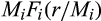
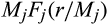
The following lemma shows that Assumption is suitable for return functions related to vaccination. A well‐accepted approach in literature to model the time course of an epidemic is by means of a compartmental model. One of the most fundamental compartmental models is the
If the epidemic is modeled with the
In Appendix S1, we provide the characterization of the return function that follows from the 
We introduce our game as a pair (

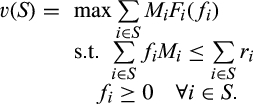


To show that cooperation can lead to increased health benefits, we illustrate our game with the following example. Analyzing such a game is difficult for two reasons. Firstly, realistic return functions can be difficult to evaluate, because they might be implicitly defined. Secondly, the optimization problem underlying the value function is NP‐hard. Therefore, we use simple return functions that have all the characteristics of Assumption , such that the reader can easily verify the example. In addition, we approximate the value function using discretized enumeration with step size 
Consider a situation with three identical players. Let 


The initial distribution of doses of vaccine in Example 1 is proportional to the population size. This is the policy that is advised by the CDC (Centers for Disease Control and Prevention 2009a). Example 1 demonstrates that, when doses of vaccine are scarce, this initial distribution can be sub optimal and cooperation can increase the total health benefits. When all players keep their doses to themselves, the total return is approximately equal to zero. But by combining the doses and leveraging the convex part of the return function, a total return of almost 0.9 can be obtained. In this case, the high return could be achieved because one player benefited from the willingness of the other players to give away their doses of vaccine. However, a player is only willing to give away (part of) his vaccine stockpile if he can also benefit from the increased return of the other player. In the next section, we therefore discuss how the total return, achieved through cooperation can be allocated among the players.
The Core
The core (Gillies 1959) of a game is formally defined as the set of all allocations 
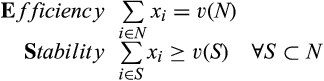
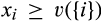
We illustrate the concept of the core in the following example. Recall that all numerical values are rounded to four decimal places.
The return function of the three identical players is illustrated in Figure . One can verify that 

Graphical Representation of the Return Function:
In Example 1, vaccines are scarce with respect to 

The simple setting of Example 1 illustrates the existence of core allocations. In section , we will identify classes of problems for which such allocations exists. However, it is also possible that the core is empty, meaning that no allocation exists that satisfies the efficiency and stability conditions in .
An Empty Core
With the following example we illustrate that the core can be empty. We again determine the value function via discretized enumeration with step size 
Consider a situation with three identical players: 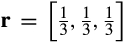




The intuition behind an empty core is related to the convex–concave shape of the return function. This shape establishes the existence of a
Cooperation Costs
In this study, we use the existence of a core allocation as a measure to determine whether cooperation is plausible. However, in reality there are other aspects that also affect players’ willingness to cooperate. These aspects, which we refer to as the “cooperation costs,” might even outweigh the benefits of cooperation. We distinguish between indirect and direct costs.
The indirect cooperation costs are related to the organizational, political, and ethical aspects of vaccine redistribution. It requires effort and willingness to organize and arrange the redistribution of doses of vaccine. Because of these aspects, public health institutes such as the CDC only allow vaccine sharing to alleviate a shortage (Centers for Disease Control and Prevention 2016). For example, during the 2004–2005 influenza season in the United States, vaccine sharing and redistribution were used to deal with unexpected disruptions in the supply of influenza vaccines (Hinman et al. 2006, McQuillan et al. 2009).
Redistribution of doses of vaccine has also an important ethical dimension, because sharing doses reduces the available stockpile for the own population. Countries might therefore be hesitant to share their doses of vaccine, even if they would receive a monetary compensation for it. In this study, we assume that the money received can also be used effectively to increase the health benefits, for example, via treatment for infected patients or via campaigns to reduce transmission. In our numerical experiments in Appendix S3 we also consider the case of selfish countries that will only give away doses of vaccine if they have sufficient doses left for their own population.
There can also be direct costs involved in cooperation, for example, related to the transportation costs of redistributing vaccines. In some applications these costs are negligible compared to the gains of cooperation. This is, for example, the case in spare part pooling (cf., Karsten et al. 2012). However, if the transportation costs are substantial, they might affect the possibilities of cooperation. Since vaccines need to be stored and transported in a temperature‐controlled environment, transportation costs for redistributing vaccines can be high (Duijzer et al. 2018a).
We analyze whether introducing cooperation costs affects the non‐emptiness of the core. We thereto introduce a new value function, where the value of a coalition Let Let




Case (a) can include cooperation costs that are related to political willingness and the organizational aspects needed to set up a cooperation among parties. Case (b) can include transportation costs that might be different for every player. Cooperation costs that depend on how many doses of vaccine are transported from one player to another are not captured by one of the two case and might have an effect on the non‐emptiness of the core. For a further discussion on this, we refer to section .
The following theorem shows that, under certain conditions, the non‐emptiness of the core is preserved after the introduction of cooperation costs.
Suppose that the core of the original game ( The core of the game The core of the game





Theorem 1 shows that including cooperation costs does not affect our conclusions regarding a non‐empty core as long as the cooperation costs are outweighed by the benefits of cooperation.
To conclude, a non‐empty core is robust against the introduction of certain cooperation costs. This justifies our choice for the existence of a core allocation as a measure to determine whether cooperation is plausible. In the remainder of the study, we therefore say that cooperation is
Market Allocations
Core allocations satisfy a set of clear conditions, but their actual interpretation can be difficult. We therefore propose another type of allocations, so‐called
Definition of Market Allocations
We introduce a particular type of allocation, namely those with a market price. Let 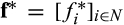




Market Allocations and the Core
Although market allocations have a nice and clear interpretation, their relation to the core is not always clear. For special types of games, so‐called “market games” the core is always non‐empty and there is always a market allocation in the core (see our discussion in section ), but this does not hold for the game that we consider in this study. For our game, the core can be empty. Nevertheless, market allocations can be constructed for any situation and thus market allocations always exist, even if the core is empty. Conversely, it is also possible to have a non‐empty core that does not contain a market allocation. This is illustrated with the following example. Again, we determine the value function via discretized enumeration and present the numerical values rounded to four decimal places.
Consider a situation with three players: 
One can easily verify that 



The fact that there is no market price in Example 3 is again caused by the convex–concave shape of the return function. Player 3 is initially at the sweet spot and by selling some doses he loses a lot in effectiveness. Since player 1 is the only player who buys doses, he needs to pay a high price to compensate player 3. However, in case of a market price, player 1 must also pay the same high price for the doses he buys from player 2. Player 1 is not willing to do so and therefore there is no market allocation in the core.
The fact that the core is non‐empty can be explained as follows. We can use Equation to determine the prices 





In general, Example 3 shows that the requirement of a single market price can be quite restrictive. There can be many allocations belonging to the core that correspond to individual prices for the players.
Two players
In the previous sections, we have seen that the core can be empty and that a market allocation that belongs to the core does not necessarily exist. In this section, we provide an interesting result for games with two players. These games have the elegant structure that one player gives (part of) his doses of vaccine to the other player. Thus, there is one “buyer” (denoted with the letter
In case of two players (i.e., |

Theorem 2 can intuitively be explained as follows. The market price compensates the seller for selling his doses of vaccine. Therefore, this price must be high enough for the seller and at the same time not too high for the buyer. Such a price exists, because by redistributing the doses the players can achieve at least the same total return as on their own. For two players, all core allocations are market price allocations, because one player buys doses from the other. There are no other players involved, and hence the compensation that the seller receives for giving away doses is completely paid by the buyer.
Analytical Results
In the previous section, we have seen that the core is always non‐empty for games with two players, but that for more than two players the core can be empty. In this section, we study the conditions for games with |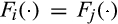
Analysis of the Value Function
To analyze our game, we first analyze the value function. The following lemma shows that any coalition of players can always use all doses of vaccine they have. This lemma follows directly from the fact that the return functions are non‐negative and non‐decreasing (see Assumption ).
For every coalition 

To investigate in what way the players will divide their doses of vaccine when they cooperate, we introduce the following concept. Let the function 





The function 




Corollary 1 is illustrated in Figure . This figure shows that there is a unique vaccination fraction 


This Figure Illustrates the Existence and Uniqueness of




From the analysis of Duijzer et al. (2018b), we can derive that the dose‐optimal vaccination fraction is increasing in the reproduction ratio of the epidemic, a measure for the severity of the outbreak. That means that there are more doses of vaccine needed to reach optimal coverage in case of a highly infectious disease than for a mild disease. Moreover, the dose‐optimal vaccination fraction is decreasing in the moment of vaccination. The later the doses of vaccine are administered, the fewer doses are needed to reach optimal coverage. The intuition behind this is that already many people will be infected when doses of vaccine are administered later during the outbreak, such that fewer people can still benefit from vaccination.
Next to 




For any 

The proof of Corollary 2 can be found in Appendix S2. This corollary is illustrated in Figure . The left panel of the figure shows that 


The vaccination fractions 


Consider a coalition of players If If 








Above theorem shows that if the vaccination fraction 


We refer to case (
Core Allocations
In this section, we derive sufficient conditions under which the core is non‐empty. We show that in those cases there is a market allocation in the core. That means that in those cases, cooperation with all players is plausible and the total return is divided in such a way that all players buy and sell doses of vaccine for the same price. We provide analytical expressions for these market prices and compare these prices to a simple price that could be used as a rule of thumb. This simple price is based on the intuition that the price per dose is equal to the total additional return divided by the total number of available doses. To formalize this intuition, we introduce 


Let us now analyze the cases for which we can show that a market allocation is in the core. To do so, we use the two cases of Theorem 3 for which the value function can be characterized. The following theorem considers the case of severe shortage, that is, when there are very few doses of vaccine in total (case (
Assume 



Theorem 4 can intuitively be explained as follows: when doses of vaccine are scarce, the highest possible return is achieved when all doses are given to a player for which they are the most beneficial. Hence, all doses are given to a player 


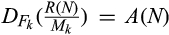
We can also show non‐emptiness of the core when there is sufficient supply of vaccine (case (
Assume 



To prove this theorem, we make use of duality for convex non‐linear optimization problems. Deriving core allocations using duality theory is often done for linear optimization problems (Deng et al. 1999, Owen 1975), we extend this approach to non‐linear problems.
We can intuitively explain Theorem 5 as follows. Note that by Theorem 3 any optimal solution 



When there are many doses of vaccine, the value per dose will go down. Players with many vaccines are therefore willing to sell some of their doses for a relatively low price. Rewriting the market price of Theorem 5 gives the following: 


In Theorem 4 the total number of available doses of vaccine is such that in the optimal division of doses, all players will receive a number of doses in the region of increasing additional returns. This implies that any player who buys doses of vaccine will obtain a higher return per dose from the dose he bought than from the doses of vaccine he initially had. Since both the initial doses and the bought doses contribute to
In contrast, in Theorem 5 there are so many doses of vaccine that in the optimal division of doses all players receive a number of doses of vaccine in the region of decreasing additional returns. This implies that a player who buys doses of vaccine will potentially have a higher return per dose for his initial doses, than for the doses he buys. The return per dose for the bought doses might be even lower than the average return
Identical Return Functions
In this section, we derive more detailed sufficient conditions for a non‐empty core for a class of games where all players have the same return function, that is, 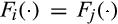
If all players have the same return function, then 


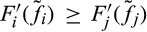
Consider identical return functions (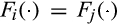



In addition, we can derive an additional result which shows that the core is also non‐empty when the total number of available doses of vaccine is such that we can exactly provide a subset of players with their dose‐optimal vaccination fraction. These results are presented in the theorem below.
Consider identical return functions (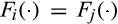



To interpret Theorem 6, recall that the additional gain per dose, 



Theorem 6 shows the importance of the vaccination fraction 
Case Study
In this section, we apply our results to a case study on influenza vaccination. We describe the case in section and present our results in section .
Case Description
In the United States, the CDC is responsible for allocating influenza vaccines during an influenza epidemic. The policy is to allocate vaccines to geographical regions in proportion to their population size (Centers for Disease Control and Prevention 2009a). In this section, we will investigate if, under such an initial distribution of the doses of vaccine, there is potential for collaboration during an influenza epidemic (e.g., by redistribution some of the doses). For that, we use the cooperative game as introduced in section .
To model the influenza epidemic, we use the
Number of Inhabitants of the 10 Regions in the United States (Teytelman and Larson 2013)

To obtain good estimates of the value function, we use a realistic return function 


The Return Function
The fraction of people who escapes infection can be translated to health benefits by multiplying with a factor that accounts for the average health benefits per individual spared from infection. Here, we assume that this factor is the same for every region, which is reasonable because all regions correspond to the same country. This implies that we can maximize the total number of people who escapes infection instead of the monetary health benefits.
Case Results
In this section, we analyze cooperation between the regions. We vary the total number of available doses of vaccine and the moment of vaccination to analyze in which cases the core is non‐empty. We also study whether there is a market allocation in the core.
Let 
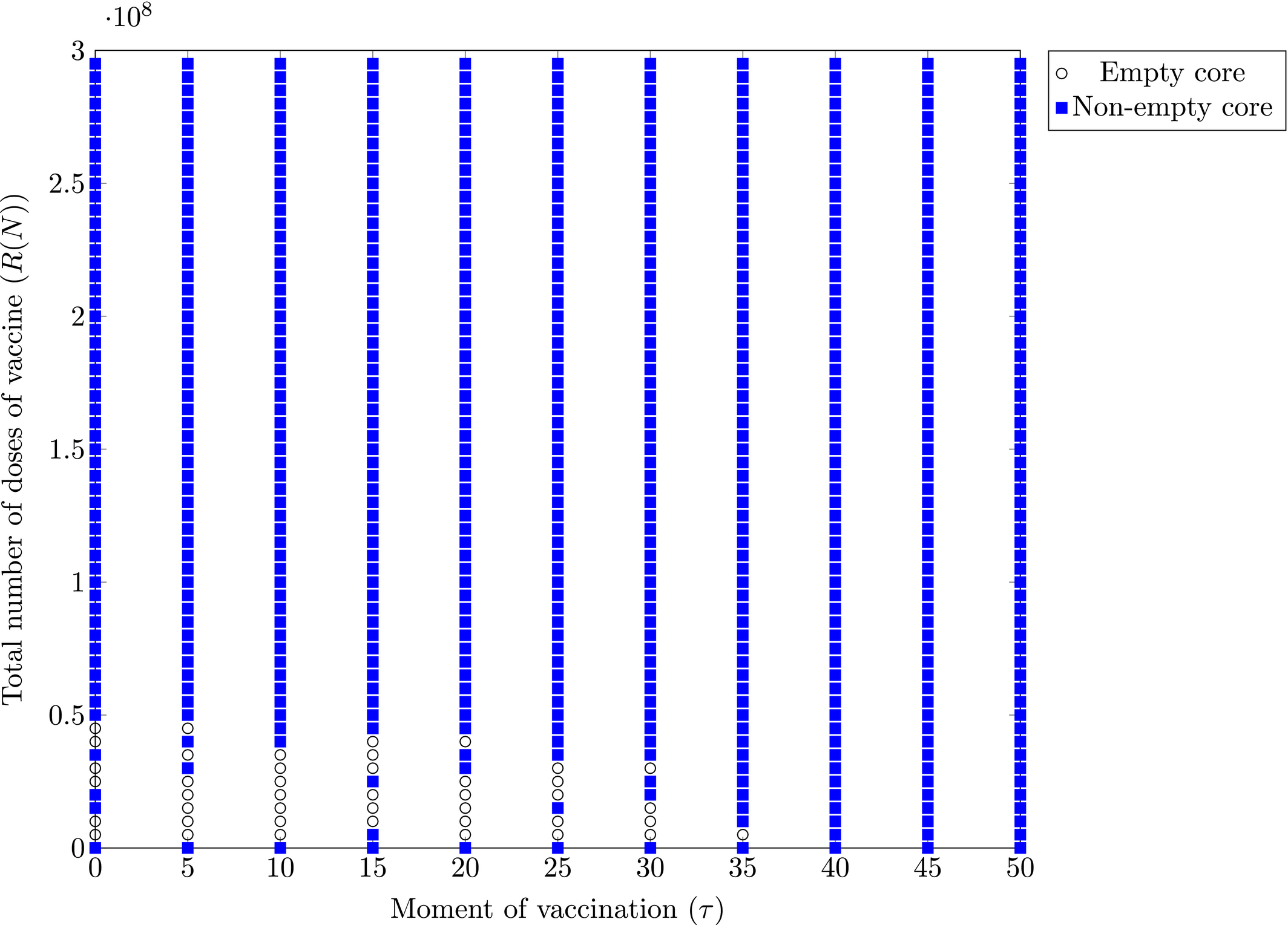
This Figure Illustrates the Non‐emptiness of the Core for Various Combinations of the Total Vaccine Stockpile (
We see in Figure that the core is non‐empty when there are sufficient doses of vaccine available. Additional results, not reported here, show that the core is also non‐empty for 



The intuition behind the fact that 

Figure also shows that outside of the connected area with non‐empty core and sufficient doses of vaccine, there are only a few points for which the core is non‐empty. There is no clear pattern for which combinations of 
In addition to analyzing the non‐emptiness of the core, we also study whether there are market allocations in the core. These numerical results, not reported here, show that when the core is non‐empty, there almost always exists a market allocation in the core. For large vaccine stockpiles (

To conclude, the results for this case study confirm that cooperation is a delicate matter. Only when the number of available doses of vaccine is very small or above a certain threshold, approximately characterized by 
Discussion and Conclusion
This study analyzes the redistribution of doses of vaccine and cooperation between players. The return that players obtain from the doses of vaccine is modeled via an S‐shaped return function. Such a function captures convex returns for a limited number of doses of vaccine and concave returns in case of many doses. We use the concept of the core from cooperative game theory to analyze whether cooperation between the players is plausible. We derive theoretical conditions under which cooperation is plausible and we show that the doses of vaccine can be traded for a market price in those cases. We perform numerical analyses to generalize these findings. Our results show that parties are most likely willing to cooperate in case of severe shortages and in case of sufficient supply, with possible mismatches between supply and demand. This main result is robust under several alternative modeling choices. We show analytically that the possibilities for cooperation are preserved after the introduction of certain types of cooperation costs. Our numerical experiments show that the main result is independent of the number of players and of whether they are altruistic or selfish. Finally, a case study on the redistribution of influenza vaccines confirms these findings for realistic return functions.
With our analysis, we also provide insights into general resource (re)allocation problems with S‐shaped return functions. For example, this is the case in contexts where sufficient coverage is important, such as the allocation of ambulances over regions or the division of medical specialists over hospitals. For these contexts, cooperation under S‐shaped functions can potentially lead to a high increase in the total return. But this shape makes it also less likely that a core allocation of the total return exists. Hence, one must be careful when investigating potential cooperation between players. However, we find that, when cooperation is plausible, there is often just a single price for which resources are traded. Such a market price is likely to enhance cooperation in practice, because it prevents having dissatisfied players who found out that other players have bought resources for a lower price.
The results in this study are established under some assumptions. First of all, we assume that the doses of vaccine can be exchanged among players and that a player can assign a monetary value to the return he obtains from a certain number of doses. This implies that a health agency might sell some doses of vaccine and receive money as compensation for an increased number of infections. This money can also be used effectively to increase the health benefits, for example, via treatment of infected patients or via campaigns to reduce transmission. In addition, we assume that players are independent of each other. The return of one player does not depend on the number of doses of vaccine given to other players. It heavily depends on the context whether this assumption is reasonable. The assumption of no interaction is legitimate when the players correspond to geographically distant regions and when the interaction within a region is much larger than between regions (Mamani et al. 2013, Sun et al. 2009, Wu et al. 2007). It would be interesting to include interaction between the players, although this would complicate the analysis of the cooperative game in two dimensions. Firstly, the return functions are more complex if they dependent on each other. Secondly, determining the value function is more difficult, because it requires additional assumptions on the actions taken by players outside of the coalition.
We use the concept of the core to determine whether the total return can be divided in a stable way among the players. The advantage of core allocations is that they guarantee that a player will never be worse off by cooperating with all other players, neither by working on his own nor by cooperating with a subset of the players. A drawback is that core allocations do not always exist. As an alternative, one could exclude the coalitional stability conditions for some coalitions for which it is unlikely (e.g., due to geographical or political reasons) that they would cooperate. This results in a so‐called restricted game (see, e.g., Faigle 1989). In a restricted game the collection of coalitions that need to satisfy the stability conditions need not contain all subsets of players. As a consequence, the core of a restricted game is “larger” than the original core and thus might be non‐empty (while the core of the original game is empty). Another possibility is to keep all coalitions, but to relax some of the coalitional stability conditions with a fixed constant or factor. These generalization of the core, that do include some overhead for deviation of coalitions, are better known as the least core (Maschler et al. 1979) and the multiplicative
Our results demonstrate that cooperation is a delicate matter, because it is not always possible to divide the total benefits in such a way that all parties are willing to cooperate. However, if cooperation is an option, we provide an intuitive and stable way to divide the total benefits by trading all doses of vaccine for a market price.
