






Abstract
Learning by doing is a fundamental driver of productivity among knowledge workers. As workers accumulate experience working on certain types of tasks (i.e., they become specialized), they also develop proficiency in executing these tasks. However, previous research suggests that organizations may struggle to leverage the knowledge workers accrue through specialization because specialized workers tend to lose interest and reduce effort during task execution. This study investigates how organizations can improve specialized workers’ performance by mitigating the dysfunctional effects of specialization. In particular, we study how other sources of task experiences from the worker's immediate manager as well as the organization itself help manage the relationship between worker specialization and performance. We do so by analyzing a proprietary dataset that comprises of 39,162 software service tasks that 310 employees in a Fortune 100 organization executed under the supervision of 92 managers. Results suggest that the manager role experience (i.e., the manager's experience supervising workers) is instrumental in mitigating the potential negative effect of worker specialization on performance, measured as task execution time. Such influence, however, is contingent on cases in which organizational task experience (i.e., the organization's experience in executing tasks of the same substantive content as the focal task) is limited. Taken together, our research contributes to multiple streams of research and unearths important insights on how multiple sources of experience beyond the workers themselves can help capture the elusive benefits of worker specialization.
Introduction
Learning by doing is a fundamental driver of productivity for knowledge workers in settings such as legal process outsourcing, information technology (IT), medical diagnostics, banking, and tax services (Clark et al. 2013, Regan and Heenan 2010, Srikanth and Puranam 2011, Staats and Gino 2012). In these settings, workers accrue technical and organizational expertise by repetitively performing similar tasks (Gupta and Govindarajan 1984, KC and Staats 2012, Smith 1766, Vickers et al. 2007). This accumulation of task experience (hereafter referred to as specialization) has been associated with progressive but marginally diminishing improvements in worker performance, a phenomenon the literature commonly labels the individual learning curve (e.g., Avolio et al. 1990).
The concept of the individual learning curve has faced some criticism among scholars. Prior studies have reported the existence of diseconomies of specialization, which can reduce the marginal positive effect of specialization on worker performance (see Fisher 1993, Loukidou et al. 2009). These diseconomies occur because high levels of specialization can induce worker boredom and disengagement (Bruursema et al. 2011, Skowronski 2012). In extreme cases, the costs of specialization can override its benefits, as seen in a study conducted by Staats and Gino (2012). Investigating back‐office bank processes, the authors found that when workers had limited experience in performing other tasks, a U‐shaped relationship emerged between worker's focal experience and task execution time. As such, organizations may struggle to realize the full potential of their workers’ specialization, a critical concern in knowledge‐intensive environments that rely on employee know‐how for competing. This problem is particularly salient for first‐line managers, who are responsible for ensuring workers’ productivity by keeping them engaged and motivated (Hales 2005). Despite abundant literature on worker engagement and motivation (see e.g., Christian and Slaughter 2011, Louis et al. 2010), a gap still exists in research on how to derive benefits of worker specialization. In fact, Huckman and Pisano (2006) call for more research to study how organizations and first‐line managers, beyond the workers themselves, affect the daily execution of tasks. This requires studying interactions among different types of experiences within an organization. More than a decade after this call, we find very limited research on this topic.
In this study, we address this gap by building on arguments from the organizational learning literature. Specifically, we contend that first‐line managers benefit from two types of experience when seeking to better motivate and control worker behaviors, thereby mitigating the potential negative effect of worker specialization on performance. The first type of experience is
We develop our empirical investigation in the context of a large software services organization, which we refer to as Alpha. Part of a multinational Fortune 100 technology and consulting company, Alpha offers an appropriate context for our inquiry for a number of reasons. First, worker specialization matters for Alpha: As workers acquire experience maintaining a specific enterprise resource planning (ERP) software module (e.g., sales, finance, etc.), they learn about unique characteristics that are instrumental to effective module servicing (see Boh et al. 2007). Second, Alpha tracks worker activities in detail and evaluates worker performance individually; this allows investigating more precisely the association between specialization and performance. Third, Alpha supports its operations with a state‐of‐the‐art workflow system, allowing us to collect important covariates of worker performance (e.g., task priority, worker breadth of experience). Specifically, we used data covering 39,162 software service tasks that 310 employees executed under the supervision of 92 managers over a nearly 4‐year time span. Our estimation approach utilized a selection model to mitigate possible biases originating from non‐randomness during worker selection. We further leveraged insights from qualitative data collected from over 30 field interviews with Alpha managers and workers to ground our hypothesis and interpret our results.
Findings suggest that manager role experience is instrumental in fostering specialized workers’ performance, but this effect is stronger when an organization has limited task experience. In other words, a substitution effect exists between manager role experience and organizational task experience. Specifically, we find that when organizational task experience is low (10th percentile, or 1464 tasks), increasing manager role experience from low (10th percentile, or 85 tasks) to high (90th percentile, or 3300 tasks) levels is associated with a 26% reduction in highly specialized workers’ task execution time. This compares to a (not statistically significant) reduction of only 9% when organizational task experience is high (90th percentile, or 25,584 tasks). These results are robust to different model specifications, operationalization, and values of manager and organizational task experience.
Through these insights, we make multiple contributions to organizational learning theory and practice. To begin with, our study addresses the call from Lapré and Nembhard (2011) for research on multilevel learning curves, showing that just studying worker‐level learning curve models may result in under specification issues if they do not account for the contingent effects of manager and organizational experience. Second, we extend the sociotechnical systems literature (Cherns 1987, Loukidou et al. 2009) and more recent empirical research on worker productivity (Staats and Gino 2012), both of which propose that diseconomies of specialization can be limited by increasing task variety. These studies do not, however, consider managerial experience, a further actionable factor to capitalize the potential benefits of worker specialization. Third, we advance research on the worker‐level effects of managerial experience (e.g., Easton and Rosenzweig 2012, 2015, Huckman et al. 2009) showing that manager role experience asymmetrically affects the performance of workers with different levels of specialization when organizational task experience is low. Finally, the results of this study have important practical implications in suggesting that managers with high role experience, likely a scarce resource for many organizations, are not always more effective at leading workers than managers with low role experience. They are only effective when workers are highly specialized and the organization has not accumulated substantial experience in a focal task domain. When these conditions are not met, reliance on managers with low role experience, who are plausibly less expensive than those with high role experience, does not entail a loss of worker performance.
Background
Numerous researchers from disciplines such as operations, organizational learning, and labor economics have studied the influence of experience gathered by means of task repetition on performance (Anzai and Simon 1979, Lapre and Tsikriktsis 2006, Lapre et al. 2000, Larkin et al. 1980). At the individual level, worker specialization has been argued to improve individual performance (Drazin and Rao 2002, Quiñones et al. 1995, Tesluk and Jacobs 1998). By performing tasks of similar characteristics, workers accrue knowledge and expertise regarding technical and organizational issues (Gupta and Govindarajan 1984, KC and Staats 2012, Smith 1766, Vickers et al. 2007). This knowledge, in turn, can increase workers’ proficiency using relevant tools during task execution (Argote 2013, Easton and Rosenzweig 2012, Huckman and Pisano 2006). Kim et al. (2012), for instance, found that every time front‐line workers in a university IT services center doubled their problem‐solving experience, they reduced problem resolution times by 6.7%. Similarly, Staats and Gino (2012) found that bank clerks improved the execution of a specific task by 3.7% above the average for each 100 repetitions in a single day. Comparable results are found in studies that focus on other types of problem‐solving activities, such as cardiothoracic surgery (KC and Staats 2012), computing services (Kim et al. 2012), and software services (Boh et al. 2007).
Despite the appeal of specialization, recent studies have questioned its benefits on theoretical and empirical grounds. For instance, high specialization has been found to cause workers to lose motivation and interest in their jobs, which, in turn, can harm performance (Loukidou et al. 2009). Compared to working on new tasks, the repetitive execution of similar tasks can cause workers to achieve a level of expertise in which no conscious effort is necessary for task completion (Fisher 1993). This, in turn, tends to reduce worker arousal and motivation levels while increasing disengagement and boredom (Hackman 1969, McCauley and Ruderman 1994, McCauley et al. 1995). Scholars have argued that under these circumstances, workers may display negative attitudes toward their job (Stout et al. 1988), reduce their effort (Staw 1980), and engage in counterproductive behaviors such as leaving the post or engaging in conversation and horseplay (Scott 1966). All of these effects ultimately worsen task execution outcomes (O'Hanlon 1981, Smith 1981). For example, Dyer‐Smith and Wesson (1995) in a study of seafaring watch‐keepers and data entry clerks found that expertise developed on the basis of repetitive task execution was associated with progressive disengagement from work and more time elapsed before noticing and correcting errors. Bruursema et al. (2011)found in a more recent study of over 200 workers in multiple industries that job boredom was significantly related to counterproductive work behaviors such as abuse, sabotage, withdrawal, production deviance, and theft.
Although these studies are mostly based on workers in industrial and manufacturing settings, similar issues have been found among employees in knowledge‐work settings (Costas and Kärreman 2015, Harju and Hakanen 2016, van der Heijden et al. 2012). For instance, Staats and Gino (2012) empirically investigated the effects of worker specialization in the context of back‐office banking activities, where worker performance was measured using task execution time. Their study is unique in identifying situations where the marginal costs of specialization outweighed the marginal benefits. This was evidenced in a U‐shaped association between worker experience in a focal task and task execution time, though only for workers with limited breadth of experience prior to task assignment. While a monotonically decreasing (i.e., tapering) learning curve can be explained by just invoking decreasing marginal returns from experience, this U‐shaped pattern (a special case) confirms the existence of negative consequences of worker specialization.
Given these findings, it remains an open question how organizations can reduce the costs of overspecialization and better leverage the tacit knowledge workers accumulate through experience. Staats and Gino (2012), in line with sociotechnical systems theory (Fried and Ferris 1987) and the job characteristics model (Hackman and Oldham 1976), suggested exposing workers to a broader set of tasks as one countermeasure. Doing so, however, also may have unintended consequences such as switching costs due to time delays (Bendoly et al. 2014), task interruptions (Adler et al. 1999), and opportunity costs associated with workers learning multiple tasks (Adler and Cole 1993). Furthermore, it is not always possible for managers to assign workers to diverse tasks due to demand characteristics or other organizational constraints. As a result, organizations must rely upon other means to ensure that workers, particularly specialists, achieve their performance potential.
Management scholars have also proposed alternative approaches to foster worker performance (Huckman and Pisano 2006, Lapré and Nembhard 2011). For instance, in a study of cardiac surgeons, Huckman and Pisano (2006) find that organizational experience, measured as the time surgeons spend in a given hospital affects quality, measured as patient mortality. This effect, however, does not transfer across hospitals. Similarly, Easton and Rosenzweig (2012) found a strong relationship between team leader experience and project success in the context of Six Sigma projects. While these studies point to the presence of direct effects of other sources of experience, they fail to investigate how some of these sources interact with the worker specialization experience to affect outcomes—an important relationship studied in our work.
Hypotheses Development
Based on the existing literature, we now know that with increasing specialization workers tend to lose interest in their job and engage in counterproductive behaviors. Ensuring that a specialized workers achieve their full performance potential, therefore, represents a motivational and monitoring challenge for first‐line managers, who must keep workers engaged with the focal task and not entangled in counterproductive activities. While this ability may partially originate from a manager's intrinsic strengths, it also depends upon the manager's knowledge of effective employee engagement and oversight. One such source of knowledge is a manager′s own role experience (Easton and Rosenzweig 2012, Huckman et al. 2009). Likewise, organizational experience in the execution of a focal task can offer managers information about task performance benchmarks and process execution standards (Choo 2014, Clark et al. 2013) that could prove useful in leading these workers. In the next section, we hypothesize how a manager's role experience moderates the effect of worker specialization on worker performance, and how this moderation effect is conditional on the level of organizational task experience.
The Effect of Manager Role Experience
Supervising workers and gaining manager role experience (Huckman et al. 2009) typically entails acquiring knowledge on assigning tasks, providing feedback, and monitoring, motivating, coaching, and helping workers (Plakhotnik et al. 2010, Sias 2009) in an effort to foster performance (Borman et al. 1993, Easton and Rosenzweig 2012, Huckman et al. 2009, McEnrue 1988). With increased role experience, managers develop a finer appreciation for the difference between their supervisory role and what used to be their operational role as workers (Huckman et al. 2009). They also learn about exercising power and control (Hill 2007), realizing the benefits of delegating and trusting workers while taking responsibility for subordinates’ performance (Charan et al. 2011, Henderson and Lee 1992). At Alpha, multiple managers stressed how role experience was the key to learning to lead workers. Newly appointed managers struggled to detach themselves from the operational details of software analysis, parametrization, and programming. Several Alpha managers acknowledged that after moving to supervisory roles, they tended to micromanage subordinates’ activities, driving excessive stress and conflict. Only by accumulating role experience, did managers abandon these dysfunctional behaviors and learn the “soft skills” needed for, subtly, inducing workers to perform to their full potential.
Building on these ideas, we argue that manager role experience can help mitigate the potential negative effects of worker specialization on worker execution performance. First, by means of role experience, managers can improve their ability to identify and employ influential tactics (e.g., inspirational appeal, consultation, rational persuasion, pressure, legitimation) that promote or deter specific worker behaviors (Falbe and Yukl 1992, Higgins et al. 2003). Simply put, they become better at motivating workers as they accumulate experience. Knowledge gathered through experience allows managers to recognize the best influential tactic for individual situations along with whether, and to what extent, each subordinate is susceptible to its application (Sparrowe et al. 2006, Yukl and Tracey 1992). In the case of Alpha, we found that managers with high role experience grew aware of subtle motivational tactics and workers’ reactions to them. In one instance, a manager at Alpha found that she could encourage highly specialized workers to put more effort into executing a “boring” task by publicly acknowledging their effort in front of their peers. Other workers, instead, were motivated by more leniency with special licenses, flexibility in arrival times, or the prospect of being assigned other interesting or challenging tasks.
Second, as managers accumulate role experience, they learn to spot and tackle the counterproductive behaviors that highly specialized workers exhibit during task execution, effectively improving their monitoring ability (Hill 2003). Developing this skill is no trivial matter; drawing the boundary that separates deviant from non‐deviant workplace behaviors can be difficult for inexperienced managers (Robinson and Greenberg 1998). Managers with increasing role experience tend to accrue important cues from subordinates’ behaviors, allowing them to exert the right kind of leadership style (Gabarro 2007, Hill 2003). One manager at Alpha noted that it took time to learn to tell whether a worker was attempting to find a better way to execute a task or deriving entertainment from an unproductive challenge. Other managers observed that detecting weak signals of workers distress that required more in‐depth checks was a subtle skill that they honed though accumulation of supervisory experience. Reprimanding a worker in the first case would be akin to micromanagement and might cause greater performance deterioration, while doing so in the second would be a proper urge to conformity that should improve task execution time.
In summary, as managers accumulate role experience, they are better able to motivate and monitor workers upon assigning them specific tasks, possibly limiting the negative effects of worker specialization. Hence, manager role experience influences the relationship between worker specialization and performance, such that role experience attenuates the negative effect of the former on the latter. That is, we expect increasing manager role experience levels to increase the positive marginal effects of worker specialization on worker performance. As such, we propose the following hypothesis: Manager role experience increases the positive marginal effect of worker specialization on worker performance.
The Effect of Organizational Task Experience
When a task of specific substantive content is executed numerous times within an organization—that is, when high organizational task experience exists—the organization tends to accumulate knowledge that supports task execution (Clark et al. 2013). In particular, as organizations “gain more experience, each individual has more opportunities to benefit from the knowledge accumulated by others” (Reagans et al. 2005, p. 871). That is, individuals gain insights from how previous tasks were administered and how colleagues performed on them. The information regarding the tasks and the prior performance can be useful in reducing uncertainty and the difficulties workers may experience in executing tasks (KC et al. 2014). In other words, knowledge derived from organizational task experience can serve as an effective benchmark, providing guidance for members’ behavior and performance (Fulmer and Gelfand 2012, Gardner et al. 2011, Hofmann et al. 2009). As part of the organization, managers are no exception.
We argue that organizational task experience can offer inexperienced managers (i.e., managers with limited role experience) a substitute for their lack of experience in motivating and monitoring workers. Accumulating task experience within the organization allows for the development of performance standards and benchmarks (Kerr and Slocum 2005). This information is especially useful for managers with lower role experience, who tend to be more uncertain about the potential and expected performance level of an experienced worker (Eisenhardt 1985). In particular, organizational task experience provides inexperienced managers evidence of expected performance for a certain type of task. With this information, managers can set fact‐based task performance goals for highly specialized workers, pushing them to deploy their experience in task execution (Latham 2004). Alpha's informants in both supervisory and executional roles observed that when a manager could tell the worker, “You did a very similar task in six hours last month” or “your colleagues have been able to execute similar tasks in no more than seven hours,” the worker found difficulty in justifying slower performance. Managers’ motivational skills, therefore, become less critical in extracting specialized workers’ full performance potential when such performance standards were available within the organization.
Additionally, as organizations accumulate task experience, they also create process templates and other formal documents that capture best practices for task execution (Bjørnson and Dingsøyr 2008, Staats et al. 2011), mitigating inexperienced managers’ inability to properly monitor workers. Knowledge of when and which controls are needed can reduce inexperienced managers’ well‐known tendency to interfere with worker activities (Bendoly et al. 2014), a particularly problematic phenomenon with experienced workers who have a stronger need for task autonomy (Chang et al. 2012, Langfred and Moye 2004). Additionally, process templates can allow inexperienced managers to identify specialized workers’ deviating behaviors (e.g., non‐standard coding approaches, excessive testing) in a timely manner, detecting potentially wasteful, non‐productive activities (April and Abran 2012). Conversely, organizational task experience is comparatively less useful for managers with high role experience because they have a better sense of how workers’ activities can be controlled and know how to detect counterproductive behaviors (Burney and Widener 2007, Luft 2010).
In summary, organizational task experience can provide information on both performance benchmarks and process standards that is particularly useful in helping managers with low role experience prevent specialized workers from engaging in performance‐undermining behaviors. Managers with high role experience, by comparison, may rely more upon the knowledge they have accumulated in their own experience. We therefore propose the following hypothesis: The moderation effect of manager role experience on the relationship between worker specialization and worker performance is stronger at low levels of organizational task experience when compared to high levels of organizational task experience.
Methods
Research Context
The research setting for our study is Alpha, a technology and consulting multinational that offers ERP services (maintenance, upgrading, and modification) to large clients in diverse industrial sectors (e.g., banking, construction, consumer electronics, health care, home services, oil and gas). Schematically, software services require workers to engage in problem‐solving activities to fix malfunctions (corrective maintenance) or modify the software to meet evolving customer needs (Ramesh and Bhattiprolu 2006). While these activities are less creative and uncertain than software development, they are nonetheless knowledge intensive. Workers must customize solutions based on the problem and implement them by re‐parameterizing or reprogramming affected ERP functionalities (see Appendix A for information on different tasks executed at Alpha). Previous software services research has shown that accumulated experience is an important predictor of worker performance (Banker and Slaughter 1997).
Work at Alpha was organized in a fluid fashion (Huckman and Staats 2011), in which each worker formally reported to a “module” manager but also executed tasks pertaining to other ERP modules. Hence workers could work under the supervision of different module managers and, eventually, of their deputies. In any case, workers usually focused on a limited number of modules, with 88.5% of Alpha workers executing tasks in fewer than four modules. Workers were located in five different countries: 76% in the focal country, and 9%, 7%, 7%, and 1%, respectively, in the other four countries where Alpha maintained operations. Workers in the focal country took on tasks related to all modules, while those in other countries executed tasks in about half of the modules.
Most service requests at Alpha required more than one worker (84.56%). In these cases, managers split the required work into tasks and assigned each task to a worker who became accountable for the task and associated testing activities. To the extent possible, managers avoided assigning interdependent activities to different workers, instead attempted lumping these into a single task. That is, work was modularized, a common practice in white‐collar operations (Hopp et al. 2009). By assigning tasks to individual workers and not to teams as a whole, managers could track each worker's performance, a key metric being the time taken to execute the task. Empirical studies of productivity in software services have reported this same metric for measuring worker performance (Kim et al. 2012, Narayanan et al. 2009, Pendharkar and Subramanian 2007).
Close worker–manager interaction spanned different activities and was a key to ensuring proper task execution. An average Alpha worker was assigned to and completed four tasks per day, a task's average throughput time being about 7 days. Each of these tasks involved multiple interactions with the manager, who began the process by allocating responsibilities to workers, explaining the nature of the task, and clarifying how it addressed a customer request. Managers also exercised control over worker activities and performance, ensuring they scheduled their workday and channeled their efforts to meeting service‐level client agreements. Upon service request completion, managers authorized workers to submit the modification or bug fix for final client approval. Rejected requests would be re‐processed to find and fix any problem, though this was an exceedingly rare event in our setting (<3% of the service requirements).
Data Source
We used information extracted from Alpha's software services workflow‐support system to test our hypotheses. This system included data on 39,162 ERP software service tasks that 310 workers performed under the supervision of 92 different managers. The unit of analysis in our study is a task a given worker performs under a given manager's supervision. The workflow system archives provided data on the characteristics of all service requests that Alpha received (e.g., serviced module, priority level, type of service request), the timing of different activities executed in response to the service request (e.g., task reception time, task execution time), as well as details about personnel involved in task execution (i.e., manager and worker). The years of data in our sample began shortly after Alpha was founded, allowing us to reconstruct reliable measures of specialization for workers and managers’ role experience.
We conducted 30 semi‐structured interviews with various Alpha personnel to better understand the work context, interpret the workflow system data, and gather additional insights from data analysis. These interviews focused on Alpha's organizational structure, types of worker–manager–organization interactions, and worker selection decisions.
Measures
Dependent Variable
Independent Variables
Control Variables
We incorporated several variables to avoid omitted variable bias in our analyses. They include:

Independent Variables in the Model
Estimation Approach
Our hypotheses investigate how manager role experience influences the relationship between worker specialization and individual performance, contingent on organizational task experience. To investigate these relationships, we controlled for worker, manager, and module fixed‐effects. Furthermore, our sample may suffer from selection bias because workers are not randomly assigned to tasks. Therefore, we used Dahl's (2002) multiple‐choice, two‐stage selection models to address endogeneity concerns caused by the effect of non‐observed factors on worker selection for task execution (Bourguignon et al. 2007, Dahl 2002). Stage 1 accounts for the worker‐selection decision process, while Stage 2 corresponds to the performance model after adjusting for staffing decisions.
We implemented Dahl's (2002) correction methodology following the procedure Wu et al. (2017) put forth. We estimated the selection equation in Stage 1 by means of a conditional logit model, using the task as grouping variable. The conditional logit model allowed us to factor in worker characteristics for modeling the selection of one worker over another for a specific task. The worker choice set,
After estimating the Stage 1 conditional logit model, we specified the selection correction function Lambda—
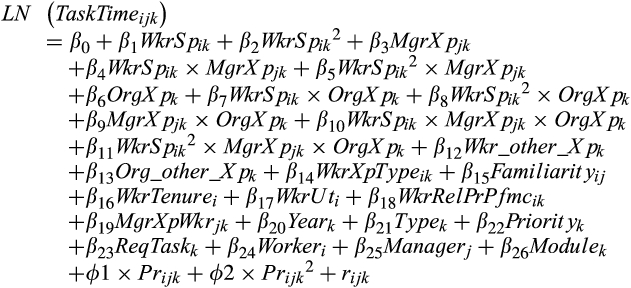
We used a log‐linear specification in our model to account for the worker specialization variable's long tail on the right side of the distribution (Steenland and Deddens 2004). This specifications is consistent with prior research on learning curves that rely on a second‐order term to capture how high levels of worker experience may compromise worker performance (Narayanan et al. 2009, Staats and Gino 2012). Additionally, log‐linear models can eliminate potential biases in the estimates of the worker's learning rate associated with any missing information of prior accumulated experience (Lapre and Tsikriktsis (2006). We estimated the performance equation in Stage 2 by means of a bootstrap procedure (biased corrected; 2000 iterations), clustering errors by worker to correct for heteroscedasticity and autocorrelation. We rely on bootstrap estimation to reduce concerns regarding potential issues associated with (1) skewness in our independent variables and (2) the functional dimensionality of our model. Bootstrap procedures are appropriate when parametric assumptions are not viable (Carte and Russell 2017, Wood 2005). More importantly, estimates obtained using bootstrapping are shown to be robust to potential violations of normality assumptions associated with skewed datasets. For example, using moderated regression procedures in a Monte Carlo simulation, Russell and Dean (2000, p. 182) found evidence indicating that “bootstrapping procedures provide a viable alternative to traditional, parametric statistical procedures for detecting moderator effects regardless of how
In summary, our selection (Stage 1) equation, which represents the probability that manager 

Results
Table gives the means, standard deviations, and pairwise correlations for the variables used in the analysis. Table gives the results for the selection (Stage 1) model and Table for the performance (Stage 2) model. Regarding the selection decision, the model estimation results suggest that worker specialization is associated with worker selection (see Table ). Specifically, the analysis of first‐ and second‐order terms shows that worker specialization has a positive (
Descriptive Statistics and Pairwise Correlations
Note
All correlations in the table are significant at the
Selection Model Estimation Results
Note
*** represents that zero is not contained in the 99.9% bootstrap confidence intervals.
Performance Model Results
Note
+, *, **, *** represent whether zero is not contained in the 90%, the 95%, the 99% or the 99.9% bootstrap confidence intervals, respectively.
Hypothesis 1 posits that manager role experience helps mitigate the potential negative effect of high levels of worker specialization, increasing the positive marginal effect of worker specialization on performance. To capture not just diminishing but negative returns of increased specialization beyond a particular level, we included in our model the quadratic term of worker specialization (
Model 2 in Table shows the coefficient estimates of the model that includes interactions between manager role experience and worker specialization. The results of the model suggest that manager role experience indeed influences the relationship between worker specialization and execution time. To better interpret these findings, we plot the relationship at low (10th percentile, 85 tasks ) and high (90th percentile, 3300 tasks) levels of manager role experience, keeping all control variables at their mean level (see Figure ). A 95% bias‐corrected bootstrap confidence interval analysis shows that, when evaluated at low levels of worker specialization (10th percentile—13 tasks), the difference between execution time predictions at low and high levels of manager role experience is not significantly different from zero. The average difference is positive (0.05), with a confidence interval running from −0.05 to 0.15. Conversely, when evaluated at high levels of worker specialization (90th percentile—470 tasks), the average difference is positive (0.17), with a confidence interval running from 0.09 and 0.20. Similar results to these low‐ and high‐specialization analyses are obtained when assessing the difference at the 25th (avg. dif. = 0.05; CI [−0.03, 0.13]) and 75th (avg. dif. = 0.13; CI [0.05, 0.21]) percentiles of worker specialization, respectively. These findings suggest that, as expected, variations in manager role experience have a statistically significant influence on the relationship between worker specialization and task execution time. An increase in manager role experience translates into substantial changes in highly specialized workers’ performance. Therefore, we find support for Hypothesis 1.
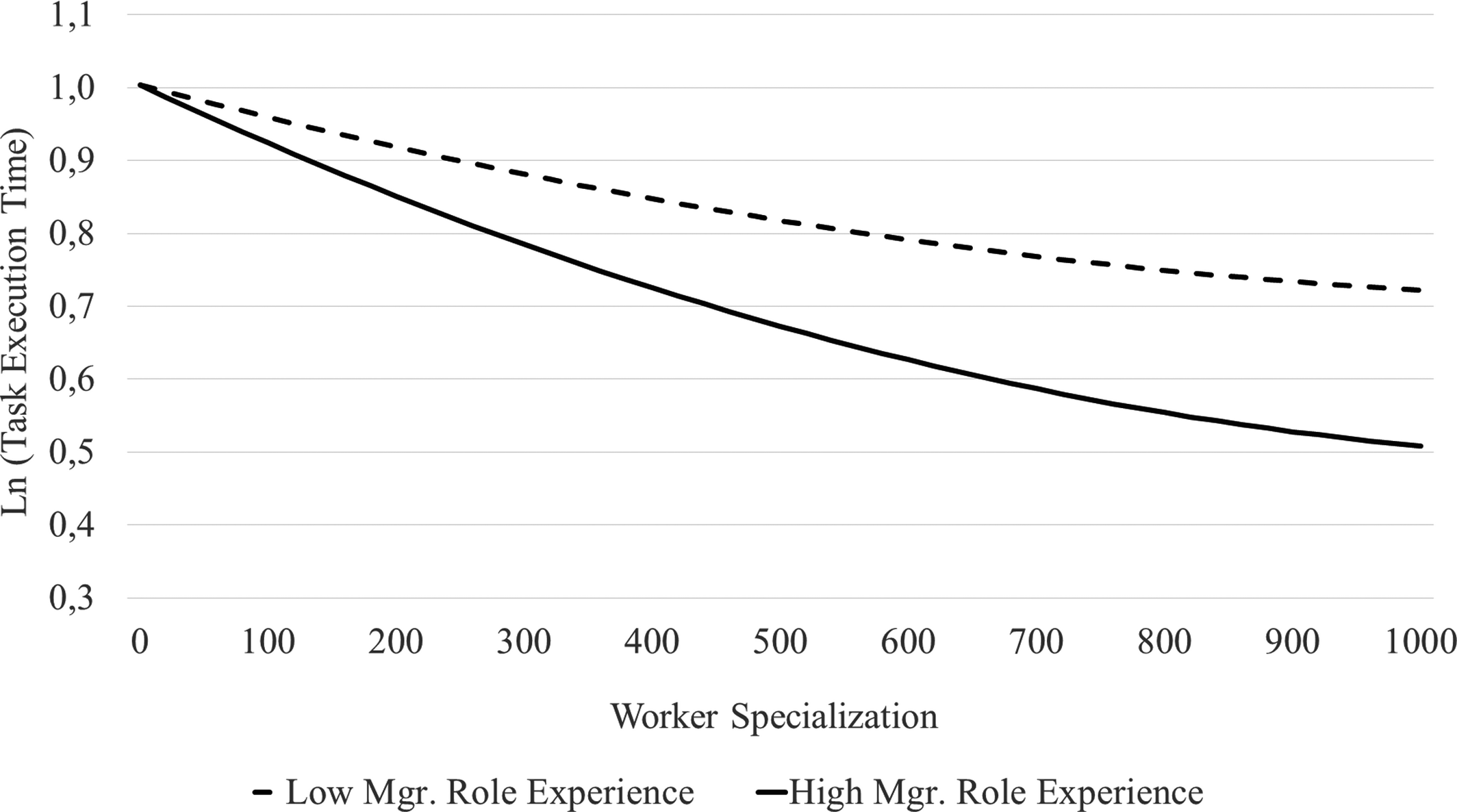
Conditional Effect of Worker Specialization on Task Execution Time at Different Levels of Manager Role Experience
In Hypothesis 2, we contend that the influence of manager role experience on the relationship between worker specialization and performance is contingent on the level of organizational task experience. To investigate this hypothesis, we include additional interaction terms among worker specialization, manager role experience, and organizational task experience in the model. Model 2 in Table gives the estimation results for the performance model, including the organizational task experience contingency. The coefficients of the interaction terms that include organizational task experience are significant (i.e., confidence intervals do not include zero), suggesting that organizational task experience is a significant contingency factor. To better understand these results, we plotted the relationship between worker specialization and performance at low (10th percentile) and high levels (90th percentile) of manager role experience, and at low (10th percentile—1464 tasks) and high levels (90th percentile—25,584 tasks) of organizational task experience, keeping all control variables at their mean level (see Figures and ). Figure suggests that varying manager role experience leads to substantial changes in highly specialized workers’ task execution time. For instance, an analysis of the predicted values of the performance model shows a significant difference between task execution time at the 90th percentile of worker specialization. This difference between predicted
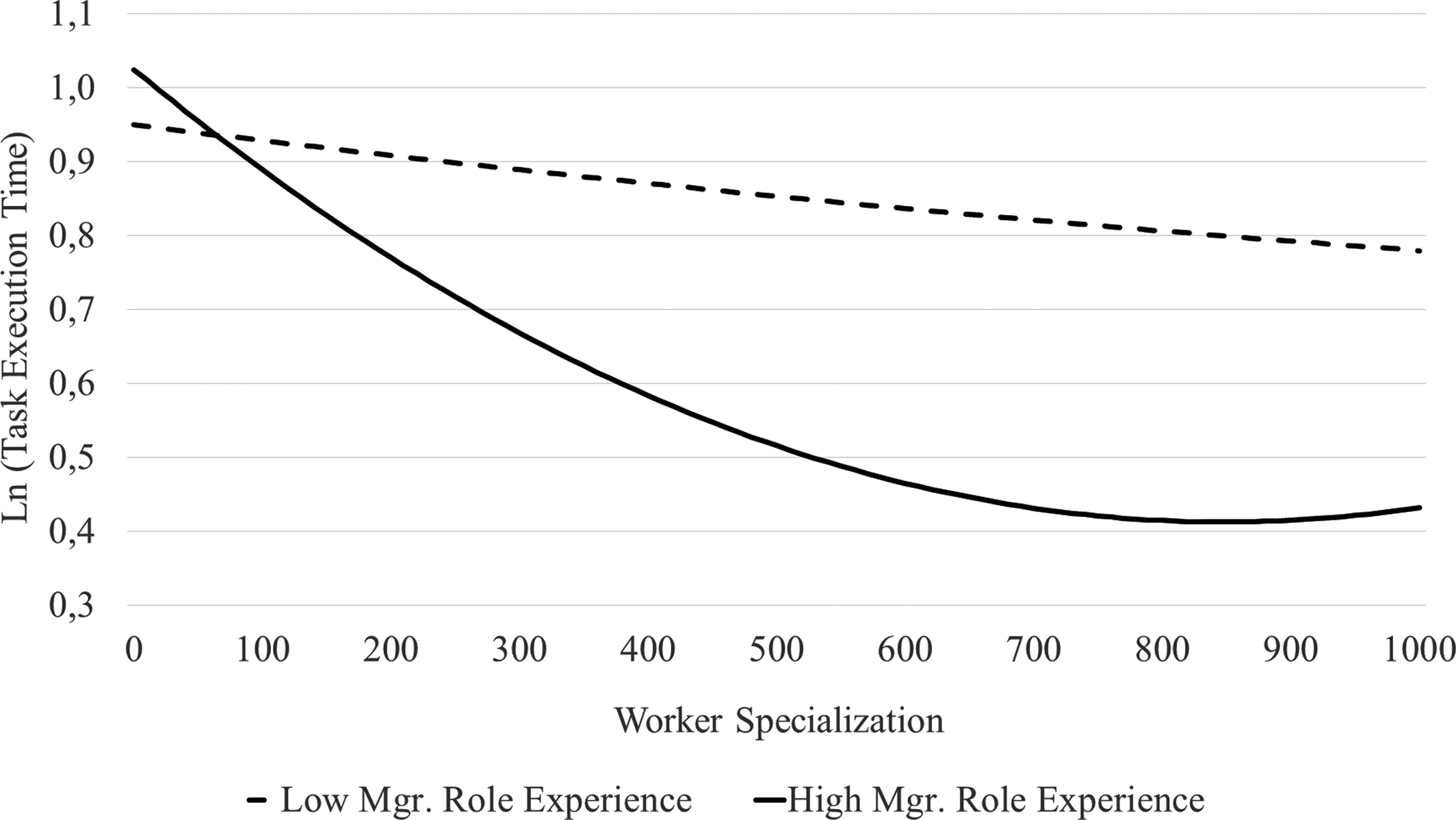
Conditional Effect of Worker Specialization on Task Execution Time at Different Levels of Manager Role Experience (Low levels of organizational task experience sample)
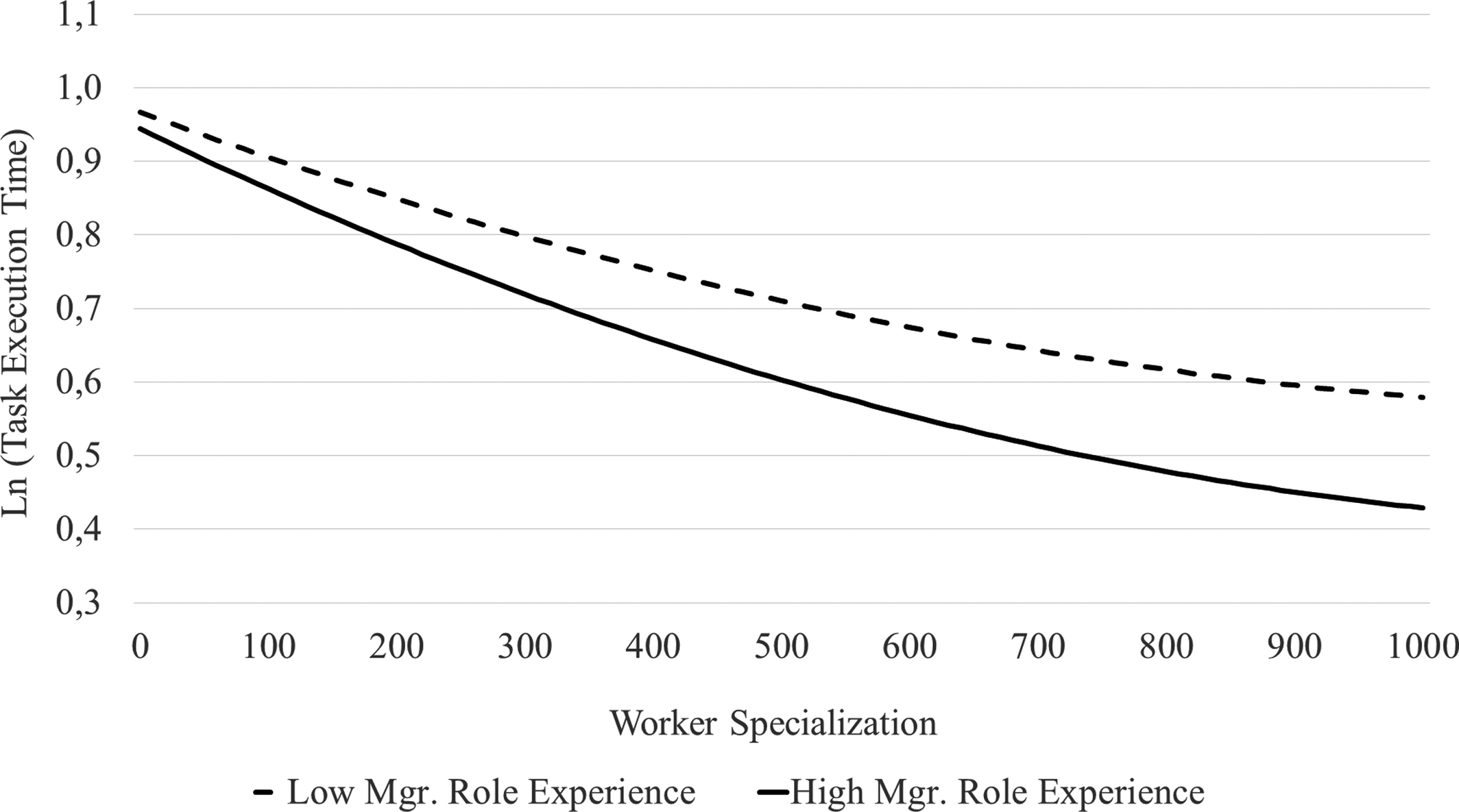
Conditional Effect of Worker Specialization on Task Execution Time at Different Levels of Manager Role Experience (High levels of organizational task experience sample)
Figure depicts a similar pattern in the relationship between worker specialization and task execution time at low and high levels of manager role experience. We find, however, that the average difference between the predicted values of
We also analyzed whether the differences in the predicted values at different manager role experience levels differ from each other at different levels of organizational task experience. Our results show that at high levels of organizational task experience and worker specialization (both at the 90th percentile), the average difference between the predicted values at high (90th percentile) and low (10th percentile) levels of manager role experience differs significantly from that obtained at a low level of organizational task experience (10th percentile). The difference in differences of the predicted values of
Robustness Checks
We conducted several tests to check the robustness of our estimated results. First, we analyzed the relationship between worker specialization and task execution performance at different levels of manager role experience (i.e., 5th, 20th, 80th, and 95th percentiles of
Second, we repeated our analysis defining low and high levels of organizational experience using different levels of the organizational task experience variable. We computed differences in predictions for low organizational task experience at the 25th and the 40th percentiles of
Third, limitations exist related to the experience information we can derive from our data. Though these data began shortly after the organization began operating, we do not have information on the experience of workers or managers prior to this time. As such, we acknowledge that our data are limited and the missing data may influence our results. To check for any potential effect of truncated experience measures, we followed Avgerinos and Gokpinar (2018) and included the following two robustness checks in the revision: The first one involves running our models after excluding the first 12 months of each worker and manager's experience. For example, for a worker that joined Alpha in June 2007, we removed all observations until June 2008. Afterward, we recalculated all the experience, familiarity, and tenure variables. Post‐truncation, all results were consistent with those of our original models. We found that, at high levels of organizational task experience and worker specialization, the average difference between the predicted values at high and low levels of manager role experience is smaller than the difference obtained at low levels of organizational task experience. In line with our hypothesis, no significant differences in the differences of the predicted values were found when running the analyses for low worker specialization values. The second one involves dropping observations of employees who joined Alpha before the beginning of our data set, including the 78 workers who worked for Alpha's parent company before it came into existence. Dropping these workers from the analyses did not alter the results. As in the prior two checks, we found that at high levels of organizational task experience and worker specialization, the average difference between the predicted values at high and low levels of manager role experience is lesser than the difference obtained at low levels of organizational task experience. Furthermore, no significant differences in the differences of the predicted values were found at low values of worker specialization. Taken together, these results suggest that the missing information on experience from the dataset does not pose a threat to our main findings.
Fourth, beyond worker specialization in a module, experience with the type of service requirement (e.g., corrective, modification request, and support) also may contribute to worker performance. To check whether specialization on task type impacts our results, we split the sample into subsamples by task type and re‐estimated the models in each subsample. The results of the analysis on each of the subsamples reveal patterns consistent with those in the original analysis. That is, the type of tasks where specialization is accrued does not influence the effect of specialization on worker performance.
Fifth, even though we capture worker fixed effects, better workers may be assigned more complex tasks over time and be less prone to lose motivation and become disengaged. Were this the case, estimation of specialization effects could be biased. We therefore computed a new specialization variable as the cumulative number of tasks that worker (
Sixth, we ran our models using manager task experience in exchange for manager role experience. Manager task experience captures the supervisory experience of the manager that is specific to the focal task module. We measured this variable as the number of tasks in the focal task module that the manager supervised prior to focal task allocation. The results of these models were consistent with those in our main analyses.
Seventh, to rule alternative functional relationships between sources of experience and execution times, we ran our models using log‐log and log‐log2 and compared the goodness of fits (AIC and BIC) with the model used in our study. The goodness of fit measures (AIC and BIC) for the model used in our study were lower than the log‐log or log‐log2 models suggesting that our approach fits the empirical data used in the study.
Finally, in our dataset, serial correlation might arise between tasks of the same module performed by the same worker. The Wooldridge test (Drukker 2003, Wooldridge 2010) for serial correlation suggests the likely existence of first‐order autocorrelation (i.e., AR(1)). As such, we estimated our model's Stage 2 (performance) equation based on a worker fixed‐effects panel regression with AR(1) disturbances (Avgerinos and Gokpinar 2018, Baltagi and Wu 1999). We defined the panels in the data structure following our worker specialization variable. The time variable corresponds to the sequence of tasks that worker (
Discussion and Conclusions
Repeating similar tasks can allow workers to acquire the knowledge and skills required to satisfactorily execute their work (Gupta and Govindarajan 1984, Smith 1766, Vickers et al. 2007). Over time, however, too much repetition can breed disengagement and the adoption of behaviors that thwart workers’ execution performance (Bruursema et al. 2011, Skowronski 2012). In this study, we empirically investigate the factors beyond individual worker traits that can allow firms to extract the full potential of worker specialization while limiting its costs. This effort also responds to the calls in the organizational learning literature to study the interactions between multiple sources of experience within an organization (Lapré and Nembhard 2011). Results indicate the existence of complex relationships among organizational task experience, manager role experience, and worker specialization when affecting task execution time. When organizational task experience is sufficiently high, the relationship between worker specialization and task execution time does not depend on manager role experience. Conversely, when organizational task experience is low, managerial role experience moderates the relationship between worker specialization and execution times, such that increasing the level of manager role experience magnifies the positive marginal effect of worker specialization on performance. The main contribution of this research is to illustrate the relationships among the three sources of experience, offering new theoretical and practical insights as outlined below.
Theoretical and Practical Implications
This study is the one of the few to investigate the interactions between multiple learning curves that can be at various levels within the organization (Lapré and Nembhard 2011). A recent study by Clark et al. (2013) found a moderating effect of organizational task experience on the relationship between worker experience and performance. In our study, we go a step further by integrating the role experience variable with the individual learning curve model. Support for the postulated interaction between worker specialization, manager role experience, and organizational task experience ultimately suggests that individual learning curve models that link worker specialization with performance are underspecified. We recommend more research on this topic in the future to account for the moderating factors presented in this study. One particular avenue for future research would be to extend our model to capture how other dimensions of organizational, manager, or peer knowledge interact with worker specialization to drive not only worker performance but worker selection as well—a topic that so far received very limited attention in the learning curve literature.
Second, our study contributes to the debate over factors that can offset possible diseconomies of specialization. While the existence of beneficial effects of specialization is an established fact in the learning‐curve literature (Gaimon et al. 2017, Jaber 2016, Lapre et al. 2000), different literature streams warn that these benefits can be reduced when specialization becomes too high. Both the classic job characteristics model (Fried and Ferris 1987, Hackman and Oldham 1976) and sociotechnical systems theory (Cherns 1976) suggest that workers should not be exclusively specialized in one task; instead, some degree of task variety is essential for worker engagement. Staats and Gino (2012) developed this idea and found that task variety, understood as breadth of experience, can mitigate the costs of specialization. To date, however, no prior research exists regarding what firms can do to maximize the performance potential of worker specialization, besides ensuring that workers are exposed to a variety of tasks. We fill this gap and extend the findings of Staats and Gino (2012) by providing two additional moderating factors that can explain how to counter potential negative effects and leverage worker specialization.
This study also advances the understanding of the effects of managerial role experience. Recent studies have begun to examine the main effect of a manager's experience on subordinate performance (e.g., Easton and Rosenzweig 2012, 2015, Huckman et al. 2009). We advance this line of research by theorizing and empirically showing that manager role experience can asymmetrically affect the performance of workers with different levels of specialization when the organization has relatively low levels of task experience. More precisely, specialized workers perform better when supervised by managers with high role experience, while inexperienced workers do not. Conversely, when organizational task experience is high, this effect is not present. This finding extends the insights from Easton and Rosenzweig (2015), who found in a study of Six Sigma projects that organizational experience moderates the relationship between project success and a manager's experience leading similar projects. We add to this emerging line of research by suggesting an interplay among individual, managerial, and organizational experience. A broader implication of our findings to the manager experience literature is that worker performance does not necessarily improve under the guidance of the most experienced manager. This finding also contributes to the debate about the performance effects of managers on their subordinates and organizations (Cho et al. 2016, Greening and Johnson 1996).
Our work has several important practical implications for staffing decisions. We find that if the organization were to optimize worker performance, staffing decisions must account for the nuanced relationships among worker specialization, manager role experience, and organizational task experience. To illustrate the importance of these contingencies, we quantified the effect of worker specialization on performance using the coefficients in Model 2 of Table . Results suggest that when organizations lack necessary task experience, manager role experience plays a key role in leveraging the performance potential workers derive from their levels of specialization. For instance, in the case of low levels of organizational task experience, increasing levels of worker specialization from low (10th percentile) to high (90th percentile) yields a decrease of nearly 37% in task execution times under a highly experienced manager's supervision. Under a manager with average levels of role experience (1230 tasks), the execution time reduction nears 21%. Such benefits are limited to 8% when workers are under the supervision of a manager with limited role experience. In contrast, when organizational task experience is high, the benefits of increasing the worker specialization level from low to high do not significantly differ regardless of a manager's role experience. For instance, in cases in which managers have high role experience (90th percentile), execution time drops about 26%, compared with 24% with average role experience and 21% with low role experience (10th percentile).
Furthermore, organizations can benefit from understanding the conditions in which relying on potentially costly resources such as highly experienced managers adds value to daily operations. Our results show that the benefits on task execution from manager role experience become limited as the organization accumulates experience. A sensitivity analysis reveals that in cases involving limited organizational task experience (10th percentile), having an experienced manager (90th percentile) supervise tasks compared to one with limited experience (10th percentile) drives significant reductions in execution times only if the worker has substantial specialization (65th percentile). Under other conditions, having experienced managers lead workers entails an opportunity cost, because the same worker performance can be achieved relying on managers with low role experience. In summary, we find that staffing tasks with workers possessing high levels of specialization, even when they are available, is neither necessary nor valuable. In fact, such a decision would be detrimental to performance if the experiences of both the task‐supervising supervising manager and organization were limited. Therefore, it is important for the organization to recognize that the individual value of personnel specialization is limited and depends on the availability of additional sources of experience.
Limitations and Conclusion
As for any non‐experimental study, claims of causality must be taken with caution and are mostly based on logic, theoretical explanations, and qualitative insights captured from personnel at the research setting. Ideally, causal links would have been better probed with a field experiment where workers are randomly assigned to managers in situations of both high and low organizational task experience. Clearly, such an experiment would have entailed non‐trivial risks to the operational core of the studied organization. Nevertheless, the rich data we accessed allowed us to model worker selection decision, allaying concerns about the possibility that non‐randomness in worker selection drives the results.
Second, while we controlled for differences across workers and managers, we lack data to set up controls for the effect of the education and training individuals have received. These are common personnel development tools and their effect on performance may be, to a certain extent, confounded with that of work experience. We partially mitigate this problem by accounting for worker and manager fixed effects, which at least capture all training and education effects that precede the observational period the data cover.
Third, even though our dataset included rich, individual‐level experience information, we did not have information about workers’ and managers’ prior job experience. We performed different robustness checks to investigate the sensitivity of the results to truncation in experience variables, finding that the results did not substantially change. Additionally, most workers came from other departments within the same organization. That is, they did not necessarily have previous experience in software services. Lastly, the observational period covered by the data (3.5 years) began less than 1 year after establishment of the unit, thereby limiting the extent to which truncation might be considered problematic.
Finally, we could not explicitly investigate the effect of the independent variables on the quality of workers’ output. We do so indirectly, because the dependent variable “task execution time” includes the time the worker had to spend fixing problems when the task did not pass quality checks. However, aspects of software service quality (e.g., appropriately annotating changes made to the code) exist that task execution time does not capture. Future research could investigate the effects of the studied independent variables on different quality metrics to provide a more nuanced picture of the consequence of these variables on worker performance. We do acknowledge that no estimation procedure is perfect and that we believe in our study conclusions to be valid given the robustness of our multiple estimation procedures along with field observations during and after data collection. We are confident that the results arrived are the most accurate to obtain for the type of empirical data used in the study. Nevertheless, we urge future scholars to look at these relationships in other settings to validate and extend our study findings.
Notwithstanding these limitations, this study offers novel insights into the relationship between worker specialization and performance. The existence of diseconomies of specialization has been known since early critiques of Taylorism, but little is known about how they can be managed. We show that the occurrence of diseconomies of worker specialization is not a universal phenomenon; instead, they can be substantially mitigated when organizational task experience is sufficiently high. Conversely, when organizational task experience is low, managers’ role experience plays an instrumental role in capitalize on specialized workers’ deep experience.
Footnotes
Characterization of Different Service Tasks at Alpha
Acknowledgments
The authors thank the department editor Enno Siemsen, the senior editor and the reviewers, whose comments and suggestions improved the paper, significantly, throughout the entire review process. All errors and omissions remain the responsibility of the authors. The second and third authors contributed equally to the paper.
1
The worker reports execution times in intervals of 15 minutes. In our sample, 133 of the 39,162 observations were associated with times that did not match 15‐minute intervals. The most common of those time reports corresponded to what workers associated with 35 minutes (33 obs.), 10 minutes (12 obs.), 50 minutes (9 obs.), 20 minutes (8 obs.), and 5 minutes (7 obs.).
2
When entered in the performance model, the worker–manager gender match variable does not have a significant relationship with task execution time
3
Given that the performance of the worker depends on factors that influence the choice of the worker
4
5
For interpretation purposes, we report the number of tasks that correspond to the values of the variable in their original scale, not mean‐centered.
6
This and other confidence interval analyses correspond to bias‐corrected bootstrap analysis based on 1000 iterations.
