






Abstract
We examine the implications of proximity to a physical store in offline–online retail competition where online disutility costs, which encompasses factors such as trust in the seller, returns, and after‐sales support, are important. Building on classical models, we consider a traditional retailer's expansion online, benefitting from the physical store's presence in serving customers online. Our innovation is to allow online disutility costs to be mitigated if the purchase is from a dual‐channel retailer, defining the mitigation as a function of proximity to the traditional store. Although expansion online is rarely profitable for traditional retailers, the expanded presence increases consumer welfare—which is further increased by competition from a pure e‐tailer. However, the competition between a pure e‐tailer and dual‐channel retailers can lower social welfare: in aggregate consumers may incur greater online disutility costs than transportation costs to obtain lower prices online. When online disutility costs are high and no pure e‐tailer is present, dual‐channel retailer prices and profits, in traditional stores and online, are greater than those where the market only has physical stores and a pure e‐tailer. Furthermore, consumer welfare is lower. Thus, consumers benefit from an expanded presence of traditional retailers online only when online disutility costs are low enough that mitigation matters. If online disutility costs are low, then their mitigation can result in higher social welfare in a market with only dual‐channel retailers. Similarly, the mitigation of online disutility costs can result in higher social welfare when dual‐channel retailers and a pure e‐tailer coexist.
Keywords
Introduction and Background
Consumers generally believe that a wider selection of retail stores from which to purchase benefits them and society—a version of “more is better.” This is especially true in the electronic retail, or e‐tail, world of commerce where an expanded presence and greater competition from and between online stores is commonly viewed as having advantages for consumers. Despite the presence of dual‐channel (traditional and online) retailers in most industries, there are few results that evaluate the benefit of having traditional retailers online for consumers and society. Filling this research void is more important now because physical stores are increasingly recognized as a critical asset for online retail operations as rapid changes are taking place in the overall sector in tandem with technological shifts. Starting from traditional brick‐and‐mortar chains like Walmart to the flagship store of online retailing, Amazon, many are capitalizing on physical presence (Wahba 2015, Warner 2016). From the operations management (OM) perspective, a physical store through increasing non‐digital attributes such as trust, branding, credibility benefits, and awareness provides demand enhancement effects for the online counterparts (Bell et al. 2015) and facilitate critical after‐sales services. Thus, understanding the value of physical stores in dual‐channel retailing and how this value varies with distance between the customer and store in different competitive environments is important.
Our research goal is to determine the effects of the advent of online stores, the impact of disutility costs of purchasing online, and the effect of mitigating those costs where proximity to a traditional store of a dual‐channel retailer reduces the disutility costs of purchasing online. Our approach is to study competitive market structures we observe in practice: traditional retailers together with one dominant pure e‐tailer (Balasubramanian 1998), traditional retailers competing in the online channel, and traditional retailers also competing in the online channel with a pure e‐tailer. This follows the methodology of positive economics that involves developing a body of knowledge about “what is” in contrast to “what ought to be” (Keynes 1890). Indeed, what is found in practice is shown in Figure 1 that lists the NAICS 3‐digit subsectors from the retail sector of the economy, omitting gasoline retailers (subsector 447) and non‐store retailers (subsector 454). In the right‐hand column, we list the .com websites of multiple retailers for each subsector. This shows conclusively that in practice multiple traditional retailers competing in the online channel is common across all retail subsectors.
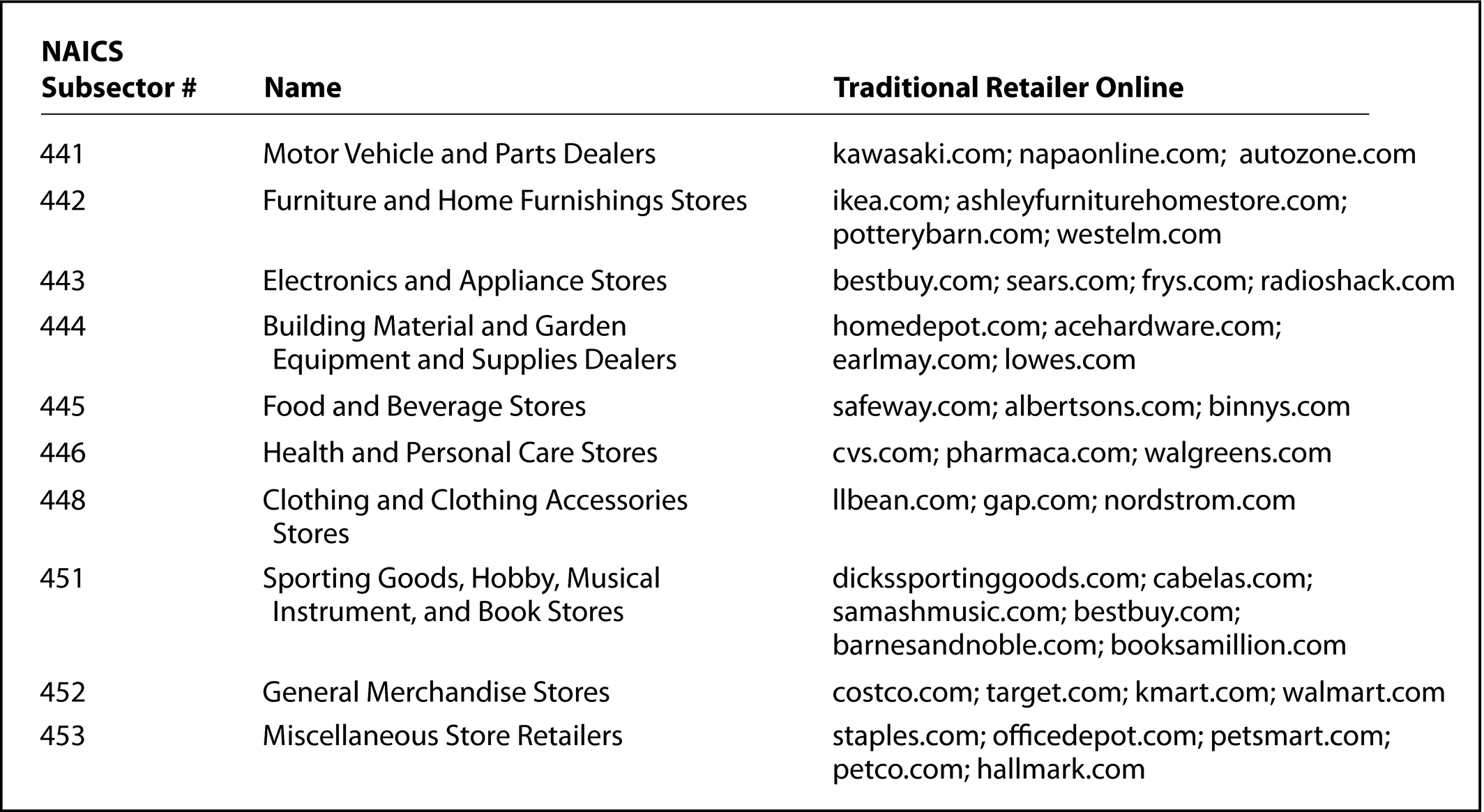
Traditional Retailers Online by NAICS Subsector
As the Nobel Laureate Friedman (1953) argues, the positive economics approach is to develop “a system of generalizations that can be used to make correct predictions about the consequences of any changes in circumstance.” We operationalize this by setting up and solving for prices, profits, consumer and social welfare in each competitive market structure, and then compare them in terms of these measures both analytically and numerically to address our research goals. As another Nobel Laureate Maskin (2014) might define it, we take economic institutions (measures relating to different market structures), explicitly incorporate the phenomenon of interest (mitigating of online costs based on proximity), and try to predict what outcomes they will give rise to (effects of the advent of online stores, impact of online disutility costs, and the effects of mitigating those costs from proximity).
Why proximity to a physical store matters: We conceptualize and model a vital aspect of dual‐channel retailing—mitigating the disutility of buying online—in studying goods for which channel and seller characteristics matter in the context of traditional and online retail competition. The extant literature suggests key components that underlie the disutility of buying online include trust (Jarvenpaaa et al. 2000, Stewart 2003) and challenges in post‐purchase services such as returning the product (Balasubramanian 1998, Forman et al. 2009). Because traditional retail stores have a physical location to interact with consumers, they dominate online retailers on service, after‐sales support, and trust (Verhoef et al. 2007). Consequently, access to a traditional retail store of a dual‐channel retailer helps mitigate the costs—reduce the disutility—of buying online, essentially allowing the retailer to take advantage of proximity. Not surprisingly, the value of having a physical location close to consumers is touted regularly in popular media (e.g., Reich 2014, Rowe 2013).
Trust plays a significant role in consumer decision‐making when buying online (Hoffman et al. 1999). Accordingly, the traditional store of a dual‐channel retailer enhances consumer trust when they are purchasing online. Using an experiential survey, Jarvenpaaa et al. (2000) found that for trust to exist a consumer must believe that the seller has both the ability and motivation to reliably deliver goods of the quality expected, and this trust is more difficult to engender for an online store than a traditional retail store. They speculate that “the presence of a physical store or the recognition of the merchant's name might have an effect on consumer trust in an Internet‐based store” (Jarvenpaaa et al. 2000). This trust is sometimes referred to as institution‐based trust, and is taken to be higher when an online retailer also does business in the traditional retail channel. Experimental results from Stewart (2003) have shown that a connection to a traditional retail store had a significant positive effect on intention to buy, suggesting that institutional factors are important to trusting intentions. Hence, dual‐channel retailers are able to benefit from institution‐based trust because the trust transfers from a traditional retail store to the online store (Stewart 2003). The evidence from this research indicates that the traditional store of a dual‐channel retailer provides a distinct advantage to the retailer's online counterpart by mitigating the online disutility cost, while a pure e‐tailer does not enjoy this benefit. For example, most consumers would recognize and relate
A critical disadvantage of purchasing online is problems related to returning a product (Forman et al. 2009). The challenges online consumers face in making returns can be substantially reduced by visiting a traditional store of the dual‐channel retailer. If there are post‐purchase issues such as minor defects or complex assemblies, then consumers can drive to the store and return the product or get satisfactory service. Indeed, even the option of going to the nearest traditional retail store gives a consumer peace of mind and reduces the online disutility cost. Based on a survey of transaction costs, Liang and Huang (1998) found that some products are more suitable for selling online than others, and this depends on the need for characteristics such as post‐purchase service. For example,
Naturally, a consumer's beliefs about a retailer (for example, trust or ease of dealing with post purchase issues) is a function of visiting the store, developing a sense of the store ambiance and attitude, and interacting with personnel at the store. Accordingly, a traditional store of the dual‐channel retailer may help in developing or reinforcing these beliefs. Because a consumer's likelihood of visiting a traditional store depends on the distance from the store, in modeling the benefit for a dual‐channel retailer it is critical to account for the distance as well. To illustrate, first time parents may benefit from talking to knowledgeable personnel from traditional stores like BabiesRUS and trying out different products before purchasing. Even after purchasing, parents may need help with putting the products together or using them. Certainly, this type of help cannot always be effectively rendered without face‐to‐face interaction, and in this context distance from the traditional store matters.
It is clear that by offering free returns, e‐tailers (dual‐channel and pure) try to partially mitigate the disutility of buying online, and this is evidence that this disutility exists. However, anecdotal evidence suggests that offering free returns does not meet/exceed the value of having a traditional store. For example, Warby Parker, the online eyeglasses pioneer, opened traditional stores in many cities to tackle the issue of online disutility costs. Amazon is opening college campus locations where items can be picked up/returned (e.g., Purdue, UC Davis) and is also considering opening traditional stores. After all, the free return shipping does not guarantee that the shipping is free of issues, a product may get damaged on the way back. Almost all retailers reserve the right to determine whether to fully refund a product after receiving the returned product and inspecting it—whether online or offline. Returning the product to a physical store allows consumers to obtain their refund instantly and many customers value that certainty.
In sum, the presence of a traditional retail store nearby mitigates the online disutility cost of purchasing from the online store of the dual‐channel retailer, and this mitigation depends on how far a consumer is from a traditional store. Brynjolfsson et al. (2009) empirically demonstrate that having traditional stores nearby reduces the online demand for popular products, which are likely to be available locally. Similarly, using data on bookselling Forman et al. (2009) show that when a local traditional retail store opens, consumers substitute away from online stores, which implies that the comparison between online disutility costs and transportation costs matters even for books which require less face‐to‐face instruction for use. The novelty in our work is to formally articulate and model the mitigation of online disutility costs and derive insights by comparing consumer welfare and social welfare between commonly observed retail market structures. Thus, in examining the impact of mitigating online disutility costs, we conceptualize an important component of e‐commerce, which plays a significant role in competition online, and between online and traditional stores.
Our analysis: We study this retail and e‐tail competition when selling the types of goods for which a seller's traditional store is valuable to consumers when they make purchases online. We specify a model of how dual‐channel retailers, when they also sell online, mitigate online disutility costs to consumers based on the consumers' proximity to the traditional store. Using this specification, we then formulate and solve an extension to each of the paradigm analytical models—Salop's (1979) “circle around the lake” and Balasubramanian's (1998) “pure e‐tailer in the center”—whereby traditional retailers also sell online so that, first, the retailers are dual‐channel retailers (Salop model with online stores) and, second, there is competition online (Balasubramanian model with retailers selling online). For example, considering the market for home improvement products, Home Depot and Lowe's are the main competitors both in traditional retail stores and online, which matches our first extension (Salop model with online stores). The market for running shoes, on the other hand, has dual‐channel retailers (e.g., Finish Line and Foot Locker) as well as pure e‐tailers (e.g.,
In our models, the tension between a dual‐channel retailer's expanded presence intensifying competition and its mitigation of consumers' online disutility costs yields surprising results for consumer and social welfare. We find that although expansion online is rarely profitable for traditional retailers, the expanded presence increases consumer welfare—which is further increased by competition from a pure e‐tailer. However, competition from a pure e‐tailer and traditional retailers online can lower social welfare: in aggregate consumers may incur greater online disutility costs than transportation costs to obtain lower prices resulting from online competition.
When online disutility costs are high and no pure e‐tailer is present, dual‐channel retailer prices, and respective profits, in traditional stores and online are greater than those where the market only has physical stores and a pure e‐tailer. This is similar to Thomadsen (2012) that argues firms may increase prices to avoid cannibalization. Furthermore, comparing the Balasubramanian model to the Salop model with online stores, the mitigation of online disutility costs is insufficient to offset higher prices and, hence, consumer welfare is also lower.
Compared to the Salop model with online stores, competition from a pure e‐tailer lowers social welfare as consumers that purchase from the pure e‐tailer do not benefit from mitigation of online disutility costs. However, if online disutility costs are low, then their mitigation can result in higher social welfare from the Salop model with online stores than from the Balasubramanian model. Similarly, the mitigation of online disutility costs can result in higher social welfare from the Balasubramanian model with retailers selling online than the Balasubramanian model. This latter set of results show the social value of mitigating online disutility costs.
Our modeling approach builds on conventions that have been used in related studies. As in the standard Salop (1979) model and related works (e.g., Balasubramanian 1998, Paul and Pezzino 2011), consumers are assumed to be informed about prices and the availability of the product and its characteristics, and thus the process is not one of product search. In this standard setup, there are no supply chain effects such as vertical integration and double marginalization, no information asymmetry about prices in different retail channels (see Zhang 2009) or question of product fit with consumer expectations (see Ofek et al. 2011). Thus, consumers do not face any fit uncertainties but all seller specific uncertainties persist. For example, a consumer may know that they want a Nikon D7200 camera, but a product may arrive damaged, may malfunction, may have missing parts, etc., or the consumer may need help in operating the camera properly. The online disutility costs embody these disutilities faced by consumers buying online. Other articles have analyzed conditions for market failures and excessive market provision of differentiated products (Paul and Pezzino 2011) and established that dual‐channel retailers are an essential outcome in an equilibrium (Bernstein et al. 2008). Therefore, our focus is exclusively on retail‐level competition and understanding the role of proximity to a traditional store in market structures where only dual‐channel retailers are competing, or dual‐channel retailers and pure‐etailers are competing.
Our model contains two critical costs. One is the unit transportation cost associated with consumers purchasing from a traditional retail store. This unit cost, and the consequent total transportation cost a consumer faces, is an exogenous parameter in our model along with the consumer's location on the Salop circle. The other critical cost in our model is the fixed online disutility cost. When purchasing from an online store of a traditional retailer, this cost is mitigated for consumers proportional to their distance from the traditional store. Indeed, it is the operation of a traditional store that reduces the disutility costs of a given consumer purchasing from the traditional retailer's online store. All of our propositions come as a result of comparing the relationship between these two critical costs across different retail market structures. Our numerical illustrations, backed up by our proofs, effectively vary the online disutility cost and the mitigation relative to the unit transportation cost.
Perdikaki and Swaminathan (2013) consider consumer search in duopoly retailer competition where consumers face a traveling cost to and between retailers, and each retailer has a proportion of consumers that are located closer than to the other retailer. Each retailer can invest in enhancing consumer valuation of purchasing from them, potentially counterbalancing part of the traveling cost. Using numerical analyses, they show how with retail competition prices can decrease with increases in unit costs when retailers serve their local market. In a model with a setup similar to ours, Jeffers and Nault (2011) consider pure e‐tail entry into the traditional retail channel without accounting for the mitigation obtained from the store presence, which makes traditional retailer entry online infeasible because of zero profit. They find that a pure e‐tailer opening up a traditional store can increase prices and profits across retailers, and in this way consumers can be better off with less competition.
Balakrishnan et al. (2014) examine showrooming where traditional stores are used for browsing by consumers that may ultimately purchase online at a cheaper price. Consumers face a store visit cost to go to a traditional store, and an e‐purchase cost of purchasing online akin to our online disutility cost. In their model, the e‐purchase cost varies across consumers and the store visit cost does not, and there is a probability and cost of returning a purchase. Moreover, in an extension, they consider a traditional retailer with an online store, but without an advantage over a pure online retailer, as well as additional store traffic and product costs. They find that a retailer can combat showrooming through price, although showrooming can occur in equilibrium. Mehra et al. (2017) analyze price matching, increasing the difficulty of matching products between online and traditional stores, and charging customers for showrooming as three strategies a traditional retailer can take to counter showrooming. Consumers that evaluate products only online may choose a product with a worse fit being unable to assess non‐digital attributes. Using a Hotelling line to differentiate consumer costs of visiting a traditional store, they find that price‐matching is not an effective strategy for the traditional retailer, although the other two strategies can increase profits.
Other OM literature slightly further from our model setting includes Ryan et al. (2012) that studies whether an online retailer should also sell through an online marketplace. Sun et al. (2008) shows how an asymmetric equilibrium can be obtained in a duopoly if pure e‐tailers can choose between an in‐stock operation with an inventory and a stockless operation, using stocking policy as the basis of differentiation. Supporting the existence of online disutility costs, Ba and Johansson (2008) examine how electronic service delivery affects customer satisfaction and finds that technological capabilities and processes can improve service quality and satisfaction.
Our analysis proceeds as follow. First, we briefly review the Salop (1979) and Balasubramanian (1998) models, and explain our specification of how a traditional store can mitigate online disutility costs faced by consumers when purchasing from a retailer's online store. Using a consistent framework, we show the solutions to the Salop and Balasubramanian models, and then obtain the similar solutions for the extensions to each of these models when traditional retailers also sell online. Subsequently, we organize our results along three broad themes: the effects of the advent of online stores, the impact of disutility costs of purchasing online, and the effects of mitigating these costs through proximity to a traditional store. We conclude with a discussion of our findings, our contributions, and implications for future research.
Our Model
Salop model: Our model and its variants are based on the well‐known Salop model (Salop 1979) of a circle around the lake creating a circular spatial market, which itself is an extension of the Hotelling (1929) model of horizontal differentiation along a line. Salop's model has a continuum of consumers, x ∈ [0, 1], spread uniformly around a circle of unit circumference. Each consumer is in the market for one unit of the good, consumption of which yields utility


Retailers operate traditional stores selling identical goods with a marginal cost normalized to zero. Each retailer is aware of the other's offering price, and faces a fixed entry cost

Balasubramanian model: Balasubramanian's (1998) model extends the Salop model to include a pure e‐tailer which offers a good identical to that of the traditional retailers. In Balasubramanian's model, the pure e‐tailer has equal access to any point on the circumference. In Figure 2, the pure e‐tailer is located at the center of the circle, with a radius distance to each point on the circumference. As an alternative to purchasing from one of the traditional stores as in the Salop model, consumers can purchase from the e‐tailer and incur a fixed online disutility cost plus the price paid for the good. In line with Balasubramanian (1998), the fixed online disutility cost, which we denote as

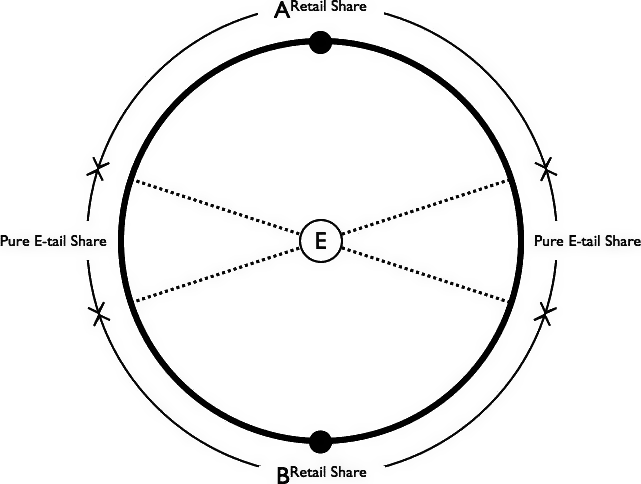
Balasubramanian Model — Two Traditional Retailers (A & B) and One Pure E‐Tailer
Our formulation: Our formulation is based on traditional retailers also selling online, offering identical goods through both stores. To be consistent with Balasubramanian's model, we take retailers as having no online entry costs. Consumers that purchase from a dual‐channel retailer online incur the fixed online disutility cost, plus the price of the good.
Our innovation is that with the existence of traditional retail stores, when purchasing from dual‐channel retailers online, the disutility cost can be in part mitigated. The extent of this mitigation depends on distance from a traditional store as consumer's likelihood of visiting a traditional store depends on distance from the store. The disutility is based on a consumer's uncertainty about the seller along the dimensions mentioned in the Introduction: trust, ability to help with product operation and other post purchase issues. For example, when purchasing from
Our formulation also allows for a dual‐channel retailer to set different prices online and in the traditional store. This is consistent with many retailers including Macy's, whose website specifies (Macy's 2016): “
Our formulation has two separate cases. The first is two retailers that compete across traditional and online stores, which is essentially the addition of online stores to the original Salop model with two retailers (see Figure 3). The second is two retailers that compete across traditional and online stores, and a pure e‐tailer, which is essentially the addition of traditional retailers selling online to the original Balasubramanian model (see Figure 4).
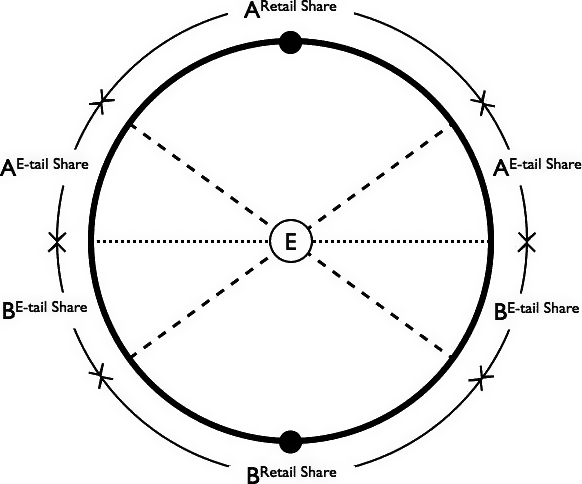
Salop Model with Online Stores — Two Dual‐Channel Retailers
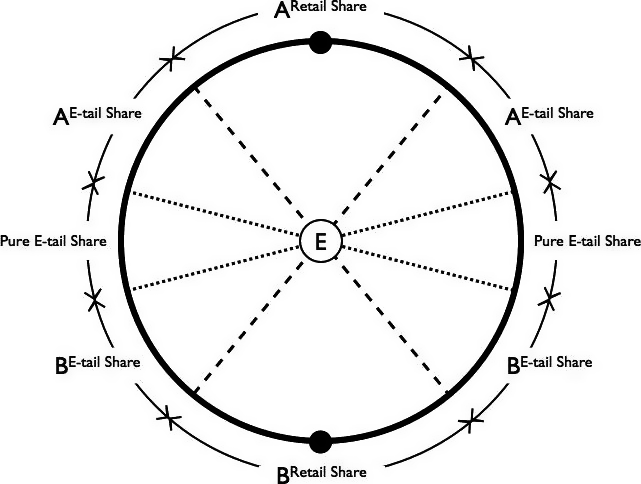
Balasubramanian Model with Retailers Selling Online — Two Dual‐Channel Retailers (A & B) and One Pure E‐Tailer
Mitigation of disutility costs: To incorporate the mitigation of the online disutility costs that the existence of a traditional retail store brings to consumers, we define two additional parameters. First is the marginal drop in mitigation of online disutility costs with distance,




We denote the traditional retail prices as


Model Solutions
Salop model solutions (s): Two retailers offer identical goods. A consumer at the distance x ∈ [0, 1/2] from retailer r is indifferent between purchasing from either retailer if










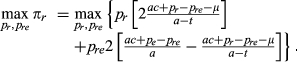
The e‐tailer's market share is 1 − 4x, and each retailers' market share is 2x. Each retailer's profit maximization problem is













Each retailer's market share from its retail store is
















The retailer's market shares are as defined in the Salop model with online stores. The pure e‐tailer market share is















Accounting for the fact that prices, and thus profits, are a transfer between sellers and consumers, social costs are a subset of total costs to consumers that only include online disutility costs less mitigation and transportation costs. Consequently, the relative effects of different market structures on social welfare may differ from the relative effects of different market structures on consumer welfare. As with consumer welfare, with the market covered, each consumer derives the same value from consumption across models. Although our analysis of social welfare is done based on social costs, as with consumer welfare, we describe our results in terms of social welfare as it is more common and natural.
Main Results
We organize our results under three broad themes that emphasize the insights from this study in a meaningful way. They are as follows: (i) the effects of the advent of online stores, (ii) the impact of online disutility costs (μ), and (iii) the effects mitigating these online disutility costs through proximity to a traditional store. In choosing these themes, we rely on the key innovations in our modeling setup and the drivers of the changes in the economic institutions (different market structures) we focus on.
For ease of exposition, we use numerical constraint plots to more clearly demonstrate our results below. The proofs are in the Online Appendix.
The Effects of the Advent of Online Stores
We first consider the advent of online stores expanding retailer presence in the form of only dual‐channel retailers or dual‐channel retailers and a pure e‐tailer serving the market.
To begin, online stores in the Salop model (se) reduces traditional retail prices as the expanded presence through online stores separates the market into those consumers that incur transportation costs and those that incur online disutility costs. To understand why this occurs, in the Salop model (s), each consumer except the indifferent consumer has a lower transportation cost with one or the other retailer. However, while transacting online, for a given consumer, the difference in the online disutility costs is smaller than the difference in transportation costs. As a consequence, the price competition between the retailers' online stores affects online prices, and causes the traditional retail store prices to be lower. Thus, the expanded presence engenders increased competition.
A similar effect persists even if a pure e‐tailer is present in the market. Our next proposition compares profits in the Balasubramanian model (b) to those from the Balasubramanian model with retailers selling online (br).
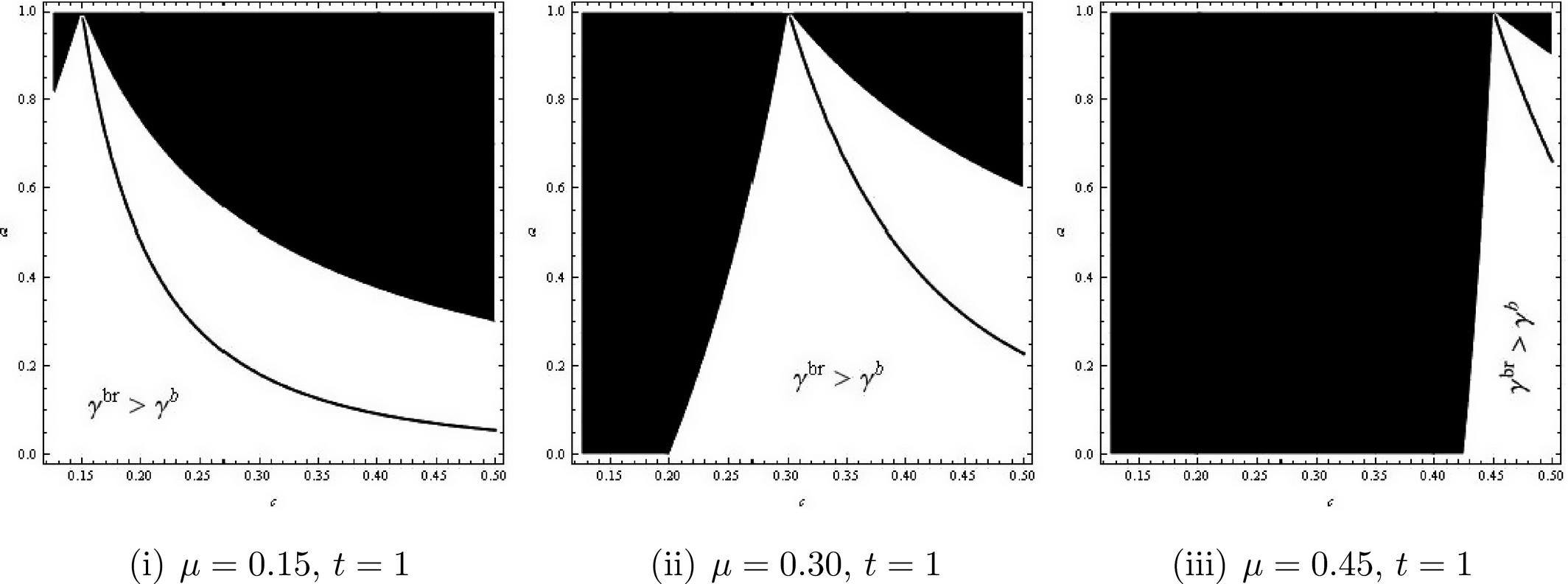
Expanding presence through online stores is rarely profitable for a traditional retailer.
We show the result numerically through the constraint plots in Figure 5. Without loss of generality, we set the unit transportation cost to unity so that t = 1. By construction t > a, so that the marginal drop in mitigation with distance is a < 1. We increase μ successively moving from Figure 5a to c. The shaded areas reflect our constraints: the market share condition from Equation 19 as well as the constraints on the mitigation parameters in Equation 2.

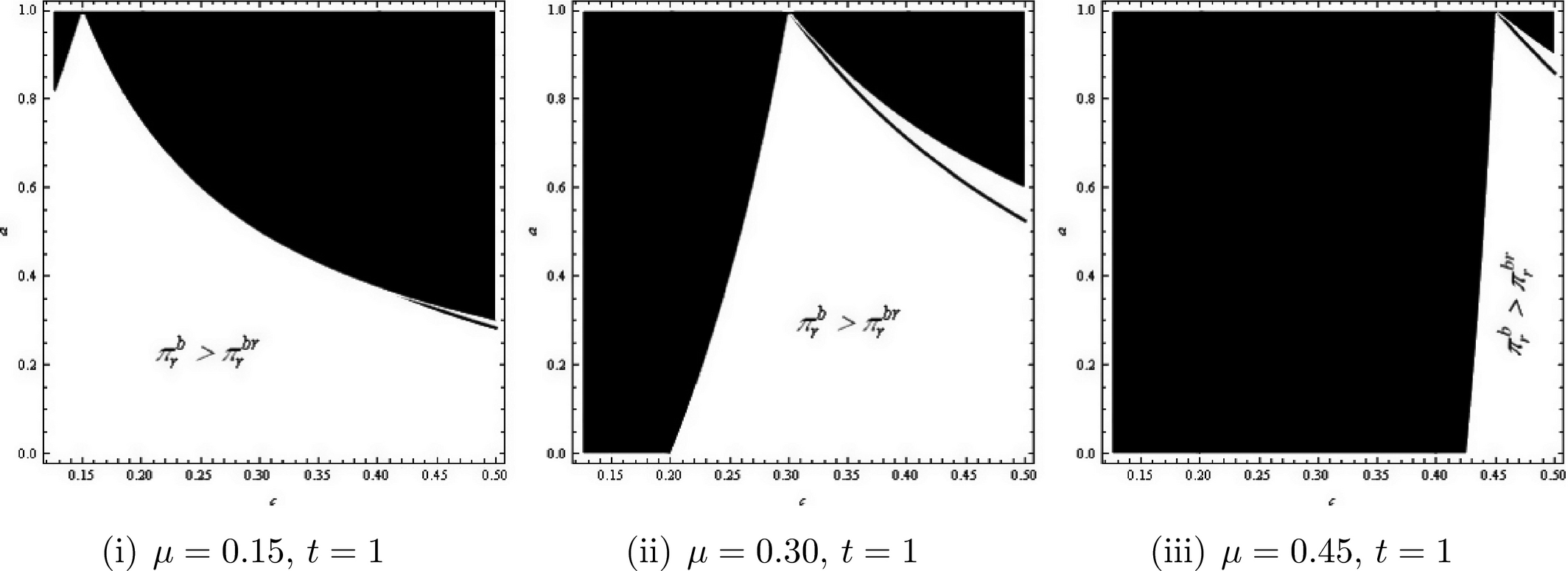
Retail profits in the Balasubramanian Model (b) Compared to the Balasubramanian Model with Retailers Selling Online (br)
Corollary 1 compares profits in the Balasubramanian model (b) to the Salop model with online stores (se). When online disutility costs are high, then the effects of an expanded presence together with mitigation tend to dominate those of increased competition between dual‐channel retailers due to online presence, and vice versa.
If fixed online disutility costs are high (low), then retailers in the Salop model with online stores are relatively more (less) profitable than traditional retailers in the Balasubramanian model.
We show the result numerically through the constraint plots in Figure 6. Without loss of generality, we set the unit transportation cost to unity so that t = 1. By construction t > a, so that the marginal drop in mitigation with distance is a < 1. We increase μ successively moving from Figure 6a to c. The shaded areas reflect our constraints: the market share condition from Equation 12 as well as the constraints on the mitigation parameters in Equation 2. As μ increases, an increasing proportion of the parameter space supports

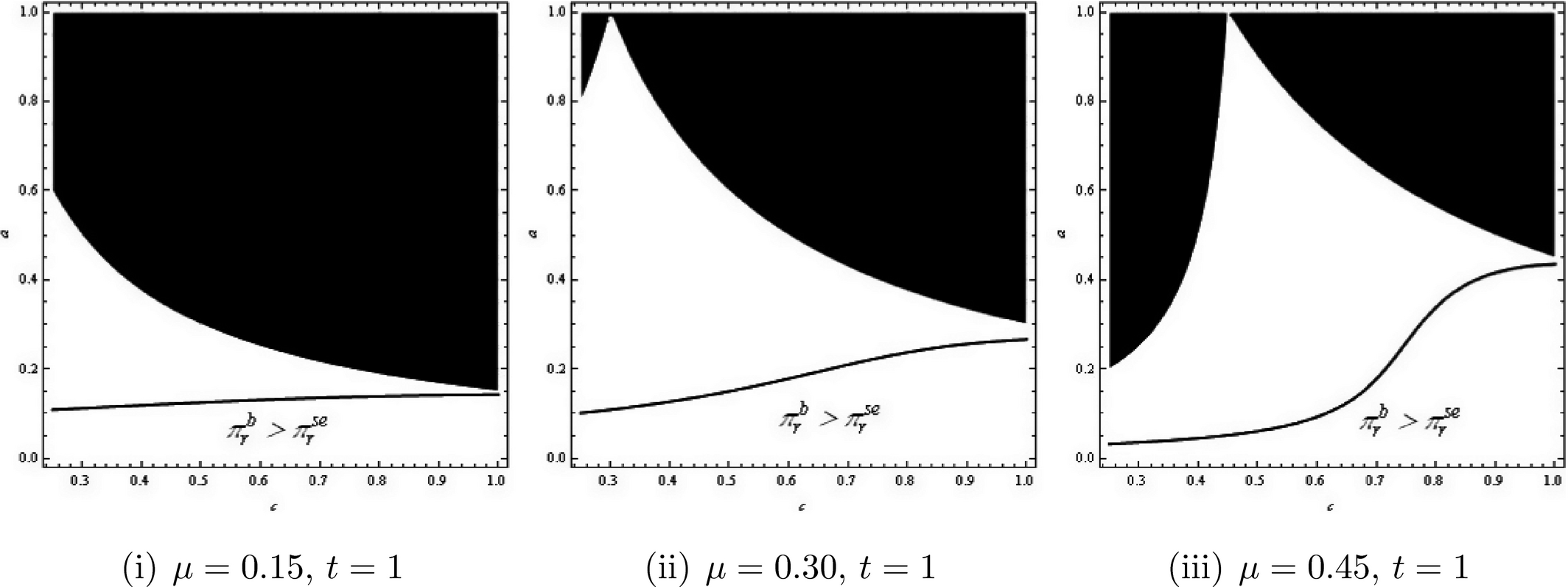
Retail Profits in the Balasubramanian Model (b) Compared to the Salop Model with Online Stores (se)
The change in pure e‐tailer profits when there is additional competition from traditional retailers selling online is straightforward as the additional competition dissipates profits:

We now examine the effects of expanded presence as compared to competition on consumer welfare. Our first result is that starting from the Salop model, consumer welfare is increased with a pure e‐tailer in the market. This result, that we choose not to state in a proposition, is that the total cost to consumers is lower in the Balasubramanian model than in the Salop model:

The following proposition, stated in two parts, shows that both expanded presence and competition contribute to consumer welfare. The first part of the proposition compares the Salop model (s) and the Salop model with online stores (se). The second part compares the Salop model with online stores (se) and the Balasubramanian model with retailers selling online (br).
(i) The expanded presence of traditional retailers with online stores increases consumer welfare. (ii) The additional competition from a pure e‐tailer in a market with dual‐channel retailers increases consumer welfare.
Retailers with traditional and online stores are effectively dual‐channel monopolists. However, the reduction in online disutility costs from a sufficiently low marginal drop in mitigation with distance for consumers that purchase online more than offsets the potentially higher retail prices for those customers that purchase from traditional stores. Consequently, from Proposition 2 (i), an average consumer is better off with traditional retailers also selling online—an expanded presence—when the market involves dual‐channel retailers only.
Proposition 2 (ii) is important because it shows that for the average consumer, the possible increases in online disutility costs that occur from competition online whereby the pure e‐tailer as well as the dual‐channel retailers in both channels have a positive market share are dominated by the decreases in prices that comes from the same competition. The possible increases in online disutility costs are due to the lack of mitigation of online disutility costs offered by dual‐channel retailers online when the pure e‐tailer has a positive market share. As described earlier, competition online reduces online prices, which in turn puts downward pressure on traditional retail prices. Consequently, competition compounds the effects of retailers' expanded presence on consumer welfare.
Overall, Proposition 2 establishes that the Salop model with online stores increase consumer welfare as compared to the Salop model, and that competition online from a pure e‐tailer further increases consumer welfare. In terms of total costs to consumers, we have

Our social welfare proposition compares the social costs in the Salop model (s) to the Salop model with online stores (se).
If fixed online disutility costs are high, then social welfare is lower when traditional retailers have online stores.
We show the result numerically through the constraint plots in Figure 7. Without loss of generality, we set the unit transportation cost to unity so that t = 1. By construction t > a, so that the marginal drop in mitigation with distance is a < 1. We increase μ successively moving from Figure 7a to c. The shaded areas reflect our constraints: the market share condition from Equation 12 and the constraints on the mitigation parameters in Equation 2. To be consistent across models, we also impose μ ≤ 1/2 from Equation 7. When μ is moderate to high in Figure 7(ii) and (iii), then


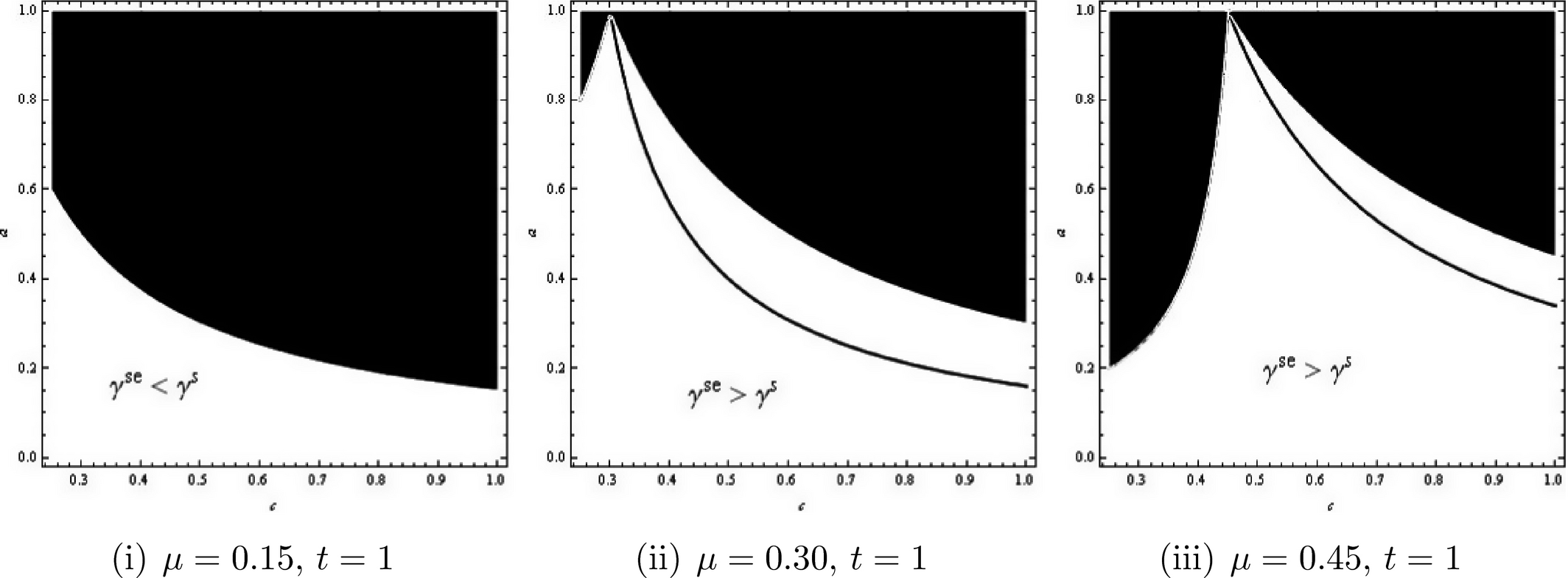
Social Welfare in the Salop Model (s) Relative to the Salop Model with Online Stores (se)
Proposition 3 is important because it shows that counter to intuition, consumers can incur greater costs—in other words, social welfare is reduced—with the addition of traditional retailers selling online. Hence, exclusive of prices, an extra channel can effectively increase costs to society. These social costs are higher when online disutility costs are sufficiently large and when the maximum mitigation (i.e., ac) is not sufficiently large to offset the high online disutility costs, in the context of a dual‐channel retailers that price discriminate between channels such that some consumers incur the higher net online disutility costs in exchange for possibly lower prices. Proposition 3 also shows that the lower the online disutility costs are relative to transportation costs (having normalized t = 1), the greater the social gain from consumers substituting online stores for traditional retail stores. Our proposition is similar to the results in Klemperer (1988) and Lahiri and Ono (1988) that finds the addition of low cost competitors, possibly with uneven technologies, can be socially detrimental.
Next, we establish the condition that determines if social welfare is increased by the addition of a pure e‐tailer to a market that only contains traditional retailers, that is, when the Balasubramanian model (b) increases social welfare over the Salop model (s). The following proposition provides the condition.
If fixed online disutility costs are more (less) than 20% of unit transportation costs, then the addition of a pure e‐tailer to the Salop model—the Balasubramanian model—decreases (increases) social welfare.
Proposition 4 comes from the combined effect of some consumers substituting online disutility costs for transportation costs and of additional price competition from the pure e‐tailer determining how many consumers make that substitution. Recalling the constraint from the Balasubramanian model in Equation 7, 2μ < t, and the condition in the Proposition, there is a substantial range in the relationship between online disutility costs and transportation costs whereby either the Salop model or the Balasubramanian model can result in greater social welfare. The explicit 20% in Proposition 4 depends on how the model is formulated. Different, but qualitatively equivalent, formulations may yield a different figure.
Combining Propositions 3 and 4, we find the surprising result that when online disutility costs are sufficiently high, then the addition of an online store—whether from a pure e‐tailer or from the traditional retailers selling online—decreases social welfare. In terms of social costs, we have

The Impact of Online Disutility Costs
In deriving insights regarding the role of online disutility costs (μ), we begin by comparing the Salop model with online stores (se) with the Balasubramanian model (b). Although the Salop model with online stores (se) offers the advantage of mitigation in lieu of the disutility costs, the Balasubramanian model (b) offers the benefit of competition in exchange of the disutility costs without any possible mitigation. Comparing the two models, if online disutility costs are high, then both traditional retail and online prices are lower in the Balasubramanian model. This occurs in spite of the Salop model with online stores having the advantage of mitigating online disutility costs. Indeed, with this mitigation, a consumer purchasing online has lower effective online disutility costs purchasing from the closest retailer's online store, making the dual‐channel retailers close to local monopolists. This causes prices to be higher compared to when a pure e‐tailer competes with traditional stores.
However, if the fixed online disutility cost is not too high, then even with the mitigation of online disutility costs, the retailers' online stores are less differentiated and greater price competition between online stores results causing both traditional retail and online prices to be lower compared to when a pure e‐tailer competes with traditional stores. The following proposition provides the formal statement.
If fixed online disutility costs are high (low), then the Salop model with online stores results in higher (lower) traditional retail and online prices than the Balabubramanian model.
We show the result numerically through the constraint plots in Figures 8 and 9. Without loss of generality, we set the unit transportation cost to unity so that t = 1. By construction t > a, so that the marginal drop in mitigation with distance is a < 1. We increase the online disutility costs, μ, successively moving from Figure 8a to c. The shaded areas reflect our constraints: the market share condition from Equation 12 as well as the constraints on the mitigation parameters in Equation 2. As μ increases, an increasing proportion of the parameter space supports


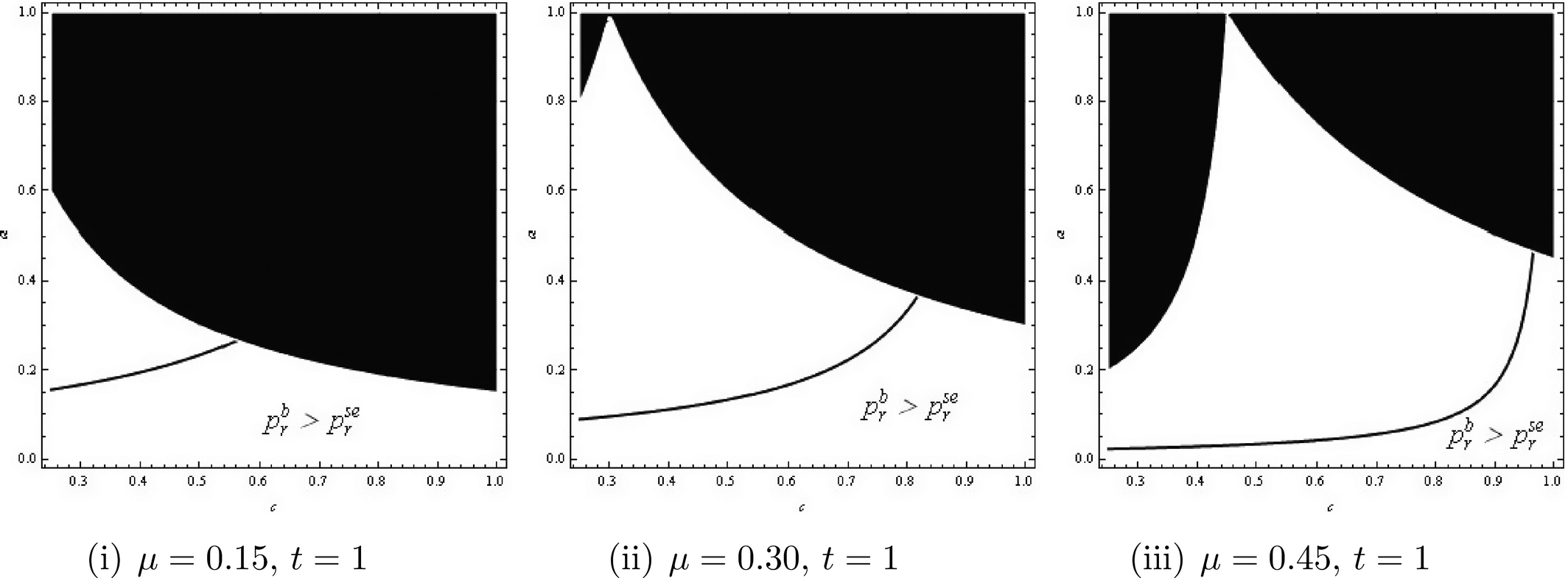
Comparing Traditional Retail Prices in the Balasubramanian Model (b) to the Salop Model with Online Stores (se)
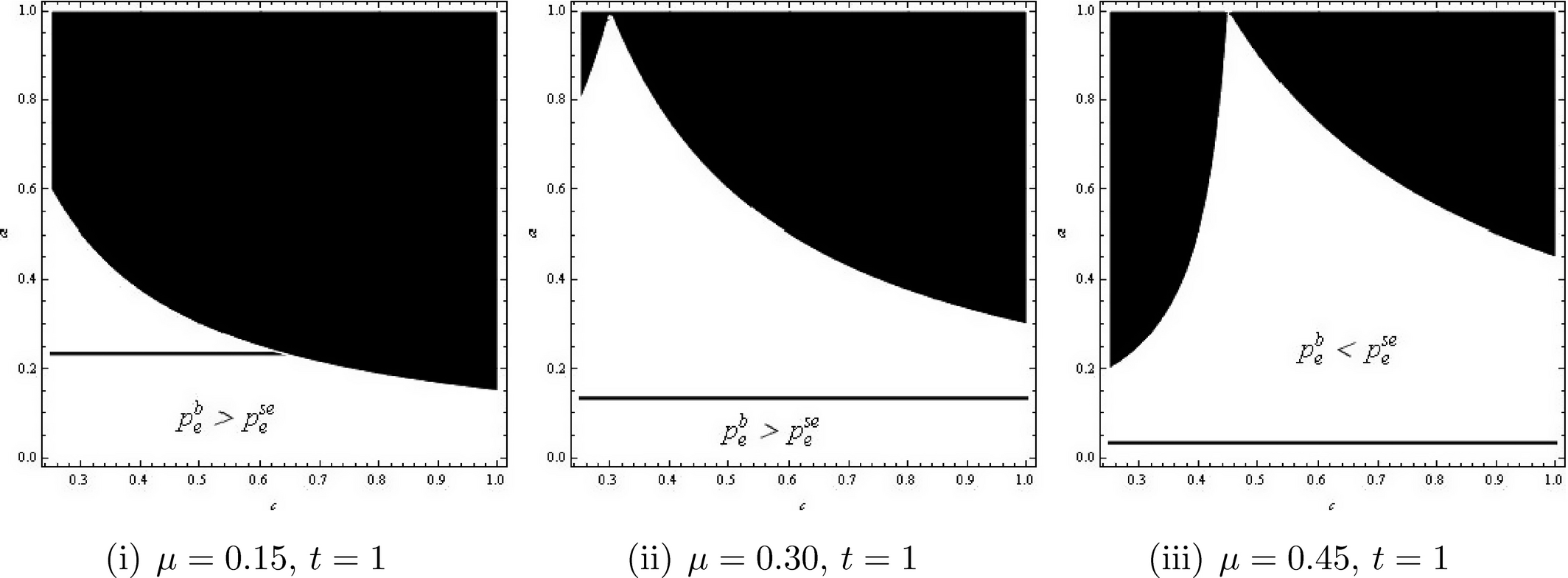
Comparing Online Prices in the Balasubramanian Model (b) to the Salop Model with Online Stores (se)
Proposition 5 is important and surprising because it shows that the effect of an expanded presence even with mitigation of online disutility costs—the Salop model with online stores—does not necessarily lead to lower prices as compared to the Balasubramanian model. Such lower prices in the Salop model with online stores only occurs with low online disutility costs and a lower marginal drop in mitigation with distance. The latter means that the mitigation applies to a greater range of consumers, which in turn, intensifies the competition between the online stores of the dual‐channel retailers. This intensified online competition creates pressure on traditional retail prices, increasing the rivalry between the two retailers. In contrast, the pure e‐tailer in the Balasubramanian model competes directly with each traditional retailer and does not increase the rivalry between the retailers (see Figure 2). With higher online disutility costs or as the marginal drop in mitigation increases and mitigation becomes less substantial over distance, the rivalry between the online stores of the two dual‐channel retailers (se) is reduced, and higher traditional retail and online prices can be sustained.
Finally, traditional retail and online prices are lower when there is competition online from the Balasubramanian model with retailers selling online (br) versus the Salop model with online stores (se). The additional online competition from a pure e‐tailer in the former reduces online prices offered by the dual‐channel retailer, and this in turn further lowers traditional retail prices. Hence, competition is more powerful than an expanded presence in determining prices. Using our results, the relationship between prices is

In comparisons between the original Salop model (s) and the Salop model with online stores (se), and between the original Balasubramanian model (b) and the Balasubramanian model with retailers selling online (br), dual‐channel retailer profits from one model versus the other can be higher or lower depending on the value of the online store. Generally, we expect that a lower fixed online disutility cost and a higher maximum mitigation favors retailer profits from the online store, and vice versa.
Not surprisingly, profits from the Salop model with online stores (se) are higher than those from the Balasubramanian model with retailers selling online (br) since the pure e‐tailer adds direct competition online, and indirect competition to traditional retail stores. Counter to the intuition about dual channels being advantageous, retail profits are higher in the Salop model (s) as compared to the Salop model with online stores (se) because the additional channel increases competition between the retailers regardless of online disutility costs or their mitigation. Consequently,


It remains to determine whether consumers are better off incurring the disutility costs under an expanded retailer presence—the Salop model with online stores (se)—or under increased competition—only a pure e‐tailer in the e‐tail channel, the Balasubramanian model (b).
If fixed online disutility costs are high (low), then the Balasubramanian model increases (decreases) consumer welfare relative to the Salop model with online stores.
We show the result numerically through the constraint plots in Figure 10. Without loss of generality, we set the unit transportation cost to unity so that t = 1. By construction t > a, so that the marginal drop in mitigation with distance is a < 1. We increase μ successively moving from Figure 10a to c. The shaded areas reflect our constraints: the market share condition from Equation 12 as well as the constraints on the mitigation parameters in Equation 2. When μ increases, an increasing proportion of the parameter space supports

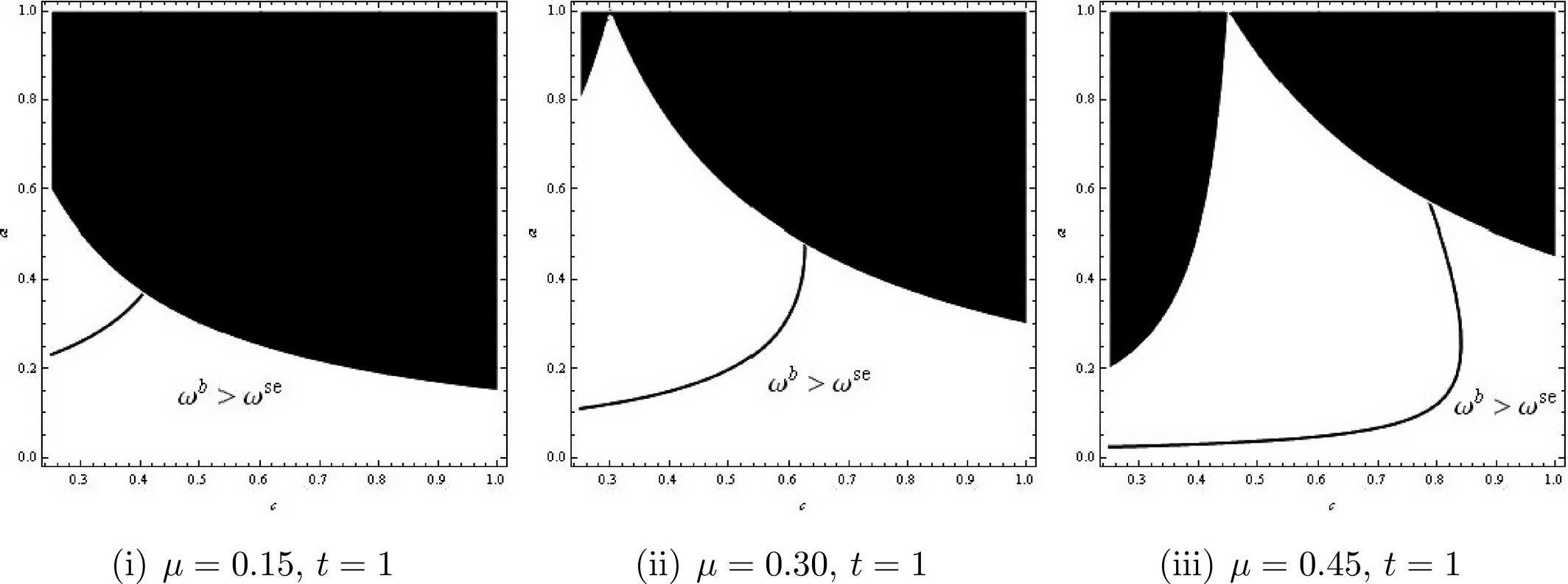
Consumer Welfare in the Balasubramanian Model (b) Relative to that in the Salop Model with Online Stores (se)
Proposition 6 is important and surprising. It shows that the consumer welfare‐increasing effect of mitigating online disutility costs from proximity to traditional retail stores in the Salop model with online stores (se) overcomes the consumer welfare‐increasing effects of competition on prices in the Balasubramanian model (b), at lower levels of the online disutility costs. As online disutility costs increase, the effects of competition are greater than those of mitigation over an increasingly greater range of the parameter space. Consequently, mitigation is only consumer welfare‐increasing if the marginal drop in mitigation (a) is low and the maximum mitigation (ac) is high.
It is also possible to show that in the Balasubramanian model with retailers selling online (br), consumer welfare increases because both competition and expanded presence works to lower both traditional retail and online prices (see Equation 28). Putting the relations together over the different market configurations, we have

The Effects of Mitigation of Online Disutility Costs
We first examine the effects of competition and compare these effects with those of an expanded presence online. We begin with a conclusive theorem that shows online competition from a pure e‐tailer (Balasubramanian model with retailers selling online, br) decreases social welfare relative to the expanded presence from the Salop model with online stores (se).
Compared to the Salop model with online stores, Balasubramanian model with retailers selling online decreases social welfare.
This proposition is important and surprising because it shows that social welfare in the Salop model with online stores is reduced by online competition from a pure e‐tailer. It is also a strong theorem in that it does not depend on conditions outside the two model's solutions. The reason welfare is reduced is because net of prices—traditional retail and online profits do not enter into social costs—consumers located far from a dual‐channel retailer purchase from the pure e‐tailer and do not benefit from mitigation of their online disutility costs as they would if they purchased from a retailer's online store. In other words, if only traditional retailers have online stores (Salop model with online stores (se)), then the online disutility costs are always mitigated for consumers that purchase online. The reversal of the effects on costs, total versus social, from Proposition 2 is because prices fall with online competition between dual‐channel retailers and a pure e‐tailer (see Equation 28), and more than offset the differences in transportation and online disutility costs.
Next, we compare social welfare in the Balasubramanian model (b) with that from the Salop model with online stores (se).
If fixed online disutility costs are high and the marginal drop in mitigation is low, then social welfare is higher in the Balasubramanian model than in the Salop model with online stores.
We show the result numerically through constraint plots in Figure 11. Without loss of generality, we normalize the unit transportation cost to unity, t = 1. By construction t > a, so that the marginal drop in mitigation with distance from Equation 1 is a < 1. We increase μ successively moving from Figure 11a to c. The shaded areas reflect our constraints: the market share condition from Equation 12 as well as the constraints on the mitigation parameters in Equation 2. As μ increases across Figure 11a through c, when a is low, then

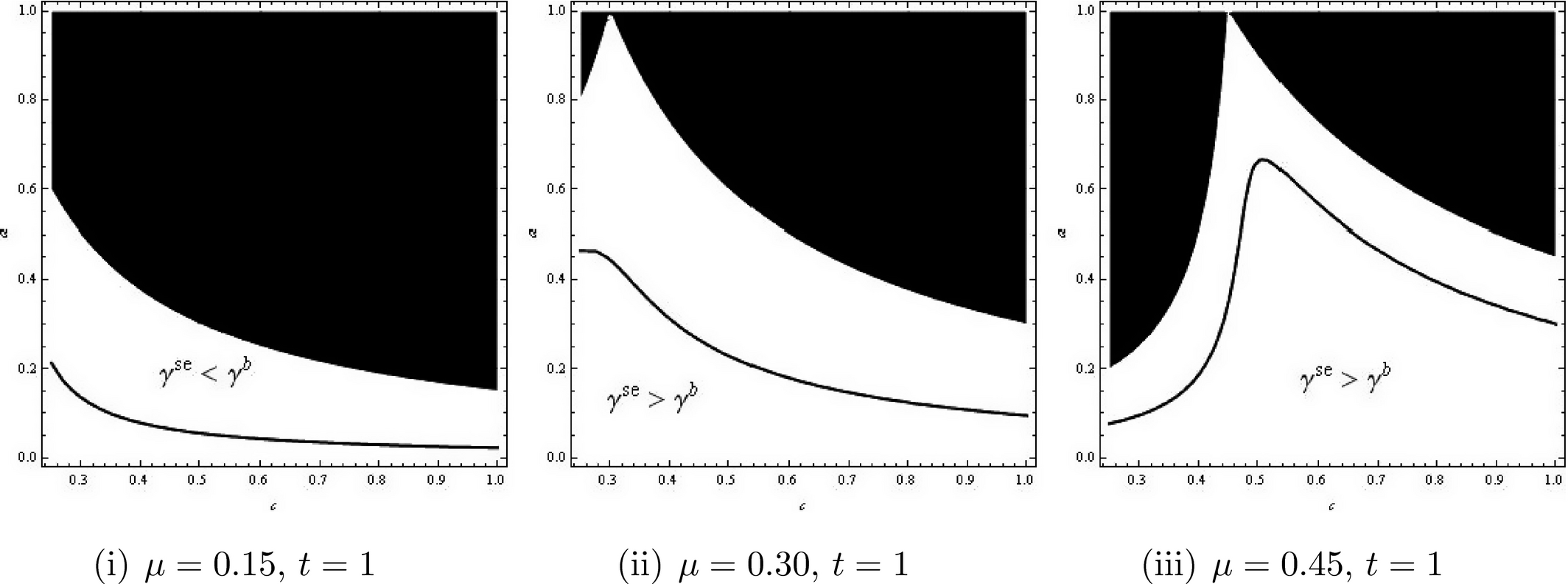
Social Welfare in the Balasubramanian Model (b) Relative to that with the Internet Channel in the Salop Model (se)
Proposition 8 is important and very surprising. It shows that competition between a pure e‐tailer and traditional retailers (Balasubramanian model (b)) can only increase social welfare relative to the expanded presence and consequent mitigation of online disutility costs from the Salop model with online stores (se) if online disutility costs are high and the marginal mitigation is low. Otherwise, the mitigation of online costs for all consumers that purchase online in the Salop model with online stores dominates the market share effects of competition with a pure e‐tailer. This occurs because when price is excluded, the calculation of social costs is based on transportation costs and online disutility costs. Examining the premise of the theorem, a high marginal drop in mitigation of online disutility costs with distance favors the online stores of dual‐channel retailers relative to the pure e‐tailer in terms of lower social costs. Moreover, a high marginal drop in mitigation also increases the maximum mitigation of online disutility costs, which reduces the net online disutility costs incurred by consumers.
Our last proposition compares social welfare in the Balasubramanian model (b) to the Balasubramanian model with retailers selling online (textitbr).
If fixed online disutility costs are high, social welfare suffers with competition among online stores, unless the mitigation is high.
We show the result numerically through constraint plots in Figure 12. Without loss of generality we normalize the unit transportation cost to unity, t = 1. By construction t > a, so that the marginal drop in mitigation with distance from Equation 1 is a < 1. We increase μ successively moving from Figure 12a to c. The shaded areas reflect our constraints: the market share condition from Equation 19 as well as the constraints on the mitigation parameters in Equation 2. As μ increases across Figure 12a through c, when a is low, then

Social Welfare in the Balasubramanian Model (b) Relative to that in the Extended Balasubramanian Model (br)
Reflecting the result from Proposition 7, the premise in Proposition 9 is weaker than that in Proposition 8. Proposition 9 is important in that, exclusive of prices, the society incurs greater social costs with the addition of traditional retailers selling online beyond a pure e‐tailer if online disutility costs are high and mitigation is low. Otherwise, we find social welfare benefits from competition online between a pure e‐tailer and dual‐channel retailers. This is due to the extended presence of traditional retailers' online stores and the mitigation of online utility costs that results. Thus, social costs are lower because more consumers mitigate their online disutility costs.
Focusing on the effect of mitigating online disutility costs, if online disutility costs are not high and marginal/maximum mitigation is high, then combining the results of Propositions 7, 8, and 9, together with those from Propositions 3 and 4 related to the Salop model we have

Conclusion
Our goal is to examine competition between dual‐channel retailers and online stores when having a traditional physical store can mitigate the online disutility costs that consumers incur purchasing online. The mitigation of these online disutility costs is based on a traditional retail store engendering greater trust, opportunities for inspection, returns and support when consumers purchase online. To examine this competition, we extended two paradigm models—the Salop (1979) “circle around the lake” model and the Balasubramanian (1998) “pure e‐tailer in the center” model—to include traditional retailers expanding their presence by selling online. We specified how consumers' online disutility costs are mitigated if they purchase online from these dual‐channel retailers. We compared the four models from the perspective of prices, profits, consumer welfare, and social welfare. In this, we juxtaposed the effects of competition from a pure e‐tailer with those of an expanded presence of traditional retailers selling online.
We divided the effects of the expanded presence of traditional retailers online and the consequent mitigation into three broad themes. First, examining the effects of online stores, we find that expansion online is rarely profitable for traditional retailers as it can increase competition, but at the same time consumer welfare increases both because of prices and due to mitigation of online disutility costs. However, when the price reduction from competition is stronger, then traditional retailers online can increase social costs. This is because as more consumers choose to purchase online to benefit from lower prices, they incur the disutility costs which net of mitigation can be higher than the alternative transportation cost.
Second, studying the impact of disutility costs of purchasing online, we find that when such costs are high, the expanded presence of traditional retailers online increase prices in traditional stores and online relative to when facing competition from a pure e‐tailer. The mitigation of online disutility costs is insufficient to offset higher prices, and consumer welfare is lower. Indeed, consumers benefit from an expanded presence of traditional retailers online only when online disutility costs are low enough that together with mitigation they dominate increased prices.
Third, researching the effects of mitigating online disutility costs through proximity to a traditional store, we find that after an expanded presence of traditional retailers online, competition from a pure e‐tailer lowers social welfare as price competition causes some consumers to purchase from the pure e‐tailer and forgo the mitigation of online disutility costs. Most importantly, if the mitigation of online disutility costs is such that net disutility costs of purchasing online are low—due to low online disutility costs and/or higher marginal and maximal mitigation—then the expanded presence of traditional retailers online can increase social welfare. These latter results show the social value of traditional retailers mitigating online disutility costs.
The key element of our formulation, and the element responsible for our results, is the partial mitigation of online disutility costs when consumers purchase online from a seller that also has a traditional retail store. Others have obtained some pricing results similar to ours, however these results usually are a consequence of including consumer search to resolve price uncertainty as part of the model formulation (see Lal and Sarvary 1999), and higher prices can be maintained because of the cost of additional search. Similarly, higher prices and consumer welfare can be maintained from vertical strategic interactions—through integration and double marginalization—between an upstream manufacturer and downstream retailers within a mixed channel system (see Yoo and Lee 2011). As we noted earlier, Jeffers and Nault (2011) find that a pure e‐tailer opening up a traditional store can increase prices and profits across retailers, stifling competition between online and traditional stores, making consumers worse off—without mitigation, multiple online stores are not profitable. Thus, explicitly modeling the partial mitigation of online disutility costs based on distance from a traditional store is at the heart of the technical contribution of our work, and at a more general level, the mitigation is responsible for the expanded presence of traditional retailers.
In terms of managerial implications, as many traditional‐turned‐dual‐channel retailers are trying to strategically leverage their physical locations (e.g., Macy's, Walmart, Nordstorm), our analysis would help them comprehend when and how different types of market structures benefit them. For example, when the disutility of purchasing online is high, dual‐channel retailers can benefit from keeping the competition among themselves — thus, be able to charge higher prices in both channels than just operating traditional stores in the presence of an e‐tailer. Also, by leveraging the linkage with the physical store, that is, utilizing the mitigation for the online purchases, they may marginalize pure e‐tailers. Along the same line, our analysis provides guidance to pure e‐tailers about when to seek linkages with physical locations — after all, as mentioned above, many historically pure e‐tailers are changing their business models. Our results may also inform policy makers as the retail sector is slowly bracing for mergers and acquisitions (Thau 2015).
The limitations of our analysis are similar to those in previous related studies. Consumers in our model do not differ in their online disutility costs, and a significantly more complex model would result if consumers differed in their online disutility costs—in effect another dimension of differentiation beyond the spatial one in the Salop model. In addition, we do not explicitly model the sequence of entry decisions. We assume at the start that transportation costs and fixed entry costs are such that the Salop model is in equilibrium with two retailers and compare this with market structures where either both traditional retailers sell online and/or when a pure e‐tailer sells online.
We recognize that what we observe in practice is the result of a complicated history that cannot be parsimoniously modeled in a standard entry game. As we show in an online appendix, an entry game with two identical retailers sequentially deciding whether to open an online store followed by a pure e‐tailer does not lead to an equilibrium where all decide to compete online—when it is profitable for a pure e‐tailer to enter with two traditional retailers online, the intensity of online competition causes one or both traditional retailers to have been more profitable staying offline, and in the sequential game they do not enter. In contrast, a common market structure we observe in practice is multiple traditional retailers online (our Figure 1) together with a pure e‐tailer like
Of course, 20 years of retail e‐commerce has seen dramatic changes in technology such as search, visualization, broadband penetration, and most recently mobile. There have also been fundamental changes in payment services and security, and in postal/courier delivery services. Together with this, there has been much entry and exit in the traditional retail and online retail marketplace, with changes in both vertical and horizontal integration as well as electronic markets and auctions. What we observe in practice might result from an entry game model if a more elaborate characterization of changes described above were formulated as asymmetries in online fixed costs or marginal costs of online order processing and distribution for traditional retailers, or as additional dimensions of differentiation. However, a formulation that characterizes history in such a way as to produce the desired equilibrium simply to justify studying properties of the equilibrium is of limited usefulness.
Footnotes
Acknowledgments
We thank Jian (Ray) Zhang for research assistance and Jeanette Burman for editing assistance. We also thank the participants at the 2013 Theory on the Economics of Information Systems (TEIS) Workshop for valuable comments, especially the discussant Marius (Florin) Niculescu. Finally, we thank the Department Editor, Subodha Kumar, for his persistance through the various revisions of our work. This work was supported by grants from the Natural Science and Engineering Research Council of Canada, the Social Science and Humanities Research Council of Canada, together with the Robson Professorship Endowment, the Informatics Research Center, and the Center for the Digital Economy.