






Abstract
Migraine costs European Society ¬27 billion per year. Other headaches may account for a similar amount. Given this enormous impact, the question arises as to whether the funding of research efforts in this field are sufficient. A recent European study called the Resource Allocation to Brain Research in Europe (RABRE) examined funding of brain research. Identified charities and Government agencies in Europe filled out a questionnaire regarding their funding of brain diseases. Industry spending was evaluated by three different previously validated methods. In the present report, detailed results are presented for migraine and other headaches. In 2004, migraine research was funded by nearly €315 million. Of this, €308 million was invested by the pharmaceutical industry, whereas public funding was estimated at €7 million. No funding was identified for non-migraine headache disorders. Of the public spending, €714 000 came from private foundations. There was a very large difference between different European countries in the funding of headache research. When public funding was compared with the cost of different brain disorders, migraine funding was in the middle range. This was due to relatively large industry funding. Compared with societal costs, migraine received the least public funds amongst all brain disorders, i.e. 0.025%. We conclude that migraine attracts reasonable interest from the pharmaceutical industry, but Governmental and charity funding is extremely low and no funding was identified for non-migraine headache disorders. Considering the huge economic impact of these disorders, public funding of research into migraine and other headaches should be greatly increased in the future.
Introduction
There has been very little focus on how resources are allocated to different sectors of research. Recently, the European Brain Council (EBC) together with the research organization European Health Economics (EHE) conducted a large study entitled Resource Allocation to Brain Research in Europe (RABRE) (1).
Resource allocation to migraine and other headaches was estimated but, because of the broad scope of the study, only limited data could be presented. The present report gives a more detailed account of the funding of research into migraine and other headaches in Europe. It also compares these results with other brain diseases and with the resource allocation in the USA. Furthermore, the data are compared with the cost and burden of migraine and other headaches. With the goal of providing data that could aid decision makers in developing European and national research plans, we hypothesize that funding of research into migraine and other headaches is low compared with the impact of those disorders.
Methods
For a detailed description of the methods, reference is made to the RABRE publication (1). In brief, the RABRE study examined all known sources of funding of brain research including governmental grants, charitable giving and industry support. To estimate public spending, a survey was conducted that evaluated the way brain research is funded across Europe. By directly contacting the primary sources of research funding, the estimate represented the money spent by European institutions rather than the actual total research investments at European research institutions. The latter may include research funded from outside Europe, e.g. the National Institutes of Health (NIH) in the USA. Estimates were made for countries with insufficient response rates to account for omitted data. Country- and disorder-specific spending was extrapolated from the data received.
Industry funding was assessed using three different approaches: (i) a worldwide survey of pharmaceutical expenditure according to disease area issued by the Centre for Medicines Research (2); (ii) the published cost of developing a new drug and applying that cost to the number of new chemical entities launched in Europe in recent decades (3); and (iii) the share of total R&D expenditure by pharmaceutical companies for brain diseases that have entered the market between 1985 and 2004 (4). Disorder-specific expenditures were estimated based on the share of brain disorder-specific drugs that have entered the market.
A more extensive description of methods has been given in the general European publication (1).
Results
The overall results of the RABRE study are presented in Fig. 1.
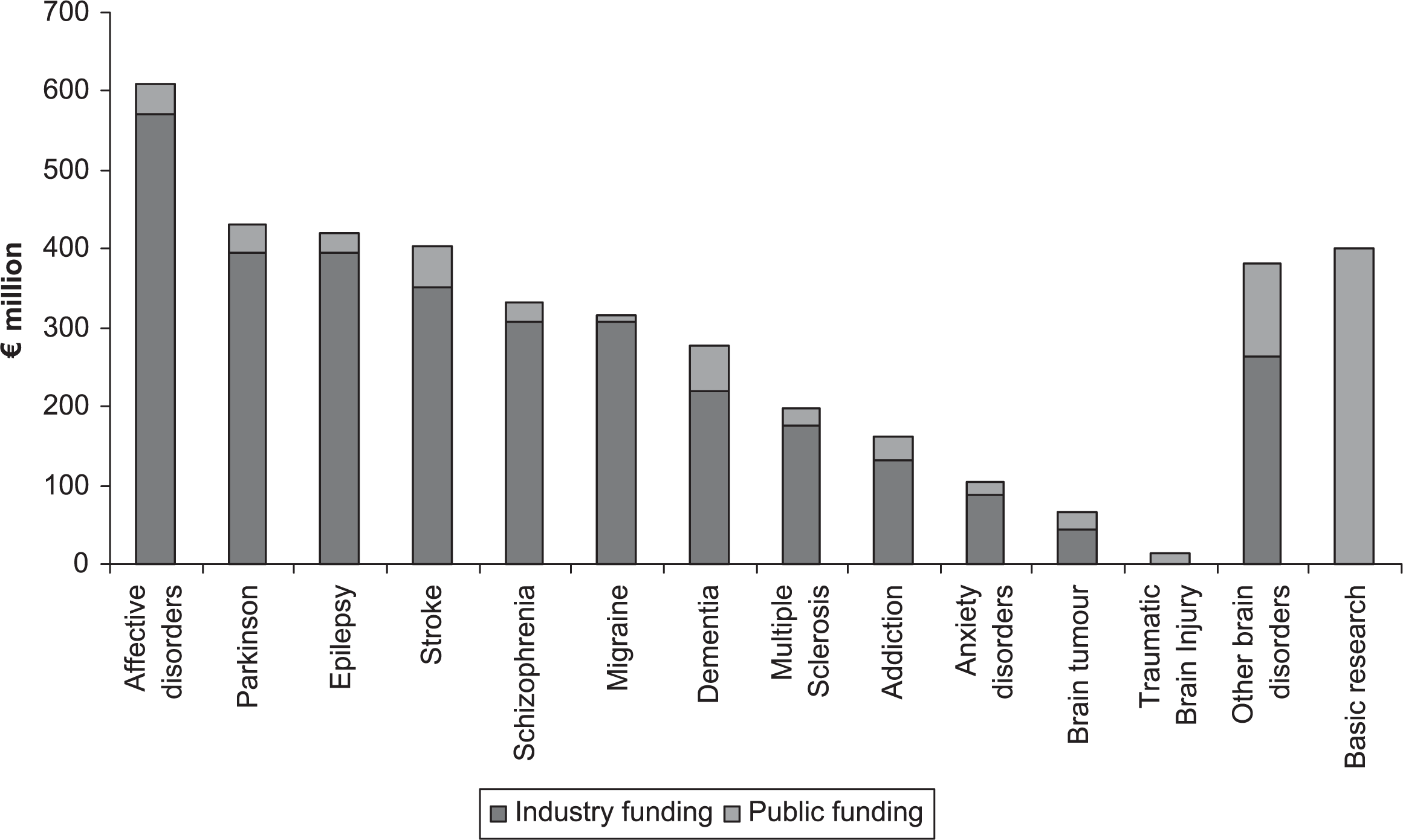
Distribution of total brain research spending by group of disorders in Europe (2005).
Migraine is in the middle range of funding of brain disorders with an annual funding of 315 million Euros. Private, i.e. industry, funding at €308 million predominates. Public funding is €7 million. No funding was identified for non-migraine headache disorders. Sources of public funding, divided between Government funding and charity giving is displayed in Fig. 2.

Public migraine research funding in Europe (2005).
While Government funding is small with €6 million, charity funding is almost non-existent (€0.7 million). Private (industry) funding is distributed to different diseases and here migraine funding is in the middle range (Fig. 3). Other headaches do not appear in these figures because no public or private funding could be identified.
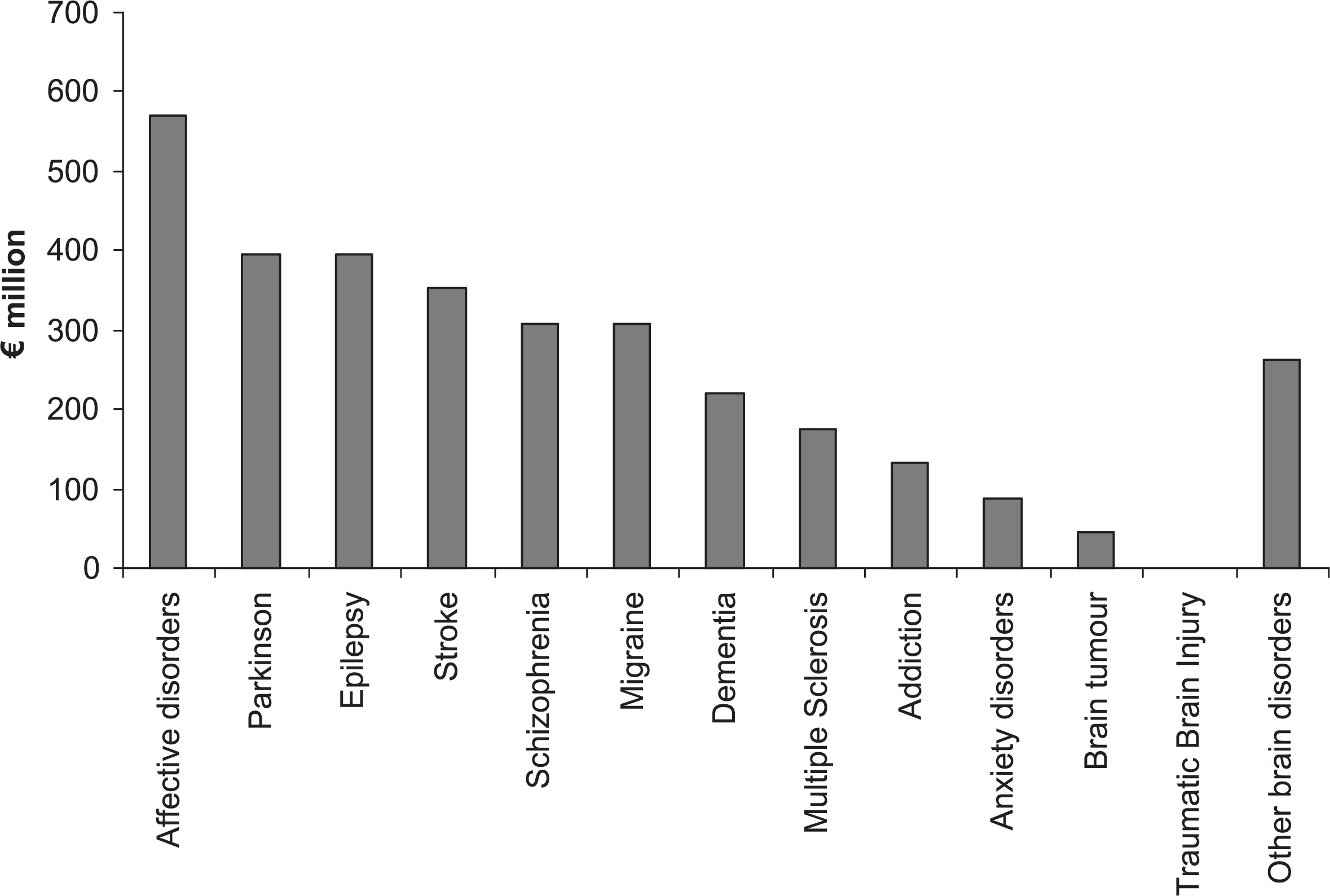
Industry funding of brain research by disease areas in Europe (2005).
Fig. 4 shows public migraine funding in different European countries. Approximately 2/3 of these data have been imputed on the basis of numbers from countries where information was available.
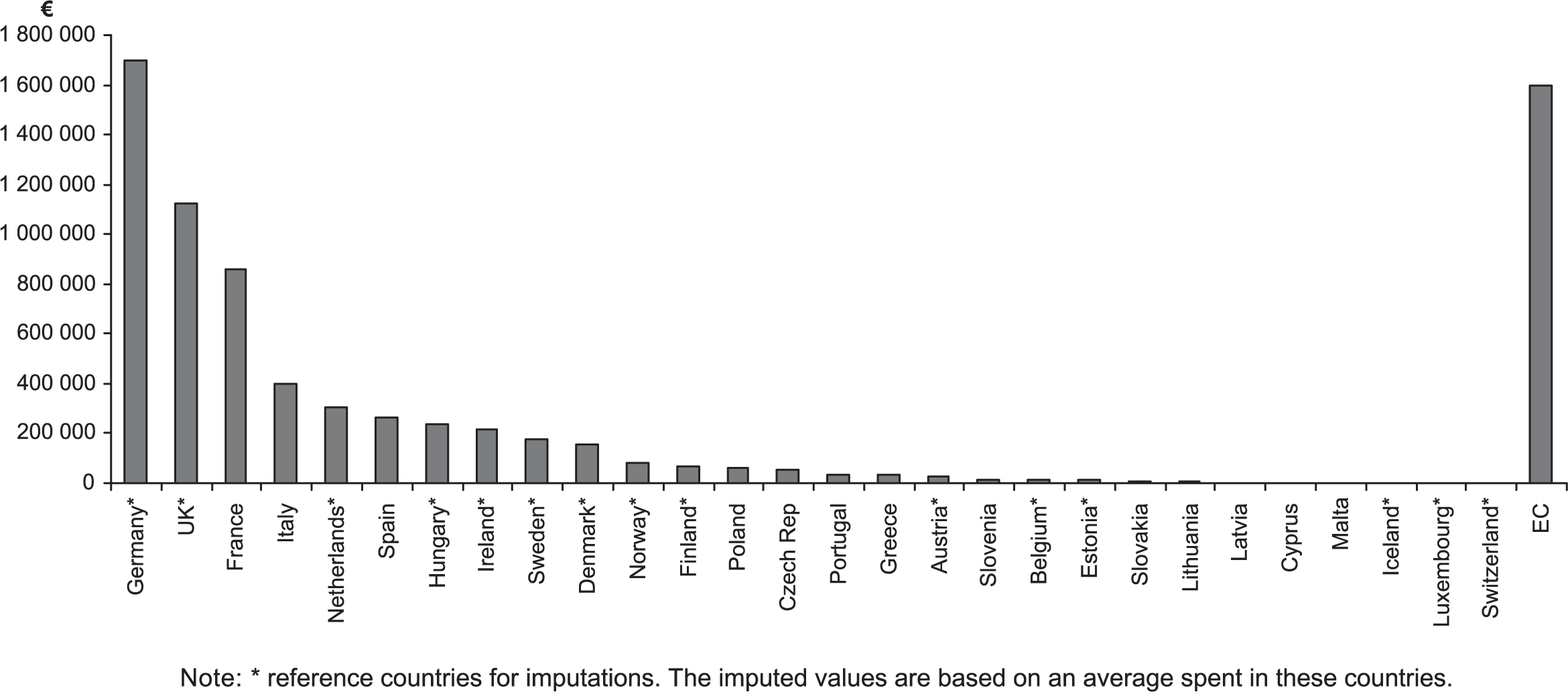
Public spending on migraine research per country (2005).
It can be seen that public spending is low and totally absent in most countries while EU has awarded one major grant. Fig. 5 shows 3 different estimates for private (industry) funding of migraine research.

Industry expenditure on migraine research by estimation method in Europe (2005).
The different approaches are described under methods. Fig. 6 shows the public funding of brain diseases relative to the cost of those diseases. Migraine shows the lowest ratios of funding to cost (0.025%).

Total public funding of brain disorders as percentage of costs in Europe (2005).
Finally, a comparison to the resource allocation in the United States for public funding was not attempted. No public funding of migraine was identified in the US in 2004.
Discussion
Good epidemiological studies of migraine and other headache disorders have appeared only within the last 15 years. They have consistently shown that migraine is a common disorder with a 1-year prevalence of around 10–12% and a lifetime prevalence of between 15 and 20% (5). More variable figures have been presented for other headaches, but chronic tension-type headache appears as a prevalent disorder causing much absenteeism from work and decreased working efficiency. The Cost of Disorders of the Brain in Europe study recently (6) analysed all European epidemiological data and arrived at a 1-year prevalence of migraine of 14%. Thus, out of 450 million Europeans, 41 million at any given time have migraine (age 18–65 years). The economic cost of migraine is estimated at €27 billion per year (6). No precise figures could be given for other headaches due to insufficient data, but it has been estimated (6) that the cost is at least equal to that of migraine. Thus, headache disorders combined may cost European society >€50 billion per year, which equals the cost of dementia or stroke.
World Health Organization (WHO) figures for the burden of brain disease in Europe have also been published (7). Migraine accounted for no deaths but for a loss of 1236 382 disability adjusted life-years (2002) (8). The latter is the composite index used by WHO to describe the burden of a disease. It represents the complete impact of a disorder and is thus different from health economic calculations. The two measures can be regarded as supplementary. In terms of disability, migraine ranks among the 20 most burdensome diseases in the world.
Given the impressive figures for prevalence, burden and cost, the question arises as to whether migraine and other headache disorders have received appropriate attention from researchers, granting bodies and healthcare decision makers. With regard to specialized care, this is clearly not the case. Worldwide, there are few dedicated academic headache centres. The level of care (and of reimbursement) offered to sufferers is much lower than for most other brain diseases. More relevant to the present study is the question of resource allocation to research into migraine and other headaches. Is this allocation reasonable or is it too small? The present study presents the first data that allow a meaningful discussion of this issue.
Non-migraine headaches
We could not identify any private or public resource allocation to non-migraine headaches.
The present European study probably failed to detect some national funding, but this is likely to be minimal and funding of other brain diseases is similarly underestimated. Non-migraine headaches are estimated to cost approximately the same as migraine.
Private (industry) funding of migraine
Due to the advent of a new class of acute migraine drugs called the triptans, private, pharmaceutical industry funding of migraine research has been relatively high for the last 20 years. Our results demonstrate decreasing investment in migraine research by industry. This worrisome trend runs counter to the suggestion that the prevalence of migraine may actually be increasing in modern society. It has not been possible to analyse to what extent private funding for migraine is spent on treatment for acute migraine or on prophylactic treatment. It is a general perception that prophylactic treatment has been neglected during the triptan wave and that major research investment is necessary to develop better prophylactic drugs with fewer side-effects.
Comparing private investment in migraine with investment in other diseases, some seem to attract greater interest (epilepsy and Parkinson's disease), whereas others attract equal or less interest (schizophrenia and dementia).
Public funding of migraine
Public funding for migraine is extremely low. As regards the charitable sector, most countries in Europe have not reported any funding of migraine research and, as discussed above, no country has reported funding for other headache disorders. In general, charitable funding for migraine is found mostly in the UK. Governmental funding of migraine is also very low and in several countries in Europe there is no funding. When public funding is compared with economic cost, migraine is the most poorly funded of all brain diseases. Migraine is the only disorder where the public funding situation in the USA is worse than in Europe. No grants for migraine research from the NIH were listed in 2004. In almost all other fields, NIH funding exceeds European funding by several fold (9). Recently, the NIH has made a call for migraine research.
Concluding remarks
On the basis of the present results, we verify our hypothesis that headache research is underfunded. Relative to its cost, migraine is the poorest funded of all brain disorders. Private industrial funding is only moderately below average, but public funding is close to non-existent. The WHO has recently launched the ‘Global Campaign to reduce the burden of headache’ in recognition of the very considerable impact of headache disorders (10). With the current figures available, the Global Campaign to reduce the burden of headache should be followed up by a global campaign to increase the funding of research into migraine and other headache disorders.
Acknowledgements
The European study on which the present paper is based was funded by the European Commission grant 013043.