





Abstract
Headache is one of the most common types of pain and, in the absence of biological markers, headache diagnosis depends only on information obtained from clinical interviews and physical and neurological examinations. Headache diaries make it possible to record prospectively the characteristics of every attack and the use of headache calendars is indicated for evaluating the time pattern of headache, identifying aggravating factors and evaluating the efficacy of preventive treatment. This may reduce the recall bias and increase accuracy in the description. The use of diagnostic headache diaries does have some limitations because the patient's general acceptance is still limited and some subjects are not able to fill in a diary. In this review, we considered diaries and calendars especially designed for migraine and, in particular, we aimed at: (i) determining what instruments are available in clinical practice for diagnosis and follow-up of treatments; and (ii) describing the tools that have been developed for research and their main applications in the headache field. In addition to the literature review, we added two paragraphs concerning the authors' experience of the use of diaries and calendars in headache centres and their proposals for future areas of research.
Introduction
Headache is one of the most common types of pain (1–4). Different headache subtypes can be classified according to the criteria defined by the International Headache Society (IHS) in the International Classification of Headache Disorders (2nd edition) (ICHD-II) (5). In the absence of biological markers, headache diagnosis depends only on information obtained from clinical interviews and physical and neurological examinations. In clinical practice, patients often have difficulty recalling precisely the headache characteristics, especially if they have several types of headache. The episodic nature of the disease causes a bias towards the most severe or recent headache attacks. Moreover, some difficulties are related to the headache syndromes themselves, because clinical features may change during the course of the attacks and from one attack to another. Some situations (i.e. headaches in children or aura symptoms) imply specific problems and require specially designed tools.
Headache diaries and calendars make it possible to record prospectively the characteristics of every attack and this may reduce the recall bias and increase the accuracy of the description.
In this review, we considered diaries and calendars specially designed for headache and, in particular, we aimed to: (i) determine what instruments are available in clinical practice for diagnosis and follow-up of treatments; and (ii) describe the tools that have been developed for research and their main applications in the headache field.
Methods
In our review of the literature, we considered only English-language articles published in scientific journals and chapters of English-language books. We searched the articles through Pubmed using the queries ‘Headache’ [Mesh] and ‘Medical Records [Mesh], ‘Migraine’ [Mesh] and ‘Medical Records’ [Mesh], with no limits for year of publication. For every selected article, we first evaluated the abstract to determine its relevance to the subject under review and then searched the full text. We read through the references of the articles to identify any other relevant publications. Given the widely different methods used in the studies, we did not set in advance any validity criteria for the articles considered. In addition to the literature review, we added two paragraphs concerning the authors’ experience on the use of diaries and calendars in headache centres and their proposals for future areas of research.
Diagnostic headache diaries for general use
Diagnostic diaries are used on a daily basis, to collect detailed information on the headaches. Data are normally recorded every evening on a day with headache and should be sufficient to classify the attack according to ICHD-II. Diagnostic diaries are normally used for ≥1 month until a clear picture of the patient's headache diagnoses and drug use has been obtained.
In a sample of 61 migraine patients [23 with migraine and 38 with migraine and tension-type headache (TTH)] receiving clinical care in 1990 in a headache research unit, Russell et al. (6) evaluated a diagnostic headache diary filled in for 4 weeks or more. The diary, developed by one of the authors, had already been improved during 2 years of practical use prior to the study. Patients received the diary at the end of the visit and were instructed by physicians on how to use it. At the second visit, the headache recordings were evaluated with the patient. The diary was designed to provide clinical features necessary to diagnose TTH and migraine according to the 1988 IHS classification (7). In the diary patients had to record the date on which the headache occurred, start and end time of the attack, any aura symptoms (simplified vs. classification), quality, location and intensity of pain, aggravation of pain by physical activity, accompanying symptoms—nausea, photophobia and phonophobia—graded at none, mild, moderate and severe, and precipitating factors. Furthermore, the patients were requested to record all drugs taken (including simple pain killers) and the exact time of intake (Fig. 1). The diagnostic headache diaries were blindly examined by different observers and the diary diagnoses were compared with the clinical diagnoses established at the first visit. The authors state that there were no difficulties in interpreting the diagnostic headache diaries and the two observers always made the same IHS diagnoses. Data analysis shows that: (i) all patients with a clinical diagnosis of migraine had at least one headache attack fulfilling the IHS criteria of migraine; (ii) the diagnosis of episodic TTH was less frequent at the clinical interview than in the diagnostic diary; (iii) the diagnosis of chronic TTH was overestimated at the clinical interview compared with the diagnostic diary; (iv) at the clinical interviews, patients reported accompanying symptoms more frequently than in the diaries; (v) more diverse types of headache were reported in the diaries than at the clinical interviews; and (vi) headache fulfilling all but one IHS criteria for migraine and TTH and headache not classifiable was diagnosed only with the diary.

Danish diagnostic headache diary (6).
The Danish diagnostic headache diary has also been adapted to an electronic format (8) to be used for education purposes or as a diagnostic tool for general practitioners (GPs). The electronic diary is divided into four modules: patient's data, diary, medication and diagnosis. The diary page resembles the paper version (6); the medication page is intended as an additional window for entering specific information about medication when there is not enough space left on the diary page and the diagnostic module provides a diagnosis based on the 1988 IHS classification (7). The implemented diagnoses are migraine without aura, migraine with aura, migraine aura without headache, migrainous disorders, TTH, tension-type-like headache and headache not classifiable. The diagnostic diary was tested and validated, even if the authors did not provide specific information about the procedure. Comparison of computer-generated diagnoses with the clinical diagnoses showed full agreement.
In pre-IHS years, Porter et al. (9) developed a headache chronicle—a booklet in which patients record pain, treatment, interference with activities, nausea and personal feelings on a day-to-day basis over a 4-week period. The aim was not to diagnose a specific form of headache, but to provide assistance to the physicians, to provide insight to patients about the influence that emotional and environmental factors have on the occurrence of their headaches and to study the natural history of headaches. To test the diary the authors mailed the chronicle to 1148 headache patients, but only 234 subjects returned the booklet completed. The authors concluded that: (i) 38% of patients reported that the use of the chronicle was helpful and 69% thought that the information in the chronicle might be useful to their physicians; (ii) since the average level of headache pain and negative feelings decreased over the second 2 weeks for more than half of the sample, it is possible that daily reporting was therapeutic for some of the participants. The study did not provide any conclusive evidence, but it would be interesting to test the hypothesis that the diary may have a positive influence on the headache course.
Diagnostic headache diaries for specific patient categories
Diagnostic aura diary
Aura is a phenomenon that often frightens those who experience it and it is not always easy to obtain an accurate description of its symptoms. To reduce recall bias and increase the descriptive accuracy of aura and headache symptoms, Russell et al. (10) developed an aura diary based on the diagnostic criteria of the 1988 IHS classification (7). The diary was tested in a sample of 20 consecutive patients with a clinical diagnosis of migraine with aura who filled in the aura diary during at least one attack. The aura diary consisted of three questionnaires covering visual and sensory disturbances and headache. Questions about speech disturbances were simplified. In addition, the aura diary included two sets of six figures for repeated recordings every 5 min of the patients’ visual and sensory disturbances. The physicians instructed subjects on how to use the aura diary, which required completion during an attack of migraine with aura or migraine aura without headache. The prospective recordings provided very accurate descriptions of aura and headache, which cannot otherwise be obtained through a clinical interview. However, the diagnostic aura diary will probably be used mostly in scientific studies, because it is time consuming for both patients and physicians. Moreover, one patient stated that she found it agonizing to record the aura and headache, as it constantly reminded her of the attack. For this reason, despite their initial acceptance, some patients may fail to use the aura diary. Use of this tool could be proposed for the diagnosis of uncertain cases.
Headache diary for children
Collecting accurate information about headache features in children and adolescents is even more difficult than in adults. In a sample of 218 children aged 8–13 years (84 with migraine, 67 with non-migrainous headache and 67 with no headache), Metsähonkala et al. (11) evaluated a modified version of the diary designed by Russell et al. (6). In this version, the questions about nausea, vomiting and loss of appetite were asked separately; intensity of pain was described both with words and numbers; and features other than intensity of pain were not graded. The children were advised to fill in the diary during or shortly after every headache episode and they completed the diary for at least 2 months. The diary data were consistent with the interview data in 60.8% of children. The mean duration of attacks in the diary was significantly longer than the average duration reported in the interview, while there were no significant differences in reported frequencies between interviews and diaries. Thirty-six children reported both migraine attacks and other headache attacks in the diary, but only three were able to report in the interview that they had several types of headaches. In nine children it was possible to diagnose migraine only in diary records; the reasons for exclusion of these children from the migraine group, according to the interview, were inaccurate reporting of headache duration, associated symptoms and aura symptoms. There were also several children who did not report migraine attacks fulfilling the IHS criteria in the diary, even though they had migraine according to the interview. Based on such data, headache diaries can give important additional information on duration of headache episodes, aura symptoms and characteristics of pain for different types of headache in the same children. The authors suggested that at least a 2–3-month follow-up period was needed when dealing with unselected populations. Another study (12) showed a tendency to overestimate the duration and severity of headache episodes in clinical interviews compared with diaries.
A study conducted in pre-IHS years was designed to measure the validity of the pain intensity rating scale by assessing the degree of interrater concordance between a patient's self-rating of head pain and an outside observer's rating of the same pain using the same scale. The external observer would be rating only behavioural aspects of the pain, some of which would not necessarily be observed by the patient, e.g. facial pallor, flushing or glazed eyes. Sixteen children were selected for inclusion in this study according to the following criteria: (i) age 9–17 years; (ii) recurrent migraine headaches for at least the previous 3 months; (iii) headaches occurring at an average rate of once a week; (iv) no new medication within the previous 2 months; (v) headaches not linked to dietary factors, allergies, or the menstrual cycle; and (vi) no other neurological disorders or major medical problems. The results of this study provide some evidence for the validity of the headache diary as a measure of pain intensity for children with migraine headaches, but in some cases the compliance was rather poor (13).
Headache calendars
Once the diagnostic diary has been correctly filled in for a sufficient period of time and the first medical consultation is completed, it is possible to switch to the headache calendar (14) (Fig. 2). After patients have learned to distinguish between TTH and migraine or other headaches, they are generally able to fill in the calendar correctly. As with epilepsy and other periodic disorders, the use of such a calendar is invaluable in the long-term adjustment of the prophylactic strategy. The calendar is much easier to keep for the patient than the diary and can be carried in a notebook. It contains information from a whole year in one card and the evolution over time and the response to prophylactic treatment or cessation of daily intake of analgesics can easily be assessed. It is also a very important tool in the direct dialogue with the patients with respect to annual variations, treatment and evolution. Many patients continue with the calendar after discharge from the clinics. There are no specific studies on this topic.

Danish headache calendar (14).
Applications of headache diaries and calendars
Diagnostic diaries and calendars have proved helpful also in specific areas of scientific research: (i) drug trials; (ii) headache pathogenesis; (iii) clinical characterization of migraine; (iv) relation between migraine and physiological parameters (i.e. sleeping behaviour and female reproductive events); (v) communication between patient and physician. In drug trials, diaries and calendars are generally used to evaluate the characteristics and frequency of headache attacks in the run-in period and the response to symptomatic and preventive treatments (15–17). In studies on headache pathogenesis comparing patients and headache-free controls, the use of a headache diary was accidentally helpful also in demonstrating that controls do not always prove so ‘headache free’ as they are assumed to be (18). In particular, 34.2% of ‘headache-free’ controls reported multiple headache days in their headache diaries. Many studies have used general diaries or modified diaries tailored to specific objectives to describe the clinical features of migraine. In Giffin et al.’s 3-month multicentre study, electronic diaries were used to record non-headache symptoms before, during and after migraine. Data recorded included non-headache symptoms occurring during all three phases of migraine, prediction of the attack from premonitory symptoms, general state of health and action taken to prevent the headache (19). Chabriat et al. screened prospectively some precipitating factors of headache in migraineurs and non-migraineurs. The participants kept a diary for a 3-month period and precipitating factors were reported for each headache attack. Moreover, headache intensity was self-assessed during each headache attack using a visual analogue scale of 0–100 (20).
Diaries have proved indispensable to investigate the relationship between migraine and several physiological parameters. The coherence of sleeping behaviour and the occurrence of migraine attacks were described in a study based on migraine and sleeping diaries (21). The recurrence of migraine related to female reproductive events (22–24) was investigated using prospective diary cards, which enable recording of headache features, menstruation, medication consumption (symptomatic/prophylactic) and hormonal treatment.
Recently, Spanish researchers evaluated the benefits of a structured migraine diary during a prospective open-label study of triptan-naive patients. The diary was used to record information on response to therapy for a prestudy migraine attack and for three consecutive migraine attacks treated with triptans or with the usual patient's therapy. Patients were given a diary containing three self-administered questionnaires, one for each of the three study attacks. Analysing the results of the study, the authors concluded that a structured migraine diary can be a valuable aid in improving communication between physicians and patients regarding migraine disability and treatment outcomes (25).
Personal experience
Danish Headache Centre
A procedure designed to increase accuracy requires that physicians send a detailed questionnaire and a diagnostic headache diary to all patients referred to the Danish Headache Centre at least 4 weeks before their first consultation (26, 27). Detailed instructions are included in a covering letter and patients are asked to complete the diary in the following period and bring the information with them at the first consultation. This strategy gives the patients time to think and obtain important information about their previous admissions, headache evolution, their former and present treatment and, most important, to record their headaches and their drug intake in a prospective, daily manner. Having this information saves valuable time, improves the diagnostic process and facilitates treatment planning considerably.
Pavia Headache Centre
General diary
In the Headache Centre in Pavia, we have developed, in accordance with the criteria of the ICHD-II (5), a headache diary for migraine and TTH (Fig. 3a,b). The diary includes an explanatory page, a page that shows an example of a filled-in diary (to make compiling the diary easier) and then one page per month to be filled in. Full instructions are provided for compiling of each section of the diary. Our headache diary chart, used by 1000 patients, seems to be easy to fill in and provides the physician with a considerable amount of information about the headache. Furthermore, the headache diary highlights the periodicity of some attacks such as weekend headache, sleep-related headaches, shift-work headache and headache triggered by weather changes. With the new definition of chronic migraine and medication overuse headache in the ICHD-II (5), it is extremely important that diagnostic diaries are used for several weeks before an accurate diagnosis is established.
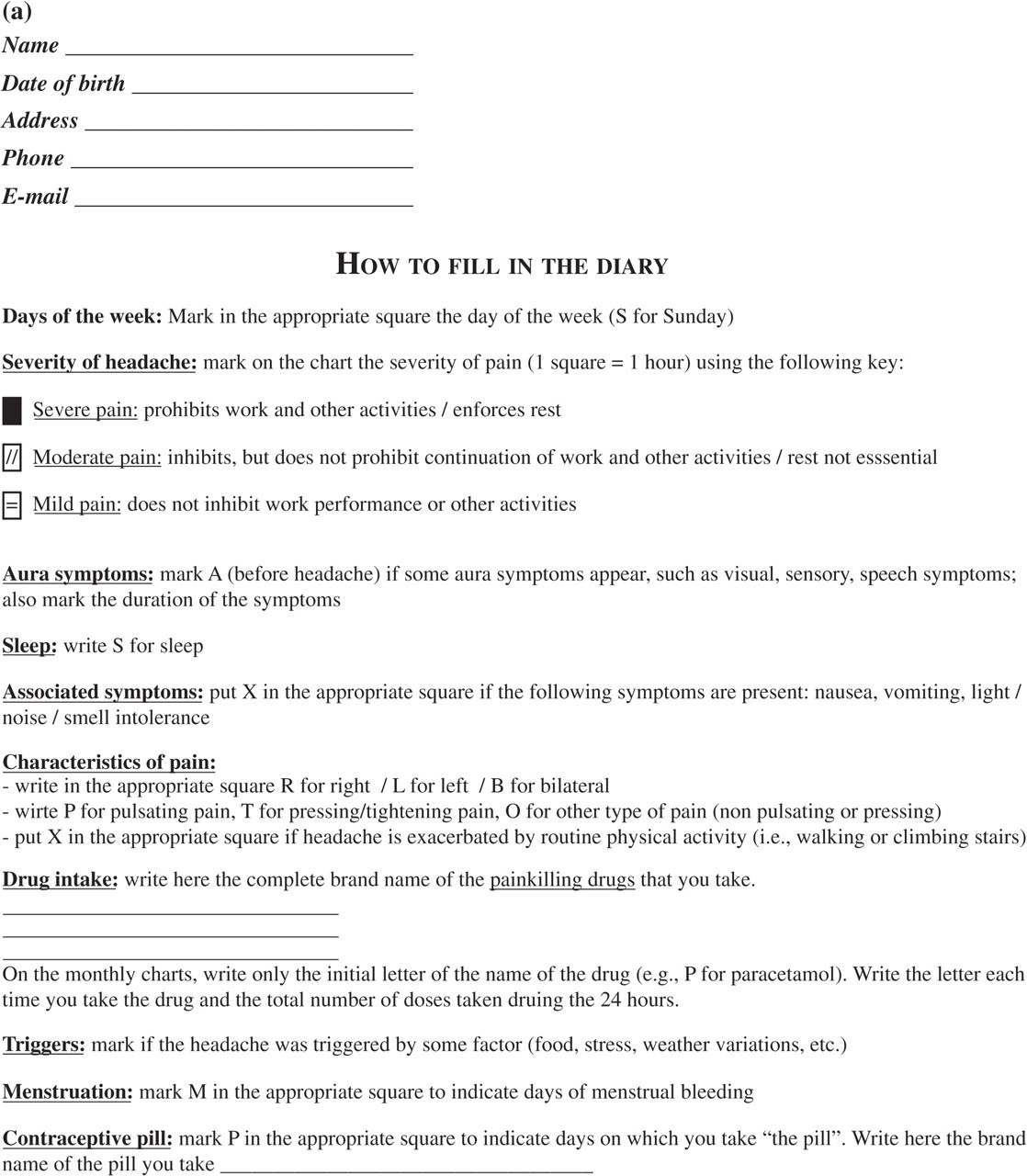
(a,b) Pavia Headache Diary.
Women's headache diary
In women, daily diaries and event logs should be highly detailed comprising menstrual cycle-related symptoms and use of sex hormones, whether for contraception, hormone replacement therapy or other purposes. Indeed, a complete record of the characteristics of menstrual bleeding may help researchers and clinicians to define subpopulations of women suffering from pure menstrual migraine and menstrually related migraine. The use of the diary is also useful in the monitoring of migraine attacks during pregnancy and menopause.
Figure 4 shows a women's headache diary that we have drawn up for the monitoring of headache attacks and specific information about menstrual cycle. This diary is used also to assess the neuroendocrine correlates of menstrual status migrainosus and menstrual migraine (28).

Women's headache diary developed by Pavia Headache Centre (28).
In addition, the concomitant use of a self-report daily scale, such as the calendar for premenstrual experiences by Mortola et al. (29), may be of help in efforts to establish the comorbidity of migraine with premenstrual syndrome. We have developed an Italian-validated modified version of Mortola's original calendar that allows one to detect in the days of menstrual cycles the presence, other than headache, of different symptoms (i.e. fatigue, irritability, depression, increasing appetite, wishing to be alone, etc.) (30).
Web diary
Over the past year we have developed a web version of the diary (31), which is very useful for patients who use the internet and allows a clinical monitoring of the patient both prior to the medical examination and during the symptomatic and preventive course of treatment prescribed as a result of it (Fig. 5). It is possible to download the ‘e-diary’ from the internet. This diary contains the same items as the traditional ‘paper’ version and applies the same criteria for assessing the parameters. Patients may send back the diary by e-mail. General statistics are worked out for each month in which the diary is kept (i.e. number of days/month with headache, number of headache attacks/month). This system makes it possible to create a bar chart that shows the headache attacks suffered in the course of the month, days of menstrual bleeding and, where applicable, days on which the patient took an oral contraceptive. For each month in which the diary is completed, a brief report is drawn up to be sent to the patient, which comments on the course/pattern of the headache.

Pavia Headache Centre e-diaries.
A computerized program is currently being added that will make it possible, taking the completed diaries as the starting point, to diagnose the type of headache (migraine and TTH), on the basis of the clinical characteristics reported.
The ‘e-diary’ has been tried out on a sample of patients and found to be easy for those who are used to using the internet.
Future proposals
On the basis of the published evidence and other experience, we plan to develop a relatively simple diagnostic headache diary for the classification of various headaches. This diary will be tested in several European headache centres and then, it is hoped, accepted as a European standard tool. The Eurohead group, furthermore, aims at developing diaries for special groups or purposes such as migraine aura, children, menstrual migraine, etc.
These diaries will also be validated against the gold standard in headache diagnosis, namely a clinical interview by a headache expert.
Computerized systems have already been introduced in clinical trials and in the Pavia centre with success. The online systems facilitate recording, reliability and data processing, but are also more costly and complicated than paper versions. It is planned to develop an electronic version of the future European diagnostic headache diary or diaries.
Conclusion
Filling in a diagnostic headache diary is helpful to identify the correct headache type and to describe accurately headache features and medications taken by patients (Table 1). It would be a major step towards homogeneous headache diagnoses if a European consensus about a diagnostic headache diary can be obtained.
Indication and limitation in the use of diagnostic headache diaries

Acknowledgements
Supported by the EU Eurohead (LSHM-CT-2004-504837).