






Abstract

Introduction:
Percutaneous endoscopic gastrostomy (PEG) tubes are one of the most commonly performed procedures for feeding access due to the ease of the procedure and the low rate of complications. 1 Ascites is a well-known relative contraindication for PEG tube placement and increases the risk for peritonitis and infected ascites. 2,3
Methods:
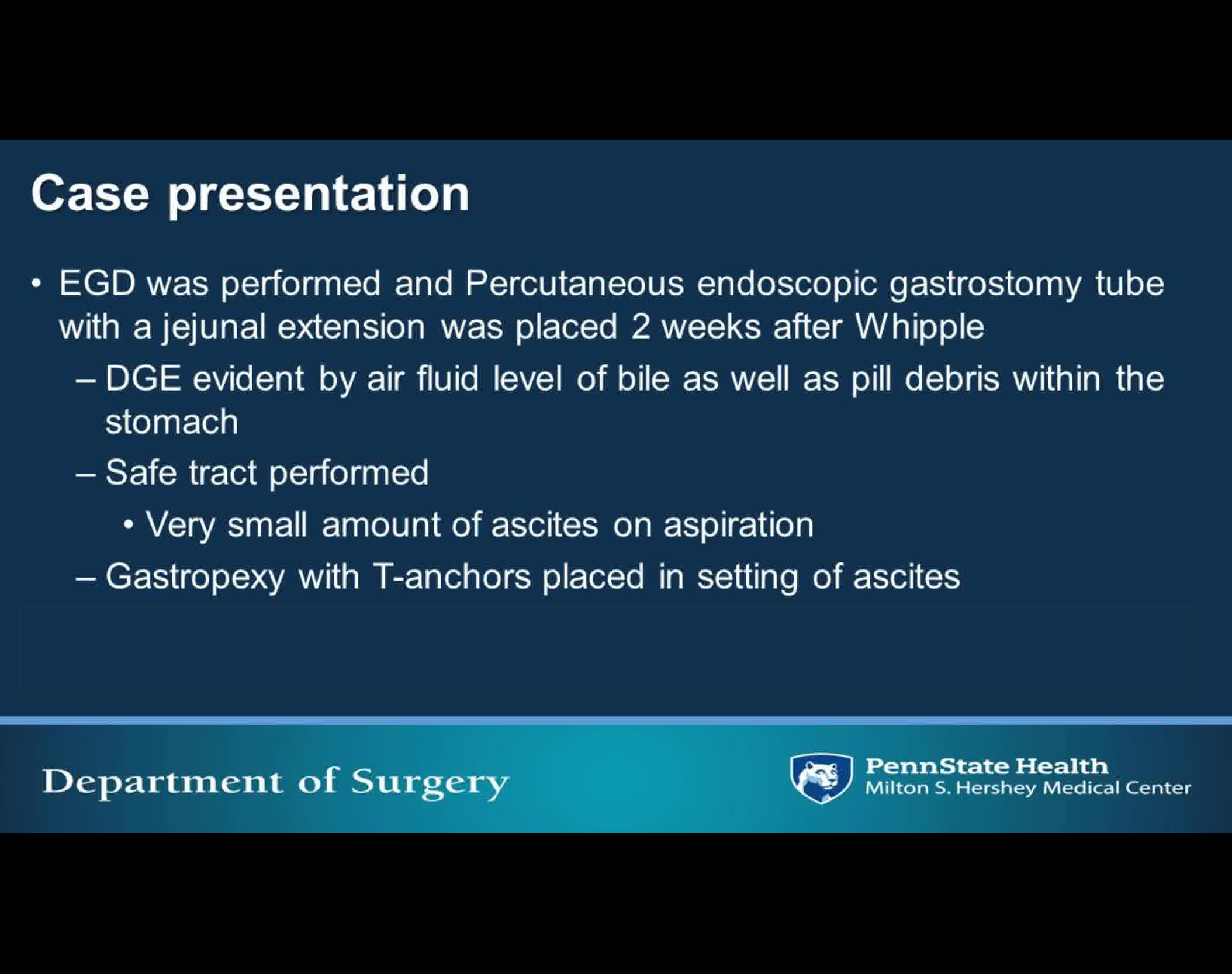
This video discusses a patient with ascites who failed to form a gastrocutaneous fistula following PEG tube placement. The PEG tube was removed in the clinic with immediate leakage of ascites from the skin defect. The patient was expeditiously transferred directly to the operating room for endoscopic gastrotomy closure with an over-the-scope clip. An anchor grasper was advanced through the gastric defect to facilitate the delivery of tissue into the endoscopic cap prior to firing the 12/6 GC-type over-the-scope clip. The abdominal wall defect at the prior gastrostomy site was closed with interrupted sutures to prevent further leakage of ascites.
Results:
Although the patient had developed more ascites, a one-month follow-up computed tomography scan revealed that the over-the-scope clip was still in position with no evidence of a gastric leak. Clinically, the patient did not have any further leakage of ascites from his previous gastrostomy site.
Conclusion:
Prompt endoscopic intervention is paramount when treating a patient who failed to develop a gastrocutaneous fistula after PEG tube placement. Having the resources of a surgical endoscopist prevented the associated morbidity and potential mortality of a surgical intervention. We recommend considering endoscopic evaluation in stable patients with gastric defects following PEG tube removal.
None of the authors have any competing financial interests.
Authors’ contributions:
E.M.P.–Speaking/Teaching Honoraria: Becton-Dickinson; Boston Scientific Corp.; Cook Biotech, Inc.; C. R. Bard, Inc.; Ovesco Endoscopy.
Funding Information:
Research Support: C. R. Bard, Inc. Consultant: Actuated Medical, Inc.; Allergan; Baxter; Boston Scientific Corp.; Cook; Medtronic; Mesh Suture, Inc. Royalties: UpToDate (Wolters Kluwer); Springer. Financial Interests: IHC, Inc., Contamination Source Identification, and SIG Biomedical.
Acknowledgment of sources of funding.
No sources of funding or resources were received to support the production of this video case study.
Recognition of Patient Consent:
Author(s) have received and archived patient consent for video recording/publication in advance of video recording of procedure.
Runtime of video:
6 mins 57 secs.
Keywords
Get full access to this article
View all access options for this article.