






Abstract


Introduction:
Perforated duodenal ulcers often require emergency surgical intervention but are associated with up to a 9.8% failure rate. 1–2 Endoscopic management is an option for the treatment of perforated duodenal ulcers in clinically stable patients and those who have ongoing leaks following initial operation. A variety of endoscopic options exist, including through and over-the-scope clips and endoscopic suturing devices. 3 However, larger defects and difficult anatomical locations can create challenges for successful endoscopic repairs. Helical tacking systems are one management option that can be utilized for defects where repair with endoscopic clips and suturing devices may be difficult. 4
Materials and Methods:
This case demonstrates a 74-year-old patient with a perforated anterior duodenal ulcer who was taken emergently for an exploratory laparotomy and modified graham patch repair. A CT scan on post-operative day five demonstrated a persistent leak from the lateral aspect of the duodenum. She was taken for endoscopic evaluation and found to have a large defect with diffusely loosened suture over the entire repair. Given the defect size and difficult anatomical location, we proceeded with closure using endoscopic helical tacking systems. Starting at the distal end of the defect and working proximally, three helical tacking systems were used to close the entirety of the defect. Endoscopic clips were placed between the tacking systems for additional re-approximation. There was no evidence of an ongoing leak at the end of the case or post-operatively.
Results:
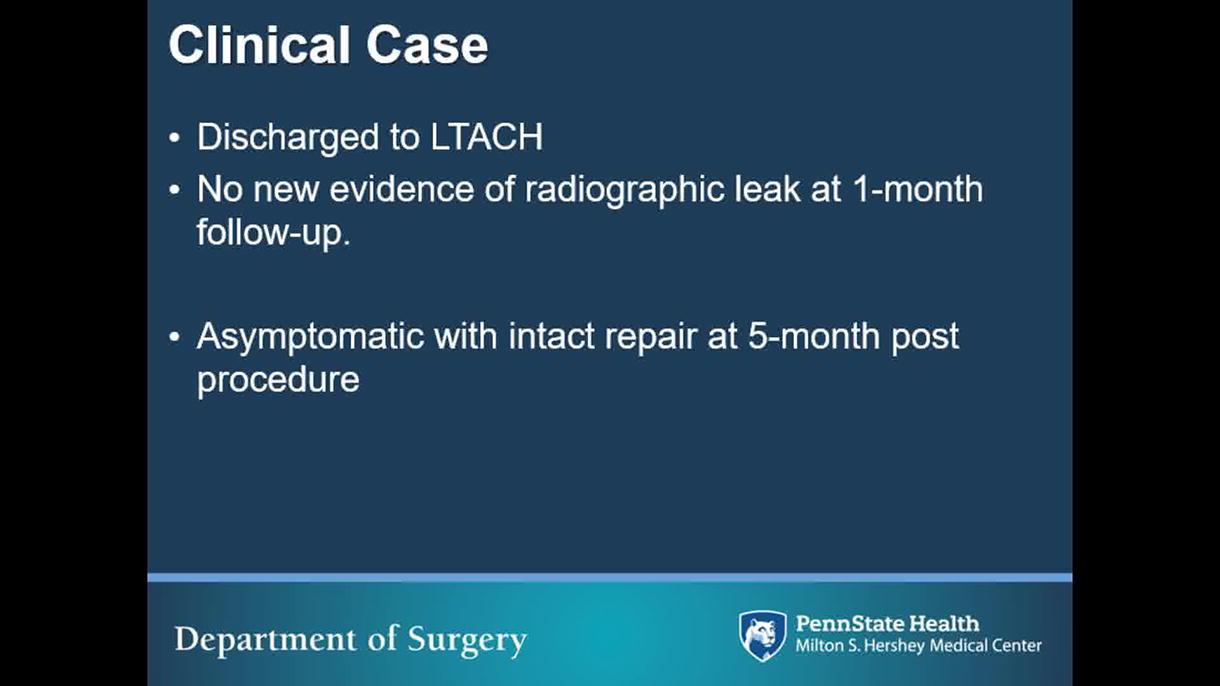
A repeat CT scan 4 days following endoscopic closure was negative for an ongoing leak. She continued to progress appropriately and was discharged to an LTACH in stable condition. She was doing well at the 1-month follow-up without new radiographical evidence of leak. She was then started on oral intake, and her drain was removed shortly after. She remained asymptomatic without additional need for intervention and an intact repair radiographically at 5 months post-procedure. No further long-term follow-up is available.
Conclusions:
This case highlights that endoscopic helical tack closure is a safe management option for persistent duodenal leaks following surgical repair when other endoscopic closure devices are not feasible. This case additionally highlights the importance of familiarity with multiple endoscopic treatment modalities, as well as intradisciplinary communication between surgical teams and endoscopists for optimal patient outcomes.
Disclosure Statement:
Drs. Quattrone, McLaughlin, and Moyer have no conflicts of interest to disclose.
Dr. Pauli is a speaker for Becton-Dickinson and Medtronic and is a consultant for Scientific Corp., Actuated Biomedical, Inc., Cook Biotech, Neptune Medical, Surgimatix, Noah Medical, Allergan, Intuitive Surgical, ERBE, Integra, Steris, Vicarious Surgical, Mesh Suture, Inc., and Telabio. He has royalties in UpToDate, Inc. and Springer and financial interests in IHC, Inc., Cranial Devices Inc, Actuated Medical.
Author(s) have received and archived patient consent for video recording/publication in advance of video recording of the procedure.
No funding was received for this study.
Acknowledgements:
This video was presented as a video abstract at the American College of Surgeons Clinical Congress 2024 in San Francisco, California.
Runtime of video: 4 mins 47 secs.
Get full access to this article
View all access options for this article.