






Abstract


Introduction:
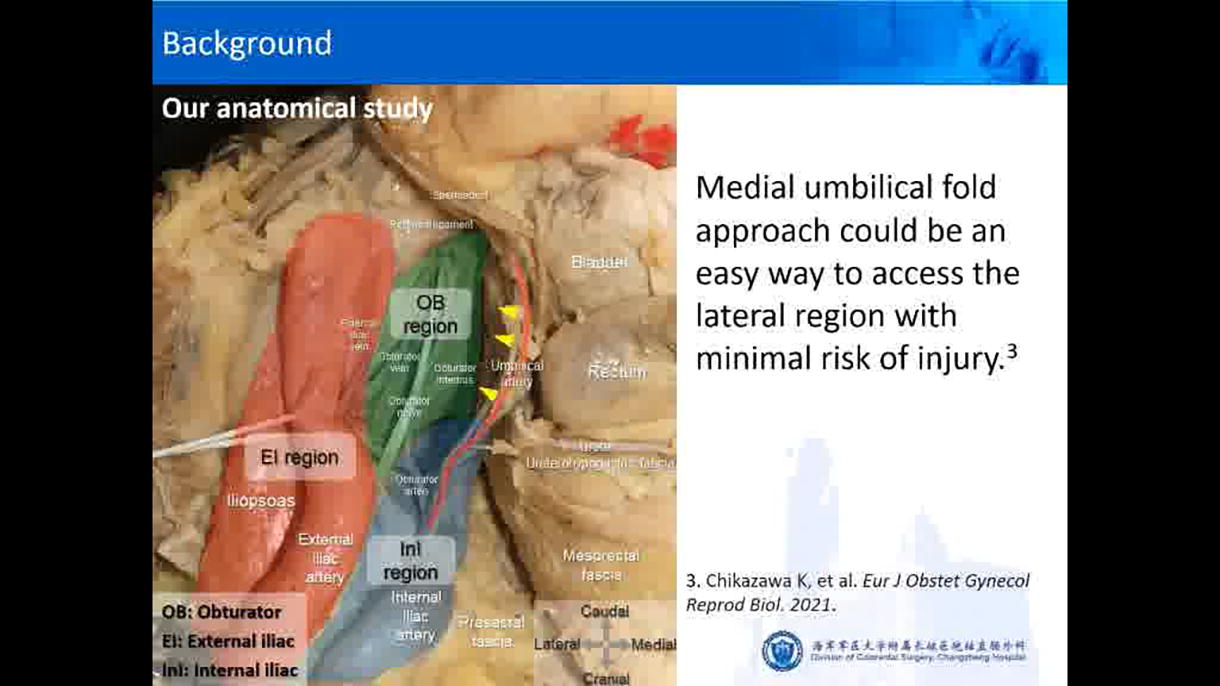
Previous studies report the safety and feasibility of laparoscopic salvage lateral lymph node dissection (LLND) for recurrent rectal cancer. 1 However, for patients with a history of pelvic surgery and radiotherapy, LLND is challenging due to its technical difficulty and higher incidence of surgical morbidity. In a previous anatomical study, the medial umbilical fold approach was an easy way to access the lateral region with minimal risk of injury. This video illustrates a case of laparoscopic bilateral LLND via a medial umbilical fold approach.
Methods:
This was a 55-year-old male patient with suspected bilateral lymph node metastasis one year after rectal surgery. He was prescribed radiotherapy and concurrent chemotherapy. 2,3 After a 6-week interval, he received LLND. The operating table was set in Trendelenburg position with an angle of 25°. Three 5-mm trocars, one 10-mm trocar, and one 12-mm trocar were used. The ureterohypogastric fascia was fibrotic because of radiotherapy, and the ureters were difficult to be mobilized. The peritoneum laterally to the medial umbilical fold was opened, and then the external iliac artery and vein were fully exposed as the lateral border. LLND was performed in between these structures. During the dissection, the obturator nerve was carefully preserved. By using the medial umbilical fold and vesicohypogastric fascia as the medial border and external iliac artery and vein as lateral border, the LLND was simplified with minimal blood loss and a reduced risk of urinary injury. 4,5 The same procedure was completed on the right side. Finally, two drainage tubes were placed.
Results:
The operation time was 3 h 40 mins. The estimated blood loss was 50 mL. No postoperative complications occurred. The patient was discharged on postoperative day 6. The final pathology confirmed a metastatic adenocarcinoma in the right lateral lymph nodes. The patient was prescribed four cycles of XELOX as adjuvant chemotherapy. No recurrence occurred at three months follow-up, and the follow-up carcinoma embryonic antigen level (4.28 μg/L) decreased compared to the neoadjuvant value (26.97 μg/L).
Conclusion:
For patients with a history of pelvic surgery and radiotherapy, laparoscopic LLND via a medial umbilical fold approach could be a simplified and safe procedure.
Author Contributions: H.Z. had full access to all of the data in the study and took responsibility for the integrity of the data and the accuracy of the data analysis. H.Z.: Concept and design. All authors: Acquisition, analysis, or interpretation of data. All authors: Drafting of the article. All authors: Critical revision of the article for important intellectual content. H.Z.: Supervision
.
Conflict of Interest Disclosures: None reported
.
Ethical Approval: This study was approved by the Ethics Committee of Changzheng Hospital
.
Source:
The video was originally produced in Changzheng Hospital and the surgeon was Haiyang Zhou.
Runtime of video:
6 mins 17 secs
*These authors contribute equally to this work.
File size: 218MB.
Keywords
Get full access to this article
View all access options for this article.