






Abstract


Background:
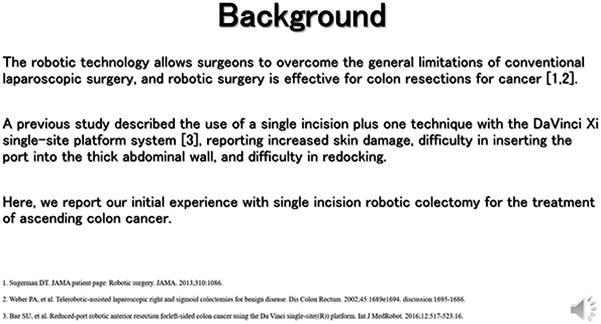
Treatment for colorectal cancer has changed dramatically in the past decade. The robotic technology allows surgeons to overcome the general limitations of conventional laparoscopic surgery, and robotic surgery is effective for colon resections for cancer. 1,2 Single-incision laparoscopic surgery is generally considered more technically challenging than conventional laparoscopic surgery. However, in our center, we have performed many reduced-hole laparoscopic procedures, including single-incision or single-incision plus one-port procedures, for colorectal cancer, as previously reported. 3 Our experience has led us to develop a single-incision robotic surgery technique for colon cancer that utilizes an umbilical incision for specimen collection and a camera port and assistant port.
Methods:
Single-incision robotic surgery for colon cancer was successfully completed in all three patients from August to November 2023.
Results:
All three procedures were technically successful without requiring conversion to open or laparoscopic surgery or intraoperative complications. The mean total operation time was 121 (118–148) min, the mean blood loss was 4 mL, and the mean incision length was 3.0 cm. Reconstruction was performed by extracorporeal functional end-to-end anastomosis. None of the patients experienced complications 60 days after surgery.
Conclusions:
Single-incision robotic surgery using the da Vinci Xi system appears to be feasible and safe for the treatment of cecum colon cancer. However, further studies are required to evaluate the differences in benefits compared with the da Vinci SP robotic platform.
Conflict of interest: The authors have no conflict to declare. No foundations are involved in the study
.
Funding statement:
Y Hirano, M Yamato, T Fujii, N Okazaki, and C Hiranuma declare that they received no funding support for this study.
Ethics approval statement:
The study design was approved by the appropriate ethics review board.
Patient consent statement:
Informed consent was obtained from the participant in the study.
Permission to reproduce material from other sources:
We permit to reproduce material from other sources.
Get full access to this article
View all access options for this article.