






Abstract
Introduction:
Endoluminal vacuum therapy (EVT) is a standard endoscopic treatment option in esophageal anastomotic leakages in adults. This technique involves combining a polyurethane sponge with a nasoenteral tube, through which an external vacuum is applied. Benefits of EVT include wound decontamination through active drainage and the ability to debride and lavage the wound cavity endoscopically at each endoluminal vacuum exchange. The main disadvantage is the treatment burden on the endoscopist and patient, as the EV must be changed at least twice a week until the leak cavity has closed and the anastomosis has healed through secondary intention, which may take several or more weeks. Although well described in adult literature, there is a paucity of studies on EVT in the pediatric population, with only case reports and case series. 1 –3 In this video case report, we describe our technique for effective management of an esophageal anastomotic leak in an infant using EVT.
Materials and Methods:
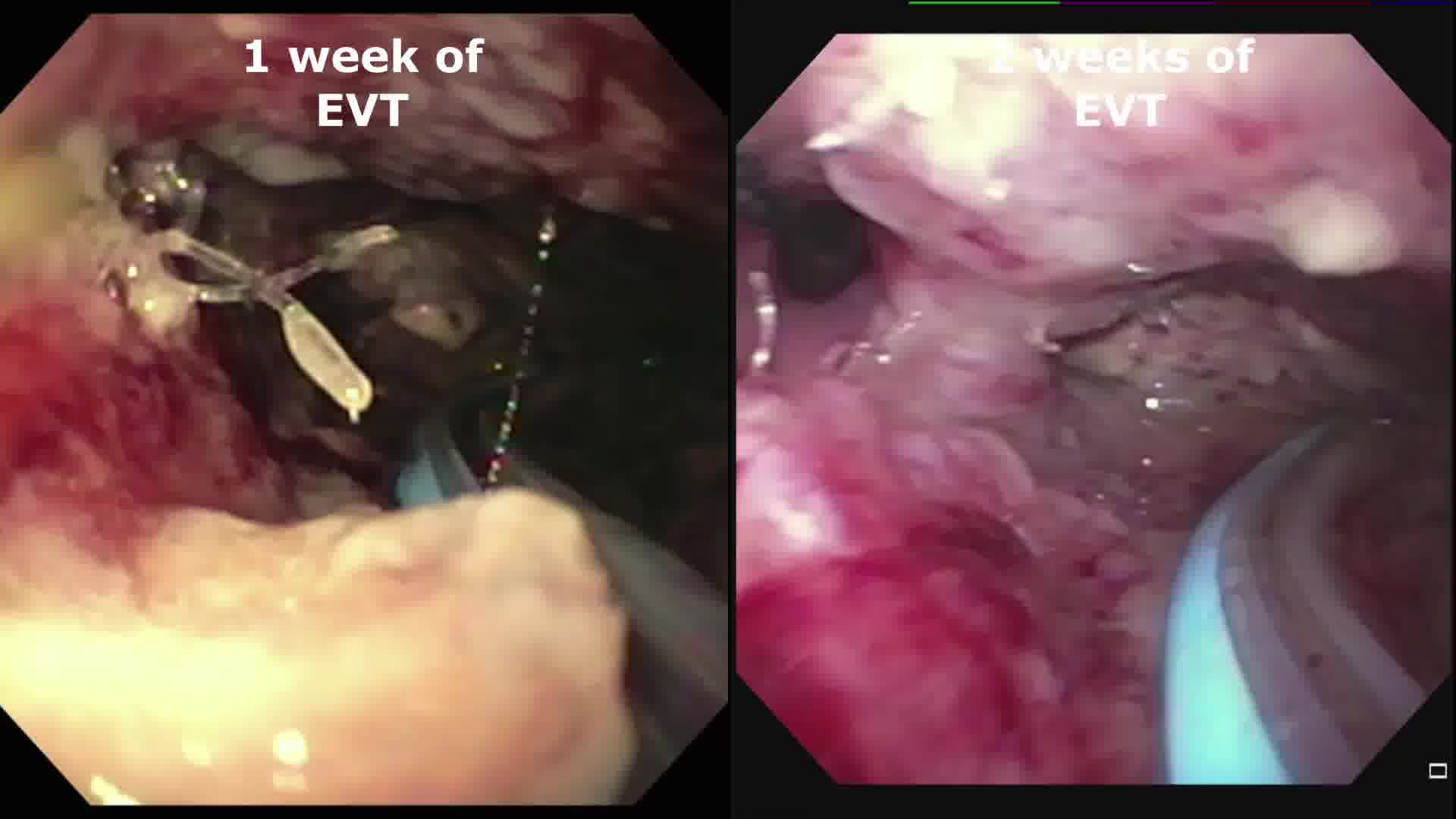
This is a 4-month-old male child with congenital isolated esophageal atresia who underwent primary repair at the age of 3 months after a procedure to lengthen his esophagus. Thirteen days postoperatively, a swallow study demonstrated contrast extravasation into the right pleural space through a sizable defect along the right lateral aspect of the mid esophagus. The decision was made to proceed with endoscopic management of the leak to avoid the morbidity of a repeat surgical operation. In the operating room, the area of the anastomotic disruption was identified, with an ∼1.5 to 2 cm gap on the right side occupying 50% to 60% of the anastomosis. The EV was made with an 8F nasogastric feeding tube with black GranuFoam secured with 3-0 Prolene sutures proximal and distal. The distal suture acted as a handle for the bronchoscopy grasper to drag it into position in a standard manner under direct endoscopic observation. The vacuum pressure was set to 75 mm Hg. After the initial EV placement, the patient subsequently underwent exchange of his endoluminal vacuum in the operating room twice a week for a period of 2 months. Foreign objects such as suture material from the patient's primary repair and chest tubes were removed during this period as well. Over time, the cavity appeared clean, contained, and was self-draining. When his esophageal anastomotic leak had healed by secondary intention, EVT was terminated.
Results:
Two months postoperatively, he underwent planned endoscopic re-evaluation and was found to have an asymptomatic short segment esophageal stricture on endoscopy that had required serial endoscopic dilatations. During this time, he received all feedings through his jejunal feeding tube while undergoing small volume per oral trials under the guidance of his speech therapists. He now only requires dilatations on an as-needed basis.
Conclusion:
EVT for esophageal anastomotic leaks is technically feasible and appears safe in the pediatric population. To date, no other similar procedures have been performed by our department in other patients. Further study is necessary to establish the safety of this procedure before its implementation as standard practice in infants.
Author Disclosure Statement: A.H., S.D.S., A.N.K., A.Y.T., M.C.S., and D.V.R. have no financial disclosures. J.S.W. is a consultant for Boston Scientific Co. and Bard. E.M.P. is a speaker for Becton Dickinson, Medtronic, Ovesco, and Boston Scientific. E.M.P. is a consultant for Boston Scientific Corp., Actuated Biomedical, Inc., Baxter, Wells Fargo, Cook Biotech, Neptune MEdical, Surgimatrix, CMR Surgical, Boehringer Laboratories, Allergan, and Noah Medical.
Runtime of video: 5 mins 58 secs
Acknowledgments: The source of the study is the Department of Minimally-Invasive Surgery at Penn State Milton S. Hershey Medical Center. This video was presented as a video presentation at the 2023 Society of Gastrointestinal and Endoscopic Surgery on March 29 to April 1, 2023.
Patient Consent:
Authors have received and archived patient consent for video recording/publication in advance of video recording of procedure.


Keywords
Get full access to this article
View all access options for this article.