





Abstract
Introduction:
Tracheoesophageal fistula (TEF) is a common congenital anomaly of the respiratory tract that is seen in ∼1 in 3500 live births. Typically, TEF occurs with esophageal atresia (EA) and may be associated with other congenital heart or genitourinary anomalies as part of the VACTERL or CHARGE syndromes. 1 Common complications after EA and TEF repair include esophageal stricture (35%), anastomotic leak (16%), and recurrent fistula (3%). 2 Most strictures respond to dilatation attempts or conservative management with antireflux medication, 3 but recalcitrant strictures may require resection and reanastomosis. Another lesser seen complication is an esophageal–bronchial fistula (EBF), which is a new fistula that forms when a leak from the anastomosis causes the site to become adherent to the lung parenchyma and a new communication forms with the peripheral bronchioles. 4
Materials and Methods:
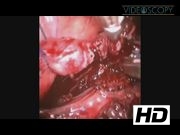
EBF: This patient is a 2-year-old with history of TEF repair at birth who presented with recurrent pneumonia along with coughing and chocking after feeds. An esophagogram revealed an EBF between the middle third of esophagus and a subsegmental bronchus of the posterior segment of right upper lobe. Rigid bronchoscopy did not reveal a recurrent TEF, but a flexible esophagoscopy identified the EBF and a 0.014” guidewire was passed, which can be used intraoperatively to aid in identification of the fistula. During esophageal dissection, a tacking suture is placed in the lower esophagus below the level of the fistula to provide better observation during the repair. Once the adherent lung parenchyma is dissected off the esophageal wall, the fistula is incised with the aid of the previously inserted guidewire. Afterward, interrupted sutures are used to close the parenchymal and esophageal defects. To close, a pleural patch is created from the adjacent chest wall then laid over the site of the esophageal anastomosis to promote healing and prevent refistulation at that location.
Recalcitrant Stricture:
In this case, the patient's stricture did not respond to several attempts at esophageal balloon dilatation and so required resection and reanastomosis. Using a thoracoscopic approach, a tacking suture is similarly placed in the lower esophagus and the stricture is identified but only partially resected to ensure that the upper and lower segments remain aligned for reanastomosis. Once the first sutures of the anastomosis are in place, the stricture is completely resected, and interrupted sutures are placed over a transanastomotic feeding tube to complete the repair.
Results and Conclusions:
Thoracosopic approaches are preferred over open repair because of reduced long-term musculoskeletal complications, reduced trauma to the surrounding structures, better observation and identification of the fistula, and less pain for the patient. They are safe and effective even in these complex and less common complications after TEF repair.
No competing financial interests exist.
Runtime of video: 4 mins 30 secs


Keywords
Get full access to this article
View all access options for this article.