






Abstract
Background:
Congenital rectal stenosis (CRS) is an extremely rare disorder that is classified into the spectrum of anorectal malformations (ARMs). 1 Ladd and Gross classified CRS as a type IV AMR and Stephans classified CRS an intermediate-type ARM. 1 –3 CRS is sometimes associated with presacral tumors and sacral bone anomalies. However, the pathogenesis of isolated cases was unknown. CRS is treated by laparotomy or a posterior sagittal approach. 4,5 We report an infantile case of CRS that was treated by laparoscopic surgery.
Patient and Operative Procedure:
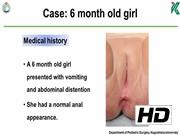
A 6-month-old girl presented with vomiting and abdominal distention and was transferred to our hospital. The patient had a normal anal appearance. Contrast enema revealed caliber change. The narrow segment of the rectum was 2.5 cm in length above the anal canal. A rectal mucosal biopsy showed a normal submucosal plexus and no acetylcholine esterase-positive fibers. In addition, presacral tumor and sacral bone anomaly were not recognized on computed tomography. CRS was diagnosed in the patient. Symptoms became clinically evident after starting baby food. Dilatation treatment was ineffective. We performed laparoscopic super-low anterior resection for a stenotic lesion using Swenson's technique. Under general anesthesia, the patient was placed in the lithotomy position. A 10-mm longitudinal skin incision was made at the umbilicus and laparotomy was performed; then a Lap-Protector® (size, XXS; Hakko Co., Ltd., Tokyo, Japan) was inserted into the umbilical wound and an EZ Access port® (Hakko) was attached. A 5-mm trocar was inserted through the EZ access port and a 45°5-mm laparoscope was used to clearly view the deep pelvic space. Three additional trocars were inserted in the right upper abdomen (5-mm: optical port), right lower abdomen (5-mm: operator's right hand), and the left lateral abdomen (3-mm: assistant's grasper). The umbilical trocar was used for the operator's left hand. The sigmoid colon and rectum were dilated above the peritoneal reflection, and the narrow segment was confirmed to be distal to the peritoneal reflection. A full-thickness rectal biopsy was performed again by extracting the rectosigmoid colon through the Lap-Protector, and an intraoperative pathologic examination showed no abnormal findings. The peritoneal reflection and rectum were carefully dissected using 3.5-mm bipolar scissors (RoBi®; KARLSTOZ, Tuttlingen, Germany). Keeping the dissection line between the prehypogastric nerve fascia and the fascia propria of the rectum is important for preserving the pelvic nerve. The dilated sigmoid colon was resected just under the normal colon, and the stump was ligated to avoid leakage. The stenotic rectum and dilated sigmoid colon were resected just above the anal canal using Swenson's technique. The resected colon and rectum were picked up through the Lap-Protector. The normal sigmoid colon was pulled through, and anastomosis was performed outside the anus.
Results and Conclusion:
The postoperative course was uneventful. An examination of the resected specimen revealed the presence of normal ganglion cells without inflammation, vascular abnormality, and specific findings. Laparoscopic super-low anterior resection using Swenson's technique was a feasible and less invasive approach for CRS.
Acknowledgments:
We thank Brian Quinn for his comments and help with the article. This study was supported by Grants-in-Aid for Scientific Research from the Japan Society for the Promotion of Science (JSPS, No.16K11350, 19K09150), research grants from JFE (The Japanese Foundation for Research and Promotion of Endoscopy), J-CASE (Japanese Consortium of Advanced Surgical Endoscopy), Kyushu Society of Endoscopic and Robotic Surgery, Karl Storz Award from Japan Society for Endoscopic Surgery, The Mother and Child Health Foundation, and the Kawano Masanori Memorial Public Interest Incorporated Foundation for Promotion of Pediatrics.
The authors declare no conflicts of interest in association with this study.
Runtime of video: 4 mins 55 secs
This case report was presented at Paediatric Colorectal Club—26th International Meeting, Belgrade, Serbia, June 9, 2019.


Keywords
Get full access to this article
View all access options for this article.