






Abstract
Introduction:
Laparoscopic anterior sectionectomy is a challenging procedure requiring dissections close to major vessels. This video presents the techniques of laparoscopic right anterior sectionectomy performed for a patient with hepatocellular carcinoma (HCC) in segment VIII, tailored for anatomical variations in segmental perfusion.
Methods:
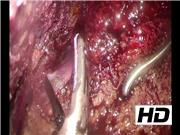
The patient is a 62-year-old lady with chronic hepatitis B. She was found to have a 3.9 cm HCC at segment VIII. Deep tumor margin was close to segments V and VIII Glissonian pedicles. Her liver function was normal and the indocyanine green retention rate at 15 minutes was 6.5%. Intraoperatively, the patient was laid in the French position with a 30° left lateral rotation. Pneumoperitoneal pressure was 12 mmHg. A flexible tip video laparoscope was used. Right liver was partially mobilized by dividing the falciform ligament and coronary ligament, until exposure of the anterior surface of suprahepatic inferior vena cava. Inflow control was performed by the Glissonian approach. Right anterior Glisson was clamped by a bulldog vascular clamp inserted through hepatotomies for temporary control. After obtaining the ischemic demarcation, parenchymal transection was carried out using ultrasonic shear (Harmonic, Ethicon Endo Surgery, Inc., Johnson & Johnson Medical SPA, Somerville, NJ). Transection was performed between right and left liver and then between right anterior and posterior sections. On approaching the right anterior Glissonion pedicle, branches encountered were followed to their origin and test clamped to identify their perfusion territory. In this case, a segment VI supply from right anterior Glisson was identified and preserved. After securing the deep resection margin by dividing the subsegmental portal pedicle deep to the tumor, parenchymal transection was completed by following the plane of right hepatic vein.
Results:
Operation lasted for 586 minutes and blood loss was 400 mL. The postoperative alanine transaminase peaked at 525 IU/L on day 1, international normalized ratio peaked at 1.4 on day 2, and bilirubin peaked at 44 μmol/L on day 3. She was discharged on the 10th day after operation uneventfully. Pathology report of the specimen was a moderately differentiated HCC with a resection margin of 0.4 cm. A follow-up CT scan at 6 months after operation showed no recurrence of tumor. Adjuvant treatment was not indicated after margin negative resection.
Discussion:
In this case, the technique of temporary inflow control of Glisson 1 was adopted. It is a convenient technique when slinging of Glisson is perceived to be risky. However, incomplete inflow occlusion was demonstrated in this case when further subsegmental ischemia of segment VI was noted on clamping of a downstream branch given off from the right anterior Glisson. An intraoperative decision was made to preserve subsegment VI after resection margin was deemed adequate by intraoperative ultrasonography. Anterior sectionectomies and central hepatectomies are complicated because of the presence of two transection planes. Experience in right hepatectomy, right posterior sectionectomy, and left lateral sectionectomy can be transferred to perform the more complicated two-plane transections. During the period 2008–2018, 58 laparoscopic major hepatectomies were performed in our center with a perioperative mortality rate of 1.7%, providing the technical basis to perform more complicated resections.
Conclusion:
The technique of intraparenchymal vascular dissection and temporary Glissonian inflow control allows for tailored anatomical resection to strike a balance between oncologic clearance and parenchymal preservation in patients with HCC.
Runtime of video: 9 mins


Get full access to this article
View all access options for this article.