





Abstract
Introduction:
Pulmonary sequestration is a rare congenital developmental malformation of the lung. It represents a piece of nonfunctioning aberrant lung tissue, with its own blood supply arising from the systemic circulation. 1 Intralobar sequestration is more common, comprising about 75% of the cases, and is usually treated by lobectomy. Extralobar sequestration is less common (25%) and usually has its visceral pleura. Segmentectomy is the procedure of choice. 2 We hereby present a patient with extralobar sequestration but with associated atypical incomplete fissures associated with adjacent normal pulmonary parenchyma.
Materials and Methods:
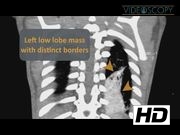
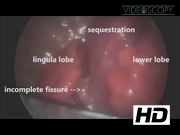
This is the 2-year-old boy who was found to have congenital pulmonary mass antenatally at an outside hospital. He had been asymptomatic. Chest CT, with angiography, showed a pulmonary mass in the left lower lung region, with systemic artery arising from the thoracic aorta. One should always look for blood supply arising from the abdominal aorta, which may pass through the diaphragm. Thoracoscopic resection was arranged. Under single-lumen endotracheal anesthesia, the patient was placed in the right decubitus position. The surgeon stood in front of the patient on the right side, with the assistant standing opposite the surgeon. The monitor was placed at the feet of the table. Three 5 mm trocars were used. The camera port was placed below the tip of scapula. Two other working ports were placed in the fourth and sixth intercostal spaces, respectively, along the anterior axillary lines. The lung was collapsed by insufflation of CO2 at 5 mm Hg at 3 L/minute. During inspection, the sequestration was noted to be situated between the lingula lobe and the left lower lobe, resembling an intralobar sequestration. After dissection of the pleura, single aberrant vein and two large systemic arteries from the aorta were identified. Each vessel was isolated and clipped using Hemolock clips near its origin, before division with Ligasure sealing device. A clear zone of demarcation was noted after controlling of the systemic vessels. Segmentectomy was performed in a manner similar to dividing an incomplete fissure with Ligasure sealing device. There were no lung tissues encountered and there were no air leaks after excision, making a lower lobe lobectomy unnecessary. A chest tube was placed for 2 days, and the child was discharged on postoperative day 3.
Results and Conclusion:
This video demonstrated that lung-sparing thoracoscopic excision of an extralobar sequestration can be safely accomplished in children with minimal morbidity. 2 Preoperative CT identification of the aberrant vessels and meticulous intraoperative dissection are the keys to success. In patients with atypical incomplete fissures, segmentectomy is the procedure of choice. 3 However, in the event of nonseparation, or unexpected intralobar sequestration, lobectomy may be necessary.
No competing financial interests exist.
Runtime of video: 4 mins 8 secs

Get full access to this article
View all access options for this article.