





Abstract
Background:
Esophagectomy and esophageal reconstruction with organs other than the gastric tube are a complicated and difficult surgical procedure. We developed a new method of thoracoscopic esophagectomy with intrathoracic esophagojejunostomy in the upper mediastinum when the gastric tube cannot be used as an esophageal substitute for reconstruction.
Materials and Methods:
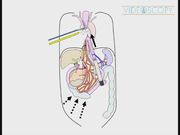
Total gastrectomy, preparation of pedicled jejunal conduit, and transhiatal lower mediastinal dissection were done under laparotomy. Upper and middle mediastinal dissection was performed thoracoscopically. After esophageal transection with a linear stapler above the arch of the azygos vein, an anvil was inserted transorally. A circular stapler-inserted jejunal conduit was introduced to the upper mediastinum through the transhiatal route with relaparotomy. Esophagojejunostomy was completed by the double stapling technique.
Results:
We completed this procedure for 10 consecutive cases without conversion to thoracotomy. The median operation time, amount of blood loss, duration of intrathoracic anastomosis, and number of dissected total and thoracic nodes were 741 (665–1019) min, 835 (380–2090) g, 94.5 (70–211) min, and 59 (16–165) nodes and 30 (10–54) nodes, respectively. There was no anastomotic leakage, conduit necrosis, or hospital mortality. Two cases showed delayed anastomotic stenosis. The median body weight loss 3 months after surgery was 13.9%. The overall 5-year survival rate was 90% (stage I, 100%; stage III, 83.3%).
Conclusions:
Thoracoscopic esophagectomy with intrathoracic esophagojejunostomy is safe and curative. This operation can be performed as a minimally invasive surgical procedure for esophageal cancer patients in whom the stomach cannot be used as a reconstruction conduit.
No competing financial interests exist.
Runtime of video: 9 mins 52 secs

Get full access to this article
View all access options for this article.
Supplementary Material
Please find the following supplemental material available below.
For Open Access articles published under a Creative Commons License, all supplemental material carries the same license as the article it is associated with.
For non-Open Access articles published, all supplemental material carries a non-exclusive license, and permission requests for re-use of supplemental material or any part of supplemental material shall be sent directly to the copyright owner as specified in the copyright notice associated with the article.
