





Abstract
Introduction:
Congenital diaphragmatic hernia (CDH) is a condition in which the diaphragm fails to form properly, resulting in a defect through which abdominal contents can herniate into the thoracic cavity. A thoracoscopic approach has been suggested for the repair of small CDH (<3 cm) defects, in hemodynamically stable infants, as it allows for improved visualization, avoids the morbidity of an open operation, and has been associated with shorter postoperative courses; shorter time courses on the ventilator postoperatively; and lower postoperative mortality. Identifying which infants have smaller defects can be difficult as they can present with a significant amount of abdominal organ herniation and mediastinal shift.
Patient:
This patient is a 3-day-old infant male, born at 38 weeks gestational age weighing 3.95 kg, who required intubation at birth due to significant respiratory distress. He was then transferred to our neonatal intensive care unit at 15 hours of life. A chest radiograph showed a left-sided CDH with mediastinal shift. A transthoracic echo showed no signs of pulmonary hypertension or cardiac anomalies. We subsequently proceeded with thoracoscopic CDH repair on day-of-life three in this 3.95 kg infant.
Treatment:
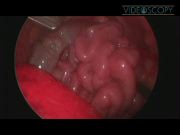
The patient was placed in the right lateral decubitus position at 45°. A 3-mm trocar was placed in the left axilla and a pneumothorax (4 mm Hg) was created. An additional 3 mm incision was made in the fourth intercostal space, also in the mid axillary line, through which an additional 3-mm trocar was placed, and another 3 mm incision through the fifth intercostal space just posterior to the posterior axillary line, through which a 3-mm instrument was directly placed. A large amount of small and large intestine was slowly reduced into the abdominal cavity through an anterior diaphragmatic defect. The defect was repaired primarily with interrupted silk suture. There was a small amount of healthy appearing lung present in the left chest, which inflated normally. No chest tube was placed, and by the third postoperative day, on chest x-ray, the patient's mediastinum had returned to its normal position with good aeration of both lungs and no pneumothorax. The patient tolerated the procedure well without any postoperative complications, had minimal blood loss, and was extubated the evening of surgery.
Conclusion:
CDHs often require early surgical intervention. Even with significant bowel herniation into the chest and mediastinal shift, we recommend starting thoracoscopically, as some patients will have a small defect and can be repaired successfully in a minimally invasive manner, thus avoiding the morbidity of an open approach.
No competing financial interests exist.
Runtime of video: 3 mins 5 secs


Get full access to this article
View all access options for this article.
Supplementary Material
Please find the following supplemental material available below.
For Open Access articles published under a Creative Commons License, all supplemental material carries the same license as the article it is associated with.
For non-Open Access articles published, all supplemental material carries a non-exclusive license, and permission requests for re-use of supplemental material or any part of supplemental material shall be sent directly to the copyright owner as specified in the copyright notice associated with the article.
