





Abstract
Introduction:
The most complex neonatal procedures have already been performed by minimal invasive approaches. 1 –3 The authors present a video of a challenging laparoscopic correction of type I duodenal atresia (wind-sock) associated with intestinal malrotation and volvulus.
Materials and Methods:
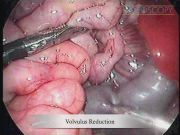
Preterm female newborn, 34 weeks of gestation with prenatal diagnosis of duodenal atresia, and 2080 g of birth weight. A postnatal roentgenogram confirmed the diagnosis. The neonate was submitted to laparoscopy at day 1 of life: one 5-mm trocar was placed in the umbilicus and two 3-mm trocars were placed in both flanks. The liver was suspended using a percutaneous stitch. An intestinal volvulus was identified and reduced. Ladd bands were divided and the mesentery was widened. As there was no visible duodenal atresia, an intraoperative contrast study was performed and a wind-sock atresia was revealed. The duodenum was incised, the membrane was partially excised, and a duodenoplasty (Heineke–Mikulicz type) was performed. 4,5 There were no intra- or postoperative complications. The child started enteral feeding on the 6th postoperative day, suspended parenteral feeding on the 13th day, and was discharged on the 15th day. Currently, she is followed as outpatient without symptoms and with an excellent cosmetic result.
Conclusion:
This video presents possible difficulties during duodenal correction and ways to overcome them with safety and assertiveness: laparoscopic volvulus reduction is safe and less difficult in the absence of bowel dilatation; intraoperative contrast fluoroscopy may help in cases of intraluminal obstruction; other procedures than diamond-shaped anastomosis can be performed in the correction of this type of duodenal atresia.
No competing financial interests exist.
Runtime of video: 3 mins 49 secs
This video was accepted for presentation at International Pediatric Endosurgery Group Meeting 2014.


Keywords
Get full access to this article
View all access options for this article.
References
Supplementary Material
Please find the following supplemental material available below.
For Open Access articles published under a Creative Commons License, all supplemental material carries the same license as the article it is associated with.
For non-Open Access articles published, all supplemental material carries a non-exclusive license, and permission requests for re-use of supplemental material or any part of supplemental material shall be sent directly to the copyright owner as specified in the copyright notice associated with the article.
