





Abstract
Introduction:
Single-incision laparoscopic surgery (SILS) and reduced-port surgery (RPS) have been introduced to provide better cosmetic effects and decrease postoperative pain and incision-related complications. In recent years, SILS and RPS procedures have been increasingly applied for a variety of abdominal surgeries, including cholecystectomy, appendectomy, and colectomy. However, it can be difficult to maintain triangulation and proper organ retraction because of the inadequate distance between instruments and the small number of access ports, respectively. In terms of gastrectomy for gastric cancer, which is associated with technical difficulties even with the conventional laparoscopic approach, SILS and RPS have not been applied widely. To resolve these problems, we devised a novel procedure of reduced-port gastrectomy for gastric cancer using two needle devices and the GelPOINT™ with an umbilical zigzag incision. 1,2 In this video, we demonstrate reduced-port laparoscopic distal gastrectomy.
Materials and Methods:
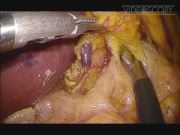
A 64-year-old woman with early gastric cancer in the lower body of the stomach underwent laparoscopic distal gastrectomy with D1+ lymphadenectomy. After placing an umbilical zigzag skin incision measuring 3.5 cm, a GelPOINT was placed through the incision. The laparoscope and two conventional instruments were inserted through the GelPOINT. Two additional needle devices (Endo-Relief; Hope Electronics) 3 were inserted in the right and left upper abdomen, with shaft diameter of 2.4 mm and tips of the same shape and size as those of the 5-mm-diameter instruments. The chief surgeon was positioned on the patient's right side, and he used the needle device in the right abdomen with his left hand and the instrument inserted through the GelPOINT with his right hand. The first assistant on the patient's left side used the left needle device with his right hand and another instrument through the GelPOINT with his left hand.
Results and Conclusions:
Distal gastrectomy with lymphadenectomy was performed using the same technique as that used for conventional five-port laparoscopic distal gastrectomy. After removal of the resected specimen through the umbilical incision, reconstruction was performed with the Roux-en-Y method. The umbilical incision was closed with absorbable sutures, and no sutures were required for the other two needle incisions. The total operative time was 329 minutes, and blood loss was minimal. There were no intraoperative or postoperative complications, and the patient was discharged 10 days after the surgery. Our reduced-port gastrectomy procedure has three key features. First, the 3.5-cm umbilical zigzag skin incision provides a sufficiently wide opening to prevent the instruments from clashing. The scar is well hidden and inconspicuous in the umbilicus. Second, by using Endo-Relief needle devices, which can be used as conventional laparoscopic instruments, postoperative pain is minimized and the two wounds outside the umbilicus are almost invisible several months after the surgery. Third, each surgeon has sufficient distance between instruments to maintain good triangulations. Taken together, this novel procedure permits safe and feasible reduced-port gastrectomy, similar to conventional laparoscopic gastrectomy, and provides excellent cosmetic results and decreased postoperative pain, resulting in almost SILS.
No competing financial interests exist.
Runtime of video: 6 mins 32 secs


Keywords
Get full access to this article
View all access options for this article.
References
Supplementary Material
Please find the following supplemental material available below.
For Open Access articles published under a Creative Commons License, all supplemental material carries the same license as the article it is associated with.
For non-Open Access articles published, all supplemental material carries a non-exclusive license, and permission requests for re-use of supplemental material or any part of supplemental material shall be sent directly to the copyright owner as specified in the copyright notice associated with the article.
