





Abstract
Introduction:
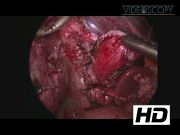
Laparoscopic Nissen fundoplication has become a very important tool for controlling severe gastroesophageal reflux disease (GERD) in the pediatric population. However, some patients, especially those who are neurologically impaired, may develop recurrent GERD that is refractory to continued medical management. If the fundoplication loosens or fails, recent literature has shown promising long-term results from gastroesophageal dissociation (GED) compared with redo fundoplication. The video demonstrates the laparoscopic operation and the use of a robotics technique to ensure correct placement of sutures.
Background:
A retrospective review was performed on pediatric robot-assisted GED operations between October 2013 and July 2014 in our practice. Three robot-assisted GED were performed on pediatric patients, 3 to 11 years old. All patients had previous Nissen fundoplications with subsequent development of recurrent reflux symptoms and/or recurrent pneumonias.
Minimally Invasive Method:
A 5-mm trocar (later upsized to 12-mm to accommodate the stapler) was placed in the umbilicus, and 8-mm robotic trocars were placed in the right and left midabdomen. An additional 12-mm robotic trocar was placed just medial to the gastrostomy tube, which was preserved, for the robotic camera. Placement of these trocars allowed for easier dissection of what was anticipated being a difficult operation due to previous fundoplication. The camera placed in the upper abdomen allowed for closer visualization during esophagojejunal anastomosis creation. Once the hiatal hernia was closed, the jejunum was divided with Endo-GIA stapler 30-cm distal to the ligament of Treitz and side-to-side jejunojejunostomy was created 30-cm distal to the tip of the Roux limb with another Endo-GIA stapler. The Roux limb was passed in a retrocolic position toward the hiatus. An Endo-GIA stapler was used to divide the esophagus just above the fundoplication, while preserving the posterior vagus nerve. At this point, the da Vinci robot was docked, and the esophagojejunostomy was performed with a single-layer anastomosis in an end-to-side manner after the esophageal staple line was excised.
Results:
Postoperatively, the patients went to the pediatric intensive care unit and, on postoperative day 2, underwent contrast studies through the gastrostomy and nasoenteric tubes. No leaks were identified in these patients, and tube feeds were gradually advanced to goal. The patients were discharged on postoperative day 6 (two patients) or on postoperative day 10. At follow-up appointments, all patients reported no coughing, gagging, vomiting, and minimal to no retching.
Conclusions:
For neurologically impaired patients with recurrent reflux symptoms following fundoplication, especially those who take most of their feeds through a feeding tube, GED may be a reasonable alternative to performing multiple redo fundoplications. By utilizing the da Vinci surgical robot with its articulating instruments and 3D visualization to perform the esophagojejunostomy, we were able to ensure precise placement of sutures while preserving at least one of the vagus nerves, avoiding the need for a pyloroplasty, as well as preserving the gastrostomy tube site.
No competing financial interests exist.
Runtime of video: 5 mins
This work was presented at the 2014 IPEG conference in Scotland.


Keywords
Get full access to this article
View all access options for this article.
Supplementary Material
Please find the following supplemental material available below.
For Open Access articles published under a Creative Commons License, all supplemental material carries the same license as the article it is associated with.
For non-Open Access articles published, all supplemental material carries a non-exclusive license, and permission requests for re-use of supplemental material or any part of supplemental material shall be sent directly to the copyright owner as specified in the copyright notice associated with the article.
