





Abstract
Introduction:
With the increase of experience in endoscopic submucosal dissection, a new endoscopic technique named endoscopic full-thickness resection (EFTR) without laparoscopic assistance has been applied to resect gastric submucosal tumors originating from the muscularis propria layer and/or having close proximity to the serosa. 1 The key stage of the EFTR procedure is the effective closure of the wall defect left after resection, to prevent peritonitis and the need for surgical intervention. Here we describe a new method to repair gastric defects by using endoloops and metallic clips.
Methods:
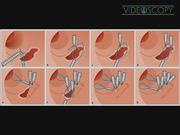
This is a 65-year-old patient, who felt epigastric discomfort since May 2013. Then, she went to hospital and had gastroscopy, the result showed that there was a tumor at the gastric antrum. The endoscopic ultrasonography showed the tumor was originating within the muscularis propria and no lymph node metastasis was detected. On November 13, 2013, we decided to use EFTR to treat this lesion. After a short anesthesia induction, the submucosal tumor was initially detected by endoscopy. First, we departed the lesion from the mucosal layer to the serosa using an electric knife. The tumor together with its surrounding muscularis propria and serosa was removed by snare resection. Then, the omentum could be seen through the gastric wall defect and we started using the endoloop and metallic clip interrupted suture method to repair a gastric defect. An endoloop was anchored with a clip to normal mucosa near the proximal resection margin, and then the maneuver was repeated to anchor the same endoloop at the distal resection margin. After that, the endoloop was tightened slightly to approximate the border of the defect. We totally used three endoloops in this case to repair the defect. After EFTR, the patient received gastrointestinal decompression and antibiotic treatment.
Results:
The patient woke up in half hour after EFTR and was discharged 6 days after the endoscopic resection. The antibiotic treatment was taken until the patient went home. After 1-month follow-up visits, the metallic clips and endoloops fell off spontaneously and the patient had no symptoms to report.
Conclusion:
At this time, the EFTR of small gastrointestinal stromal tumors and other submucosal tumors was a therapeutic technique under scientific evaluation. The use of the endoloop and metallic clip interrupted suture method seemed to be a safe, easy, and feasible new procedure for repairing gastric defects left after EFTR.
No competing financial interests exist.
Runtime of video: 7 mins 44 secs


Get full access to this article
View all access options for this article.
References
Supplementary Material
Please find the following supplemental material available below.
For Open Access articles published under a Creative Commons License, all supplemental material carries the same license as the article it is associated with.
For non-Open Access articles published, all supplemental material carries a non-exclusive license, and permission requests for re-use of supplemental material or any part of supplemental material shall be sent directly to the copyright owner as specified in the copyright notice associated with the article.
