





Abstract
Introduction:
Hepatopancreaticoduodenectomy (HPD) has been offered as a surgical option for selected patients with cholangiocarcinoma showing widespread infiltration. 1 Although the applications of laparoscopic liver or pancreatic resection have been greatly expanded, 2 there have been a few reports on a laparoscopic HPD.
Materials and Methods:
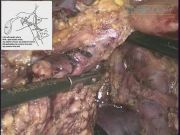
An 80-year-old woman with cholangiocarcinoma showing widespread infiltration underwent a pure laparoscopic HPD, including left hepatectomy, caudate lobectomy, and pylorus-preserving pancreaticoduodenectomy. First, a pylorus-preserving pancreaticoduodenectomy was performed as previously described. 3 The common bile duct was lifted in the cranioventral direction, and skeletonization of the hepatic artery and portal vein was advanced up to the hepatic hilum, and then the left hepatic artery and portal vein were divided. The left liver was mobilized, and the caudate lobe was fully separated from the inferior vena cava (IVC). Liver parenchymal transection began from the caudal-ventral edge of the demarcation line and was performed along the middle hepatic vein. The direction of parenchymal dissection proceeded toward the right edge of the IVC. The right anterior and posterior sectional bile ducts were divided, respectively. Finally, the left hepatic vein was divided, and the specimen was placed in a plastic endobag, and extracted through a navel incision, which was extended to 5 cm. The proximal jejunal end was delivered through a window in the transverse mesocolon. Child's method of reconstruction, which included an end-to-side pancreaticojejunostomy, an end-to-side hepaticojejunostomy, and an end-to-side duodenojejunostomy in a proximal-to-distal manner, was performed intracorporeally.
Results and Conclusions:
The procedure took 629 minutes, and operative bleeding was 200 mL. The patient was discharged on the 28th postoperative day, because the patient had developed biliary leakage that later resolved spontaneously. A histological examination showed well-differentiated tubular adenocarcinoma. Although the tumor had widely infiltrated to the extrahepatic bile duct, the surgical margins were histologically clear (R0 resection). During the 12-month follow-up since the treatment, no recurrence has been detected. A formidable challenge remains for surgeons in laparoscopic HPD. Therefore, we prepared instruments for conventional open HPD in advance to convert to open surgery as rapidly as possible if necessary. Pure laparoscopic HPD is minimally invasive, safe, and feasible, and can achieve R0 resection in selected patients with cholangiocarcinoma.
Runtime of video: 5.5 mins


Keywords
Get full access to this article
View all access options for this article.
References
Supplementary Material
Please find the following supplemental material available below.
For Open Access articles published under a Creative Commons License, all supplemental material carries the same license as the article it is associated with.
For non-Open Access articles published, all supplemental material carries a non-exclusive license, and permission requests for re-use of supplemental material or any part of supplemental material shall be sent directly to the copyright owner as specified in the copyright notice associated with the article.
