





Abstract
Background:
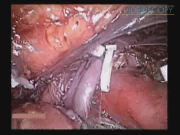
The aim of this video is to show how to perform step-by-step technique of laparoendoscopic single site surgery (LESS) transumbilical transmesocolic approach for treatment of nutcracker syndrome.
Material and Methods:
An 18-year-old man with lumbar pain, hematuria, and varicocele had a diagnosis of nutcracker syndrome with computed tomography scan.
Surgical Steps:
The patient was positioned in left lateral decubitus. Then, the following were performed: 3-cm intraumbilical incision; location of Alexis retractor; adaptation of surgical glove with two 10-mm trocars and one 5-mm trocar attached to Alexis; pneumoperitoneum with 15-mm CO2 pressure; identification of aortic pulsation; opening posterior peritoneum between duodenum and inferior mesenteric vein (IMV) with harmonic scalpel and conventional instruments; ligation and division of IMV; dissection of aorta until identification of obliterated renal vein, superior mesenteric artery (SMA), and dilated tributary veins; external suture passed in the mesentery of transverse colon to superior retraction; ligation and division of adrenal and gonadal veins with hem-o-lock clips; renal vein repair with Penrose drain; circumferential release of renal vein out of fibrotic adherence until vena cava; immediate observation of renal vein outflow restoration; measuring the length of renal vein to receive the external prosthesis; locating polytetrafluoroethylene (PTFE) tube around renal vein; fixation of the mesh in adventitia of aorta with 4-0 prolene attached with hem-o-lock clips; endoscopic confirmation of the correct placement of mesh related to vena cava, renal vein, and SMA; suturing of posterior peritoneum; and incision closure.
Results:
Operative time was 131 minutes. Blood loss was 50 mL. No complication was observed. Hospital stay was 22 hours. Improvement of symptoms was obtained. Time to normal activities was 2 weeks. Esthetic aspect was satisfactory. Postoperative Doppler showed normal renal vein drainage.
Conclusion:
LESS extravascular renal vein stent is safe and feasible to treat nutcracker syndrome.
The authors have nothing to disclose
.
Runtime of video: 8 mins 15 secs


Get full access to this article
View all access options for this article.
Supplementary Material
Please find the following supplemental material available below.
For Open Access articles published under a Creative Commons License, all supplemental material carries the same license as the article it is associated with.
For non-Open Access articles published, all supplemental material carries a non-exclusive license, and permission requests for re-use of supplemental material or any part of supplemental material shall be sent directly to the copyright owner as specified in the copyright notice associated with the article.
