






Abstract
Introduction:
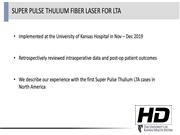
Tumor laser ablation (LTA) is a valuable option for treatment of urothelial cell carcinoma (UCC) in patients who are not amenable to nephroureterectomy. Recent in vitro studies demonstrate efficacy of the SOLTIVE™ Super Pulse Thulium Fiber Laser (SPTF) for lithotripsy and a safety profile comparable with those of Ho:YAG systems. 1 –5 Previous reports on ex vivo models have demonstrated similar cutting depth and better coagulation properties favoring the SPTF. 6,7 However, the clinical use of this novel technology for LTA has not been described. The purpose of this study is to report the first cases of upper tract and bladder UCC treated endoscopically with the newly released thulium super pulse.
Materials and Methods:
In this retrospective chart review, we identified patients with upper tract and/or bladder UCC treated with the thulium super pulse between November 2019 and December 2019. Patient characteristics, intraoperative parameters/images, surgeon subjective assessments, and postoperative outcomes were obtained.
Results:
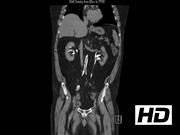
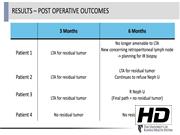
A total of four patients, mean age 75.3 years, underwent LTA with the thulium super pulse during the study period. Procedures were unilateral in three patients with one patient undergoing bilateral upper tract and bladder LTA. Although not the routine indication for endoscopic LTA at our institution, the patients in our cohort presented here had high volume or high-grade disease, but declined more invasive therapies such as nephroureterectomy. All had undergone biopsy before endoscopic ablation. Laser fiber size was 150 or 200 μm. Mean laser time was 19.4 ± 11.4 minutes, total energy was 22.2 ± 21.7 kJ, and operative time was 146 ± 40.1 minutes. The most commonly used laser setting was 0.6 J and 12 Hz in the upper tract and 0.6 J and 26 Hz in the bladder. All surgeries were outpatient, except for one patient who stayed because of postoperative oxygen requirement. There were no specific complications related to use of the laser. On subjective surgeon assessment, increased satisfaction with the thulium super pulse laser was thought to be secondary to a more precise and controlled ablation, excellent tissue hemostasis, and improved visualization.
Conclusions:
Initial LTA with thulium super pulse fiber laser seems promising regarding tumor ablation, hemostasis, and intraoperative safety. This novel technology has the potential to potentially become the gold standard for the treatment of UCCs in the future with further study patients who are more amenable to endoscopic ablation such as those with low grade and low volume of tumor burden. Prospective studies comparing this new laser platform with current standard of care system (Ho:YAG) are required for further conclusions.
Patient Consent:
Authors have received and archived patient consent for video recording/publication in advance of video recording of procedure.
Music:
B.B.W., R.V.C., M.M., and J.M.H. have nothing to disclose. W.R.M. is a clinical consultant for Lumenis, Boston Scientific, and Olympus. None of these companies played a role in this research
.
Runtime of video: 7 mins 51 secs
Keywords
Get full access to this article
View all access options for this article.