





Abstract
Introduction:
Renal neoplasms with inferior vena cava (IVC) tumor thrombus represent a complex surgical challenge. The reported incidence in the literature ranges from 4% to 10%. 1 There have been various series describing the feasibility and safety of robot-assisted laparoscopic IVC thrombectomy with appropriate patient selection. 2 –5 Management of these tumors through a robotic approach may decrease blood loss; however, it still has a high risk of significant intraoperative blood loss. 2,3 Transfusion rate has been reported to be 33%. 2 In the Jehovah's Witness patient population who do not accept transfusion of blood products, the risk of intraoperative hemorrhage associated with IVC tumor thrombectomy remains high but may be decreased using the robotic approach.
Materials and Methods:
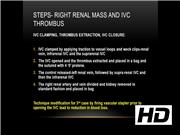
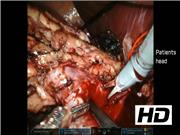
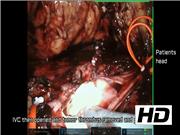
Three patients underwent completely intracorporeal robot-assisted laparoscopic IVC tumor thrombectomy for level II IVC tumor thrombi. One patient, who was of the Jehovah's witness faith, refused transfusion of whole blood products, but did agree to the use of cryoprecipitate, albumin, volume expanders, and autologous blood in the form of acute normovolemic hemodilution if needed during surgery. During one case, we describe our technique and technical modifications in an attempt to decrease intraoperative blood loss. Specifically, we employed early utilization of the vascular stapler across the renal vein and artery after isolation but before opening of the IVC. The staple line and thrombus are then excised en bloc. A retrospective chart review was performed to extract procedure and patient data.
Results:
Three cases were performed (N.P.) completely robotically without the need for conversion to open. Mean renal tumor size was 12 cm (range 9.6–14.5 cm) and mean tumor venous thrombus length was 3.23 cm (range 2–4.7 cm). Two patients presented with metastatic disease. Two patients underwent preoperative renal embolization. One patient underwent robot-assisted laparoscopic subtotal colectomy for a transverse colon mass in the same operating room setting. Mean console time was 388 minutes (range 268–556 minutes), estimated blood loss was 533 mL (range 300–900 mL), and hospital stay 9.3 days (range 7–13 days). In the third case, we employed our technique modification as already described. This led to a reduction in blood loss (300 mL compared with 900 and 400 mL in the two previous cases). No intraoperative complications occurred. Two Clavien IIIa postoperative complications occurred. One patient developed sepsis from an infected seroma and acute respiratory failure requiring intubation. Another patient experienced a ST-segment elevation myocardial infarction requiring stent placement. At a mean of 14.67 months of follow-up, two patients are still alive. One patient expired 5 months postoperatively because of progression of known metastatic disease. One patient developed progressive metastatic disease and was started on targeted therapy. One patient has no evidence of metastatic disease and is on surveillance.
Conclusion:
Robotic IVC thrombectomy is feasible and safe in the Jehovah's Witness patient population with appropriate preoperative planning and patient selection.
No competing financial interests exist.
Author(s) have received and archived patient consent for video recording/publication in advance of video recording of procedure.
Runtime of video: 8 mins 20 secs
Presented as a video abstract at the 2016 South Central Section Meeting of the American Urological Society, 2017 World Congress of Endourology, and 2017 Society of Laparoscopic Surgeons Minimally Invasive Surgery Week Meeting.
Get full access to this article
View all access options for this article.