





Abstract
Introduction:
Minimally invasive, robot-assisted, laparoscopic retroperitoneal lymph node dissections (RPLNDs) using a low-abdominal approach are commonly performed at the Naval Medical Center San Diego (NMCSD) for testicular cancer. To date, we have performed 47 robot-assisted RPLNDs, in both the primary and postchemotherapy setting. Significant complication rates, defined as Clavien–Dindo grade 2 or higher, associated with this approach have been considerably lower when compared with the open approach, 6.52% vs 21.43%, respectively. Postoperative pain is significantly less in that the robot-assisted group required only an average of 48.53 mg of morphine equivalents compared with 633.38 mg morphine equivalents in the open group. The hospital stays were also significantly reduced from 6.54 to 2.24 days using the robotic approach. This approach has shown potential versatility for other retroperitoneal disease processes and was recently used to excise a retrocaval mass.
Materials and Methods:
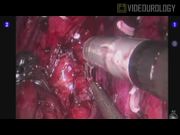
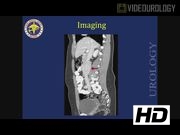
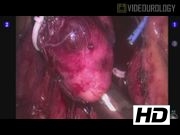
A 20-year-old woman being evaluated for chronic low back pain was noted to have an incidental finding of a 7.5 × 4.5 × 3.3 cm infrarenal retrocaval mass on imaging. The retroperitoneal mass excision was completed using the low-abdominal port placement that we use for our robot-assisted RPLNDs. The key elements to our approach were (1) supine positioning with enough Trendelenburg to keep bowel contents clear of the operative field, (2) infraumbilical port placement, (3) robot positioning over the left shoulder, (4) hammock sutures placed percutaneously under direct visualization through the incised peritoneum to suspend the bowel contents where improved visibility into the retroperitoneum is needed, and (5) removal of the mass through an existing 12-mm port site.
Results:
The mass was excised without complication. The operative time was 348 minutes. The estimated blood loss was 100 mL. The patient required minimal medication for postoperative pain and was meeting discharge criteria on postoperative day 1. Final pathology was consistent with Castleman's disease, stromal-rich variant.
Conclusions:
Robot-assisted laparoscopic surgery for retroperitoneal pathology requiring excision is a safe approach to be considered by urologists who are appropriately trained in robotic surgery. Extrapolating from the data obtained from our experience with robot-assisted RPLNDs, this approach can meet, if not exceed, the gold standard with regard to surgical outcome all while possibly decreasing the postoperative pain and the duration of the hospital stay. Although there is some variation in the technique used in this approach, primarily due to the advances in robotic technology, the general concepts with regard to positioning, the use of hammock sutures, and the use of existing port sites for removal of excised tissue remain unchanged.
No competing financial interests exist.
Runtime of video: 6 mins 27 secs
Keywords
Get full access to this article
View all access options for this article.