





Abstract
Introduction and Objectives:
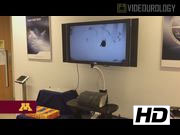
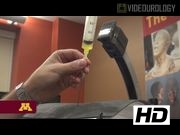
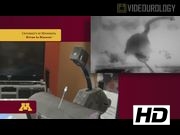
Achieving proper renal access is a challenging component of the percutaneous nephrolithotomy (PCNL) procedure. The SimPORTAL C-Arm trainer (CAT) is a fluoro-less physical C-arm for percutaneous kidney access, which has been previously tested for feasibility and fidelity to the real PCNL puncture procedure. In this video, we are presenting the working principles and imaging results of its double-camera system.
Materials and Methods:
The CAT. The CAT is made of two main components: a mini C-arm for simulating fluoroscopic imaging and a silicon flank model for needle insertion. The new version presented in this video has an aluminum structure and is scaled to fit on a standard desk. It is provided with two video cameras connected through USB to an Apple MacBook Pro™ for video processing. The images sent by the two webcams are overlaid using the chroma key transparency filter and software processed to achieve the final on-screen result. The preliminary validation study. A total of 14 urologists tested the training device during a urological hands-on training course held in Hemel Hempstead in 2013. After a didactic lesson about percutaneous renal access techniques held by an expert, subjects performed the bull's eye technique on the CAT, using a 16-gauge needle. Each participant performed at least two puncture attempts.
Results:
Eighteen of the 26 punctures (69.2%) successfully hit the provided stone in the calix. Twelve attendants (85.7%) considered the X-ray simulated image as an accurate representation of a real fluoroscopic image and all of them (100%) felt that avoiding radiation was important for training. Compared to virtual reality simulators, the CAT has been classified as “same” or “better” by 13 attendants (92.8%). Thirteen participants (92.8%) would use the CAT to train novices in percutaneous kidney access and would use the CAT to demonstrate the bull's eye technique.
Conclusions and limitations:
The video shows how the novel double-camera system, coupled to the processing software, was able to obtain visual information enough to accomplish correctly the training tasks, without expensive additional 3D motion tracking technologies. Our C-arm training system for percutaneous renal punctures demonstrated to be feasible and a valid low-cost alternative to virtual reality systems. The development of a dedicated silicon block will allow, in the future, to practice not only prone but also supine position percutaneous renal accesses.
No competing financial interests exist.
Runtime of video: 7 mins 8 secs
Keywords
Get full access to this article
View all access options for this article.