





Abstract
Introduction:
With the improvement in endoscopic techniques and shockwave lithotripsy, the role of laparoscopic ureterolithotomy (LU) has changed significantly over the past decade. 1 LU remains a viable option for patients with large impacted upper ureteric stone which are less well treated by endoscopic methods. LU has been shown in small series to have the highest stone-free rate when comparing to extracorporeal shockwave lithotripsy (SWL) in the management of upper ureteral stone of >1 cm. 2 In addition, LU has shorter hospitalization, shorter convalescence, and better analgesic profile compared with open ureterolithotomy. 1 Various methods of intraoperative ureteric stent insertion during LU have been described but with varying reports on safety or efficacy. 3 –6 One of the challenges during LU is the laparoscopic insertion of ureteric stent into a small ureteric incision. This can be time consuming and technically challenging. Slippage of the guidewire or stent occurs commonly and their prolonged adjustment can cause further trauma to the ureteric incision. Furthermore, migration of the stent can also occur during removal of the safety guidewire. Retrograde insertion of ureteric stent prior to LU reduces transperitoneal adjustment during LU, but requires intraoperative radiological support, which adds to the logistical and time requirement. We present a video on a novel method for retrograde placement of ureteric stent in patients undergoing transperitoneal LU without the need for intraoperative radiological guidance.
Materials and Methods:
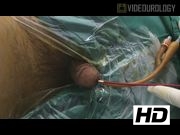
Rigid cystoscopy is performed prior to laparoscopy and the urethra length from the bladder neck to the glans penis is measured using the cytoscopy sheath. Ureteric catheterization is performed and advanced to the level of obstruction using rigid cystoscopy under sterile conditions. The urethral length is marked on the ureteric stent pusher and the patient is positioned and lateralized. Transperitoneal LU is performed in lateral decubitus position depending on the site. After stone removal, the ureteric catheter is exchanged for the guidewire and the ureteric stent is advanced across the ureteric defect under direct vision to the appropriate stent pusher marking and ureteral closure is performed. A retrospective review was performed for patients who underwent retrograde stent insertion and its viability assessed. In our initial series, all patients were kept for around 4 days to observe for postoperative complications.
Result:
A review of four patients who underwent LU and retrograde ureteric stenting in 2014 was performed. Stent placement was performed with minimal transperitoneal manipulation. Mean operative time was 211 (195–210) minutes. All patients had a drain output of less than 100 mL on postoperative day 1. No additional procedures were required for stent adjustments. There were no significant (Clavien–Dindo grade 3) complications using this method across different surgeons. Patients had removal of ureteral stent at outpatient cystoscopy.
Conclusion:
Retrograde ureteral stent insertion during laparoscopic ureterolithotomy is feasible, reproducible, and safe.
No competing financial interests exist.
Runtime of video: 7 mins 14 secs


Get full access to this article
View all access options for this article.