





Abstract
Introduction:
Renal artery aneurysms represent a rare clinical entity with a documented incidence of only 0.09%–0.3% in the general population. 1 Endovascular management has largely replaced surgery when treatment is indicated, as it is effective and has low morbidity. However, not all aneurysms are amenable to stenting or endovascular coiling due to location and vascular anatomy. As a result, surgery remains the gold standard for definitive repair. 2 Historically, open-surgical repair was the most common modality used; however, advancements in laparoscopy have lead to the development of the minimally invasive approaches. The DaVinci™ (Intuitive, Sunnyvale, CA) surgical platform facilitates complex resection and intracorporeal suturing when compared to pure laparoscopy. Further, selective arterial clamping, which aims to minimize the ischemic injury to the kidney, has been described for both laparoscopic and robotic partial nephrectomy. 3 –6 Herein, we present our robot-assisted laparoscopic technique for resection of a renal artery aneurysm, using selective arterial clamping to avoid global ischemia. Video run time is 9 minutes and 40 seconds.
Materials and Methods:
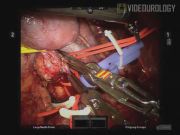
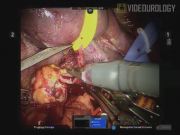
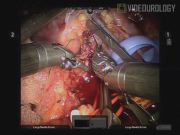
A 35-year-old man presented with right-sided flank pain and was found to have a 1.6-cm saccular renal artery aneurysm. A CT angiogram was performed, which revealed a single right renal artery, with a proximal branch to the upper pole. There was also a proximal branch to the lower pole, close to the aneurysm. He was seen by an interventional radiologist who felt it was not amenable to endovascular repair. Decision was made to proceed with definitive robot-assisted laparoscopic repair. The patient's body–mass index was 23.39 kg/m2, and blood pressure was 119/80. Serum Cr was 0.88 mg/dL, and eGFR was >60 mL/min/1.73 m2. A three-armed robotic approach was used with two 8-mm robotic ports, a 12-mm camera port, a 12-mm assistant port, and a 5-mm port for the liver retractor. Port placement was identical to that of our robotic partial nephrectomy, which has previously been described. The hilum and segmental vessels were dissected, to allow for selective clamping and avoidance of global ischemia during repair. Only segmental vessels to the mid-polar region were clamped (aneurysm inflow/outflow), leaving the upper and lower poles perfused.
Results and Conclusions:
The operative time was 4 hours, and the estimated blood loss was 200 mL. The regional warm ischemia time was 44 minutes, and there were no intraoperative or postoperative complications. Doppler ultrasound was utilized after resection of the aneurysm to document flow through the reconstructed artery, and to the renal parenchyma. Serum Cr and Hb on discharge were 0.8 mg/dL and 11.9 g/dL, respectively. The final pathology was a fibroatheromatous plaque. A renogram at 2 months postrepair revealed excellent perfusion and drainage in each kidney. Split function was 54.6% on the left, and 45.4% on the right. Robot-assisted renal artery aneurysm repair is technically feasible. Morbidity and short-term functional outcomes are favorable. The use of the robotic surgical platform facilitates complex resection and suturing. Additionally, hilar dissection of segmental vessels allows for selective clamping and avoidance of global renal ischemia.
Runtime of video: 9 mins 40 secs
Keywords
Get full access to this article
View all access options for this article.