





Abstract
Introduction:
Rectourethral fistulas in men are most commonly seen after therapeutic interventions for prostate cancer, whether via prostatectomy, radiation therapy, or cryotherapy. There have been limited previous reports of a laparoscopic, as well as a robotic, approach to rectourethral fistula repair after radical prostatectomy in well-selected cases. 1,2 We present a video of a novel robot-assisted technique for surgical repair of rectourethral fistula. Runtime of video: 5 minutes and 50 seconds.
Materials and Methods:
A 61-year old man developed a rectourethral fistula near the bladder neck after a robot-assisted radical prostatectomy, likely secondary to an unrecognized rectal injury. After failure of conservative measures, including an indwelling Foley catheter and a suprapubic tube, he was referred to our center for surgical repair.
Surgical Technique:
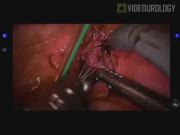
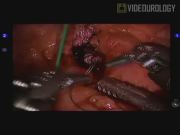
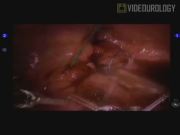
Utilizing a 6-port transperitoneal setup, similar to that described for a robotic prostatectomy, we performed a robot-assisted transvesical rectourethral fistula repair. We initially proceeded with cystoscopy to identify the fistula and its location with respect to the ureteral orifices. After port placement and lysis of adhesions, the bladder dome was identified through retrograde filling through the patient's catheter. Then, a horizontal cystotomy was made, and the camera and working arms were advanced transvesically to the fistulous opening. A ureteral catheter was placed to aid in the protection of the ureteral orifice during dissection. The fistula was then circumferentially mobilized to the base of the tract. The rectal wall and the bladder were closed individually using a 3-0 Maxon suture. After this, the patient's suprapubic tube was exchanged, and the cystotomy at the bladder dome was closed in two layers. The cystotomy closure was verified to be watertight with bladder irrigation. Our colleagues in Colon and Rectal Surgery then performed a temporary loop ileostomy.
Results:
The operative time was 200 minutes, including cystoscopy and temporary loop ileostomy formation. The patient had an uncomplicated postoperative course and was discharged on hospital day 2. The indwelling Foley catheter and suprapubic tubes were removed at 3 weeks postoperatively after a cystogram showing no residual extravasation.
Conclusions:
Given this result, a transvesical robot-assisted repair of a rectourethral fistula repair appears technically feasible in appropriately selected candidates. Longer follow-up and larger case series will be needed to validate this finding.
The authors have no disclosures.
Runtime of video: 5 mins 50 secs
Keywords
Get full access to this article
View all access options for this article.