





Abstract
Introduction:
This video presents our novel endoscopic technique for management of complete ureteral avulsion from uretero-vesical junction (UVJ).
Materials and Methods:
A retrospective study of prospective data on 1934 ureteroscopic stone manipulation procedures performed at our Urology Department in Saudi German Hospital–Jeddah from January 2001 to January 2011 was conducted. The ureterorenoscope used was an 8F, Storz, semirigid ureterorenoscope. During this period, three cases of complete ureteral avulsion from UVJ were recorded. All these three cases were managed successfully by our novel endoscopic technique that we present in this video.
Surgical Procedure:
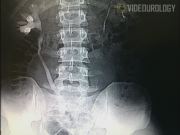
Postavulsion event, the ureteroscope is withdrawn outside the patient keeping the guidewire (GW) in place. A Double-J (DJ) stent is then applied along the GW up to the kidney. The ureteroscope is then reinserted into the bladder, and guided by the DJ through the avulsion site into the retro peritoneum up to the lower end of the avulsed ureter, grasping it with grasping forceps and pulling it down to the avulsion site in the bladder wall, confirming proper approximation of ureteral mucosa to bladder mucosa, and then indwelling urethral catheter is fixed in. In the case presented in this video, the situation was more complicated by inadvertent drop of the GW out of the patient after ureteral avulsion, which necessitated reinsertion of the GW into the avulsed ureter at the retroperitoneum with difficulty.
Results:
Our overall success rate (stone-free rate, on plain abdominal and pelvic X-rays, for ureteroscopy as primary treatment) was 1810/1934 (93.6%). We classified the position according to whether the stone was above or below the pelvic brim. The success rates were 841/924 (91%) and 969/1010 (96%) for upper and lower ureteric stones, respectively, in our series. The causes of failure 1 were failure 14; to enter ureteric orifice, 9 cases (0.5%); failure to reach the stone, 66 cases (3.4%); stone migration, 49 cases (2.5%); total, 124/1934 (6.4%). The unsuccessful cases underwent other stone manipulation procedures, either in the same or in another session. The overall complication rate was 159/1934 (8.22%) (urinary tract infection, 9 cases [0.5%]; clot retention, 2 cases [0.1%]; ureteral tears and perforation, 131 cases [6.8%]; ureteral stricture, 11 cases [0.6%]; ureteral avulsion, 5 cases [0.3%]; total, 159/1934 [8.22%]). Ureteral tares and perforations were the commonest complication, 131/1934 (6.8%). However, all were usually mild, and all were managed conservatively by DJ ureteral stenting. There was no death. Complete ureteral avulsion occurred in five cases. Two cases occurred during distal stone basketing and were managed by open ureteral reimplantation 14; 2 . The other three cases occurred at the UVJ 14; 3 and all were managed successfully by our novel endoscopic technique, with complete healing and no stricture formation as confirmed by imaging follow-up (ultrasonography every 3 months for 1 year, and intravenous urography after one year), except in one case, where a mild narrowing at the healed UVJ has been detected 3 months postoperatively at the time of DJ removal, which necessitated Holmium laser incision of the narrowed ureteral orifice and reinsertion of DJ for another 3 months.
Conclusions:
Endoscopic removal is the treatment of choice for ureteral stones. Endoscopic management of complete ureteral avulsion from UVJ appears to be a feasible, safe, reproducible, and minimally invasive new endoscopic technique.
Author has nothing to disclose.
Runtime of video: 10 mins
Get full access to this article
View all access options for this article.