





Abstract
Introduction:
Laparoscopic and retroperitoneoscopic partial nephrectomy are well-described techniques. 1 Hemostasis is challenging during this procedures. Clamping of the renal vasculature is often necessary to allow for tumor removal in bloodless field. The consequent warm ischemia (WI) places significant time constraints on the surgeon. 2 Although different ex vivo reports on laser-assisted partial nephrectomy using different types of lasers were published, there are a few available in vivo series that mostly described an open partial nephrectomy under cold ischemia. 3 –10 The aim of present study was to develop a safe and effective technique for clamp off laser-assisted laparoscopic (LLPN)/retroperitoneoscopic (LRPN).
Patients and Methods:
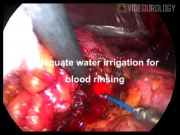
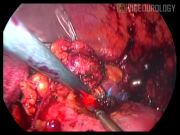
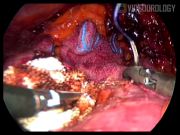
Eight patients (6 men, 2 women; age range, 32–88 years) were consecutively included in a prospective study to evaluate LLPN/LRPN. These were chosen (out of 28 patients) on the basis of T1-tumors of different sizes and kidney locations in patients with different general conditions in a single-surgeon series omitting the effect of intersurgeon experiences. All tumors were accidentally discovered during routine ultrasonography examinations and/or abdominal tomography/magnetic resonance. Diode-laser light at a wavelength of 1318 nm was coupled into a bare-ended flexible fiber (core diameter 600 μm) transmitting 55–70 W in continuous wave mode. A suitable fiber guidance instrument 11 and an irrigation system were developed for this purpose. A fiber moving velocity of about 3 mm/s parallel to suction of blood and water rinsing were necessary for adequate manipulations. Fiber tip-parenchymal contact is necessary for cutting while coagulation is in noncontact manner. Intense smoke developed if the laser was activated continuously for periods >1 minute per application. Circumferential coagulation of the parenchyma around bleeding vessels induces shrinkage of the tissues and intensifies final energy application to the vessel till occlusion. Larger vessels may need suturing. While lasering of the collecting system during tumor excisions was necessary in some cases, there had been only one entry to collecting system, which was closed by water-tight 4/0vicryl sutures. Perioperative renal function and serum C-reactive protein were measured. Histological evaluations of the coagulation depth and resection margins (R) were performed.
Results:
5 LLPN and 3 LRPN were performed. Mean tumor size was 3.5 cm (2–5 cm) with mean operation time of 143 minutes (110–175 minutes) and mean estimated blood loss 345 mL (50–600 mL). There was no conversion to open surgery. Owing to bleeding obscuring surgical field, WI (19 minutes, 24 minutes) was necessary in two central tumors. One central tumor was removed without WI. There were no observed perioperative complications. No postoperative urine leak. The postoperative creatinine (0.6–2.1 mg/dL, median 1.0) was elevated within 0.1–0.5 mg/dL (median 0.15) (p = 0.032) and returned to its preoperative values before the 8th postoperative day. Serum C-reactive protein was significantly elevated postoperatively with a median of 7.24 mg/dL (range 0.5–16.8, p = 0.003). Histological examinations revealed a coagulation depth of 1–2 mm without limiting the evaluation of tumors or resection margins, which were found free in all cases (except one central tumor). Tumor histology was clear cell, papillary, chromophobe renal cancer, as well as oncocytoma and angiomyolipoma. During follow-up (6–8 months), one patient developed A-V fistula (1 month postoperatively), which was embolized. Otherwise, follow-up examinations were uneventful.
Conclusions:
The described clamp-off LLPN/LRPN was employed to the peripheral renal tumor cases without compromising the oncological results. The technical equipments need more optimization. Long-term follow-up in larger series is mandatory. Central tumors were challenging.
The authors wish to acknowledge the Rolle & Rolle company, Salzburg, Austria, for their support to the current study.
No competing financial interests exist.
Runtime of video: 9 mins 25 secs
Get full access to this article
View all access options for this article.