





Abstract
Introduction:
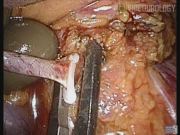
The altruistic act of kidney donation places the donor at risk for complications with no potential direct benefit. Any significant morbidity in a healthy donor is unacceptable. A review of the FDA's MAUDE database demonstrated that the two most common mechanisms of stapling device failures were an incomplete staple line and failure of the stapling device to release from the tissue. This video demonstrates a hand-assisted donor nephrectomy complicated by an adherent stapling device, managed without open conversion.
Materials and Methods:
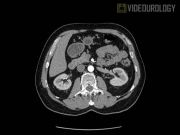
This video presents a 57-year-old altruistic man who underwent a left hand-assisted laparoscopic donor nephrectomy. This patient had an early arterial bifurcation 12 mm from the aorta. The renal artery was dissected to the aorta and an endoscopic TA stapling device was fired but failed to release from the tissue. Since the occlusion of the artery was questionable an additional 10 mm hem-o-lok clip was placed above the stapling device and the kidney was rapidly removed. This video demonstrates how the stapling cartridge was removed from the junction of the aorta and renal artery without open conversion.
Results:
The warm ischemia time was 240 sec and the graft functioned immediately. The recipient developed a stricture at 3 months, but the creatinine was 1.6. The donor suffered no additional morbidity.
Conclusions:
This video demonstrates a technique for handling an adherent stapling device that would not release from the renal hilum. Strategies for handling stapling device failure may improve the safety of donor nephrectomy.
D. Duane Baldwin: Scientific Advisory Board—Onset Medical. All other authors have declared no conflicts of interest.
Runtime of video: 4 mins 33 secs

Keywords
Get full access to this article
View all access options for this article.