





Abstract
Editorial Comments
In this video, the role of the assistant is addressed during robotic partial nephrectomy. The steps choreographed in this video are universally applicable to all assistants, and are not limited to specialized centers. During the advent of this procedure, several surgeons voiced concerns of the ability of an inexperienced assistant to perform some critical maneuvers such as clamping, clipping, and suction. Our experience mirrors that of the authors, in which the relative experience of the assistant is not a factor in outcomes of robot-assisted partial nephrectomy. All assistants should watch this short video as a primer on their role during the operation.
Associate Professor, Urology Washington University School of Medicine, St. Louis, Missouri.
Introduction:
The bedside assistant is important in achieving success in robotic partial nephrectomy (RPN). In this video, we present the major steps of RPN, with an emphasis on the role of the bedside assistant. We also compare our outcomes with RPN stratified by the experience level of the assistant.
Methods:
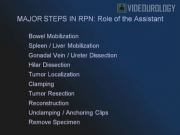
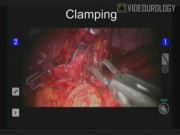
Major steps of RPN in which the bedside assistant has an important role include port placement, bowel mobilization, spleen or liver retraction, ureter and gonadal vein dissection, hilar dissection, tumor localization, hilar clamping, tumor resection, renorrhaphy, unclamping, and removal of the specimen. Perioperative outcomes for 78 consecutive RPN cases performed by a single surgeon were compared between experienced assistants (those who assisted on >100 robotic prostatectomy cases with laparoscopic kidney experience) and inexperienced assistants.
Results and Conclusions:
We identified on video at least 12 steps during RPN in which maneuvers performed by a trained assistant could be beneficial. Although perioperative outcomes between cases performed by experienced assistants (n = 28) and inexperienced assistants (n = 50) were similar, experienced assistants were more likely to assist on more complex RPN cases (endophytic involving collecting system repair; 58% vs. 33%, p = 0.04). In conclusion, the bedside assistant plays an important role in RPN. We present key steps in the procedure in which the assistant can have a role in facilitating excellent outcomes in RPN.
No competing financial interests exist.
Runtime of video: 6 mins 32 secs

Keywords
Get full access to this article
View all access options for this article.