





Abstract
Introduction:
With increased use of laparoscopy in urologic surgery, the reported rate of complications involving adjacent organ injury is as high as 4%. 1 Early recognition and a systematic stepwise approach to each complication is essential to minimize conversion to open surgery without compromising patient safety. In the following video, laparoscopic management of adjacent organ injury including the spleen, vasculature, and bowel with laparoscopic repair is demonstrated during laparoscopic renal surgery.
Methods:
Digital video captures of laparoscopic renal surgery were reviewed to identify cases where a complication involving adjacent organ injury was managed laparoscopically. Each case was selected based on the image quality and content, with regard to the extent that it supplied a unique scenario to demonstrate a particular aspect of complication management. Bleeding was controlled with hemostatic adjuncts, bipolar electrocautery, or clips. Suture was used to repair adjacent organ injury when necessary. Several cases are shown, organized by category of injury.
Results:
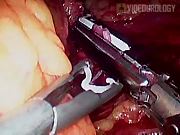
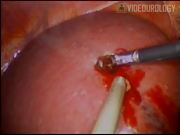
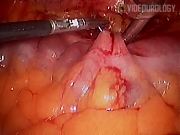
Two instances of splenic laceration are demonstrated, and the smaller laceration is treated with bipolar electrocautery. The second, larger laceration does not respond to this, but bleeding is controlled with application of hemostatic agents and pressure. Next, bleeding from vessel branches including the adrenal vein, lumbar vein stump, and periureteral artery is controlled with bipolar electrocautery. A third type of complication, stapler misfire causes the stapler to be stuck on the renal vein, occurs during a donor nephrectomy. The vein is divided distal to the stapler to allow the kidney to be removed, whereas the stapler remains on the vein. Proximally placed clips are used to reinforce the staple line and the stapler is removed. Bleeding after application of the stapler across a renal artery and then a vein is controlled with proximally placed clips. Hemostasis is achieved before dividing the vessels. Finally, recognition and treatment of bowel injury during port placement is shown. A small injury in the bowel is repaired with a two-layered suture closure.
Conclusion:
Early recognition of complications involving bleeding and adjacent organ injury during laparoscopic surgery can allow safe management via laparoscopic repair. The repair of these complications may involve a variety of techniques that should be readily available. Open conversion, in some instances, may still be necessary.
The authors of this video do not have any financial disclosures related to the production of this video.
Run time of video: 7 min 28 sec
Keywords
Get full access to this article
View all access options for this article.