






Abstract
Abstract
Background:
Identifying parathyroid glands intraoperatively can be challenging and elusive for even the most experienced of surgeons. Interestingly, parathyroid glands have been shown to autofluoresce, and so technology built to help identify parathyroid glands based on this characteristic has been developed. However, parathyroid carcinoma is a rare disease process, and there have been no studies to evaluate the autofluorescence of parathyroid carcinoma specifically. We present a case example of the use of parathyroid autofluorescence technology in a patient with parathyroid carcinoma.
Case Presentation:
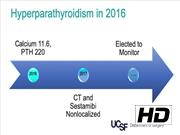
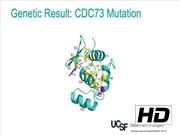
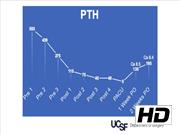
We present the case of a 27-year-old man with history of a 2.8-cm jaw tumor who was found to have elevated calcium and parathyroid hormone (PTH) consistent with primary hyperparathyroidism. He was found to have questionable family history of endocrinopathies and bone disorder, and underwent genetic testing, yielding a CDC73 mutation. After multiple imaging studies, he was found to have a 3 cm concerning focus in the anterior mediastinum. He underwent exploration through a cervical incision, and dissection was carried down to the mass just abutting the innominate, as guided by preoperative imaging. Autofluorescence levels for this mass were found to be low using both PTeye and Fluobeam modalities; however, the PTH aspirate of the gland was >5000 pg/mL. A normal left lower gland was identified and had as expected elevated levels of autofluorescence. After excision of the abnormal gland, PTH levels normalized. Final pathology report of our excised gland showed parathyroid carcinoma with negative staining for parafibromin. The patient required postoperative treatment with calcium and calcitriol.
Discussion:
In this case of autofluorescence detection during parathyroidectomy for a parathyroid carcinoma, the cancerous parathyroid tissue did not have elevated autofluorescence levels. Normal parathyroid tissue did autofluoresce as expected. To our knowledge, this has not been described in the literature and can help inform surgical decision making, in that if there is a concern for cancer, to not rely on autofluorescence techniques exclusively.
K.M. is a consultant for Prescient Surgical
.
Runtime of video: 5 mins 41 secs
Keywords
Get full access to this article
View all access options for this article.