





Abstract
Abstract
Background:
Since Dr. Emil Kocher initially modified the conventional open thyroidectomy, it has been the standard surgical technique for almost a century. 1 Over the past decade, great development has been achieved in surgical devices, like the electrothermal bipolar vessel sealing systems and the harmonic scalpel (Ethicon Endosurgery), which improve hemostasis as well as reduce heat transfer, but the thick blade makes them awkward to use.1–3 The aim of this video is to describe a new technique: Wu Gaosong's procedure. During the operation, we utilize bipolar forceps, which is characterized by a tiny but precise structure, and thus greatly decreases the possibility of injury to recurrent laryngeal nerve or parathyroid glands during the operation. By dripping the bipolar forceps with 4°C 0.9% saline continuously, we keep it cool and make it produce less thermal damage. Dissecting the thyroid from inferior pole to superior pole would preserve the superior parathyroid glands and cut off the superior pole of the thyroid more easily. Instead of cutting off the thyroid from the isthmus, we perform en bloc resection.
Case:
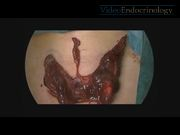
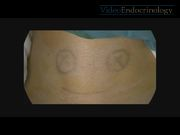
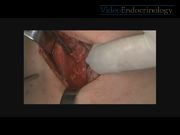
A 52-year-old woman was enrolled for thyroid nodule and hyperthyroidism. The patient underwent ultrasound-guided fine needle aspiration biopsy, and BRAFV600E mutation was found in the biopsy tissues of the thyroid nodule. Thyroid function tests revealed thyroid stimulating hormone at 0.000 μIU/mL (0.35–4.94), T3 6.34 pg/mL (1.71–3.71), and T4 1.78 ng/dL (0.70–1.48). Chest X-ray and laryngoscopy findings were normal. Total thyroidectomy was planned. After exposure of the thyroid, the lower pole of the left thyroid lobe was separated and the vessels were cut off. The left inferior parathyroid was separated from the thyroid with scissors. Then, the left thyroid lobe was separated from the surrounding tissues and detached from the vertebrate trachea cartilage. Special attention was given to protect the recurrent laryngeal nerve and superior parathyroid gland. The upper pole of the left thyroid lobe was freed, and then the vessels of the upper pole were cut off. The right lobe was surgically removed by the same method. Finally, the thyroid was completely resected. The procedure took about 30 minutes and blood loss was about 5 mL. The patient was discharged on postoperative day 2 without hypocalcemia, hoarseness, seroma, hematoma, and wound infection. The final pathologic diagnosis is bilateral nodular goiter toxicity and thyroid papillary carcinoma on the right side.
Conclusion:
This video illustrates the technical advances of Wu Gaosong's procedure. Because this procedure can be easily mastered, we believe it will be widely used.
This work was supported by the National Science Foundation of Hubei Province through contract grant Nos. 2008CDB179, WJ2015MA003, and 2004ABA246.
No competing financial interests exist
.
Runtime of video: 8 mins 32 secs
Get full access to this article
View all access options for this article.
References
Supplementary Material
Please find the following supplemental material available below.
For Open Access articles published under a Creative Commons License, all supplemental material carries the same license as the article it is associated with.
For non-Open Access articles published, all supplemental material carries a non-exclusive license, and permission requests for re-use of supplemental material or any part of supplemental material shall be sent directly to the copyright owner as specified in the copyright notice associated with the article.
