






Abstract
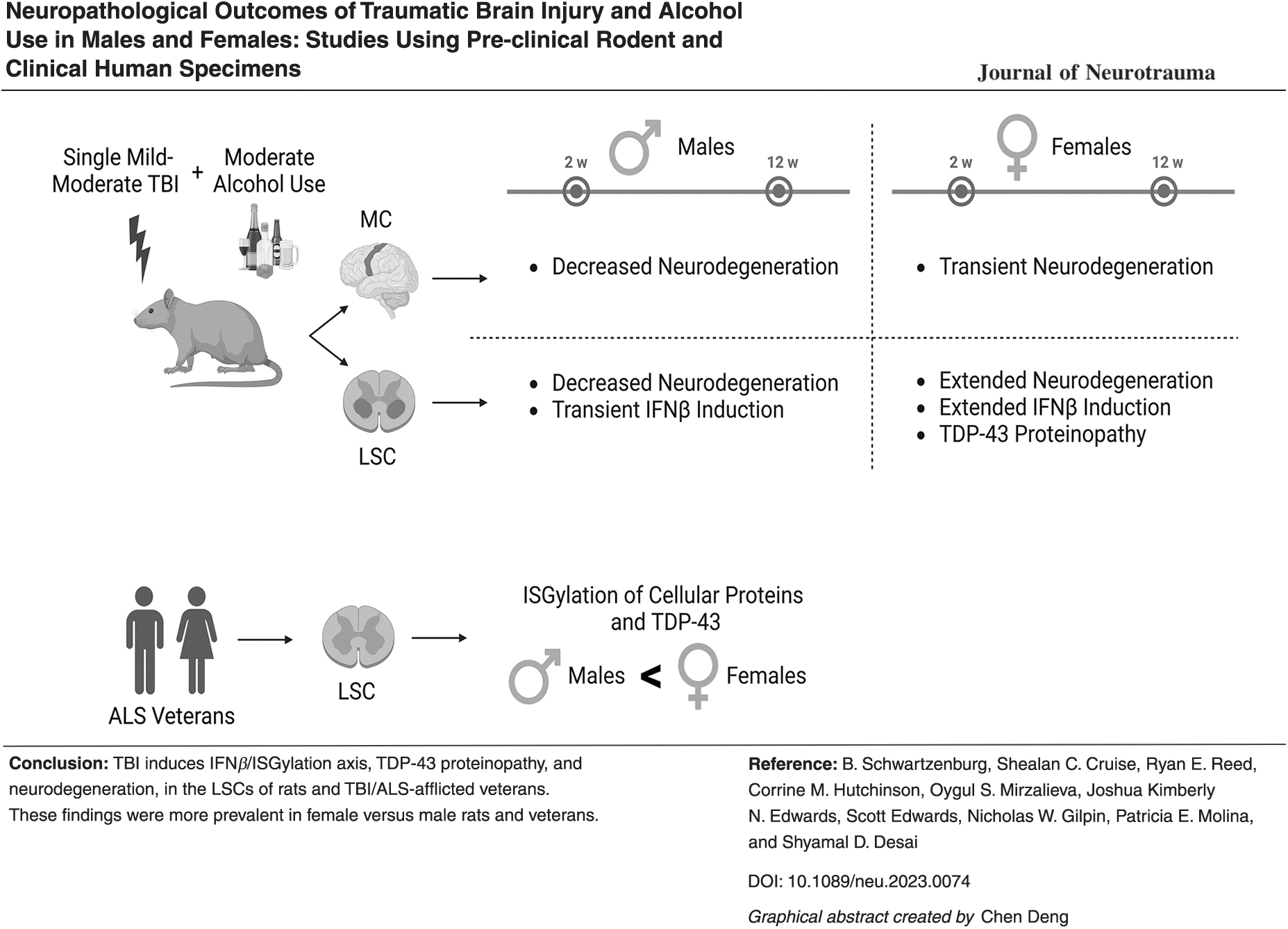
Traumatic brain injury (TBI) and alcohol misuse are inextricably linked and can increase the risk for development of neurodegenerative diseases, particularly in military veterans and contact sport athletes. Proteinopathy (defects in protein degradation) is considered an underlying factor in neurodegenerative diseases. Whether it contributes to TBI/alcohol-mediated neurodegeneration is unexplored, however. Our recent studies have identified ISGylation, a conjugated form of ISG15 (Interferon-Stimulated Gene 15) and inducer of proteinopathy, as a potential mechanistic link underlying TBI-mediated neurodegeneration and proteinopathy in veterans. In the current study, a rat model of combined TBI and alcohol use was utilized to investigate the same relationship. Here, we report sustained induction of Interferon β (IFNβ), changes in TAR DNA Binding 43 (TDP-43) ISGylation levels, TDP-43 proteinopathy (C-terminal fragmentation [CTF]), and neurodegeneration in the ventral horns of the lumbar spinal cords (LSCs) and/or motor cortices (MCs) of female rats post-TBI in a time-dependent manner. In males, these findings mostly remained non-significant, although moderate alcohol use appears to decrease neurodegeneration in males (but not females) post-TBI. We, however, do not claim that moderate alcohol consumption is beneficial for preventing TBI-mediated neurodegeneration. We have previously demonstrated that ISGylation is increased in the LSCs of veterans with TBI/ALS (amyotrophic lateral sclerosis). Here, we show increased ISGylation of TDP-43 in the LSCs of TBI/ALS-afflicted female veterans compared with male veterans. Knowing that ISGylation induces proteinopathy, we suggest targeting ISGylation may prevent proteinopathy-mediated neurodegeneration post-TBI, particularly in women; however, causal studies are required to confirm this claim.
Get full access to this article
View all access options for this article.
References
Supplementary Material
Please find the following supplemental material available below.
For Open Access articles published under a Creative Commons License, all supplemental material carries the same license as the article it is associated with.
For non-Open Access articles published, all supplemental material carries a non-exclusive license, and permission requests for re-use of supplemental material or any part of supplemental material shall be sent directly to the copyright owner as specified in the copyright notice associated with the article.
