






Abstract
Dietary changes could potentially reduce prostate cancer morbidity and mortality. Transgenic adenocarcinoma of the mouse prostate (TRAMP) prostate tumor responses to a 100 g of fat/kg diet (whole walnuts, walnut oil, and other oils; balanced for macronutrients, tocopherols [α-and γ]) for 18 weeks ad libitum were assessed. TRAMP mice (n=17 per group) were fed diets with 100 g fat from either whole walnuts (diet group WW), walnut-like fat (diet group WLF, oils blended to match walnut's fatty acid profile), or as walnut oil (diet group WO, pressed from the same walnuts as WW). Fasted plasma glucose was from tail vein blood, blood was obtained by cardiac puncture, and plasma stored frozen until analysis. Prostate (genitourinary intact [GUI]) was weighed and stored frozen at −80°C. Plasma triglyceride, lipoprotein cholesterol, plasma multianalyte levels (Myriad RBM Rat Metabolic MAP), prostate (GUI), tissue metabolites (Metabolon, Inc., Durham, NC, USA), and mRNA (by Illumina NGS) were determined. The prostate tumor size, plasma insulin-like growth factor-1 (IGF-1), high density lipoprotein, and total cholesterol all decreased significantly (P<.05) in both WW and WO compared to WLF. Both WW and WO versus WLF showed increased insulin sensitivity (Homeostasis Model Assessment [HOMA]), and tissue metabolomics found reduced glucose-6-phosphate, succinylcarnitine, and 4-hydroxybutyrate in these groups suggesting effects on cellular energy status. Tissue mRNA levels also showed changes suggestive of altered glucose metabolism with WW and WO diet groups having increased PCK1 and CIDEC mRNA expression, known for their roles in gluconeogenesis and increased insulin sensitivity, respectively. WW and WO group tissues also had increased MSMB mRNa a tumor suppressor and decreased COX-2 mRNA, both reported to inhibit prostate tumor growth. Walnuts reduced prostate tumor growth by affecting energy metabolism along with decreased plasma IGF-1 and cholesterol. These effects are not due to the walnut's N-3 fatty acids, but due to component(s) found in the walnut's fat component.
Introduction
F
Increasingly, studies using animal models have been used to gain basic insight into the health effects of walnut consumption. 5 –10 Our previous mouse feeding study showed that walnuts reduced prostate cancer (PCa) tumor growth and used soybean oil as a control because it has virtually the same fatty acid ratios as walnuts. 8 However, other studies of PCa and walnuts used corn oil as their control fat despite the differences in fatty acid composition between corn oil and walnut fats. 11 These differences in fat composition between the walnut and control diets make it difficult to conclude with certainty that the effects noted ascribed to walnuts are not due simply to the differences in fatty acids. The current study uses the same high-fat diet-fed transgenic adenocarcinoma of the mouse prostate (TRAMP) PCa model, but the control diet (walnut-like fat [WLF]) contained an oil blended from nonwalnut sources to be virtually identical in fatty acids to walnut fat, whereas the fat source of the other two diets was either from whole walnuts (WW) or from walnut oil (WO), which was pressed from the same batch of walnuts as the WW diet. This design allows a more direct assessment of the specific contributions of walnuts and their constituents in altering prostate tumor growth.
Materials and Methods
Animals
Tramp mice [C57BL/6-Tg (TRAMP) 8247Ng/J] were purchased from Jackson Laboratories (JAX Mice and Services, Bar Harbor, ME, USA). A large number of mice required necessitated multiple small cohorts shipped at 6–7 weeks old over the course of 3 months.
Animals were housed in individual cages (USDA, Western Regional Research Center, Albany, CA, USA) in a temperature/humidity controlled room with free access to water and diets. Animals were fed standard rodent chow until the start of the experimental diets at 8 weeks old and randomized into the three diet groups (n=17/group). Feed consumption was recorded twice per week and animals weighed weekly. After 18 weeks of ad libitum feeding, animals were killed under anesthesia by diaphragm puncture. Procedures involving animals followed institutional and national guidelines and were approved by both the Animal Care and Use Committee, USDA Western Regional Research Center (Albany, CA, USA) and the UCDavis Institutional Animal Care and Use Committee.
Diet
The diet composition (100 g fat/kg diet) was based on the high-fat diet previously used. 8 The experimental design was specifically modified by having three diet groups: one group of animals (WLF) consumed a high-fat diet compounded from a blend of nonwalnut vegetable oils to match walnut fat; another diet group (WO) consumed a diet formulated with WO pressed from the same batch of walnuts used as the WW group; and finally, a group was fed a high-fat diet from WW. The diets used were custom compounded (Dyets, Inc., Bethlehem, PA, USA) and had the same macronutrient composition (minerals, carbohydrates, proteins, and alpha and gamma tocopherol content). The WLF diet was shipped complete, whereas the other diets were shipped as powders and finalized by the addition of either WW or WO. Walnuts were provided as shelled whole kernels with brown husk by the California Walnut Commission. Diets were stored at−20°C until provided to the animals.
Sampling
Cardiac puncture was used to collect blood into EDTA-rinsed syringes and the plasma was isolated and stored as multiple aliquots at −80°C until analysis. The prostate genitourinary intact (GUI), that is, the bladder, seminal vesicles, and coagulating and ampullary glands were removed and weighed. The GUI was then flash frozen in liquid nitrogen and separately stored at −80°C until analysis. Dissection and analysis of prostate tissue might seem preferable; however, in the later stages of TRAMP tumors, the tissues of the GUI form a solid mass making dissection and identification of specifically the prostate tissue extremely difficult and unreliable. Moreover, the use of the GUI allows assessment of the changes in both the tumor and its microenvironment, both of which are essential for tumor formation and progression. 12
Plasma analysis
Plasma glucose was measured using a handheld glucometer (LifeScan, Inc., Milpitas, CA, USA) from blood from the animal's tail vein blood immediately before sacrifice.
Plasma lipoprotein cholesterol was determined by size exclusion chromatography, as previously described (30). Bovine cholesterol lipoprotein standards were used to calibrate the HPLC signal on the basis of peak areas.
Plasma samples were submitted to Myriad/Rules Based Medicine (Myriad RBM, Austin, TX, USA) for analysis using their rodent quantitative protein biomarkers metabolic Multi-Analyte Profile.
Metabolomic analysis
GUI tissues selected at random (n=8–11/diet) were submitted for metabolomic analysis. Analysis used mView, a metabolomic profiling system (Metabolon, Inc., Durham, NC, USA), and compounds were identified by matching with purified standards.
mRNA analysis
mRNA was isolated from whole GUI and then characterized by next-generation sequencing (NGS), a nontargeted approach that can quantify much lower mRNA levels and is not restricted to an arbitrary number of mRNA species. The mRNA was isolated from four individual GUI/diet according to the manufacturer's instructions (TRIzol plus RNA purification kit; Invitrogen, Life Technologies, Carlsbad, CA, USA). PolyA+ RNA was selected [Sera-Mag oligo(dT) beads; Thermo Scientific] and fragmented (Ambion Fragmentation Reagents kit; Ambion, Austin, TX, USA). cDNA synthesis, end repair, A-base addition, and ligation of the Illumina PCR adaptors were performed according to Illumina's protocol. Libraries were then size selected on a 3.5% agarose gel and PCR amplified for 15–18 PCR cycles. PCR products were then purified and libraries sequenced on an Illumina Genome Analyzer I flow cell. Scythe (version 0.981) and Sickle (version 1.2;
Statistical analysis
Data for each mouse were collected in Excel and statistical analysis was performed using ANOVA (JMP Pro 11 for Macintosh; SAS, Inc., Cary, NC, USA) with differences having a P<.05 considered significant. Metabolomics data were assessed using Welch's two-sample t test. Q values were computed, but no absolute cutoff was set to maximize the power to detect differentially regulated metabolites and those ratios having a P<.05 were considered significant. For NGS data, several packages from Bioconductor (release 2.11;
Results
Tissue weights
The effect(s) of the diets on body weight and prostate weight are presented in Table 1. Body weight did not differ, whereas whole prostate weights were statistically significantly lower in the WW and WO diet groups compared to the WLF diet group. Increases or decreases in the GUI weight have been shown to correlate closely with increased or decreased prostate tumor burden and occurrence. 8,14
TRAMP mice (n=17/diet, 7–8 weeks old) were allowed ad libitum access for 18 weeks to one of three different diets. The diets were identical in terms of macro and micronutrients and contained 100 g/kg diet of dietary fat provided as WW, WLF (fats blended to mimic walnut fatty acid composition), or WO (pressed from same walnuts as used for WW diets). Animals were weighed, then killed, and GUI was obtained by dissection and weighed.
Mean values with unlike letters are significantly different (P<.05).
GUI, genitourinary intact; WLF, walnut-like fat; WO, walnut oil; WW, whole walnuts.
Plasma analytes, triglycerides, and lipoprotein cholesterol
Plasma glucose, insulin, insulin-like growth factor-1 (IGF-1), leptin, and testosterone resulting from feeding the different diets are presented in Table 2. Homeostasis Model Assessment (HOMA) as a measure of insulin resistance is presented for each diet group in Table 2 as well.
TRAMP mice (n=17, 7–8 weeks old) were allowed ad libitum access for 18 weeks to one of three different diets. The diets were identical in terms of macro and micronutrients and contained 100 g/kg diet of dietary fat provided as WW, WLF (fats blended to mimic walnut fatty acid composition), or WO (pressed from same walnuts as used for WW diets). Glucose was measured using tail vein blood and handheld glucometer. Plasma was obtained from blood drawn through cardiac puncture. HOMA was calculated from values obtained to assess insulin sensitivity.
Mean values with unlike letters are significantly different (P<.05).
HOMA, homeostatic model assessment; IGF-1, insulin-like growth factor-1.
Plasma total triglyceride and cholesterol, as well as the distribution of cholesterol among the different plasma lipoprotein fractions are presented in Table 3.
TRAMP mice (n=17, 7–8 weeks old) were allowed ad libitum access for 18 weeks to one of three different diets. The diets were identical in terms of macro and micronutrients and contained 100 g/kg diet of dietary fat provided as WW, WLF (fats blended to mimic walnut fatty acid composition), or WO (pressed from same walnuts as used for WW diets). Plasma was obtained from blood drawn through cardiac puncture. Mean values for plasma total and subfraction cholesterol were determined by size-exclusion liquid chromatography.
Mean values with unlike letters are significantly different (P<.05).
TG, triglyceride; TC, total cholesterol; VLDL, very low density lipoprotein; LDL, low density lipoprotein; HDL, high density lipoprotein.
Metabolomic analysis
The metabolomic results for whole GUI are expressed as ratios of compound amounts in the WO and WW groups compared to the WLF group. Ratios exceeding 1 means the compound's level increased, whereas a ratio less than 1 means it declined relative to that in the WLF. WO and the WW groups showed only a limited number of specific compounds having both a common direction of change and a significant ratio, which are detailed in Table 4.
Significant changes (P<.05) in GUI tissue metabolite levels relative to WLF diet GUI tissue.
TRAMP mice (n=17/diet, 7–8 weeks old) were allowed ad libitum access for 18 weeks to one of three different diets. The diets were identical in terms of macro and micronutrients and contained 100 g/kg diet of dietary fat provided as WW, WLF (fats blended to mimic walnut fatty acid composition), or WO (pressed from same walnuts as used for WW diets). GUI was obtained by dissection, selected at random (n=8–11/diet), and submitted for metabolomic analysis.
NGS-based mRNA analysis
Specific mRNA in the walnut diet groups (WW, WO) was compared to the levels of the same mRNA in the WLF diet group. Specific mRNA in the walnut groups (WW, WO) compared to the levels of same mRNA in the WLF group with adjusted p-values<0.05 was considered differentially expressed. 15 Compared to the WLF diet group, the WO diet group had 566 significantly differentially expressed transcripts, whereas the WW diet group had 530 differentially expressed transcripts. The differentially expressed mRNAs in the two groups were then matched by ID and the same direction of change (i.e., both groups' relative levels up or down simultaneously) between WW and WO to produce a list of 16 walnut regulated mRNA transcripts. These are listed along with a fold change heat map in Figure 1.
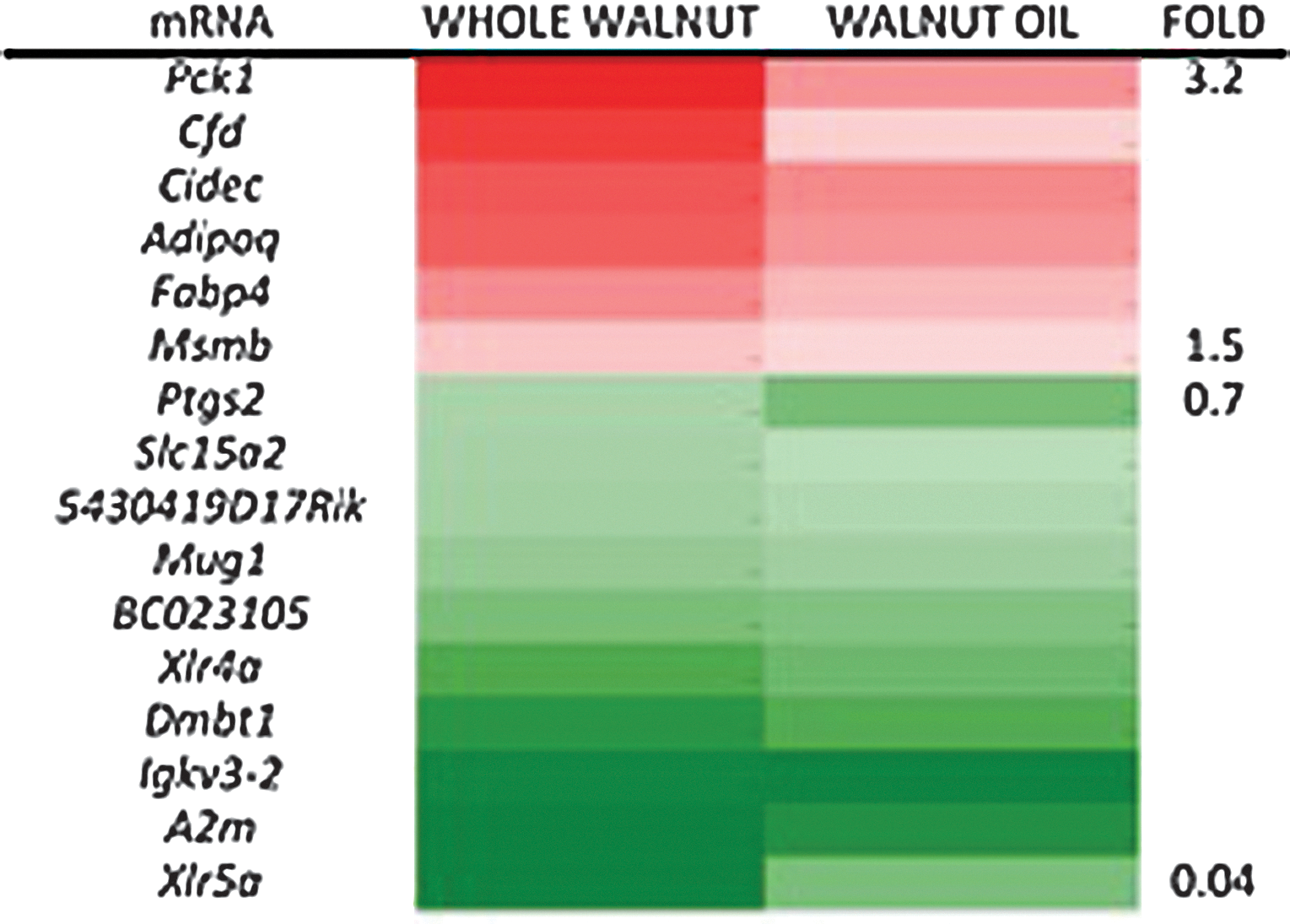
Results of next-generation sequencing (NGS)-based genitourinary intact (GUI) mRNA quantitation statistically significantly increased or decreased specific mRNA abundance ratio compared to walnut-like fat (WLF) for both whole walnut (WW) and walnut-fat diet groups' GUI. TRAMP mice GUI was obtained by dissection and 4/diet were randomly selected for mRNA isolation and NGS sequencing. The NGS data were analyzed and those WW and walnut oil GUI mRNA species whose ratio to the levels found in the WLF was statistically significant are considered differentially expressed and were then matched for having the same direction of change. The results are presented as a list of as well as heat map of walnut diet-affected mRNAs. Color images available online at
Discussion
The relationship between diet and PCa has been extensively studied, as PCa is the Western male's second leading cause of cancer-related death with the role of dietary fat intake in PCa being of specific interest. However, fat is a caloric component of significant complexity, whose use as a diet composition descriptor (e.g., high fat) renders the identification/attribution of specific effects to dietary fats difficult and misleading. As an example, high fat intake in humans, in some but not all cohorts, has been shown to be a factor in the development and progression of PCa. 16 –19 In animal studies, the Freedland's group showed using mouse PCa xenograft models that decreased saturated fat diets did not extend survival and that fish oil-fed mice outlived those fed corn oil, olive oil, or animal fat diets. 20,21 In our previous study, we found that WW, high-fat diets reduced TRAMP mouse prostate tumor size and growth compared to a soybean oil, high-fat diet. 8 Hardman and Ion found that the growth of implanted MDA-MB231 human breast cancer cells in female nude mice and later the growth of large T-antigen-driven mammary tumors in female transgenic mice were slowed by a walnut-enriched diet versus a corn oil-based diet fed either throughout (i.e., in utero and then after birth) or after weaning. 6,7 Reiter et al. reported recently that the growth of LNCaP androgen-sensitive prostate adenocarcinoma xenografts in mice was negatively associated with walnut feeding compared to a corn oil control diet. 10
The results of the current study reaffirm our findings, that is, reduced prostate tumor growth by walnut-containing diets, but crucially again show that this effect is not an effect of walnut's fatty acids. They also again demonstrate that the dietary fat intake level is not a driver of PCa, given that a reduced GUI size was found in both the WW and WO diet groups despite their high dietary fat levels. In addition, although γ-tocopherol is high in walnuts and has recently been reported to have protective effects on N-methyl-N nitrosourea-induced epithelial dysplasia in rat ventral prostate, neither α- nor γ-tocopherol is responsible for the slowed PCa growth, as all three diets provided equivalent levels of both. 22
As noted previously, the animals fed diets containing either WW or WO had significantly reduced plasma cholesterol and altered lipoprotein distributions. High-cholesterol diet-fed TRAMP mice have accelerated prostate tumor development, whereas reduced cholesterol availability induces apoptosis in LNCaP prostate tumor cells. 23,24 Importantly, the current study results are not due to decreased plasma testosterone in response to the reduced plasma cholesterol in the WW and WO diet groups. This was a potential issue raised by the previous study as decreased androgen biosynthesis has been linked to lower plasma cholesterol and the TRAMP model depends on testosterone-driven SV40 T-antigen expression. 25 In both the WW- and WO-fed groups, plasma testosterone was higher than the WLF group (Table 3). Furthermore, neither fiber nor minerals (e.g., Zn, Mg, and Se) were responsible for any of the effects noted, as these dietary components are either not found in WO diets or higher only in WW diet (Se ∼0.9 mg/kg diet versus ∼0.2 mg Se/kg diet in WLF and WO).
The current study results expand and further define the effect of walnut diets on PCa-related energy metabolism, its signaling, and machinery. That both the walnut-derived diets showed decreased IGF-1 is of note, as elevated IGF-1 is associated with increased risk of PCa and breast/mammary cancer. 26 The tumor inhibitory effects of 30% calorie restriction on orthotopically transplanted mammary tumor in mice can be partially counteracted by exogenous IGF-1. This suggests that the slowed prostate tumor growth may be in response to walnut-induced declines in IGF-1. 27 Other findings point to altered whole animal energy metabolism in the walnut diet groups as HOMA, a measure of insulin resistance, was lower in the WW and WO groups than the WLF control. The WW and WO diet groups also had increased CIDEC mRNA levels (Fig. 1) that has been linked to increased insulin sensitivity. 28 In addition, the WW and WO diet groups had increased PCK1 mRNA expression (Fig. 1) and PCK1 is known for its role in gluconeogenesis and is increased in the livers of rats subjected to 30% CR. 29,30
In addition to the mRNA changes already noted, the WW and WO diet groups had increased expression of mRNAs coding for FABP4 (fatty acid binding protein 4), along with mRNAs coding for Cfd (adipsin) and adiponectin as well (Fig. 1). Higher serum adiponectin is associated with a marked reduction in risk of PCa 31 –33 MSMB mRNA, increased in both WW and WO (Fig. 1) codes for PSP94, a tumor suppressor with lower levels being associated with more aggressive PCa. 34,35 Of particular note, COX-2 mRNA was significantly reduced in the WW and WO diet groups (Fig. 1). Increased COX-2 expression levels are associated with PCa, and downregulated COX-2 expression reduced the prostate tumor size in TRAMP mice fed a 1% w/w ursolic acid diet. 36
The response of the prostate to the various diets was also assessed by metabolomics profiling. The WW and WO diet groups relative to the WLF group had statistically significant declines in glucose-6-phosphate, succinylcarnitine, and 4-hydroxybutyrate, suggesting effects on cellular energy status/tricarboxylic acid cycle in the GUI (Table 4). Recently, fish oil diet's PCa benefits have been related to changes in the mitochondrial activity and insulin synthesis/secretion. 21
Recent work has shown that a high-fat diet can drive prostate differentiation and this can be opposed by thiazolidinedione, a PPARγ agonist. 37 In addition, the PPAR activity has been proposed to directly or indirectly modulate the supply of glucose and lipids for prostate metabolism. 37 The WW and WO diet groups, as noted earlier, both had increased FABP4 mRNA, a known PPAR target. 38 In other studies, PPARγ can be activated by a lipid-rich walnut extract. 39
Plumbagin (5-hydroxy-2-methyl-1,4-naphthoquinone) is found in walnuts and inhibits TRAMP prostate tumor tissue growth through inhibition of STAT3 and its downstream target genes. 40 Both STAT3 and IGF-1 signaling pathways converge on AKT. This may explain the reduced cholesterol levels in the walnut diet group animals, as AKT controls cholesterol synthesis by affecting SREBP-2, a cholesterol supply-related transcription factor. 41 Finally, the reduced IGF-1 level noted as well as the gene and metabolic changes found in walnut- and WO-fed animals parallel many of those identified as related to the inhibition of mice breast cancer growth by FGFR4 knockout. 42
In summary, the current study provides additional evidence that the PCa health benefits, which accompany walnut consumption, are associated with walnut-driven changes in IGF-1 and cholesterol-related systems along with energy-related metabolic systems, all of which have been shown to be important in human PCa. The use of walnuts either whole or as oil as the sole fat source at high levels in the diets presents potential issues regarding walnuts in plausible human diets. However, the recently reported, walnut-associated cancer-related benefits in human studies suggest that walnut's beneficial effects on human cancer do not require unrealistically high consumption levels. 3,4 In addition, these study results also suggest that walnut's beneficial effects with respect to cancer are not lost when walnuts are consumed as part of a typical American diet. More generally, our findings show that the use of total fat content of walnuts specifically or of either a food or a diet when assessing health effects is unwarranted, as it proved a very poor predictor of walnut's health-related effects. Finally, the current study results further highlight the need to continue to improve our current understanding of walnuts' health effects to effectively use them in diets to reduce PCa morbidity and mortality.
Footnotes
Acknowledgments
Hyunsook Kim was supported by the KU-Research Professor Program of Konkuk University. This study was supported by research grants to the University of California, Davis from the American Institute for Cancer Research (award MG10A001) and the California Walnut Board. Neither had input into study data analysis or the contents and conclusions of the manuscript. The manuscript's contents are solely the responsibility of the authors and do not necessarily represent the official view of the United States Department of Agriculture (USDA) Agricultural Research Service (ARS).
Author Disclosure Statement
The authors have no conflicts of interest to declare.