






Abstract
The purpose was to test whether a single dose of black pepper or rosemary produced short-term enhancements in sustained attention, motivation to perform cognitive tasks, or feelings of mental energy and fatigue. Outcomes were measured in 40 young adults with below average feelings of energy before and twice after they orally consumed capsules containing either black pepper (2.0 g), rosemary (1.7 g), or a placebo (3.1 g rice flour). Sustained attention was measured using a 16-min dual task, in which, single-digit numbers were presented every second on a screen and the participant performed both a primary task [detection of three successive, different odd digits] and a secondary task [detection of the number 6]. Feelings of energy and fatigue were measured using the vigor and fatigue subscales of the Profile of Mood States and visual analog scales (VAS). Analysis of variance showed nonsignificant condition (spice versus placebo)×time (T1, T2, & T3) effects for motivation, measured with a VAS, and the intensity of energy and fatigue feelings. Unadjusted effect sizes revealed that rosemary induced small, transient reductions in false alarm errors (d=0.21) and mental fatigue (d=0.40) at isolated time periods. Time-varying analysis of covariance, controlling for motivation to perform cognitive tasks, showed no significant effects on the primary or secondary task outcomes of correct responses (hits), errors (false alarms, misses), speed of response (reaction time), and signal detection sensitivity. It is concluded that black pepper and rosemary, consumed in a capsule form, in the doses used and while wearing a nose clip to block olfactory effects, do not induce consistent short-term improvements in sustained attention, motivation to perform cognitive tasks, or feelings of mental energy and fatigue in young adults with low energy.
Introduction
A
In rodents, the main alkaloid of black pepper, piperine, either alone, 4 or in a cocktail of naturally available substances 5 has been shown to improve several aspects of learning and memory. In humans, acute doses of substances that are structurally similar to piperine are used as energy-enhancing party drugs. 6 In laboratory experiments, one of these drugs, benzylpiperazine, has been shown to increase feelings of energy and decrease feelings of fatigue. 7
Rosemary showed a dose-dependent effect on the speed of memory 1–6 h post-treatment in a study of older adults. Positive effects were found for the lowest dose (750 mg) and negative effects for the highest (6000 mg) dose. 8 Psychobiological effects from oral ingestion of rosemary may result, in part, from olfactory consequences. The scent of rosemary alone has been associated with improved information processing speed, increased self-reported alertness, as well as decreased electroencephalographic alpha- and beta-power in the frontal lobes, 9 –11 a brain area involved in the top-down control of attention. 12 In the experiment summarized here, we purposefully focused on the potential nutritional effects of spice consumption by using a noseclip to prevent olfaction of spice-related volatile compounds during the treatment.
The rationale for the research summarized here stemmed from potential cognitive and mood enhancing effects of both black pepper and rosemary, a tripartite model of mental energy (i.e., mental energy defined as performance on cognitive tasks that emphasize sustained attention, feelings of energy, and motivation to perform cognitive tasks) 13 and a need for well-designed investigations in this research area. 14 The primary purpose of this experiment was to test whether the consumption of a single, practical amount of black pepper or rosemary impacts feelings of mental energy and fatigue, perceived motivation to perform cognitive tasks, or performance on a cognitive task that required sustained attention. It was hypothesized that over time both spices would induce a short-term improvement in mood, motivation, and sustained attention compared to a placebo. We included general energy and fatigue mood measures as well as those that specifically focused on feelings of both mental energy/fatigue and physical energy/fatigue. It was expected that the spice treatments would have little effect on physical energy or physical fatigue reports, but these were included as a control and to aid in interpreting the mental energy and mental fatigue data. It also was expected that larger effects of the spice treatments would be observed using the specific scales that emphasize mental energy and fatigue.
Materials and Methods
This investigation was a double-blind, randomized, placebo-controlled crossover experiment examining the acute effects of black pepper and rosemary on sustained attention, mood, and motivation. The research was conducted in a manner consistent with the sixth revision (2008) of the Declaration of Helsinki.
Participants
To be included in the study, participants were required to report (1) average or lower feelings of energy during the prior week based on vigor scores <13 using the Profile of Mood States—Brief Form (POMS-BF), 15 (2) no hypersensitivity or allergies to black pepper or rosemary, (3) good physical health as indexed by the Physical Activity Readiness Questionnaire, 16 and (4) freedom from current over-the-counter stimulant use or regular prescription medication use (except oral contraceptives). Forty participants between the ages of 18–34, from a large university in the southeastern United States volunteered and this provided statistical power of 0.80 to detect an effect of one-half standard deviation (SD). 17 The sample was 73% women and 48% white, 25% Asian, 15% black, 2% Pacific Islander, and 10% two or more races. The mean (±SD) age, weight, and height were 20.8±3.4 years, 141.0±27.8 lbs. (∼64.0±12.6 kg), and 65±4.6 in (∼1.65±0.12 m), respectively. All participants received $30 for their time.
Treatments
The spice and placebo capsules (blue, opaque, gelatin capsules; Qualicaps) were provided by the McCormick Science Institute's Characterized Sample Program. The weights of the capsules (mean±SD) were as follows: black pepper, 0.504±0.02 g; rosemary, 0.425±0.016 g; placebo, 0.78 g rice flour. Rosemary was a mixture of herbs from Albania (Rosmarinus officinalis) and Morocco (Rosmarinus eriocalyx). Chemical analysis revealed that the rosemarinic acid content was 20 mg/g, the total oxygen radical absorbance capacity was 1704 μmol trolox equivalents (TE)/g, the total phenolic content was 49.8 mg of gallic acid equivalents (GAE)/g, and the % moisture was 5.78% v/w. Plants contain hundreds of chemicals and prior studies have shown that R. officinalis also contains carnosic acid, carnosol, eriocitrin, luteolin 3′-O-β-D-glucuronide, luteolin 3′-O-(4′′-O-acetyl)-β-D-glucuronide, luteolin 3′-O-(3′′-O-acetyl)-β-D-glucuronide, hesperidin, diosmin, isoscutellarein, 7-O-β-D-glucoside, homoplantaginin, rosmanol, epirosmanol, isorosmanol, rosmaridiphenol, rosmadial, miltirone, and genkwanin. 18,19 The black pepper was a mixture of dried fruits from Brazil, India, Indonesia, and Vietnam. Chemical analysis revealed that the blend of piper nigrum had a piperine content of 53 mg/g, the total oxygen radical absorbance capacity was 424 μmol TE/g, the total phenolic content was 8.2 mg of GAE/g, and the % moisture was 10.2% v/w. Other known chemical constituents in Piper nigrum include lignans, alkaloids, flavonoids, essential oils (sabinene, pinene, phellandrene, linalool, oleoresin, and limonene), and chavicine. 20 The capsules were stored at ∼23°C in light-impenetrable containers until used. As needed, an investigator not involved in day-to-day testing, placed appropriate capsules into coded medicine bottles and provided those to the researchers who were involved in direct contact with the study participants.
Experimental testing
All cognitive testing was performed in a seated position in a thermoneutral (23±1°C), sound-attenuated [∼60 dB(A) below ambient] chamber with lighting at ∼80 lux.
Testing day 1
On the first day, screening for study eligibility was performed, the informed consent completed, and the cognitive task practiced (630 stimuli) under supervision and with feedback to ensure the participants understood the task and to attenuate potential practice effects.
Testing days 2 and 3
The day 2 and 3 testing sessions were identical except that the participants received one treatment on day 2 and a different treatment on day 3. Allocation of the two treatments was determined by the third author using randomization into three blocks with Research Randomizer (
Participants arrived and were first screened for that day's eligibility. Participants were ineligible for a daily testing session if they reported (1) a prior night's total sleep duration of 2 h less or more than their typical sleep duration as reported using a study-designed questionnaire (available from the authors) during screening on day 1, (2) consuming any food, beverage (besides water), or caffeine in the 6 h before testing using a study-designed questionnaire, or (3) using prescription or over-the-counter medication or nutritional supplements during 24 h before testing (reported on a study-designed questionnaire), which in the investigators' judgment could influence the primary outcome measures. Participants who were ineligible for testing on a given day (n=3) were rescheduled for a different day.
Eligible participants completed baseline (time 1) mood and motivation questionnaires, and then the cognitive task. Participants then received one of the three treatments, all of which involved the oral consumption of 4 capsules with 8 oz. of distilled water within 1 min. To aid in blinding, and to eliminate potential olfactory effects, participants wore a noseclip while consuming the capsules. Spice and placebo consumption was confirmed through direct observation by the investigators. Following capsule consumption, participants sat in a quiet room and watched a nature documentary (Planet Earth, The Jacques Cousteau Odyssey) for 1 h to allow time for the treatments to become bioavailable. Mood, motivation and cognitive assessments, which took 20–25 min, were completed a second time immediately after the 1-h rest period and a third time 30 min after the 1-h rest period. Following the final cognitive test each day, participants completed a “What I got” study-designed questionnaire, which asked for a guess as to which treatment they received and how certain they were (ranging from 0–100% certainty) of the guess. Respondents who indicated a certainty above 59% were asked to provide a reason why.
Cognitive task
Participants performed a version of the Bakan Vigilance Task. 21 Visual stimuli were presented and a motor (finger) response was required for target stimuli. Individual numbers (1–9; Tahoma; font size 20) were presented on a desktop screen, 12 inches in height×16 inches wide (∼30.5 cm×40.6 cm). The participant performed a primary and secondary task. The primary task was to detect the presentation of three successive, differing odd digits (e.g., 7, 3, and 5). The secondary task was to respond to a specific number (i.e., 6). Participants were instructed to press the right button in response to a primary stimulus and the left button in response to a secondary stimulus. Stimuli were presented for 1000 milliseconds and a total of 960 stimuli were presented during each 16-min cognitive testing period. There were 8 primary and 95 secondary target stimuli presented. The data were acquired using SuperLab Pro Experimental Laboratory Software, Version 2.0 (Cedrus Corp., 2002) loaded on a portable laptop (Gateway Solo; Gateway, Inc.), and interfaced with a Model RB-530 Response Pad (Cedrus Corp., 2002). Upon completion of the study, each data file was analyzed using Cedrus Data Viewer 2.0 (Cedrus Corp., 2007) and the following measures were obtained for both the primary and secondary tasks: correct responses (hits), errors of omission (missed targets), false alarm errors (pressed a button in the absence of a target), and reaction time for correct responses (in milliseconds). In addition, participants' sensitivity for detecting the presence and absence of the targets was calculated as recommended from signal detection theory 22 using a nonparametric index [P(Ā)]. 23 The P(Ā) reflects a combination of each participant's average percent hits and false alarms. The P(Ā) score is a nonparametric analogue to the efficiency with which stimuli can be detected (known as d′) and values range between 0.50 and 1.0.
Motivation and mood measures
Motivation data were obtained using a 0–10 scale. The sensitivity of the scale to nutritional and caffeine administration has been demonstrated. 24
Feelings of energy and fatigue were assessed using the POMS-BF 15 and the State-Trait Energy and Fatigue Scales (STEF, available from the authors). Psychometric evidence supporting the validity of inferences drawn from scores obtained with the STEF subscales is summarized in an unpublished manual (available from the authors) and other publications. 24 –27
Statistical analyses
All the statistical analyses were performed before breaking the blind. Mood and motivation data were scored by hand. All data were entered or imported into IBM SPSS Statistics (Version 19.0.0), which was used to perform the data analyses. In a preliminary analysis, two individuals had cognitive task performance scores, which were deemed as outliers (>3 SDs from the mean); consequently, their data were excluded from the primary analysis. Variables that were not normally distributed (i.e., assessed from Kolmogorov–Smirnov tests <0.05) were transformed using either a square root or log transformation before the primary analyses. A chi-square test was used to determine whether the average accuracy of the guess as to which treatment was received differed from chance. The hypotheses were tested by examining whether repeated measure ANOVAs (mood, motivation, and cognition data) or analyses of covariance (ANCOVAs; cognition data) revealed a statistically significant (P≤.05) condition (spice versus placebo)×time (time 1, time 2, and time 3) interaction. Because variation in motivation can influence the cognitive test performance, RM-ANCOVAs used motivation scores at each trial as a time-varying covariate. Adjustments for sphericity, when needed, were made using Huynh-Feldt epsilon. The effect size (d) was calculated based on the mean change over time in a treatment condition minus the mean change over the same time in the placebo condition, and this difference score was divided by the baseline pooled SD.
Results
Neither pepper nor rosemary showed statistically significant condition×time interaction effects on any of the motivation or mood variables (P>.05). The largest effect of a spice on any mood measure was a rosemary-induced reduction in visual analog scale (VAS) mental fatigue of d=0.40 at time 2 (Fig. 1). All the descriptive mood results are presented in Table 1. The motivation results are presented in Table 2.
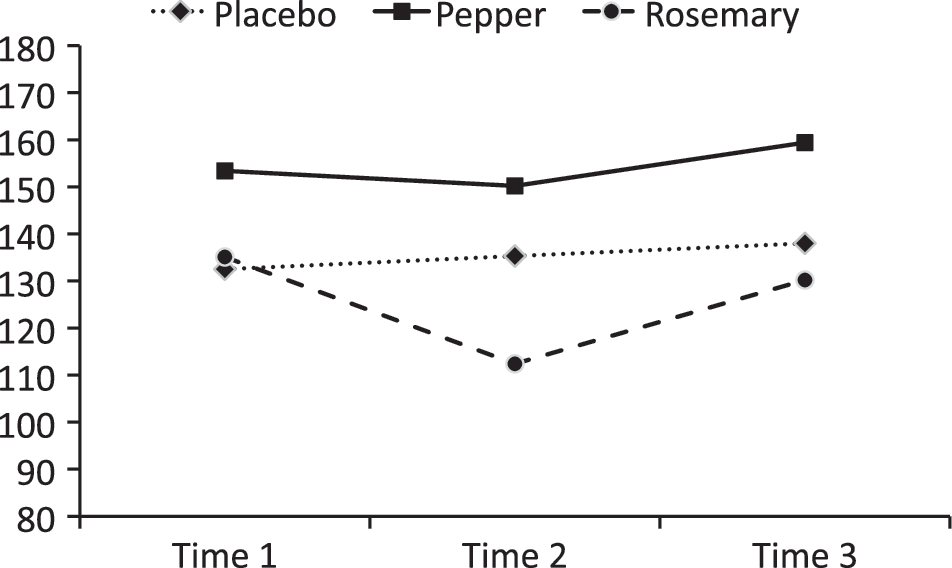
Average visual analog scale mental fatigue scores for the three conditions across time. Time 1 is the preintervention baseline and time 2 and 3 are 60 and 90 min postingestion, respectively. Mental fatigue norms (mean±SD) are 118±66 based on a nationally representative telephone survey of 202 adults.
POMS, Profile of Mood States; VAS, visual analog scales.
All condition×time interaction effects for the cognitive test measures were not significant (P>.05). The results were unchanged when motivation scores were controlled using ANCOVA. A few small positive effects for rosemary were found, such as the reduction in false alarms (d=0.21), during the primary task at time 3 (Fig. 2). All the descriptive results for the cognition outcome variables are presented in Table 2.
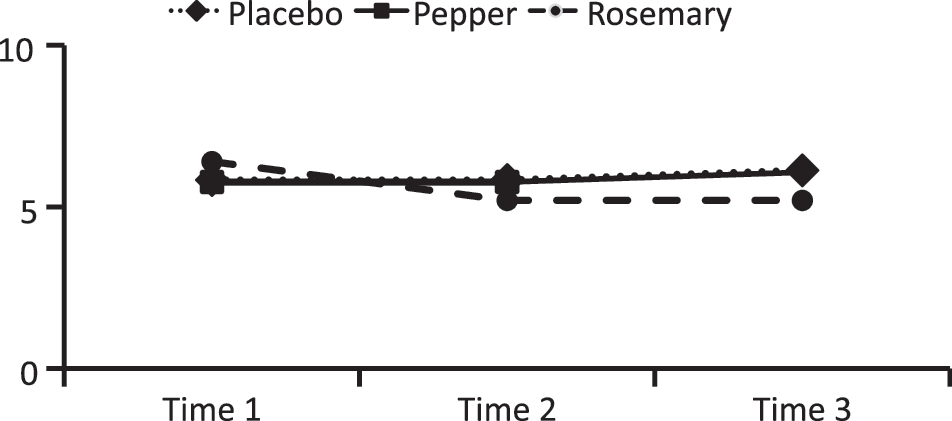
Average number of false alarms for the three conditions across time. Time 1 is the preintervention baseline and times 2 and 3 are 60 and 90 min postingestion, respectively.
The average accuracy of the guess as to which treatment was received was 46% for the placebo condition and 54% for both the black pepper and rosemary conditions. These percentages did not differ significantly from those expected by chance (χ2=0.422, P=.810). Participants reported being uncertain about what they consumed 81.3% of the time, but when they did feel certain about their guess they were accurate 80% of the time. Burping was the most common reason for a high perceived certainty as to what was consumed, but participants were wrong 25% of the time they felt they knew what they consumed after having burped.
Discussion
Rosemary did induce small, transient reductions in false alarm errors (d=0.21) and mental fatigue (d=0.40) at isolated time periods. In contrast to our hypotheses, however, the primary findings of this research were that neither black pepper nor rosemary, consumed in a capsule form, in the doses used here and while wearing a noseclip to block odor effects, induced consistent, significant short-term improvements in sustained attention, motivation to do cognitive work, or feelings of mental energy and fatigue in young adults with low energy. As expected, there was no significant change in perceptions of physical energy or physical fatigue. To optimize the likelihood of documenting an effect of the spices, we used a battery of cognitive and mood outcomes characterized by high reliability and validity. With regard to the mood findings, the specific scales that emphasize mental energy and mental fatigue did show somewhat larger effects, but the difference in magnitude between the two types of scales (i.e., mental vs. physical) was small and not meaningful.
One potential explanation for the neutral findings in the present investigation is the apparent strong placebo response. In contrast to expectations based on prior research, 24,26 performance (hits and errors) on the primary and secondary tasks in the placebo condition decreased by only a small amount over time. This appears to be akin to the substantial placebo response observed in clinical trials of psychiatric drugs. 28 In drug trials, the magnitude of the placebo response is large and has increased over time. 29,30 We are uncertain what features of our trial might have contributed to a robust placebo response, but our results suggest that in future trials, consideration should be given to using alternative research designs that could reduce the placebo response. Identifying placebo responders during an initial phase of the study could reduce the placebo effect and increase the observed effect size. 31 In addition, one meta-analysis showed that the variable with the largest effect on the size of drug-placebo differences in clinical trials of antidepressants was the percentage of patients, who were randomized to the placebo condition. 32 The placebo response decreased as the number randomized to a placebo increased. In the present trial, a relatively small number of participants were randomized to the placebo arm of the trial.
A second potential explanation for the neutral findings in the present investigation is that in contrast to what happens during culinary consumption of spices, the participants could not smell the spices. Olfaction was prevented purposefully to ensure the double blind. However, aromas can have mood and cognitive effects in both humans and animals that are used to study the underlying neurobiology. Examples include that the nasal presentation of nanoparticles of piperine influences cognitive function in rodents 33 and the aroma of rosemary increases alertness in humans. 9 –11 The present results generally align, except for the small transient rosemary effects illustrated in Figures 1 and 2, with the idea that olfaction plays a role in the acute stimulating effects of these spices because the blocking of olfaction was associated with an absence of consistent, significant improvements in mood, motivation, and sustained attention. Future work is needed to address this question experimentally by including conditions that involve taste only, smell only, and both olfaction and tasting.
Another potential explanation for the neutral findings in the present investigation is that the dose may have been ineffective for inducing psychological improvements in young adults. One prior dose–response study of rosemary with older adults reported complex dose–response relationships for the cognitive outcomes. It found that the mean reaction time was improved with 0.75 g of rosemary, slowed with a dose of 6 g, and unchanged after 1.5 and 3 g doses. In addition, large impairments in sustained attention (termed continuity) were present after rosemary doses of 1.5 and 6 g, but absent after doses of 0.75 and 3 g. 8 The variety of, and variations in, bioactive compounds in rosemary with a potential psychostimulant activity, including rosemarinic acid, pinene, 1,8-cineole (eucalyptol), camphor, verbenone, and broneol, 34,35 could plausibly contribute to complex dose–response relationships with cognitive and mood outcomes. Recent research found significant correlations between performance on a battery of cognitive tasks and plasma levels of 1,8 cineole after exposure to the aroma of rosemary essential oil. 36 The concentration of chemical compounds in plants is quite variable and depends on the interaction of numerous genetic and environmental (e.g., soil conditions, geographic location) factors. Natural variability of 1,8 cineole, and other bioactive ingredients, influences the psychological consequences of rosemary consumption. High variability in the bioactive constituents of spices, and all plant material, remains one of the several challenges to consistently document functional outcomes from the consumption of natural products.
Another alternative explanation for the neutral findings is that the Day 1 practice of the cognitive (Bakan vigilance) task was inadequate and that learning occurred during the treatment trials and masked the treatment effects. The relatively simple instructions for the task and the relatively high level of performance (high number of hits, low number of errors or omission, and false alarms) make this possibility unlikely. In addition, it is unlikely that insensitivity to change in the cognitive task accounted for the cognition results because the task has been found to be sensitive to acute exercise as well as the consumption of caffeine, carbohydrates, and a breakfast with a mixture of protein, carbohydrates, and fats. 24,26,27
In summary, while we cannot rule out that a single oral dose of rosemary or black pepper could have short-term stimulant effects, we conclude that they do not induce a short-term improvement in sustained attention, motivation to perform cognitive tasks, or feelings of mental energy under the testing conditions we used (i.e., capsule form, in the doses employed, while wearing a noseclip to block olfactory effects, and among young adults with low energy).
Footnotes
Acknowledgments
The authors thank (1) the volunteers for their participation; (2) Blake Buchanan, Emily Dobberstein, Shaan Uppal, and Abby Weinberger for assistance with data collection; (3) Gerardo Albornoz with the McCormick Science Institute for creating the spice and placebo capsules; (4) Hamed Faridi and Guy Johnson, without whom this research would not have been completed; and (5) the McCormick Science Institute for financial support.
Author Disclosure Statement
No competing financial interests exist for any of the authors.