






Abstract
Background:
Cervical cancer is the fourth most common malignancy of the female reproductive system affecting over half a million and causing over 300,000 deaths each year. Although conventional treatment offers a wide variety of preventive and therapeutic measures, they seem to have unfavourable effect especially on further reproductive outcomes in the longer run.
Case report:
In this study, we present the case of 33-year-old woman diagnosed with low to high grade squamous cervical intraepithelial neoplasia with high-risk human papillomavirus infection that benefited with individualised homeopathy. The outcomes were resolution of the pre-malignant condition and the HPV infection, preventing the use of invasive procedures that were otherwise deemed necessary.
Conclusions:
This case report indicates the need to scientifically investigate the relevance of individualised homeopathy in cervical intraepithelial neoplasia.
Introduction
Cervical cancer, the fourth most common malignancy of the female reproductive system affects more than half a million and causes >300,000 deaths each year.1,2 The risk factors in the genesis of cervical cancer are early coitarche, infection with high-risk HPV (hrHPV), other sexually transmitted infections, age >30 years, multiparity, multiple sexual partners, and compromised host defence.3,4 More than 40 types of hrHPV have been identified as inhabiting the female genital tract that can potentially cause cervical cancer. 5
The Bethesda nomenclature has replaced the earlier term cervical intraepithelial neoplasia (CIN I, II, and III) for precancerous lesion, squamous intraepithelial neoplasia, categorizing them into
(a) Atypical squamous cells (ASC)
(b) Low-grade squamous intraepithelial lesion (LSIL)
(c) High-grade squamous intraepithelial lesion (HSIL).
The ASC category is further divided into
ASC of undetermined significance (ASC-US) and
ASC—cannot exclude HSIL. 5
HPV vaccination, local ablative methods such as cryotherapy and cold coagulation, excisional methods such as large loop excision of the transformation zone, cone excision, and hysterectomy are the approaches for prevention and treatment. They seem to have unfavorable effect especially on the further reproductive outcomes. 6 This is of significance as the average age of women undergoing these procedures coincides with that of first child globally. 6
Previous case reports of homeopathy in cancer show benefit from it.7–9 In this study, we present a scarce recorded case of LSIL treated with individualized homeopathy where the lady became free of the cervical lesion and the high-risk HPV infection.
Methods
Case report
Case presentation
A 33-year-old Indian woman, presented to the homeopath after being diagnosed with LSIL–HSIL.
History of presenting complaints
On August 26, 2019, she underwent a papanicoloaou (PAP) smear test, which revealed ASC-US cytology (Fig. 1). When screened for HPV DNA, the patient tested positive for HPV (18, 52) high-risk type (Fig. 1).

Reports of the patient before onset of homeopathic treatment.
On biopsy, it turned out to be LSIL with focal HSIL CIN I–CIN II (Fig. 1). A repeat Pap smear showed low-grade intraepithelial lesion CIN I (Fig. 1), indicating progress of the condition. Patient was advised to undergo LEEP. Desirous of preserving her fertility and from fear of the procedure, the patient chose homeopathy for a noninvasive intervention.
Homeopathic consultation
At the initial anamnesis on May 18, 2020, along with LSIL, patient had poly cystic ovarian syndrome, nodular facial acne, and hair fall. Patient was very anxious about her health.
Past medical history
Bronchial asthma and atopic dermatitis in childhood, treated conventionally.
Family history
Father had hypertension, asthma, and eczema. The mother was healthy.
Obstetrics and gynecological history
Menarche at 11 years. Nullipara. Menstrual cycle every 33–36 days, scanty flow.
Diagnosis
LSIL–HSIL CIN I–CIN II (ICD 10-R87.612) 10
Homeopathic analysis of the case
The symptoms of the patients considered for repertorization (a process of building an individual picture of a patient for the sake of arriving at the likely remedies), and the results are shown in Figure 2. The lady was an affectionate sensitive person who had undergone a romantic breakup sometime before the onset of her symptoms. This had affected her profoundly and she wept a lot. She craved the attention and consolation of sympathetic friends at such a time and was relieved greatly by such an overture. Furthermore, 10 out of 13 rubrics (symptoms in reportorial language) used for repertorization were covered by the remedy Pulsatilla (Fig. 2), which is indicated for this weepy disposition after grief, ameliorated by consolation. Her other minor issues such as acne, fear of spiders, and anxiety about future were also covered by the remedy in repertorization.

Repertorization at first consultation.
Thus, her mental/emotional situation and her generalities were indicating the remedy Pulsatilla clearly. Although her pathology was cervical ulcer, the causation and her reaction to the circumstantial stress guides the homeopath toward the remedial selection. Furthermore, in this case, we see a generally healthy background with just eczema and bronchial asthma in the past history. This gives us a good prognosis according to the Levels of Health Theory of Prof Vithoulkas. 11 The prognosis is even better if the treatment succeeds to bring back the suppressed skin eruptions. The past complaints are in line with her familial tendency, and there is no inclination toward cancer in the family, confirming that she was otherwise quite healthy.
Prescription on May 18, 2020
Based on reportorial totality, Pulsatilla nigricans 200CH was prescribed in diluted form for 1 month (one tablespoon per day).
Rationale behind the prescription
The understanding that a sensitive affectionate lady went into grief of a kind peculiar to this personality and developed serious structural pathology indicated the remedy Pulsatilla nigricans. The potency selected was moderate (200CH) as she came from a healthy background and yet the current pathology was serious. Furthermore, the physician decided on diluted daily dose to stimulate gently and persistently, owing to the severity of pathology, and by shaking the dilution every day, the potency is varied a little, as directed by Hahnemann. 12
Results
Follow-up
The patient underwent homeopathic therapy for a period of 4 months. The follow-up of the case are presented in Table 1.
Follow-Up of the Case
CIN, cervical intraepithelial neoplasia.

Repertorization on June 22, 2020.

Repertorization on July 22, 2020.
Outcome
The patient persisted to follow-up till the homeopath decided to stop treatment, owing to clearance of her cervical lesions and betterment in the skin eruptions. There were no adverse reactions to the treatment throughout. The last pap smear performed on October 26, 2020 showed no signs of intraepithelial lesions, and the test for viral DNA done on November 7, 2020 detected no HPV DNA (Fig. 5).
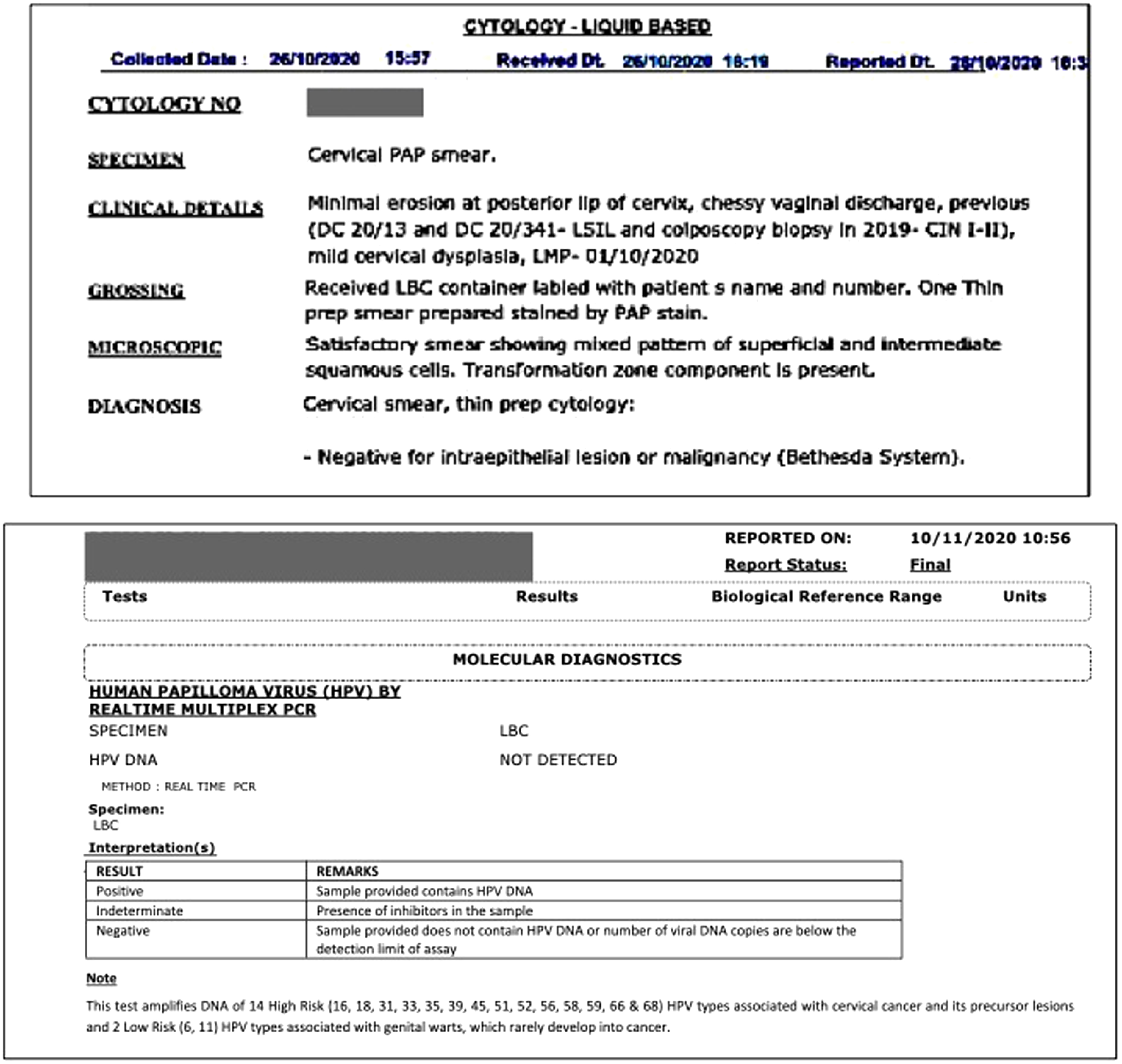
Pap smear report of October 26, 2020 and HPV DNA test report of November 7, 2020.
Discussion
Lower grade cervical intraepithelial neoplastic changes, especially in young women, revert to normal cells due to an efficient immune status and quick turnover of the cervical cells. Patients diagnosed with CIN-II and higher are advised for immediate treatment, whereas patients with CIN-I are advised to wait while under regular observation. 13 Treatment options include immune-modulators, antiproliferative medicines, antivirals, herbal treatments, and excision of the neoplastic tissues through cryosurgery or laser treatment. However, surgical excision is considered the standard of care due to the insufficient clinical trial evidence. 14 Surgical interventions are accompanied with increased risks of preterm labor, cervical incompetence, and other adverse reproductive outcomes in subsequent pregnancies. In addition, the risk of recurrence of cervical cancer is three times higher in people who have undergone than the general population for up to 20 years after the initial surgery.
This may be due to inadequate excision of the neoplastic tissues, undermining the severity of cancerous growth during the time of diagnosis, and/or the unidentified lesions hidden in the endocervical crypts. 15 The prognosis is dependent on multiple factors such as extent of the lesion and the subtype of oncogenic HPV infection. 13 Persistent high-risk HPV infection is considered a significant risk factor, but is an insufficient precursor to cervical cancer and only a small number of women with HPV infection develop CIN. 14 Other factors such as smoking and immunocompromised state increase the risk toward neoplastic changes. 13 It must also be taken into consideration that emotional distress creates susceptibility to physical diseases. 16
Complementary and alternative therapies also have been investigated for their relevance in cervical cancer. In one instance, escharotic treatment aided in the resolution of high-grade cervical neoplasia in <5 months. Multiple systems of medicines are often concurrently used by the general population alongside conventional medicine. 17 These systems use plant, animal, and mineral sources in the preparation of their medicines, and often certain compounds are similarly used in these systems to clinically manage specific disease conditions. 18 Homeopathy is widely accepted as a complementary therapy adjuvant to conventional treatment of cancer, often to minimize the adverse reactions brought on by the radiotherapy and chemotherapy.19,20
In addition, homeopathic medicines are also studied for their anticancer properties. Although homeopathic remedies such as Iodum, Kreosotum, Natrum carbonicum, Carbo animalis, Hydrocotyle, Sabina, Calcarea carbonica, Kali iodide, Conium maculatum, Hydrastis, Sanguinaria, and Lachesis muta are said to be efficient in treatment of genital warts and cervical cancer, the mechanism of action of the remedies is unknown. 18 In a study conducted by Asmita Pal et al., the homeopathic remedy Thuja occidentalis was assessed in vitro for its antiproliferative and antimigratory properties in HPV-16-infected cervical cancer cells, and it was found that Thuja mother tincture acted through an outburst of reactive oxygen species, and induced cellular demise through dual pathways, apoptosis, and autophagy.
In another study, the cytotoxicity of Echinacea angustifolia and Thuja occidentalis on the human cervical cancer lines was assessed, and it was found that certain cancer cell lines were more susceptible to homeopathic treatment and E. angustifolia exhibited a higher efficacy than T. occidentalis against these tumor cell lines. 21 Another plant of the Pulsatilla species was shown to have specific anticervical cancer effect in a study that evaluated the effect of Pulsatilla patens against the cervical cancer cell line. It was shown to alter the key signaling molecules of cellular cycle and thereby cause deregulation of the cellular proliferation, differentiation, and progress toward neoplastic type. It also promoted apoptotic death of the cells. 22 In this case, there may have been a similar effect from the homeopathic Pulsatilla nigricans, but this phenomenon is yet to be determined.
Although such fundamental studies exhibit the promising efficacy of homeopathic medicines against cancer cells, it is also important to consider that homeopathic system of treatment works on the complex integrated system of life models with its seat of action being the interactive states of physical, emotional, and mental spheres, and hence the action of the medicines should be considered on all spheres of the organism. 23 This is the approach with individualized classical homeopathic therapy.
Individualized homeopathy considers the presenting pathology along with the mental/emotional disturbances experienced by the patient in association with their hereditary influences and past diseases and treatments to synthesize an integrated picture of the diseased patient. The same approach was true in this case as well. Her hereditary background showed tendency to some allergic disorders but no cancer. This predicts a favorable outcome according to levels of health theory and indicates the possibility to find the remedial picture easily enough. 11 The sensitive personality coupled with her response to her romantic separation indicated the remedy. Furthermore, in this case, we see a favorable prognostic sign with treatment—the return of a previously suppressed skin eruption.
Although evidence exists for the direct association of history of atopic dermatitis with cervical cancer, 24 the homeopathic perspective is that when being treated for a deeper pathology (such as CIN in this case), the return of a more superficial pathology (in this case, atopic dermatitis) that the patient had suffered from, earlier in life, is a sure indication of improvement. 25 In this study, it was corroborated by the biopsy and viral DNA analysis reports, which showed absence of CIN histology and HPV DNA after treatment, within a short period. The Modified Naranjo Criteria for Homeopathy yielded a score of 10/13, indicating strong causal relation of the effects to the treatment (Table 2).
Modified Naranjo Criteria for Homeopathy—for Causality Assessment
The limitation of this case report is that spontaneous resolution of the CIN-II lesions, although rare, is a possibility and the sparse number of studies, where homeopathic treatment was exclusively used to treat cervical cancer provides weak background to base the conclusions upon. However, as the prognosis of the case follows the homeopathic principles such as the reappearance of previously suppressed dermatitis after the resolution of CIN-II, proves to be a strength of this case report.
This case adds to the body of knowledge in such a scenario. Further studies are necessary to scientifically investigate the efficacy of individualized homeopathy in treating CIN.
Conclusions
This case of an Indian woman diagnosed with LSIL with high-risk human papillomavirus infection benefited with individualized homeopathy. There are grounds to conduct further scientific investigations to determine the relevance of this therapy in precancerous lesions.
Footnotes
Acknowledgments
The authors acknowledge the help of patient in consenting for publication and thank Dr. Aaditi Lakshman, Dr. Pooja Dhamodar, and Dr. Amritha Belagaje for rendering technical help.
Authors' Contributions
Writing—reviewing and editing by S.M.; resources by O.H.; supervision and validation by G.V.
Ethical Approval
Written consent was obtained from the patient for publication of case details.
Author Disclosure Statement
No competing financial interests exist.
Funding Information
No funding was received for this article.