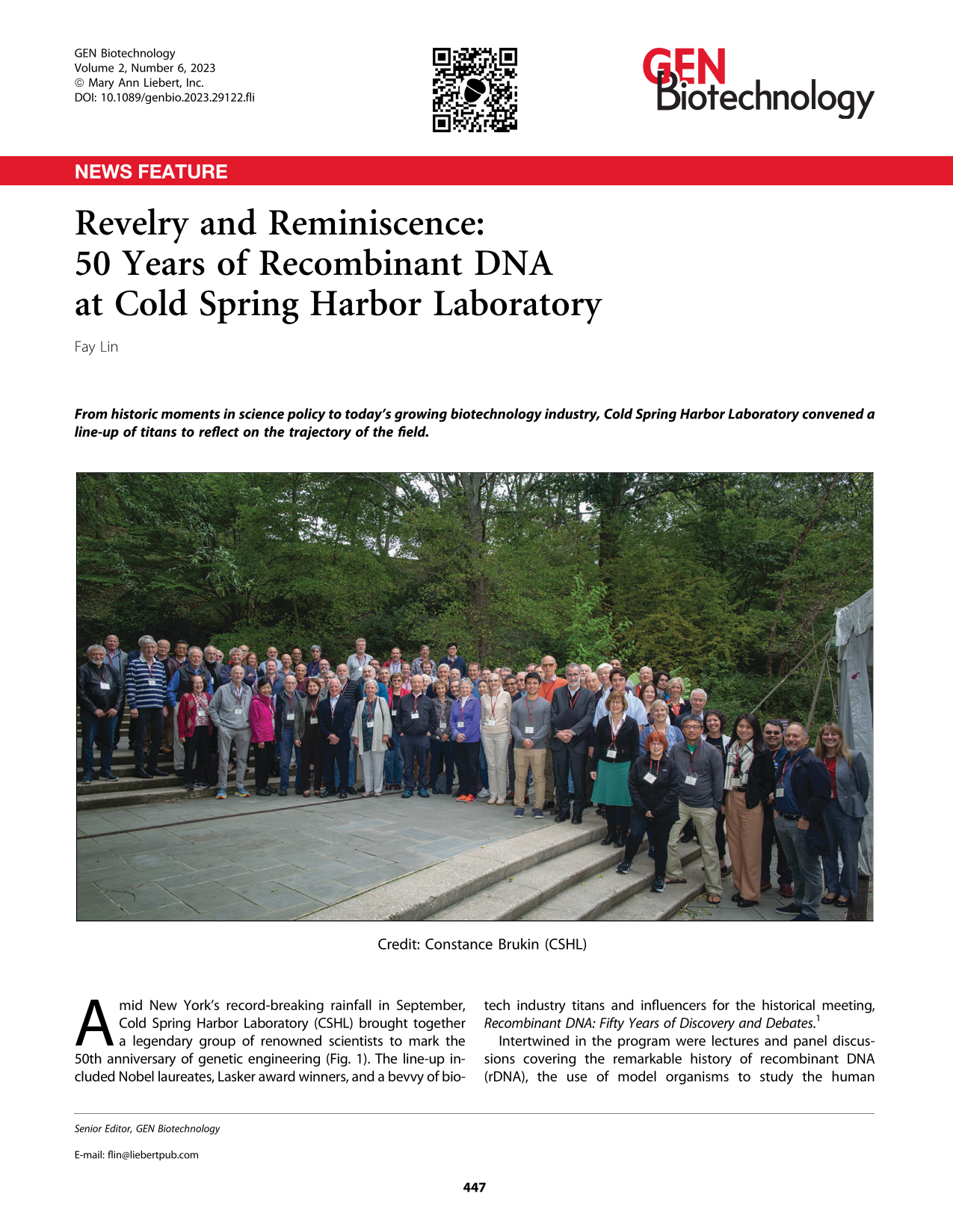
RecombinantDNA: 50 Years ofDebates. Organized by Richard Mulligan, Mila Pollock and Shirley Tilghman. September 27–30, 2023.
2.
JacksonDA, SymonsRH, BergP. Biochemical method for inserting new genetic information into DNA of simian virus 40: Circular SV40 DNA molecules containing lambda phage genes and the galactose operon of Escherichia coli. Proc Natl Acad Sci, 1972; 69(10):2904–2909; doi: 10.1073/pnas.69.10.2904
3.
MorrowJF, CohenSN, ChangAC, et al.Replication and transcription of eukaryotic DNA in Escherichia coli. Proc Natl Acad Sci U S A, 1974; 71(5):1743–1747; doi: 10.1073/pnas.71.5.1743
4.
AlbertsBM. Limits to growth: In biology, small science is good science. Cell, 1985; 41(2):337–338; doi: 10.1016/s0092-8674(85)80001-5
5.
RobertsonM. The proper study of mankind. Nature, 1986; 322(6074):11; doi: 10.1038/322011a0
ChakravartiA. The Compleat Human Genome. GEN Biotechnol, 2022; 1(3):234–236; doi: 10.1089/genbio.2022.29034.ach
8.
KarikóK, BucksteinM, NiH, et al.Suppression of RNA recognition by Toll-like receptors: The impact of nucleoside modification and the evolutionary origin of RNA. Immunity, 2005; 23(2):165–175; doi: 10.1016/j.immuni.2005.06.008
9.
KreitzJ, FriedrichMJ, GuruA, et al.Programmable protein delivery with a bacterial contractile injection system. Nature, 2023; 616(7956):357–364; doi: 10.1038/s41586-023-05870-7
10.
MeselsonM, StahlFW. The replication of DNA in Escherichia coli. Proc Natl Acad Sci, 1958; 44(7):671–682; doi: 10.1073/pnas.44.7.671