






Abstract
Background:
Performance levels in football are ever more important and no longer are just physical, technical, and tactical skills, the ones that make an athlete stand out. Cognitive variables, such as stress-coping, become more important and seem to be explaining differences in performance, for example, through reaching an optimal level of arousal. In addition, it is suggested that stress-coping skills also affect situation awareness (SA), important for decision-making in the complex and dynamic situations in football.
Objective:
This study was conducted to examine how stress-coping skills, such as stress mindset, affect performance and SA in the context of a football match.
Methods:
Twenty elite female football players participated in the study. The final sample size consisted of 15 players for the Stress Mindset Measure (SMM) analysis and 8 players for the multilevel model analyses. Two types of intervention were used to manipulate stress mindset and control over heart rate variability (HRV); a serious game called “Stressjam,” and a reflection tool called “Brainjam.” Questionnaires for stress mindset and SA and video analysis for performance were used. A total of three matches were assessed.
Results:
The “Stressjam” intervention resulted in significant differences in stress mindset throughout the intervention [F(1,5) = 7.357, P = 0.008]. Subsequently, multilevel analysis showed a positive, strong, and significant correlation between stress mindset, manipulated through “Stressjam” and SA [r(14) = 0.69, P = 0.014]. A correlation of practical interest, given the confidence intervals, was found between stress mindset, manipulated through “Stressjam,” and performance.
Conclusion:
Cognitive variables, such as stress-coping, correlate significantly with SA in football. A correlation of practical interest was found between stress-coping and performance. Further research is needed to study the relationship between stress-coping and performance in football.
Introduction
An athlete's level of performance in football is important as transfers, sponsorships, and media attention depend on it. To perform well, high levels of physical, technical, and tactical skills are needed. But football is a complex and dynamic sport, therefore cognitive skills might be of equal or even more importance for performance than physical, technical, and tactical skills. 1 However, it is not just those skills that enhance performance, according to Abdullah et al, it is the combination of these skills that will help increase performance the most. 2 Cognitive variables such as stress control, focus, and concentration seem important in explaining differences in athletes' sports performances. 3 A cognitive variable such as stress control not only affects performance but also situation awareness (SA 4 ), which is important for decision-making in the complex and dynamic situations in football. The current study will focus on improving performance and SA in football with a focus on stress.
Stress and sports performance
Research has shown that stress might result in lower sports performance, 5 a loss of attentional focus, 6 sports injuries, 7 and even sport dropout. 8 However, it is not given that stress negatively affects sports performance. According to Kerr, the reversal theory states that stress and arousal may have different effects on performance for different people, depending on thoughts and interpretation of stress and arousal.9,10 This way, a positive interpretation will result in positive effects. Positive effects of stress on performance are confirmed by the stress response curve. 11 According to this model, stress and performance levels are positively correlated up to the point of eustress. The positive and negative effects of stress illustrate the stress paradox. However, stress can generally be described as the “experience of anticipating or encountering difficulty in one's goal-related efforts.” 12
The interpretation of stress is important for its consequences. A stress mindset describes the interpretation as the way the nature of stress is perceived, either enhancing or debilitating. A stress-is-enhancing (SIE) mindset follows the belief that stress has positive effects and can be actively used toward enhancing ends like achieving goals and better health. 13 A stress-is-debilitating mindset follows the belief that stress has negative effects and is, among others, bad for health and vitality. 13 The stress mindset affects the hormone ratio of cortisol and its anabolic counterpart dehydroepiandrosterone sulfate (DHEAS), which are released during a stress response. While high levels of cortisol are often linked to depression, 14 higher levels of DHEAS are known for making the body stronger and healthier by rebuilding cells and enhancing immunity, among others. 15
A SIE mindset may foster resilience due to a combination of higher levels of DHEAS, changing the ratio, and increased positive mood. 16 Resilience (i.e., the ability to deal with adverse circumstances 17 ) is positively associated with sports performance. 18 Therefore, a SIE mindset might result in better performance. More recently another positive relationship between SIE mindset and sports performance was found through mental skills training methods. 19 Even though a relationship between SIE mindset and sports performance is possible, no studies are known to manipulate stress mindset and study its effects on sports performance.
A stress mindset can be manipulated with the use of serious (virtual reality; VR) games. 20 Maarsingh et al conducted a study with “Stressjam,” a serious VR game, which showed to be successful in manipulating stress mindset to a SIE mindset. 21 The game uses personalized heart rate variability biofeedback (HRVB) obtained via a heart rate monitor on the chest. Heart rate variability (HRV) refers to the variation in RR intervals, the time between the R-spikes of consecutive heartbeats, measured in milliseconds. 22 With HRVB, individuals obtain more control over their HRV and try to find coping skills to stress or calm down to advance in the game. HRV is used as a measure of stress because it is a reliable indicator of the actual stress level 23 and the self-regulatory strength, important for stress mindset. 24
Besides improving stress mindset, HRVB training also improves sports performance, measured objectively (e.g., video analysis) 25 and subjectively (e.g., practitioner report). 26 Both studies were conducted in sports like football, with complex and dynamic situations. However, measurements were done during training sessions, eliminating the effects of match arousal.
Stress and situation awareness
The complex and dynamic situations in football require good decision-making capabilities. An important factor for decision-making is SA. 4 In the literature, different models of SA are described. Endsley's three-levels model currently dominates the field: (1) perception of relevant information, (2) understanding of perceived information, and (3) the ability to predict the near future with this information. 27 The third level illustrates the link between SA and decision-making. In addition, it indicates that low levels of SA are problematic in football since the lack of information or projections will ultimately cause mistakes such as misplacing a pass or getting dispossessed from behind when dribbling at speed.
Research into the effects of SA on sport settings has been limited up to this point. To date, studies on SA have only been conducted during training sessions and that is a limitation. It is important to study the effects during matches since “stress levels” vary greatly between training sessions and matches. This difference in “stress levels” is important because studies on SA in other domains have found negative effects of stress on SA. Easterbrook states that the amount of information utilized in a situation tends to decrease with increased stress levels. 28 Since stress negatively affects SA, it is suggested that stress control 29 and coping with stressful situations 30 could improve SA. Biofeedback training approaches such as “Stressjam” are a promising method to increase SA because stress-coping skills and control over HRV are practiced. That control over HRV is practiced and is relevant because HRV and SA are positively related.31,32
Current study
Earlier research suggests relationships between stress and performance, HRV and performance, stress and SA, and HRV and SA. In sport psychology, most studies related to performance and SA are conducted during training sessions since it allows the researchers to control the situation. However, there are substantial differences in circumstances between training session and matches, for example in stress levels.
Therefore, in the current study, measurements will be conducted during and around matches. The research question for this study is, “How is the performance and situation awareness of elite female football players affected by serious game interventions in the context of a football match?” Performance and SA are studied separately in this study; therefore, two hypotheses are proposed. In line with previous research, it is hypothesized that stress mindset and control over HRV, manipulated through serious game interventions, have positive effects on (1) performance and (2) SA of elite female football players in the context of a match.
Two different interventions will be used to manipulate stress mindset and control over HRV. The serious VR game “Stressjam” will be used. This game has already been proven effective in manipulating stress mindset and increasing control over HRV. 21 In that study, Maarsingh et al, suggested looking at alternative ways to manipulate stress mindset without the use of VR since it has some downsides such as high equipment costs and participants getting motion sick. Therefore “Brainjam,” a reflection tool designed with the same purposes as “Stressjam,” will be added to the study as an alternative intervention. “Brainjam” is an app for mobile devices with exercises with HRVB, obtained through a heart rate monitor on the chest.
The current study will be the first to examine the effectiveness of “Brainjam” in manipulating stress mindset and control over HRV. Including “Brainjam” in the study also has a social relevance because this method is more easily accessible for any individual since only a mobile device with an app and a heart rate monitor is needed instead of a VR installation.
In addition to the two experimental conditions, a control group will be included in the study. Furthermore, questionnaires, sensors, and video analysis will be used to assess stress mindset, HRV during the interventions, performance, and SA. Control over HRV during matches will not be analyzed because a test measurement showed too little detail in the HRV data to be relevant for the current study. In line with the study of Maarsingh et al 21 and theoretical reasoning, it is expected to find a more positive stress mindset in the “Stressjam” and “Brainjam” conditions, causing an increase in performance and SA. It is not expected to see any changes in stress mindset, performance, or SA in the control group.
Materials and Methods
Participants
The participants for this study included 20 elite female football players of a team active in the highest competition of female football in the Netherlands. Participants ranged in age from 18 to 25 years and included three international players. There were no exclusion criteria and no selection criteria other than to be part of the specific elite female football team. Before the study, all participants gave written informed consent.
Interventions
“Stressjam” is a serious VR game for which the HTC Vive is used as the VR hardware. An interactive world on a tropical island was designed for the game, in which participants progress by finding effective methods of either stressing or calming down. The game is personalized with HRVB obtained through a sensor on the chest. The HRV is measured using the root mean square of successive differences (rMSSD), which gives a reliable indication of the actual stress level. 23 A baseline rMSSD of 60 seconds was compared to a short rMSSD of 6 seconds. Short rMSSD above baseline result in a blue color, indicating getting calmer. Short rMSSD below baseline result in an orange color, indicating getting more stressed. “Stressjam” was included in this study to manipulate the stress mindset to SIE mindset and to increase control over HRV.
“Brainjam” is an app with personalized HRVB. For this, the same algorithm was used as the one in “Stressjam.” The HRVB is displayed on a meter in the app, with the blue and orange colors indicating calm and stress, respectively. Within the app, participants tried different techniques to either stress or calm themselves. In this study, a minimalistic version of “Brainjam” was used that only functioned as a reflection tool showing participants the effectiveness of the different techniques. “Brainjam” was included in this study to manipulate the stress mindset to SIE mindset, increase control over HRV, and evaluate its effectiveness in doing so.
Measurements
The Stress Mindset Measure (SMM) is a reliable and valid instrument to assess the participant's stress mindset, 13 an independent variable in this study. This 8-item questionnaire is scored on a 5-point Likert scale, ranging from 0, strongly disagree, to 4, strongly agree. The SMM results in a Stress Mindset Measure-General (SMM-G) score, the higher the SMM-G score, the more positive the stress mindset, and the lower the SMM-G score, the more negative the stress mindset. The SMM is included in this study to monitor any changes in stress mindset caused by the interventions.
Performance, a dependent variable, was assessed objectively through video analysis and subjectively through experts grading the players. Analysis of video footage was based on the statistics of the Eredivisie, the highest male football competition in the Netherlands. The percentage of successful ground and air passes, duels, and dribbles were assessed, as well as the number of scoring attempts, assists, and goals. To assess the goalkeeper's performance, an extra factor was included, the percentage of saves. In addition, a goalkeeper rolling the ball to a fellow player was counted as a pass. All actions during and with resumption of the game were analyzed. A ground pass was defined as a short or long pass on the ground. An air pass was defined as a head pass or a long-range kick.
A successful duel was defined as a player taking the ball from one specific opponent or as a player keeping ball possession. Interceptions of the ball were counted as successful duels. Duels after which the referee whistles were not counted. Finally, throw-ins were not analyzed. The data obtained from these analyses were converted into one grade, keeping differences between positions in mind. The goalkeeper was graded on an average of the percentages of successful ground passes, air passes, and saves. Defenders were graded on an average of the percentages of successful ground passes, air passes, duels, and dribbles.
Midfielders and attackers were graded on the same factors, and were rewarded with extra points for scoring attempts, assists, and goals. Additional points for scoring attempts were rewarded proportionately for the player to the total amount of scoring attempts within the team, every assist was rewarded with 0.5 points and every goal was rewarded with 1.0 point on top of the finale grade.
SA, a dependent variable, was assessed with a 10-item questionnaire based on the Situation Awareness Rating Technique (SART 33 ) and the Situation Awareness Global Assessment Technique (SAGAT 34 ). The SART and SAGAT are two most widely used and validated techniques. 35 The SART is a subjective post-trial technique that provides a subjective measure of SA, the SAGAT is a probe-freeze technique that provides an objective measure of SA. It is debatable whether a subjective or objective measure reflects SA best, 32 therefore both were included in this study. Participants completed subjective questionnaires directly after the football match. Objective questionnaires were completed by two experts during the football match.
Based on the domains and constructs of the SART, questions were modified to suit the context of a football match. Both questionnaires, objective and subjective, consisted of 10 items and were scored on a seven-point rating scale, ranging from 1, low, to 7, high. SA scores were calculated by the following formula: SA = U − (D − S), where U is the summed understanding, D is the summed demand, and S is the summed supply. An average SA score of the two experts was calculated for the objective SA measure.
Design and procedure
All participants were randomly divided among three different conditions; “Stressjam” (6; condition-S), “Brainjam” (7; condition-B), and Control (7; condition-C). The study started with a baseline measurement of the stress mindset with the SMM. Subsequently, baseline measurements of performance and SA were obtained during and after a football match.
Following, the experimental groups, condition-S and condition-B, started with separate programs. Based on earlier research, “Stressjam” participants completed a total of five 1-hour sessions, one per week. 36 After each “Stressjam” session, participants completed a SMM. Sessions in condition-B consisted of a 12-minute focus exercise, in which participants were asked to stay as long as possible in orange, and a 12-minute calming exercise, in which participants were asked to stay as long as possible in blue. Based on the protocol of Lehrer et al and the study of Paul and Garg, a total of 10 “Brainjam” sessions were planned, spread over 5 weeks.25,37 In addition to the sessions, the participants completed the SMM once a week, the same day as participants in condition-S. Condition-C only completed the SMM once a week, on the same day as the participants from condition-S and -B.
After 2 weeks, performance and SA were assessed again during and after a football match. The last measurements of performance and SA were conducted after the fifth session of condition-S, totaling 18 datapoints, and after the 10th session of condition-B, totaling 21 datapoints. Following the last match measurements, all participants completed the last SMM (Fig. 1).
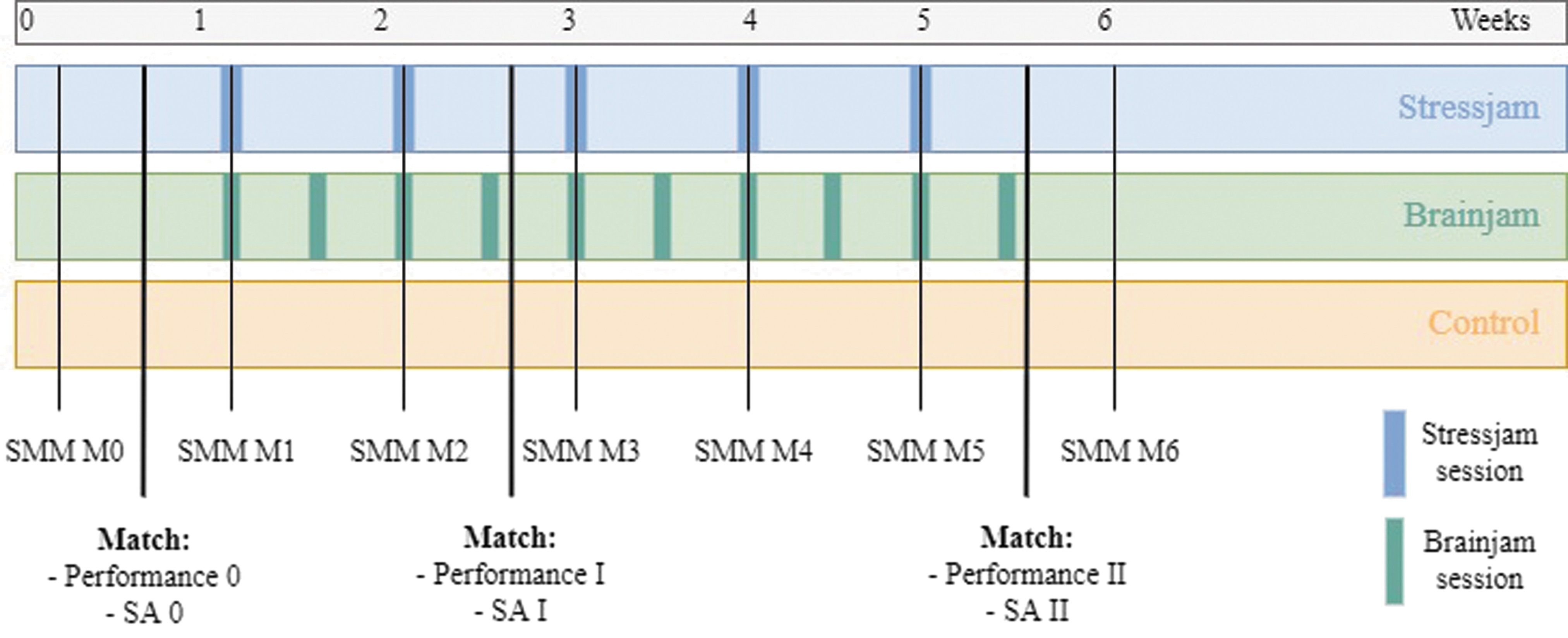
Overview of the study design. The SMM will be administered 7 times. Performance and SA will be assessed during three matches. The Stressjam condition (blue) will follow five sessions and complete the SMM questionnaires. The Brainjam condition (green) will follow 10 sessions and complete the SMM questionnaires. The Control group (orange) will only complete the SMM questionnaires. SA, situation awareness; SMM, Stress Mindset Measure.
Data analysis
All data were analyzed using R studio (version 4.0.3). The alpha significance level for all tests was 0.05. Possible changes in SMM-G scores throughout the intervention period were analyzed with repeated measures analyses of variance for each condition separately. In case significant differences were found, planned comparisons for M0–M1, M0–M2, M0–M3, M0–M4, M0–M5, and M0–M6 were carried out with Holm corrections for multiple t-tests. Only experimental conditions, for which significant changes in SMM-G scores were found, were included in further analysis.
The relationship between SMM-G score and the dependent variables, performance objective (Pobj), and performance subjective (Psub), SA objective (SAobj), and SA subjective (SAsub) were assessed with a multilevel model with maximum likelihood method using the “nlme” package in Rstudio. 38 This analysis fit the data since it was able to cope with repeated measures and missing data, not all participants played all matches. Different models were created to find the best fit for the data. These models were an intercept only model (model1), a random intercept only model (model2), a predictor model (model3), and a random slopes model (model4). The models were compared with the Anova() function which compares the Akaike Information Criterion (AIC), Bayesian Information Criterion (BIC), and log Likelihood (logLik) of the models, resulting in a Likelihood Ratio Test statistic (LRT) and a P-value.
A low AIC, low BIC, and less negative logLik indicated a better model. After model2, model3, or model4 was found to be a better fit for the data than model 1, a simple correlation test was conducted to assess the relationship between SMM-G and a dependent variable (e.g., Pobj, Psub, SAobj, SAsub). If model1 was found to best fit the data, a Pearson correlation, or Spearman correlation if parametric testing was not possible, was conducted with SMM-G and a dependent variable.
Results
A total of 20 players participated in the study. For the final sample, five participants were excluded from the SMM analyses because of incomplete data and/or interventions. As a result, the data of six “Stressjam” (Age: M = 20.50; standard deviation [SD] = 2.35), three “Brainjam” (Age: M = 21.33; SD = 1.53), and six Control (Age: M = 20.67; SD = 3.50) participants were analyzed for the SMM questionnaire. An additional four participants were excluded from correlation analyses if the multilevel model was not used, resulting in four “Stressjam” (Age: M = 19.5, SD = 1) and four Control (Age: M = 22.50, SD = 2.29) participants. First, the analysis of SMM-G will be presented, followed by the analyses of the SA questionnaires, finishing with the correlations.
Stress mindset measure-general
Descriptive statistics of SMM questionnaires for all three conditions are presented in Table 1. Not all conditions met the assumptions for parametric testing. Condition-S, grouped by measurement, met the assumption of normality (W = 0.93, P = 0.02), however, this was not the case for condition-B (M2: W = 0.75, P < 0.001; M3: W = 0.75, P < 0.001; M6: W = 0.75, P < 0.001) and condition-C (M2: W = 0.77, P = 0.03; M6: W = 0.70, P = 0.01). All conditions violated the assumption of sphericity with W < 0.001 and P < 0.001. Condition-S was analyzed with repeated measures analysis of variance (RMANOVA) with a Greenhouse-Geisser corrected P-value and condition-B and -C were analyzed with a Friedman's test. A significant difference was found in condition-S [F(1,5) = 7.36, P = 0.008; Fig. 2].
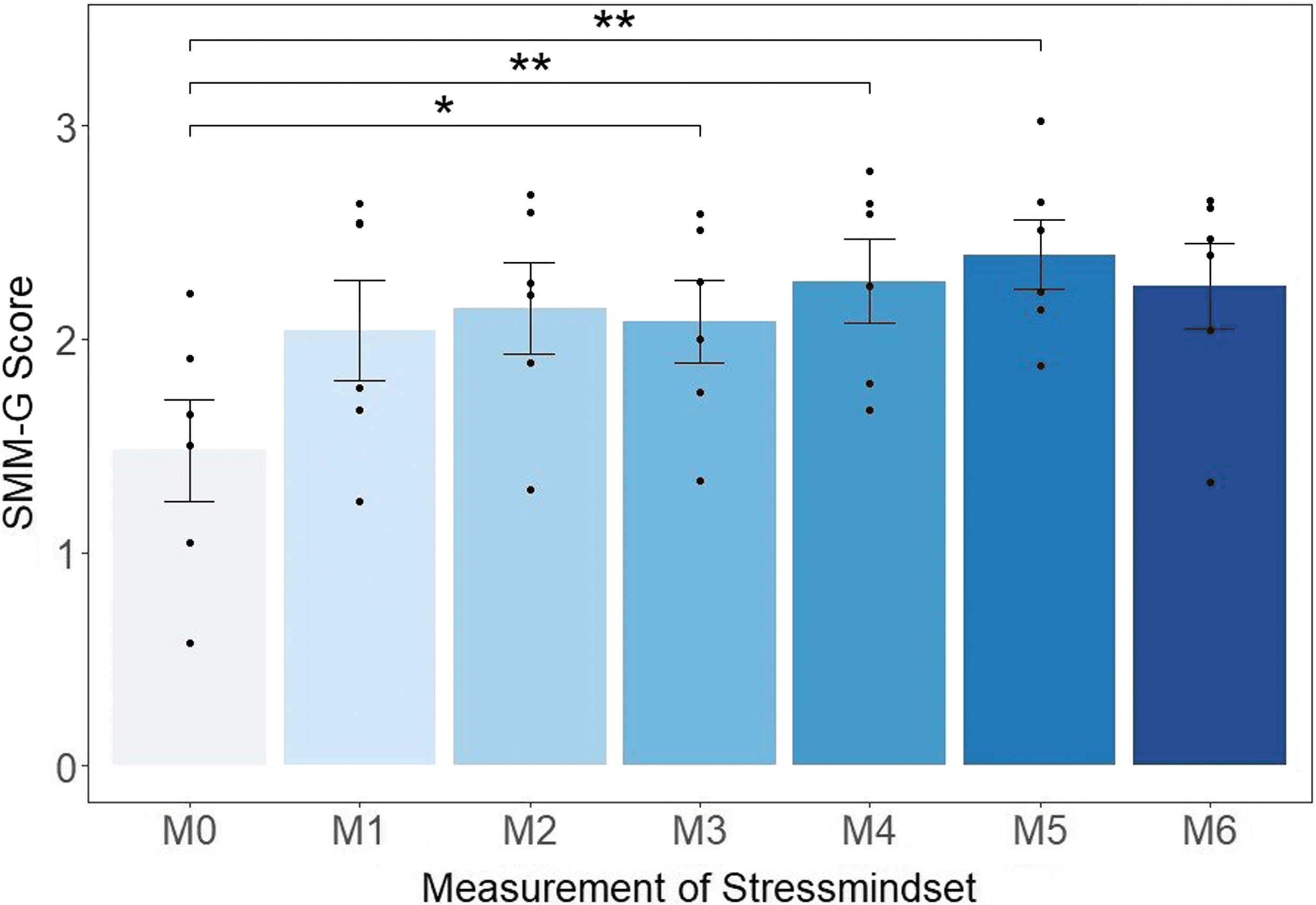
SMM-G Score on baseline and following measurements in condition-S. The mean, error bar, individual datapoints, and significances are visualized in the bar plot for each measurement (M0–M6) with the SMM. RMANOVA with Greenhouse-Geisser correction, showed a significant difference between measurements of stress mindset [F(1,5) = 7.357, P = 0.008]. A post hoc planned comparison with Holm-method corrected alphas showed significant differences between the baseline (M0; M0; M = 1.48, SD = 0.59) and M3 (M = 2.08, SD = 0.47; t = 2.77, P = 0.039, d = 1.13), between M0 and M4 (M = 2.27, SD = 0.48; t = 4.58, P = 0.0059, d = 1.87), and between M0 and M5 (M = 2.40, SD = 0.40; t = 4.97, P = 0.0042, d = 2.03). No significant differences were found between M0 and M1 (M = 2.04, SD = 0.57), M0 and M2 (M = 2.15, SD = 0.52), and M0 and M6 (M = 2.25, SD = 0.49). *p < .05; **p < .01. Condition-S, condition “Stressjam”; RMANOVA, repeated measures analysis of variance; SD, standard deviation.
Descriptive Statistics of Stress Mindset Measure Questionnaires for Condition “Stressjam,” Condition “Brainjam,” and Control Group
The represented scores are SMM-G.
Condition-B, condition “Brainjam”; Condition-C, control group; Condition-S, condition “Stressjam”; M0, baseline measurement of SMM; M1–M6, subsequent measurements of SMM; SD, standard deviation; SMM, stress mindset measure; SMM-G, Stress Mindset Measure-General.
The post hoc planned comparison with paired-t-tests and Holm-method correction showed significant differences between M0–M3 (t = 2.77, P = 0.039, d = 1.13), M0–M4 (t = 4.58, P = 0.0059, d = 1.87), and M0–M5 (t = 4.97, P = 0.0042, d = 2.03). The statistical power of the effect of stress mindset in condition-S is close to zero. No significant differences were found for condition-B [χ 2 (6) = 4.22, P = 0.66; Fig. 3] and condition-C [χ 2 (6) = 9.82, P = 0.13; Fig. 4]. Therefore, condition-B was excluded from further analysis.
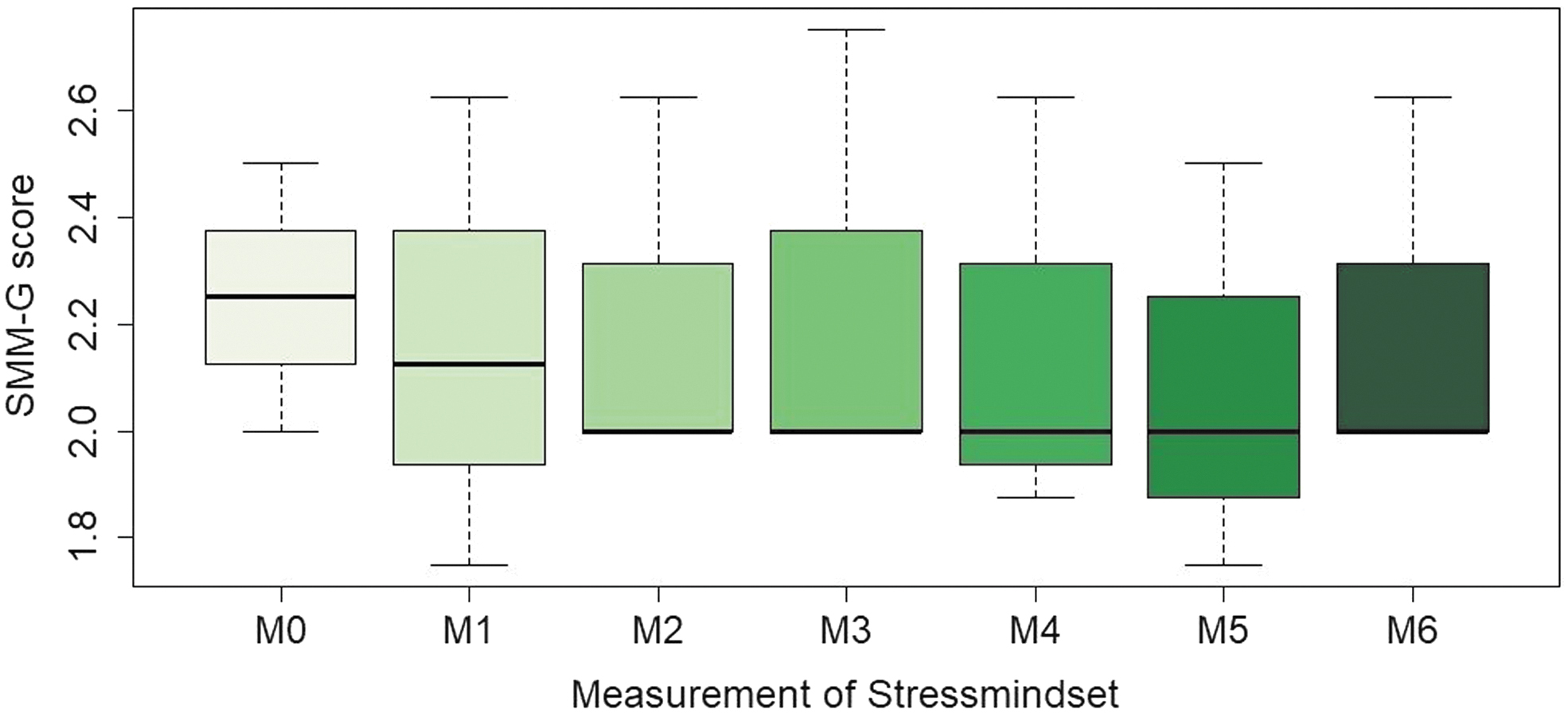
SMM-G Score on baseline and following measurements in condition-B. The boxplots show the median and IQR for each measurement with the SMM, the stress mindset baseline (M0; Med = 2.25, IQR = 0.25) and the following measurements: M1 (Med = 2.125, IQR = 0.44), M2 (Med = 2, IQR = 0.31), M3 (Med = 2, IQR = 0.38), M4 (Med = 2, IQR = 0.38), M5 (Med = 2, IQR = 0.38), and M6 (Med = 2, IQR = 0.31). No significant differences were found between M0 and any of the other measurements [χ 2 (3) = 4.22, P = 0.65]. Condition-B, condition “Brainjam”; IQR, interquartile range; SMM-G, Stress Mindset Measure-General.
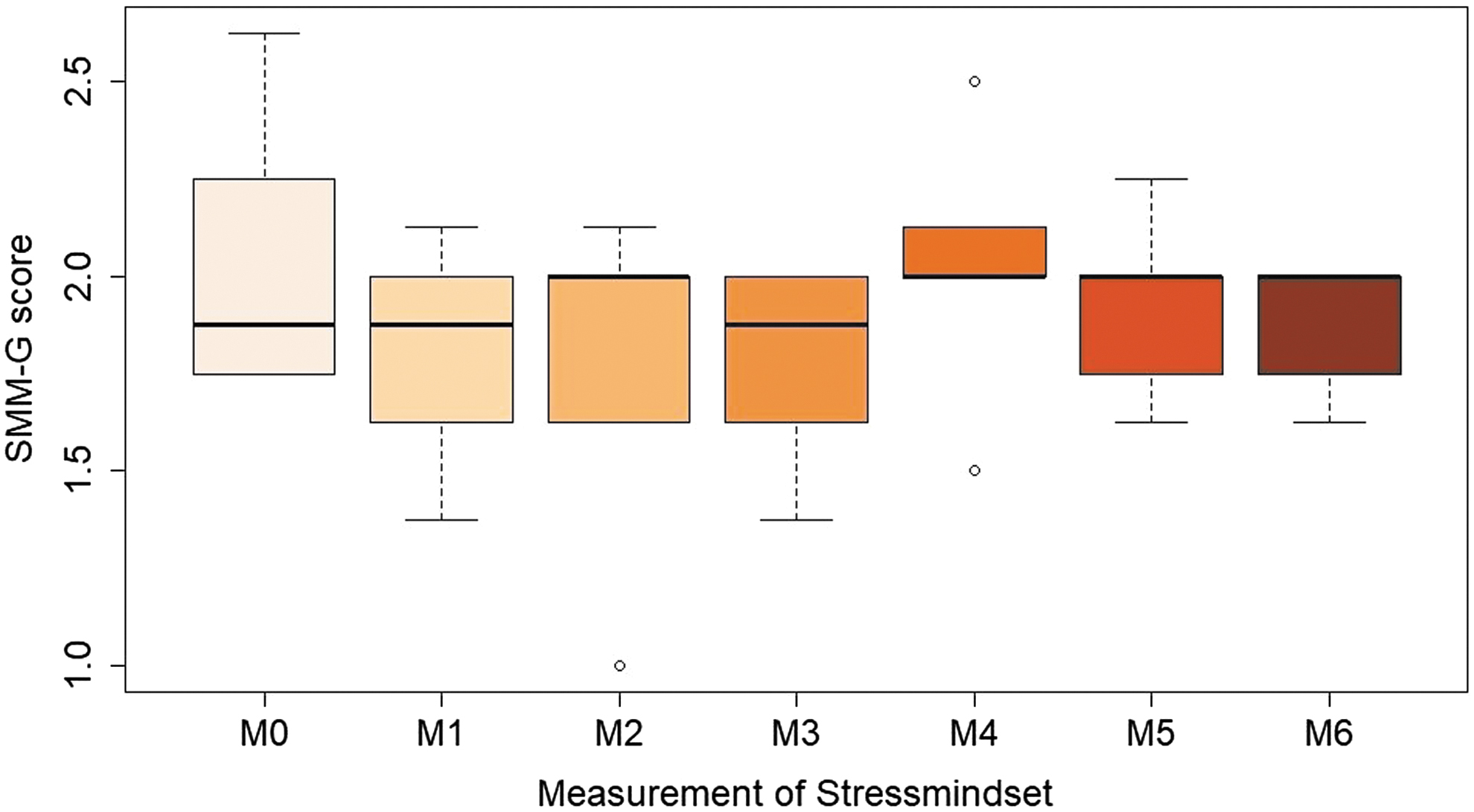
SMM-G Score on baseline and following measurements in condition-C. The boxplots show the median and IQR for each measurement with the SMM, the stress mindset baseline (M0; Med = 1.88, IQR = 0.44) and the following measurements: M1 (Med = 1.88, IQR = 0.34), M2 (Med = 2, IQR = 0.29), M3 (Med = 1.88, IQR = 0.34), M4 (Med = 2, IQR = 0.09), M5 (Med = 2, IQR = 0.19), and M6 (Med = 2, IQR = 0.19). No significant differences were found between M0 and any of the other measurements [χ 2 (6) = 9.82, P = 0.13]. Condition-C, control group.
SA questionnaires
Table 2 presents the descriptive data of the SAobj (M = 19.81, SD = 5.18) and SAsub (M = 0.84, SD = 3.03) questionnaires. The SAobj questionnaire was found to be reliable after removal of questions 1 and 5, resulting in a Cronbach's Alpha of 0.7. The SAsub questionnaire was found to be reliable after removal of questions, 10, 6, 4, and 9, resulting in a Cronbach's alpha of 0.7.
Descriptive Statistics of the Objective and Subjective Situation Awareness Questionnaires
SAobj, situation awareness objective; SAsub, situation awareness subjective.
Correlations
Stress mindset and performance objective
The random intercept only model of Pobj (model2Po) did not fit the data significantly better than the intercept only model of Pobj [model1Po; X(3) < 0.001, P = 1; Table 3], therefore, multilevel analysis was not necessary. A spearman correlation was conducted because the assumption of linearity, assessed with a plot, was violated. The Spearman correlation indicated no significant correlation between stress mindset and Pobj in condition-S [r(14) = 0.0063, P = 0.98]. Also, no correlation was found between stress mindset and Pobj in condition-C [r(10) = −0.17, P = 0.63].
Results and Comparisons of Models in the Multilevel Model Analysis
A better model is indicated by lower AIC and BIC and by less negative logLik.
P < 0.05. bP < 0.01.
AIC, Akaike Information Criterion; BIC, Bayesian Information Criterion; logLik, log Likelihood; LRT, Likelihood Ratio Test statistic; Pobj, performance objective; Psub, performance subjective.
Stress mindset and performance subjective
The random intercept only model of Psub (model2Ps) did not fit the data of condition-S significantly better than the intercept only model of Psub [model1Ps; X(3) = 0.39, P = 0.53; Table 3]. Therefore, multilevel analysis was not necessary. A spearman correlation was conducted because the assumption of linearity was violated. The Spearman correlation indicated no significant correlation between stress mindset and Psub [r(14) = 0.50, P = 0.061]. Also, no correlation was found between stress mindset and Psub in condition-C [r(10) = 0.33, P = 0.32].
Stress mindset and SA objective
The random intercept only model of SAobj (model2So) fitted the data of condition-S significantly better than the intercept only model of SAobj [model1So; X(3) = 5.09, P = 0.024; Table 3]. Therefore, multilevel analysis was necessary. The predictor model (model3So) with fixed effects of SMM-G scores fitted the data significantly better than model2So [X(4) = 8.40, P = 0.004; Table 3] and was the best fit. Model3So met the assumptions of linearity, homoscedasticity [F(5,9) = 2.28, P = 0.13], and normality.
Therefore, a simple correlation test was conducted to examine the relationship between SAobj and SMM-G. A strong, positive correlation between stress mindset and SAobj was found in condition-S [r(14) = 0.69, P = 0.014]. The power analysis for the effect for stress mindset with SAobj indicated a power of 0.922. The correlation is visualized in Figure 5. No correlation was found between stress mindset and SAobj in condition-C [r(10) = 0.028, P = 0.94].
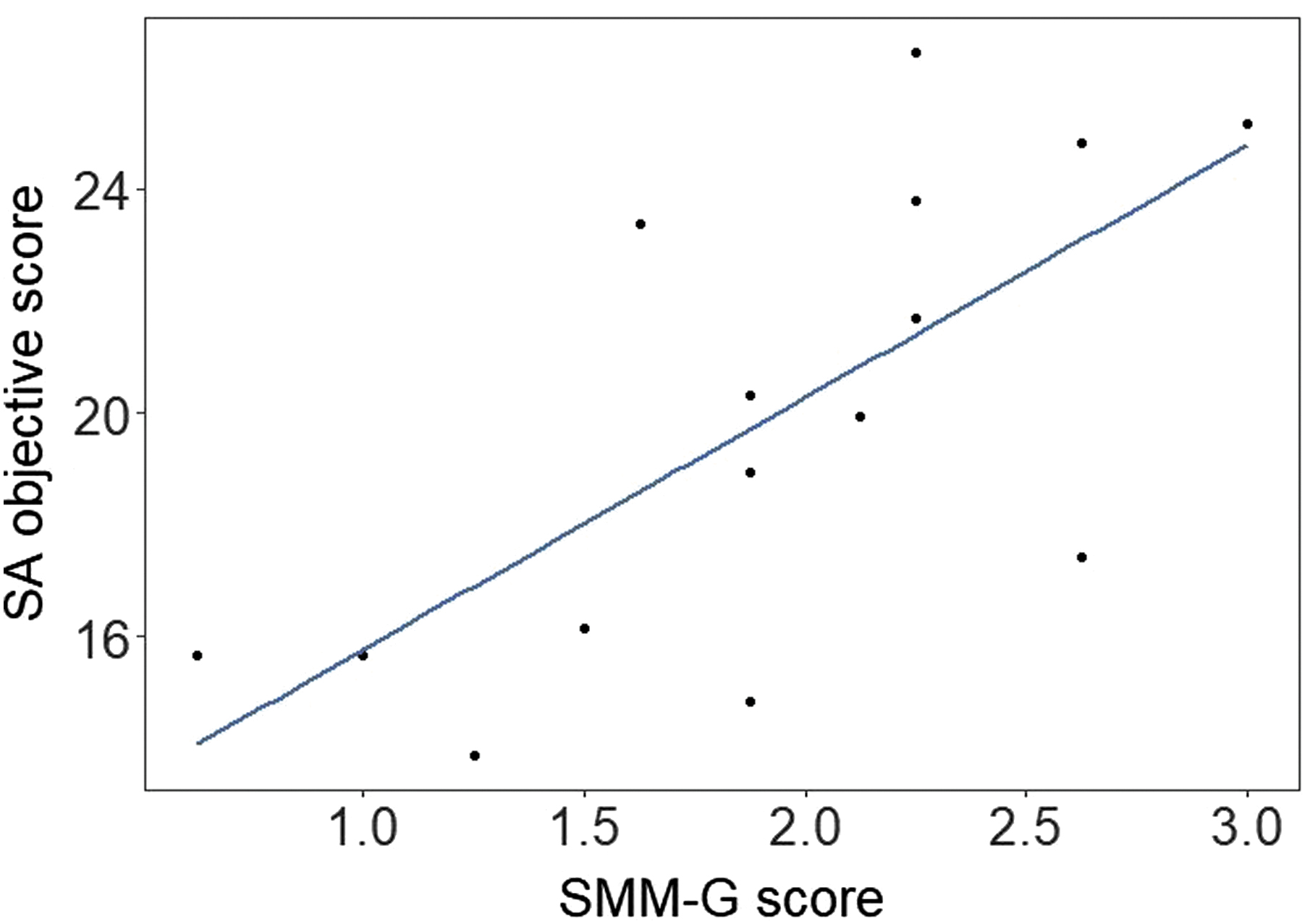
Correlation between SMM-G and SAobj in condition-S. The figure shows all individual data points and visualizes the correlation with the blue line. A strong positive significant correlation was found between the SMM-G score and the SAobj score [r(14) = 0.69, P = 0.014]. SAobj, situation awareness objective.
Stress mindset and SA subjective
The random intercept only model of SAsub (model2Ss), did not fit the data of condition-S significantly better than the intercept only model of SAsub [model1Ss; X(3) = 0.79, P = 0.38; Table 3]. Therefore, multilevel analysis was not necessary. A Spearman correlation was conducted because the assumption of linearity was violated. The Spearman correlation indicated no significant correlation between stress mindset and SAsub in condition-S [r(14) = 0.19, P = 0.51]. However, a significant correlation was found in condition-C [r(10) = 0.75, P = 0.0078].
Discussion
The aim of this study was to examine the relationship between stress mindset, obtained through serious game intervention, and performance and the relationship between stress mindset and SA, both in the context of a football match. Three distinct groups participated in the study: “Stressjam” intervention, “Brainjam” intervention, and no intervention. The results of this study will be discussed in different sections, starting with stress mindset, after which performance in relationship to stress mindset, and SA in relationship to stress mindset follows.
Stress mindset
Significant differences in stress mindset were found in condition-S during the “Stressjam” intervention, no significant differences were found in condition-C. Resultingly, it can be concluded that “Stressjam” is effective in manipulating a stress mindset to a SIE mindset, which is in line with previous research. 21 In an earlier study of Maarsingh et al, 36 it was, after preliminary analysis, suggested that SMM-G scores become more positive after repeated sessions. An increase in SMM-G scores is also visible in the current study, however, the last measurements (M6) show a small decrease in SMM-G scores. This could be explained by the fact that M6 took place a week after the last sessions, while the other measurements were taken right after a session. This decrease could indicate that training is needed to maintain a SIE mindset. Future research could focus on long-term effects of “Stressjam” intervention in a longitudinal study.
No significant differences in stress mindset were found in condition-B. This unexpected result may be explained by several factors. First, four out of seven participants had to be excluded from analysis due to missed sessions, greatly increasing the margin of error. Second, participants were free to do the sessions at home, which ultimately reduced the control over the situation. Finally, the intervention could have been unclear in explaining to participants the link between training with HRVB and ultimately manipulating one's stress mindset. This lack of explanation might partially explain the difference in effectiveness of “Brainjam” and “Stressjam” in manipulating stress mindset. “Brainjam,” in its current form, was not nearly as effective as “Stressjam” so more research is needed to find an easily accessible variant for “Stressjam.”
Another noteworthy finding in condition-B is the mean SMM-G score of 2.25 at baseline measurement, which is much higher than the average SMM-G score of about 1.65 that Crum et al found. 13 However, also, this could be explained by the small number of participants, greatly increasing the coincidence.
Performance
Inconsistent with the hypothesis and earlier research, 19 no correlation was found between stress mindset and Pobj. This might be due to a validation problem of the objective measure of performance. Fairly basic aspects of football were analyzed to assess performance. Aspects such as choosing position, number of ball contacts, and differences between significant and insignificant passes were not assessed due to insufficient resources. Even though it was known beforehand that there were little resources regarding performance analysis, it was still chosen to try with simple video analysis as there was more in this study to research than just performance. A more extensive analysis could, however, have given a better reflection of the players' performance, which could have resulted in stronger correlations than were found in the current study.
For future research, it would therefore be interesting to validate an objective measure of performance, taking all aspects into account, to examine if there is a correlation between stress mindset and performance.
Also, inconsistent with the hypothesis and earlier research, 19 no significant correlation was found between stress mindset and Psub. However, the relationship between stress mindset and Psub was of practical interest given the confidence intervals, but the current study lacked power to support this. This practically relevant finding could indicate that the subjective measure is a better reflection of performance than the objective measure used in the current research. The fact that the correlation was not significant could be explained by the small number of participants, greatly reducing the statistical power.
Situation awareness
A positive strong correlation was found between stress mindset and SAobj. The findings of the current study support the suggestion of previous research done by Roberts et al, namely that increasing stress-coping skills could benefit SA. 30 That is, especially since no correlation was found in condition-C. The “Stressjam” intervention used two techniques to increase stress-coping skills, namely stress mindset and HRVB. Further research is needed to investigate how exactly HRVB training influences SA.
Contrary to correlations with SAobj, a significant correlation between stress mindset and SAsub in condition-C was found, but not in condition-S. This unexpected correlation in condition-C could be explained by the heavy reduction in questions of the SAsub questionnaire to obtain a sufficient Cronbach's alpha. The removal of the questions might have invalidated its relevancy. The absence of correlation in condition-S could be explained by the fact that some participants completed the SAsub questionnaire a few days after the match instead of right after. The loss of control on the situation is due to restrictions of the ongoing pandemic at the time, which made it impossible to attain the matches for others than staff and players.
Due to the delay in completed questionnaires, the chances increased that participants reflected on another construct than SA. The limited relevancy of SAsub in the current study can be put forward in the debate about what measure of SA, subjective or objective, reflects SA best. 32 With the findings of this study, it is suggested that an objective measure reflects SA best when using a post-trial measurement.
Noteworthy is the big difference between the scores of the objective and subjective measure of SA. This can be explained by the fact that more questions were removed from the SAsub questionnaire compared to the SAobj questionnaire. The questions were removed to increase the internal consistency of the questionnaires. Since the calculation of SA depends on summed factors, it logically follows that fewer questions sum up to a lower score.
Limitations
One of the limitations of the current study was the fact that participants were free to complete the “Brainjam” intervention at home. This was necessary to minimize contact moments because of the currently ongoing pandemic. The limitation caused more participants to not complete all sessions in the intervention than expected. Only three participants completed all sessions, causing too much random variation in the data. Resultingly, exploring the relationship between stress mindset, manipulated through “Brainjam” intervention, and SA and performance would be meaningless. For future research, it would be best to do “Brainjam” sessions live, include more participants, and focus on having all participants complete all sessions.
Another limitation to this study was the fact that data were gathered during a global pandemic. Therefore, it was not always possible to be present during data collection. This may have affected the quality of the data, which is for example illustrated with the SAsub data. To increase the quality of the data, future research could replicate this study in times where there is no global pandemic, so a researcher can be present.
Finally, a general limitation of this study was the small number of participants, greatly affecting the statistical power. The statistical power of the SMM is close to zero. This power is likely caused by a violation of the assumption of sphericity. It has to be noted that the assumption of sphericity reflects the population of values, from which the data were sampled. Any individual sample is expected to have some variation. With an increased number of participants, the assumption of sphericity will likely be less or not violated. On the contrary, the power analysis of the effect for the SMM with situational awareness objective analysis indicated a power of 0.922. Future research could replicate this study with a greater number of participants to represent results that are better generalizable and are less prone to error.
Conclusion
The research question of this study, “How is the performance and situation awareness of elite female football players affected by serious game interventions in the context of a football match?”, can be partly answered after having carefully analyzed and reviewed the results. It can be concluded that the VR serious game intervention with “Stressjam” is effective in manipulating the stress mindset. It can also be concluded that this stress mindset is positively and strongly correlated with the objective measure of SA. These results contribute to the current body of knowledge since measurements were conducted during and right after matches instead of practices. This makes the results more generalizable and usable since elite athletes want to perform best during matches. An additional contribution to science is that the results confirm effectiveness of biofeedback training approaches such as “Stressjam” in eliciting a SIE mindset.
In addition to these significant findings, the relationship between stress mindset and Pobj was found to be of practical interest, given the confidence intervals. Other than that, there were no significant correlations found in the current study. So, no significant correlations between stress mindset, manipulated through “Stressjam,” and Pobj and SAsub were found. Also, no significant correlations between stress mindset, manipulated through “Brainjam,” and Pobj, Psub, SAobj, and SAsub were found. Therefore, it can be concluded that “Brainjam,” the way it was used in the current study, was not nearly as effective in manipulating stress mindset as “Stressjam.”
The current study explored relationships between stress mindset, manipulated by different interventions, and performance and between stress mindset and SA. The most important finding is the strong and positive relationship between stress mindset, manipulated by “Stressjam,” and SA, objectively measured, in the context of a football match. With these results, the suggestion that cognitive variables could explain differences in performance and SA can only be confirmed for SA. However, there the relationship found between stress mindset and performance was of practical interest and therefore further research is needed on this relationship.
Footnotes
Acknowledgments
I thank Bernard Maarsingh, Petar Jerčić, and Iris Rosier for supervising me during this internship. In addition, I thank Brent Maarsingh for guiding the “Stressjam” sessions. Finally, I thank the specific football club for providing participants to this study.
Author Disclosure Statement
B.M.M. reports being CEO of Jamzone and responsible for the development of “Stressjam” and, therefore, was not involved in the data analysis or directly involved in the acquisition of participants. P.J. and I.R. report working at Jamzone and, therefore, were not directly involved in the data analysis or acquisition of participants. A.-R.M.C. reports no conflict of interest.
Funding Information
This study has not received any funding.