






Abstract
Abstract
Given that over 97 percent of American teens play videogames, it is not surprising that many “games for health” target youth. Although tobacco use is the leading cause of preventable death in the United States, few digital games focus on preventing this behavior. The aims of this study were twofold: (1) to determine if youth will play a game with tobacco-related information and themes and (2) to explain the relationship between the truth® (Legacy, Washington, DC) campaign's “Flavor Monsters” gameplay and shifts in game-related tobacco knowledge, attitudes, and beliefs. First, two versions of the game, with different amounts of tobacco-related content, were developed to examine the influence of tobacco-related content on player engagement, length of play, awareness of the truth brand, and receptivity to the game. No statistically significant differences were found for engagement (P=0.81), length of play (P=0.10), or awareness of the truth brand (P=0.67). Using an online survey through a preexisting online panel of 13–24 year olds, a longitudinal (n=693) design was used whereby exposure to messages varied naturally over time. Because of the large number of anti-tobacco industry attitude questions, we created an Anti-Tobacco Industry (ATI) Index based on the results of a factor analysis. Although gameplay was not a predictor of lower levels of intention to smoke, level mastered was a significant positive predictor of ATI Index attitudes score at 3 months, controlling for baseline ATI Index score, age, gender, and ever cigarette use (P=0.002). Longitudinal findings indicate a cumulative and enduring effect, suggesting that anti-tobacco content can be successfully integrated within a mobile game to help increase anti-tobacco attitudes.
Introduction
I
Although tobacco use is the leading cause of preventable death in the United States,13,14 few digital games focus on preventing or reducing this behavior. In 1994, the U.S. Agency for Healthcare Research and Quality created a console-based tobacco prevention game for adolescents called “Rex Ronan: Experimental Surgeon.” 15 For adult smokers, digital games such as “Lit 2 Quit,” 16 “Kwit,” 17 a board game named “Pick-Klop,” 18 and a virtual reality experiment 19 offer a gaming experience to reduce or stop smoking. However, there have been no published data in the United States demonstrating the impact of gaming interventions on changes in knowledge and attitudes related to lower tobacco use. In China, there is one example of a tobacco use prevention game that increased negative attitudes toward tobacco use after players completed one round of the game. 20 Because the majority of smokers first experiment with cigarettes by 18 years of age 21 and progression to regular smoking often occurs during young adulthood, 22 youth- and young adult–focused interventions are critical to prevent the disease and death caused by tobacco use.
Since 2000, the truth® (Legacy, Washington, DC) campaign, the most successful and one of the largest national youth smoking prevention campaigns, has used mass media messages to expose youth and young adults to the facts about the health and social consequences of tobacco. 23 As referenced in other studies, truth embraces a branded strategy to increase anti-tobacco industry attitudes in an effort to reduce tobacco use.24,25 The truth campaign's “Flavor Monster” game was created using this same strategy. Given the significant penetration of digital gaming among their target audience, the truth campaign developed and released nearly two dozen branded flash games for desktop and three original mobile platform games between 2005 and 2013. 26 In August 2012, the truth campaign released its second original mobile game, “Flavor Monsters.”27,28 To increase reach and utilization, the truth campaign promoted the launch of “Flavor Monsters” through multiple media channels, including television, cinema, out-of-home, digital, mobile, and social media channels as part of a 2-year grant awarded by the Centers for Disease Control and Prevention.
The major challenge for developers of games designed to influence behavior is operationalizing the delicate balance of simultaneously entertaining and educating. Buday et al. 29 suggested that serious games, although often characterized as boring, need to avoid alienating players and strive for likeability. Thus, the goal of “Flavor Monsters” was to sufficiently engage young people to foster continued play while exposing players to sufficient levels of anti-tobacco messaging. The aims of this study were twofold: (1) to determine if youth will play a game with tobacco-related content and (2) to explain the relationship between “Flavor Monsters” gameplay and shifts in game-related tobacco knowledge, attitudes, and beliefs. In the first phase of the study, two versions of the game were developed to examine the influence of tobacco-related content on player engagement, length of play, awareness of the truth brand, and receptivity to the game. The second phase of the study used a longitudinal study design of players whereby gameplay, and thus exposure to messages, varied naturally over time.
Materials and Methods
The game: “Flavor Monsters”
The tobacco-related content within “Flavor Monsters” was inspired by the fact that tobacco companies in the United States, although banned from selling flavored cigarettes, are not prohibited from selling other flavored tobacco products in over 45 candy flavors. To bring this fact to life, the game takes place in an alternate universe where evil fantasy creatures representing actual tobacco flavors like Sour Apple, Cherry and Honey try to destroy the world.
The game, which was designed for 13–24 year olds, features six levels of play that are progressively more challenging as players are confronted with different types of “Flavor Monsters” that attack, intensify, or regenerate (Table 1). To aid players throughout the game, an animated teenage character, Kelsey, appears within the game and provides gameplaying tips. As gameplay progresses, Kelsey narrates the story and highlights facts about the tobacco industry and its products. Examples of facts include “As late as 1999, tobacco companies placed in-store advertising signage at a child's eye level” and “In 1984, a tobacco company called younger adult smokers replacement smokers.” Mr. White, the “Menthol” Flavor Monster, represents the only flavor in cigarettes not banned by the Family Smoking Prevention and Tobacco Control Act. Game rules dictate that Mr. White must be defeated in order to win the game, much like banning menthol flavoring would be a “win” for tobacco control.
NA, not applicable.
To facilitate broad participation, “Flavor Monsters” was designed for both iOS (Apple, Cupertino, CA) and Android™ (Google, Mountain View, CA) platforms and optimized for smartphones and tablets. To date, there have been 1.4 million downloads of the game.
Testing game content integration
The initial phase of the study focused on determining whether differences in the delivery and amount of tobacco-related information influenced length of play, engagement, liking, and awareness of the truth brand. Thus, two versions of the game were developed: version A (Fig. 1) included a clearer presentation of facts related to the use of flavors by the tobacco industry, and version B (Fig. 2) did not include direct references to the tobacco industry. Study participants 13–24 years of age with access to a mobile device were recruited from an online panel from June 8 through October 12, 2012. Respondents completed a pretest survey, were randomly assigned to one version of the game, and then were asked to complete a posttest survey. Data indicated that clear messaging content of tobacco-related information did not negatively impact length of play, engagement, receptivity, or awareness of the truth brand. No statistically significant differences were found for engagement (version A, mean score=28.0; version B, mean score=27.6; P=0.81), length of play (P=0.10), or awareness of the truth brand (P=0.67). Thus, version A, with higher levels of tobacco-related information, was selected for the next phase of the study. This phase of the study was approved by the Independent Institutional Review Board.

Screenshot of “Flavor Monsters” Version A. (Color images available at www.liebertonline.com/g4h)

Screenshot of “Flavor Monsters” Version B. (Color images available at www.liebertonline.com/g4h)
Evaluating the impact of gameplay
We used a single-group repeated-measures design to evaluate the impact of gameplay over time. Data were collected via the Harris Interactive Service Bureau using the Harris Poll Online panel of cooperative respondents. All participants meeting inclusion criteria completed a recruitment survey with questions on demographics, general gameplay behaviors, and measures of tobacco attitudes, beliefs, and behaviors. From this online panel, a sample of youth and young adults was recruited meeting the following inclusion criteria: (1) 13–24 years of age; (2) reported access to an iOS or Android mobile device; (3) played any digital game on that device in the past 6 months; and (4) agreed to download “Flavor Monsters” and complete three follow-up surveys. A baseline sample of 2,623 participants was collected with follow-up data obtained 1 week (n=1389), 1 month (n=1223), and 3 months (n=1003) after recruitment. In total, 689 participants completed all three follow-up surveys (weighted n=693). The online survey included items to assess game engagement, level achieved in the game, and tobacco-related knowledge, attitudes, beliefs, and behaviors. This phase of the study was approved by Chesapeake Institutional Review Board.
Measures
Background variables included age, gender, and race/ethnicity. Respondents' education level was dichotomized as completed some high school or less and some college or more. Parental highest educational attainment was categorized as less than high school, high school graduate, some college/Associates degree, and college graduate or higher. Frequency of overall gameplay was assessed using the following item: “How many different games on your phone or tablet do you play in a typical week?” Answer choices included “1–5,” “6–10,” “11–20,” and “over 20.”
Level of mastery was measured using self-report items with screenshots from each of the levels to assist in recall. Level 1 included the majority of tobacco-related information to help ensure that players who did not complete the game were still exposed to a majority of the facts.
In total, seven tobacco-related facts were in Levels 1 and 2, and five facts were included in Levels 3–8. Thus, we expected to see an association between changes in anti-industry attitudes and the highest game level mastered. To account for the variation in the level of fact placement, we categorized gameplay into the following groups: “Did not play or played very little of Level 1,” “Mastered Level 1–Mastered Level 2,” and “Mastered Level 3–Won the Game.” Two additional items were used to assign a gameplay group: “I haven't played the game” and “I played for a few minutes and stopped.” Cigarette smoking status was determined by one item that asked participants if they had ever tried cigarette smoking, even one or two puffs. 30 This question was dichotomized for analysis into ever and never smokers.
The Anti-Tobacco Industry (ATI) Index measured attitudes about tobacco products and the tobacco industry. This index was developed by the authors to increase the conceptual understanding of the work. All tobacco-related attitudes and beliefs were subjected to a factor analysis to determine those final attributes that held together to form the Index. The final ATI Index included two items using a 7-point Likert scale, from extremely negative to extremely positive, to assess participant feelings about “tobacco companies” and “how tobacco companies market their products.” Three additional items using a 5-point Likert scale, from strongly disagree to strongly agree, also assessed anti-tobacco industry sentiment (“Tobacco marketing is designed to manipulate young people,” “Tobacco product development is designed to manipulate young people,” and “Tobacco companies can't be trusted”). To address the variation in scale response categories (5 points versus 7 points), we standardized the scores to a scale of 10. Final scores represent the mean across the standardized items, with higher scores indicating more negativity toward the tobacco industry. Reliability for this index was good (Cronbach's alpha=0.84).
Analysis
Post-stratification weights were used to produce nationally representative estimates. The study sample of participants with data at all three follow-up time points was used for this analysis (unweighted n=689; weighted n=693). Weighted univariate analyses produced descriptive statistics for key background characteristics and outcome measures at each data collection point (recruitment, 1 week, 1 month, and 3 months). Weighted bivariate analyses tested for associations between background characteristics and the outcome measures. Paired difference tests (t tests) were used to compare mean ATI Index scores at recruitment and 3 months by level mastered in the game. Weighted multivariable regression was used to examine the relationship of level mastered and the ATI Index after adjusting for control variables. All analyses were performed using Stata/SE version 13.1 software (www.statacorp.com).
Results
Table 2 highlights the characteristics of the study sample, which was almost evenly split in terms of gender (52 percent male and 48 percent female) and age (52 percent were 18–24 years of age; 48 percent were 13–17 years of age). The majority of the sample was white, non-Hispanic (60 percent), with 14 percent black, non-Hispanic, 8 percent other, non-Hispanic, and 18 percent Hispanic. At baseline, 58 percent of the sample had never tried cigarettes.
Data are percentages unless indicated otherwise.
HS, high school; SD, standard deviation.
The mean ATI Index score increased from 7.5 at recruitment to 8.0 at the 3-month follow-up (Fig. 3) for participants who beat Level 3 or won the game. Although there is no difference between ATI Index score at recruitment and at 3 months for those participants who “Did not play or played very little of Level 1” (P=0.851), statistically significant differences in ATI Index attitudes were found for both those respondents who mastered Level 1 and Level 2 and those who mastered Level 3 or won the game (P=0.000). Looking at both groups who played the game, the ATI Index score at recruitment rose from 7.5 (beat Level 3 or won the game) and 7.7 (beat Level 1 or 2) to 8.0 for either group at 3 months. Effect sizes for the period from recruitment to 3 months increased with increasing gameplay, indicating that there was a meaningful change in attitudes as participants increased length of gameplay (effect size=−0.36) (Table 3). Results of a multivariable model demonstrate that level mastered is a significant predictor of increases in the ATI Index score at 3 months, controlling for baseline ATI Index score, age, gender, and ever cigarette use (P=0.000). A multivariable model was also run predicting ATI Index scores at the time point when highest level of gameplay was achieved, regardless of when a player reached this level (e.g., 1 week, 1 month, or 3 months). This model yielded very similar results, suggesting a cumulative and enduring effect regardless of when a player reached his or her highest level of gameplay.
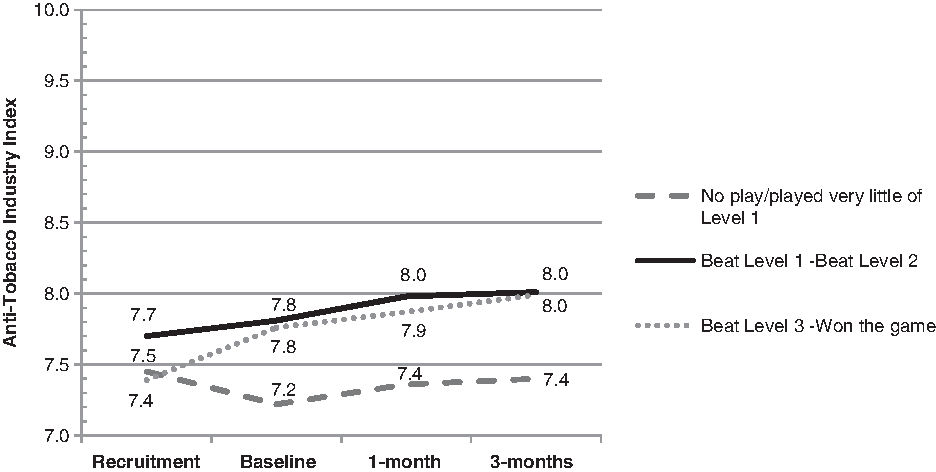
Anti-Tobacco Industry Index by level of gameplay (n=693).
Cohen's d.
SD, standard deviation.
Discussion
Integrating health-related messages within a gaming context provides a unique opportunity to improve message exposure, comprehension, and receptivity among a teen target audience. Although games now exceed motion pictures as the dominant form of media,31,32 evidence of the efficacy of games to promote healthy behaviors is scant, and only a few studies have used rigorous evaluation designs. 7 One review of electronic media-based behavioral interventions found that only a handful of studies used rigorous methods to assess behavior change or related outcomes such as knowledge or attitude change. 33 To our knowledge, this is the first study in the United States to evaluate whether exposure to tobacco-related messages within a mobile game can help shift related knowledge, attitudes, and beliefs among youth and young adults. Using a single-group repeated-measures design, findings indicate that “Flavor Monsters” gameplay, which includes a variety of fact-based messages integrated into the game narrative, is associated with increasing negative attitudes about tobacco products and the tobacco industry over time. Although gameplay was not a significant predictor of lower levels of intention to smoke, players reporting anti-tobacco and ATI Index attitudes were found to have a lower likelihood of initiating tobacco use.
There are numerous reasons why the gaming context offers a unique opportunity for integrating health messages compared with other media-based health education approaches. Gameplay itself immerses the audience into the message delivery, creating extended conversations where characters can help explain the message, raise questions about the message, and continue the dialogue about the message in ways not possible within other media venues. Players become actively engaged in the story and the strategy of the game rather than a passive listener to a narrative. This can serve to increase the potential for comprehension of and receptivity to a message, while prompting a synergistic effect of longer and deeper game engagement. Studies suggest that immersion in a story narrative of a videogame can transport players to a “flow” state where they lose track of time and become deeply engaged.34,35 Our study findings of the association between gameplay and changes in attitudes provide support for engagement as a key variable in understanding the pathway through which video gameplay can serve to improve health outcomes. Future research needs to examine the associations among game variables, psychosocial mediating variables, and behavioral outcomes. 1
Strengths
Strengths of this study include its initial phase, which provides support for integrating a high level of health-related content into mobile games despite concerns of lower receptivity and gameplay. The second phase of the evaluation uses a longitudinal study design that includes a large, diverse sample and multiple follow-up assessments over time. This naturalistic study design allowed for comparison of players with varying gameplay as well as non-players.
Limitations
Although numerous strengths exist, there are also some study limitations. First, self-reported gameplay was used to assess gameplay rather than more objective measures. Second, the study used a single-group repeated-measures design where some level of gameplay was required of each respondent, which limits our ability to generalize about real-world gameplay. Lastly, respondents were not randomized to a controlled dose of the intervention. However, this longitudinal naturalistic study did include variation of gameplay among its respondents. In addition, we conducted a bivariate attrition analysis comparing the study sample of participants who completed all three follow-up time points and those who dropped out before the third follow-up (n=1934) on age, gender, race, ethnicity, education, ever cigarette use at recruitment, videogames played during the week, and the ATI Index. We found significant differences on two race categories (white and other, non-Hispanic) and the proportion of ever smokers at recruitment. However, none of the differences was enough to impact the results (differences did not exceed 6 percent), and no difference was observed between groups on the ATI Index at the first time point.
Conclusions
The popularity of mobile gaming among teens and young adults provides another important context for delivering health-related messages in an effort to promote healthy behavior. Given the extended period of time that players spend with story and character within this context, understanding how best to optimize message delivery while not impeding gameplay is key to maximizing the impact of such an intervention. Results from this longitudinal study indicate that anti-tobacco content can be successfully integrated within a mobile game to help increase anti-tobacco attitudes. Future research needs to continue to document the impact of health-related content within mobile games as well as examining the mechanisms through which these effects occur.
Footnotes
Acknowledgments
The authors would like to thank Christine Dela Rosa, Crux Research, and Sabertooth for their contributions to the design of the “Flavor Monsters” game and/or the evaluation.
Author Disclosure Statement
No competing financial interests exist.