






Abstract
In recent decades, environmental justice experts have advanced understanding of cumulative impacts, defined as the harm that can result when multiple forms of environmental and socioeconomic distress converge on a place and compound through time. Concurrently, U.S. industry leaders have launched climate mitigation projects that often exacerbate environmental injustice in overburdened communities. We consider this critical disconnect, drawing from our collective experience in eastern North Carolina. In this rural, economically disadvantaged, and multiracial region, state and corporate leaders have authorized the development of industrialized biogas as an ostensibly renewable energy source and climate mitigation strategy. Our community-engaged analysis of cumulative impacts reveals how chemical, ecological, social, and political processes linked to industrialized agriculture and energy production interacted through time to solidify social and environmental harm. In turn, this accumulation of harm generated the conditions for industrialized biogas development to become a climate mitigation program that relies on, rather than ameliorates, environmental injustice. We argue that environmental injustice can emerge, feed back into, and solidify across socio-ecological systems through time, creating foundations for environmental “solutions” that compound harm. Centering the knowledge of communities facing environmental injustice across the natural, built, social, and policy environments will expand and improve scientific understanding of cumulative impacts. In a time of dramatic change in the U.S. federal administration, wherein environmental justice may be removed from the policy and funding agenda, now is the time to turn toward, not away from, justice.
Keywords
INTRODUCTION
In recent decades, environmental justice (EJ) experts have prioritized efforts to understand and address cumulative impacts (CIs), defined as the harm that can result when multiple forms of environmental and socioeconomic distress converge on a place and compound through time. 1 Concurrent with the incremental progress made in understanding CI, industry leaders invested in climate mitigation projects that exacerbate environmental injustice in economically marginalized communities, indigenous peoples’ communities, and communities of color. 2 The environmental science, policy, and regulation approaches that support these projects evade lessons learned about CI and, instead, treat place-based inequities as externalities and necessary trade-offs in the transition to renewability.
In this Commentary, we consider the critical disconnect between advances made in understanding CI and climate mitigation projects that threaten to exacerbate disparate levels of harm. We draw from our individual and collective research in rural eastern North Carolina (NC), where state and corporate leaders have authorized the development of industrialized biogas as an ostensibly renewable energy source and climate mitigation strategy. Our community-engaged analysis of CI reveals how chemical, ecological, social, and political processes linked to industrialized agriculture and energy production have converged over time to solidify and compound harm. Now a state-mandated climate mitigation program of industrialized biogas development relies on, rather than ameliorates, these harms, compounding environmental injustice in the name of meeting “green” goals. We argue that environmental injustice can emerge, feed back into, and solidify in multiple parts of a socio-ecological system (SES) over time, laying the groundwork for environmental solutions that undermine and disengage from EJ.
We develop this argument based on a synthesis of evidence-based research and a shared commitment to working across disciplinary, institutional, and cultural boundaries to address complex social and environmental problems through convergent knowledge production. The Principles of EJ established by the delegates to the First National People of Color Environmental Leadership Summit in 1991 guide our SES approach to examining interactions across natural, built, social, and policy environments that give rise to unjust outcomes. Our community-engaged analysis reveals that CI arise, not only from present-day contamination and socioeconomic struggles, but also from the history of disenfranchisement that laid the foundation for these stressors. We consider the broader significance of the scientific community’s failure orreticence to examine the totality of injustices experienced by overburdened communities in light of the new challenges introduced by the federal government’s February 2025 rescinding of Executive Orders on the science of environmental justice (EO 13990 & EO 14099) in the name of “climate extremism” (OAG 02.05.2025).
KNOWLEDGE CO-PRODUCTION FROM EASTERN NC
Rural North Carolina maintains a robust legacy of community-based EJ organizing in response to inequities in who benefits from industrialized development and who lives with disparate exposure to environmental harm. Actions in the early 1980s gave rise to the EJ movement in a rural, predominantly African American town in Warren County. In the 1990s, community-based EJ organizing targeted the establishment and growth of industrialized hog operations in southeastern North Carolina, which transformed the region’s environment, health, and political economy. 3 In the decades since, mass-produced hog and poultry waste became a regional hazard with disproportionate environmental and public health impacts accumulating in low income and Black, Indigenous, and People of Color (BIPOC) communities. 4 This is at least part of the context wherein industrialized agricultural and energy operations combined interests in eastern NC to advance “biogas” development as a strategy for climate mitigation.
Industrialized biogas is methane produced via anaerobic digestion systems that capture gases from concentrated, untreated livestock waste, from municipal solid waste, or from wastewater treatment plants. The gas is either consumed on site or routed, via truck or pipeline, into existing fossil gas infrastructure. Energy and agricultural industries collaboratively market these initiatives as renewable energy, and political leaders and regulatory agencies largely support their implementation to reduce carbon emissions and meet the state’s clean energy goals. Representatives of impacted communities maintain a contrasting perspective: Industrialized biogas development exacerbates, expands, and entrenches, rather than ameliorates, the cumulative socio-ecological harms of industrialized agricultural and energy operations. 5
Our Commentary draws from an established foundation of research and relationship building in eastern NC, informed by our collective expertise in community-based education and organizing; environmental law and policy; human and environmental health disparities; and human rights, climate change, and environmental sustainability. Over the past 5 years, we have had the opportunity to synthesize this work, in conversation with African American and Indigenous-led EJ organizing. In 2020, some coauthors formed a community–university partnership that aims to strengthen existing capacities and nurture new capabilities for EJ through trans-experiential “team science.” 6 This group initiated a deliberative research development process that established the need to co-generate knowledge about EJ and industrialized bioenergy development. Since then, we have generated knowledge from our experiences co-leading strategic outreach campaigns; community-based water quality testing; EJ assessments in neighborhoods impacted by industrialized agriculture, landfills, liquefied natural gas (LNG) infrastructure, wood pellet production, and disasters; and national and statewide efforts to advance recognition of CIs in EJ decision making. 7
We draw our observations about the intersections between biogas development and CIs from the inner coastal plains, specifically: Robeson County, located mainly in the Lumbee/Lumber Watershed, and Sampson County, located in the Cape Fear Watershed. Both watersheds drain lowland waterscapes, sandy soils, and pine forests with considerable plant and animal diversity, including endemic and endangered species. 8 Socially, the region is also diverse and dynamic, inhabited by Indigenous people, inclusive of Coharie, Haliwa-Saponi, and Lumbee peoples and their descendants; by descendants of European settlers and of the African diaspora; and by Mexican and Central American migrants and their descendants. Robeson County is among the most racially diverse rural counties in the United States and comprises the territorial homelands of the Lumbee Tribe, the largest U.S. Native American Tribe east of the Mississippi River, 9 while Sampson County comprises the territorial homelands of the Coharie Tribe. 10
OUR PRINCIPLED APPROACH TO CI ANALYSIS
We have written this Commentary across a dramatic shift in Presidential Administrations in the United States. Though the policy context of our concerns about CI has transformed, our fidelity to this work remains, as do the underlying structural harms. Under the Biden administration, the U.S. Environmental Protection Agency (EPA) promised, delayed, and then provided draft guidance on CI as part of a broader policy of promoting EJ. 11 We found some promise in this apparent commitment to CI; nonetheless, we worried about a bureaucratic dilution of justice in a regulatory process that seemed inert and detached from community-driven harm analyses. When grassroots struggles become institutionalized, they tend to lose the energy that brings change to the status quo. 12 This presents a challenge different from having EJ eliminated from the policy and funding agenda altogether, as is underway in the second Trump administration. 13
Amid shifting policy landscapes, the EJ Principles endure, articulating the rights of impacted communities to reparations and to be free from further forms of destruction and discrimination. EJ research guidance for assessing CI also endures, advancing an integrative, SES approach to understanding complex relationships between variables in the “total” (i.e., natural, built, social, and policy) environment. 14 SES approaches track how changes in a system spur consequences that can then reinforce, magnify, or suppress other system dynamics. 15 Both the EJ Principles and SES approaches exemplify human–environmental interdependence. 16 Because humanity and environment comprise a complex whole, they cannot be understood as divorced entities, studied in isolation from their relationality. 17 These different, but complementary sources inform our community-engaged, justice-centered approach to addressing persistent limitations in environmental science and regulatory approaches.
Injustice cannot be reduced to a singular variable; it unfolds and can ossify over time
Predominant environmental science, policy, and regulation approaches tend to measure and monitor the impacts of singular, present-day contaminants (e.g., nitrate) or events (e.g., flooding) in a mutually exclusive fashion. 18 As a result, these approaches may miss the synergistic effects among multiple types of exposure and stressors that can converge and amplify one another. Conventional approaches may also miss the historical, social, and political processes that can lay the groundwork for and sustain present-day compounding interactions. 19 Much environmental research on chemical stressors detects and quantifies contamination in air, water, or soil samples without examining how the legacies of settler colonialism and slavery set the foundation for disparate exposure. 20 Other work examines industrialization’s ecological impacts (e.g., forest degradation, species loss) but ignores the associated, accumulating cultural losses (e.g., in nutritional food sources, sovereignty, and self-determination). 21
Environmental injustice is not an externality
As a related point, existing environmental science, policy, and regulation approaches tend to treat place-based inequities as latent or external variables. Take, for example, the regulatory assumption that adverse environmental health effects only occur when contamination levels exceed established thresholds. 22 Government and industry actors can then represent individual, quantifiable instances of exposure as economic, moral, and political externalities, as if they are outliers in a system that, in reality, hinges on unjust patterning. 23 EJ cannot be reduced to an externality when, systematically, people residing near polluting industries incur an oversized proportion of the costs of pollution while corporations internalize an oversized proportion of the benefits. 24
Environmental justice is not substitutable
Of further concern, state and corporate leaders, as well as some economic and environmental researchers, tend to treat concerns about justice as if they are substitutable—as if benefits like jobs and cuts to carbon emissions could address them. Increased job opportunities and decreased carbon emissions matter greatly to impacted communities. However, we caution against the assumption that justice will somehow “trickle down” from benefits that rely on and perpuate, rather than redress, underlying harm. 25
Meaningful community engagement means centering impacted communities
An integrative approach to understanding CI is essential, but accounting for multiple factors in a system will not necessarily improve situated understandings of justice, not least when the state mandates avoiding examinations of justice. To expand and improve scientific understanding of CI, we emphasize the need to not only include but center the knowledge of communities facing environmental injustice. Members of government and university-based researchers too often reach out to impacted communities after funding decisions have been made, or they wait until the research is complete to work on “translating” scientific findings “down” to impacted communities. 26 Our approach goes beyond consultation to authentic partnership in research design, implementation, and analysis.
THE FOUNDATIONAL INEQUITIES OF INDUSTRIALIZED CLIMATE MITIGATION STRATEGIES
In what follows, we introduce critical factors that characterize the total environment in which industrialized bioenergy development now unfolds. Our community-engaged analysis reveals how intersecting processes of land dispossession, environmental pollution, adverse health effects, unfair policy decisions, and the resulting sense of powerlessness combine over time to lay the foundation for a climate mitigation strategy that exacerbates environmental injustice.
In the 1990s, then Virginia-based Smithfield Foods established thousands of concentrated animal feeding operations across the region. Hog production took hold across historic and present-day Lumbee, Coharie, and Haliwa-Saponi territory; in counties where, historically, the highest percentage of enslaved people resided; and where Jim Crow racial segregation laws had re-institutionalized the legacy of the land and labor insecurity. 27 With theintroduction of industrialized hog operations, Indigenous and African American farmers experienced a new generation of land loss, the reinvigoration of intrapersonal tensions with their neighbors, and the narrowing of job opportunities available outside of the hog industry. 28
As NC became the second largest pork producer in the United States, hogs began to outnumber people, and industrial hog “growers” (the term used in this vertical integration model) replaced small farmers. 29 Industrialized hog waste became a new entity on the landscape, managed through the controversial “lagoon and sprayfield system.” Growers store the waste, which contains pathogens, heavy metals, and antibiotic-resistant bacteria, in large, open-pit lagoons. 30 When sprayed onto nearby fields as fertilizer, the waste releases contaminants that become air and/or waterborne and include ammonia, carbon dioxide, hydrogen sulfide, methane, nitrate, and particulate matter. 31 Studies have linked airborne emissions from hog operations to anemia, compromised immune function, kidney disease, low birth weight, respiratory dysfunction, stress, depression, and reduced life expectancy. 32 Moreover, the odor is noxious, causing nausea, disorientation, and social discontinuity as people cease practices like gardening or gathering outside to share food. 33 The impacts to surface water have included contamination and eutrophication, harmful algal blooms, and fish kills in rivers and estuaries, especially when hurricane-induced floods drown trapped animals and spread industrialized animal waste across the region. 34 Thus, environmental pollution and adverse public health effects took hold as people living in proximity to the operations became exposed to numerous chemical and ecological hazards.
In response to these harms, and their disparate impacts, the state legislature ordered the Department of Agriculture to phase out the construction of new lagoon and sprayfield systems in 1997 (Session Law 1997-458, House Bill 515). In 2000, the leading pork manufacturer, Smithfield Foods, committed to developing new technologies that would limit pollution but did not adopt the resulting environmentally superior technologies. 35 In 2007, the state passed the Renewable Energy and Energy Efficiency Portfolio Standard, which required the development of renewable energy, including via the utilization of bioenergy produced from industrialized agriculture (Session Law 2007-397, Senate Bill 3). In 2021, the state General Assembly ordered the development of a new general permit to govern the operation of farm digester systems using existing hog waste lagoons (Session Law 2021-78, Senate Bill 605). In the meantime, the NC Utilities Commission approved several biogas energy projects in impacted communities without requiring the informed civic engagement or tribal consultation that is definitive of EJ. Newer measures increased the Utilities Commission’s power and weakened rate payer representation (Senate Bill 382). Thus, over 25 years following an initial moratorium on the expansion of the lagoon and sprayfield system, these systems not only remain, but they are now also foundational to the state-mandated development of industrialized biogas. Rural communities in eastern NC now contend with an unprecedented challenge: the massive economic interests and political influence of “big ag” and “big energy” industries—greenwashed and combined—led by Duke Energy, Dominion Energy, and Smithfield Foods and extended through their numerous subsidiaries.
The culmination of these social and environmental conditions over time contributes to the sense of powerlessness and despair that members of overburdened communities sometimes feel in the face of polluting industries. It’s as if their hands are tied, and there’s nothing they can do to stop the harm.
THE CONTEMPORARY ROLLOUT OF INDUSTRIALIZED BIOENERGY DEVELOPMENT
Residents and researchers have felt overwhelmed in recent years as the state targeted several additional hazardous entities for bioenergy development. In 2024, owners of the largest landfill in the state, Green for Life landfill in Sampson County, partnered with OPAL Fuels to capture methane for processing renewable natural gas. 36 As with the hog waste-to-energy initiatives, an accumulation of contamination, unfair governance, and local resistance formed the foundation for the project. 37 Used as a revenue source, the 1315-acre landfill has accepted solid waste from 73 counties in the state and receives 1.7 million tons of solid waste annually, with at least 20 more years of life in active operation. 38 The Sampson County landfill is the second-largest landfill emitter of methane in the nation, releasing 828,565 metric tons of methane per year. 39 Moreover, the landfill accepted waste for decades from Chemours, a local producer of per- and polyfluoroalkyl substances, which have since been identified in the landfill leachate, nearby waterways, and private wells. 40
Eastern NC has also been targeted for industrialized biomass development. Biomass production involves the use of heavy equipment and facilities to collect and incinerate industrialized poultry parts and excrement or to process the byproducts of manufactured timber products and clear-cut trees. Here, again the strategy for bioenergy development hinges on and seeks to repurpose foundational harms. Over the past decade, eastern NC has experienced tremendous growth in the under-regulated production of industrialized poultry. 41 Emissions from industrialized dry poultry waste, which consists of manure, litter, waste feed, dead birds, broken eggs, and feathers, contain dioxins, nitrate, arsenic, and other harmful substances that cause air and water pollution, greenhouse gas emissions, and the spread of pathogens. 42 Eastern NC has also seen tremendous deforestation with trees being clear-cut for paper, residential development, powerline and pipeline rights-of-way, poultry farms, and increasingly, for wood-based biomass production. 43
An Enviva biomass processing facility located near Robeson County and a wood pellet production facility located within Sampson County compound these concerns about environmental quality. Disproportionately sited in communities of color and low wealth, these mills release an estimated 3.1 million tons of greenhouse gases per year. 44 Compounding mounting concerns about transport and storage across these projects, Robeson County is home to one of four LNG facilities in the state, and that facility, Piedmont LNG, is one of tens of polluting facilities operating in or near predominantly Indigenous, Black, and Latinx communities. Collectively, these operations release tons of hazardous chemicals into the air annually, in a county where asthma rates are twice the state average. 45
Some of the most ecologically damaging patterns of rural industrialization have unfolded in floodplain forest habitat where blackwater rivers meander through tributary swamps, bogs, and Carolina bays. 46 Deforestation, along with the draining of swamps, has destroyed habitat and, in turn, exacerbated the causes and consequences of increased flooding. 47 As climate change increases the severity and frequency of storms in NC, extreme flooding events have the potential to send microbial and chemical hazards from waste storage and industrial facilities into the surrounding environment and contaminate surface and well water, a confluence that has led scholars to identify an existing and intensifying water contamination crisis in the region. 48 Exacerbating such risks are the post-disaster bureaucratic challenges and delays that have enabled other types of socio-ecological hazards to take hold in the forms of mold growth, land dispossession, and compromised trust in governance systems. 49
Even as the heavy polluting agricultural and energy industries have perpetuated environmental degradation and turned “natural” disasters into toxic hazards, they have not provided economic stimulation or opportunity to attract and diversify other types of sustainable business investments to overcome poverty or to stem the tide of youth out-migration. 50 Residents in both counties live below the poverty line: 21.4% of Sampson County residents and 27.9% of Robeson County. The latter comprises the highest rate in NC and over twice the national average of 11.5%. Both counties have notable health disparities, with a high prevalence of heat-related, life expectancy, and adverse maternal and children’s health outcomes. 51 Robeson County maintains the lowest health status and highest rates of violence in NC. 52
We draw from our community-engaged analyses to conceptually model these interactions in the SES map (see Fig. 1).
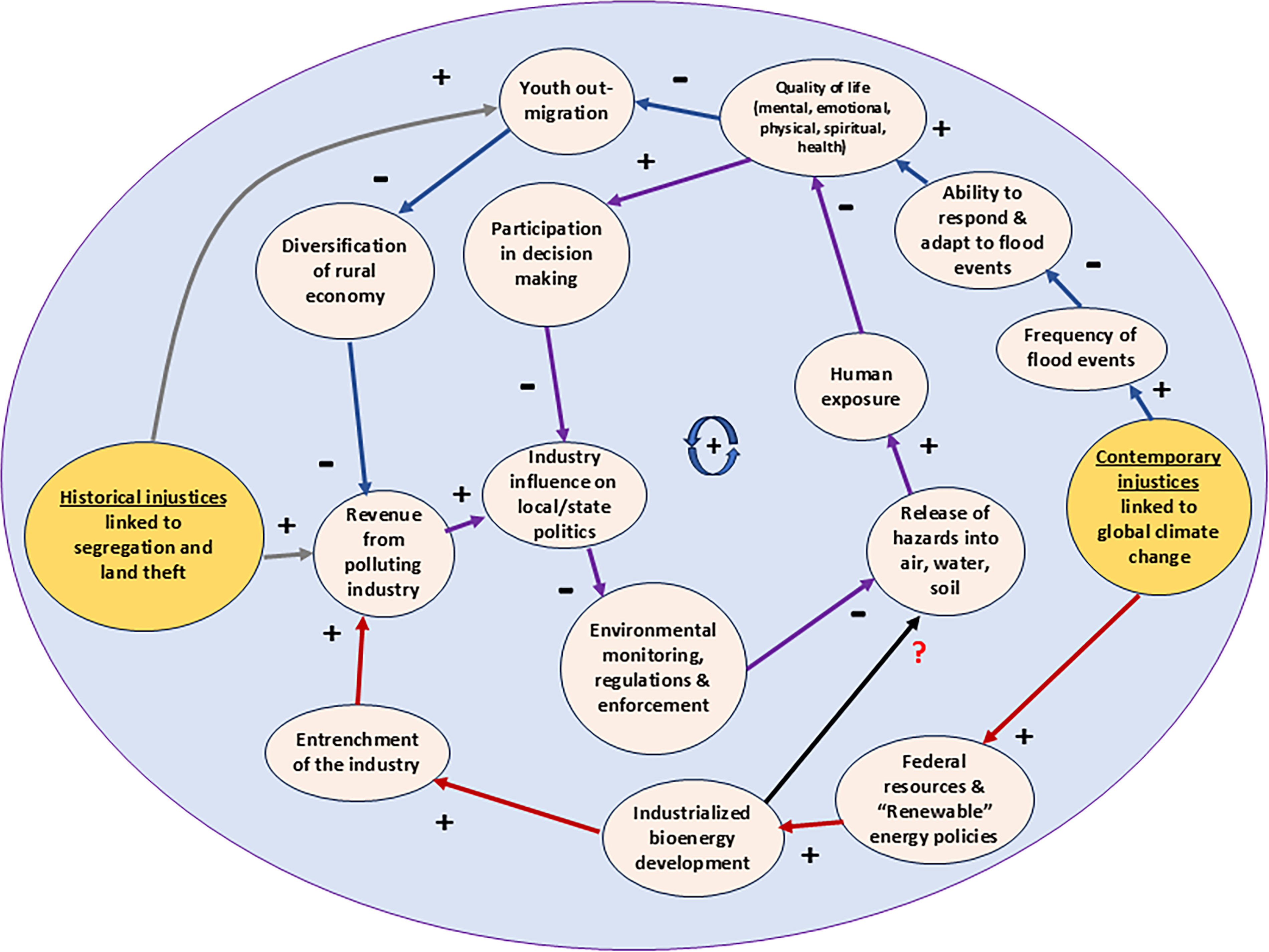
Figure 1 predicts environmental injustice feedbacks in low-income and BIPOC communitiescharacterized by industrialized bioenergy development in eastern NC. A plus sign denotes an amplifying relationship between the two nodes; a minus sign denotes an inverse, reducing relationship; and the question mark denotes an unknown relationship. The inner “human exposure” loop (purple) shows an overall reinforcing (+) relationship fed by events resulting from historical (gray) and contemporary injustices (red and blue loops).
Figure 1 helps visualize the interactions that may be sustained, altered, or intensified by industrialized bioenergy development—it by no means captures all the factors at play, nor all the relationships between the nodes that are shown. For readers new to reading such maps, we offer this short guide for how to follow the nodes through one segment of a loop: Starting from the left, we propose that historical injustices linked to racialized residential segregation and land theft reinforced the ability for polluting industries to gain revenue, which amplified industry influence on state politics and reduced environmental monitoring and enforcement, allowing increased potential for the release of hazards and increased human exposure. Increased human exposure to pollution has reduced quality of life and increased the drive (albeit not the capacity) to participate in environmental decision making. In turn, people have directed their participation in environmental decision making at reducing industry influence on local/state politics.
We predict injustices across the map related, for example, to land loss; industry influence on politics; the release of hazards into air, water, and soil; altered quality of life; and federal cuts to EJ funding and oversight. Policymakers build on and compound these injustices to regard industrialized bioenergy projects as renewable sources of energy production. The efficacy of industrialized bioenergy in reducing environmental emissions remains unknown; however, the signs demonstrating the polarity of the relationships across nodes suggest a reinforcement of disproportionate socio-ecological harm. Of prime importance to us: the potential exists for environmental injustices to reverberate at every feedback in the system. Thus, EJ cannot be reduced to an externality or latent variable to be corrected through increased jobs or decreased carbon emissions. It must, instead, be systematically addressed at several leverage points across the SES.
There are several EJ dynamics not yet modeled in our systems map, even as they are integral to understanding the potential accumulating impacts of biogas development. Among these, two brief but demonstrative examples further underscore the need for a justice-centered approach. First, BIPOC communities, including in rural eastern NC, are more vulnerable than their white counterparts to water contamination. They are more often excluded from municipal boundaries that enable access to public water infrastructure and may lack access to knowledge about potential harm to their water sources. 53 In Sampson County, some residents have been involved in a 20-year struggle to gain access to county or municipal water sources, and we have observed a heavy reliance on bottled water for drinking and sometimes cooking. These and other factors demonstrate a concerning, and understandable, lack of trust among residents, not only in their water sources but also in the governance systems meant to provide such access.
Second, despite its nominal endorsement of the United Nations Declaration on the Rights of Indigenous Peoples, the United States generally does not respect the right of Indigenous peoples to give free, prior, and informed consent for development projects that affect their interests. 54 Lumbee peoples and their Indigenous neighbors in eastern NC have lost thousands of acres of their ancestral homelands—lands imbued with cultural meaning and rich in natural and archaeological resources—to industrial food and energy projects. 55 The subsequent denial of this destruction by industry representatives compounds the harm.
The unique way the federal government has historically codified recognition for Lumbee peoples complicates these matters, providing government and industry actors an exception and an excuse to evade their responsibilities to protect Indigenous rights. In particular, the 1956 Lumbee Act (Public Law 84-570) acknowledges the Lumbee Tribe as an Indigenous group while simultaneously banning a formal relationship between the Tribe and the U.S. government. For more than 50 years, the U.S. Congress has failed to amend the 1956 law, thereby sending mixed messages to decision makers about the Indigenous rights of Lumbee people. In this atmosphere of uncertainty, decision makers have typically defaulted to nonengagement with Lumbee people. 56 Painfully widespread across EJ contexts and exacerbated in contexts of Indigenous EJ, instead of devoting their time and expertise to the matter of repair, EJ leaders must instead devote these resources to proving there is a problem, to explaining the multidimensional nature of that problem, and to advancing their right to redress.
FALSE CLIMATE SOLUTIONS COMPOUND ENVIRONMENTAL INJUSTICE
We write as residents who are directly impacted by these circumstances and as researchers who have observed and analyzed the impact and the community-based response. Current approaches to studying, legislating, and regulating environmental quality fail to examine how environmental injustice reverberates. Our community-engaged analysis identifies present-day stressors and the history of disenfranchisement that laid the foundation for their convergence in the form of climate mitigation strategies that threaten to sustain and intensify environmental injustice.
The need to address the interlinked challenges of atmospheric decarbonization and socioeconomic development is urgent. Yet, societies will not achieve their goals through “iatrogenic” outcomes, where the treatment has the potential to cause or intensify the disease. Given the unequal costs and benefits of a global, carbon-dependent economy and the urgent need for change, counterproductive measures are not just an unfortunate matter of limited research and unsustainable policymaking, they also perpetuate systems of environmental injustice. In a context wherein the term, “justice,” appears to flag suspension of federal support, many people may be compelled to drop it from their work. However, now is not the time to turn away from EJ. Today, we need approaches that center it.
AUTHORS’ CONTRIBUTIONS
Conceptualization: All authors. Visualization: C.G.W., R.W., and S.T. Writing original draft: R.W. Writing—review and editing: All authors.
Footnotes
ACKNOWLEDGMENTS
The authors acknowledge Carol Babyak, Vivian Rose Benton, Kim Fortun, Will Hendrick, James Houser, Tim Schütz, and the numerous residents of eastern North Carolina whose insights and experiences contributed to this work.
AUTHOR DISCLOSURE STATEMENT
No competing financial interests exist.
FUNDING INFORMATION
Several small internal grants supported the research that informs this article, including from Appalachian State University’s Research Institute for Environment, Energy and Economics (specifically the Conducting Complex Research Together and Sustain Grant Programs) and from the University of North Carolina Environmental Justice Action Research Clinic. We also acknowledge support from a Wenner-Gren Foundation Engaged Research Award, Gr. ERG-21 (RW, DP, SWW, DC, JC).