






Abstract
The Editor-in-Chief of The CRISPR Journal has regretfully made the decision to retract the Perspective by He Jiankui et al., entitled, “Draft Ethical Principles for Therapeutic Assisted Reproductive Technologies,” published online ahead of print on November 26, 2018, in The CRISPR Journal.
This article was originally published with no conflict of interest information provided by the authors. The editors corresponded via email over several weeks with Dr. He, who willingly supplied updated information regarding funding sources, company ties, patent applications and a clinical trial registration.
However, it has since been widely reported that Dr. He conducted clinical studies involving germline editing of human embryos, resulting in several pregnancies and two alleged live births. This was most likely in violation of accepted bioethical international norms and local regulations. This work was directly relevant to the opinions laid out in the Perspective; the authors' failure to disclose this clinical work manifestly impacted editorial consideration of the manuscript.
The Editor-in-Chief has sought advice from senior members of the journal editorial board and other experts in the field. Based on our considered review of the circumstances surrounding this submission and the lack of full and open disclosure, we have decided to officially retract the paper from the literature.
The CRISPR Journal,
its editors, and its publisher are committed to upholding the strictest standards of the scientific record and the international community it serves.
Introduction
More than seven million children are born every year with lethal or debilitating diseases of genetic or partially genetic origin. 1 Gene surgeries, including CRISPR* gene editing and mitochondrial donation techniques, promise new therapeutic strategies during in vitro fertilization (IVF) to cure or prevent these diseases before a child can suffer.
The potential utility and, for some, the controversy of gene editing to treat unborn children, including the availability and effectiveness of preimplantation genetic diagnosis for many genetic diseases, has prompted scientific societies and other worldwide organizations to publish a raft of guidelines about permissible preclinical research. 2 Guidelines for ultimate clinical practices, however, remain less defined. What should be our proposed ethics and actual red lines?
A clear vision of the future, succinctly stated in plain language, is needed for the public to gauge the field's eventual intentions and have meaningful conversations about how gene surgery may or may not affect their family, friends, and neighbors.
Surveys conducted in 2018 of >2,500 Americans 3 and 4,000 Chinese 4 show the general public of both countries are generally receptive to gene surgery in human embryos—if the sole purpose is to treat serious diseases. Respondents rejected enhancements, with the notable example of increasing intelligence being opposed by about 80% of Americans and 70% of Chinese respondents. Despite contrasting regulatory frameworks—the United States passed a law in 2015 explicitly to prohibit the U.S. Food and Drug Administration from reviewing of any applications, 5 whereas China maintains a ministerial guideline 6 drafted in response to cloning concerns 7 some 15 years prior to the emergence of CRISPR—a cross-cultural ethical divide did not emerge in the American and Chinese surveys. Support for therapeutic uses of gene surgery in embryos was high, even among a majority of highly religious Americans.
On the other hand, many survey respondents also reported they were relatively uninformed about the gene-editing field. So, current public views on gene surgery may be forming based on widely shared personal ethics toward medicine and mercy. This is an open invitation for the scientific community to support the public in making informed decisions about gene surgery's clinical utility, limitations, risks, regulatory needs, and future role in society.
Open Dialogue
Open dialogue has helped shape regulations and advance cultural attitudes in the field of IVF and other assisted reproductive technologies (ART) for >40 years. As a result, initial worries and warnings around eugenic applications have not transpired. Clinicians have proven responsible stewards of medical procedures that have helped fertility-challenged couples raise more than eight million healthy children. 8
We believe the gene-editing research community therefore has a duty to speak more openly and plainly to the public and lawmakers, despite this being an unfamiliar role for many scientists (including ourselves). Our community should also address ethics more inclusively, as others including Montoliu et al. 9 and Jasanoff and Hurlbut have argued, 10 by discussing and developing guidelines in more cosmopolitan and inclusive venues that include affected families and public stakeholders. Proactively educating journalists is crucial too.
Likewise, science journalists and editors share a duty to translate research responsibly for the general public. Sensationalism has been an unfortunate part of media coverage since the emergence of IVF in the 1970s, 11 with the prophesy of Huxley's Brave New World,12,13 rapid cultural extinction,14,15 and barcoded or discombobulated babies serving as fallback tropes16–20 that many patient groups would prefer not share equal footing with balanced reporting. 21 Another fallback is the overused term “designer baby”: this is an epithet aimed at invoking disgust, which is a common mechanism behind hate.22,23 Parents hope to protect their newborn's life from a known debilitating, familial disease. Call them “gene surgery babies” if one must or better yet ordinary people who have had surgery to save their life or prevent a disease.
Core Principles
To help advance the constructive dialogue over the past 40 years that has ensured the ethical use of ART to help fertility-challenged couples conceive healthy children, we suggest the medical and patient community identify a core set of fundamental human values that clarify for the public the clinical future of early-in-life genetic surgery in plain terms and within a document as brief as possible. Lawmakers in countries wishing to permit clinical trials and eventual regulatory submissions could build on these values to write cohesive rules that can still account for their country's distinctive mix of religious beliefs, culture, and public-health challenges. (A preface to a final document could also helpfully summarize the known risks, existing options such as preimplantation genetic diagnosis, how gene surgery/genome editing works, its limitations, and example use cases.)
As our laboratory (at South University of Science and Technology in Shenzhen, P.R. China) has studied the feasibility and safety of CRISPR/Cas9-mediated genetic surgery in nonviable and viable human and monkey embryos for several diseases over the past several years, we have thought deeply about ethical foundations for regulation in discussions between researchers, patients and advocates, and ethicists both in China and abroad. These discussions lead us to propose that, at a minimum, five core principles should be addressed in a modernization of Chinese regulations—and indeed any country's guidelines or laws—permitting gene surgery for ART: (1) a clear social purpose, (2) impermissible uses, (3) rights after treatment, (4) the human spirit's transcendence of DNA, and (5) a special duty to reduce economic inequality. We therefore propose five plain-language principles as a first draft of an ethical foundation to guide and restrict the use of therapeutic ART (see Fig. 1).
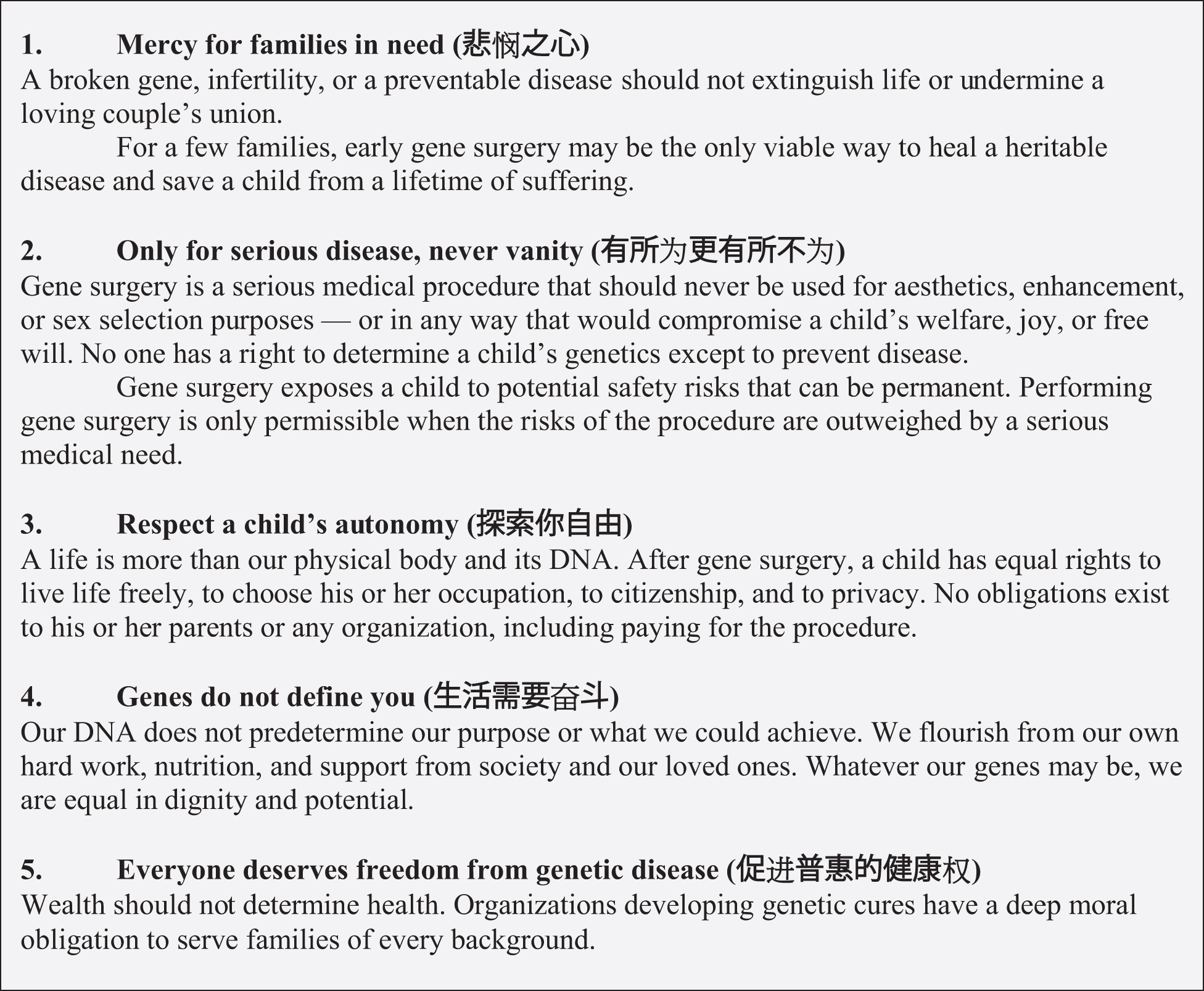
Five core principles for gene surgery in human embryos.
Of note, we hold additional but less universal beliefs that further restrict the use of gene surgery, including the need to prioritize local population health needs and focus only on treating disease via prevalent, natural genetic variants. We expect other groups will also hold additional views beyond the principles outlined here (Fig. 1). That diversity will make the world better.
We hope this call to action will help foster a more frank and plain-language dialogue about the ethics of gene surgery. In particular, we hope this approach may provide an additional way to solicit meaningful collaboration with the millions of valued members of our society who live with disabilities or serious medical conditions and who deserve to have a key role in shaping any guidelines that direct this field's future, whether that happens at traditionally scientific conferences, in print, or elsewhere.
We also hope that the humanity of this debate is not forgotten amid controversy. Many parents have lost children to genetic diseases. While these families are a minority, real lives and suffering are at stake.
Footnotes
Author Disclosure Statement
No competing financial interests exist.