






Abstract
Abstract
Physical activity (PA) parenting research has proliferated over the past decade, with findings verifying the influential role that parents play in children's emerging PA behaviors. This knowledge, however, has not translated into effective family-based PA interventions. During a preconference workshop to the 2012 International Society for Behavioral Nutrition and Physical Activity annual meeting, a PA parenting workgroup met to: (1) Discuss challenges in PA parenting research that may limit its translation, (2) identify explanations or reasons for such challenges, and (3) recommend strategies for future research. Challenges discussed by the workgroup included a proliferation of disconnected and inconsistently measured constructs, a limited understanding of the dimensions of PA parenting, and a narrow conceptualization of hypothesized moderators of the relationship between PA parenting and child PA. Potential reasons for such challenges emphasized by the group included a disinclination to employ theory when developing measures and examining predictors and outcomes of PA parenting as well as a lack of agreed-upon measurement standards. Suggested solutions focused on the need to link PA parenting research with general parenting research, define and adopt rigorous standards of measurement, and identify new methods to assess PA parenting. As an initial step toward implementing these recommendations, the workgroup developed a conceptual model that: (1) Integrates parenting dimensions from the general parenting literature into the conceptualization of PA parenting, (2) draws on behavioral and developmental theory, and (3) emphasizes areas which have been neglected to date including precursors to PA parenting and effect modifiers.
Introduction
During a preconference session to the 2012 International Society for Behavioral Nutrition and Physical Activity annual meeting, 21 experts in PA parenting met to review and discuss the observed challenges in PA parenting measurement and identify potential remedies. This article summarizes the discussions that took place. For the purposes of the workgroup meeting and the summary below, PA parenting practices were defined as behavioral strategies employed by parents to socialize children's PA, such as taking children to venues where they can be active and arranging family activities that include PA. Parenting practices adopted in the context of youth sport were not included in this definition because parenting goals in youth sport are likely to differ from those in day-to-day interactions around lifestyle PA.
Challenges to the Measurement of PA Parenting
Challenges to the measurement of PA parenting identified by the workgroup included: (1) Lack of consistency and rigor in the operationalization of PA parenting, (2) limited understanding of its dimensions and contextual sequelae, and (3) a narrow perspective on potential moderators of the relationship between PA parenting practices and child PA.
As documented in two recent reviews of PA parenting measures,8,9 a significant percentage of studies use measures of indeterminate reliability and validity. Up to 40% of studies do not cite any evidence of a scale's reliability and validity, and many studies use modified instruments whose psychometric properties are unknown. 8 The result is an expansive list of confusing and disconnected PA parenting practices that are poorly defined and measured and inconsistently labeled, using terms such as modeling, explicit modeling, facilitation, logistic support, encouragement, general support, and guiding support. The implication is that, although we know that PA parenting is important for promoting active lifestyles in children, the specific approaches that parents should adopt remain unclear.
A poor understanding of PA parenting dimensions and their contextual sequelae, the second noted challenge in PA parenting measurement, is likely a reflection of its junior status. By comparison, food parenting research, which exhibits richer and more rigorous operationalization of food parenting and its subdimensions, has a longer and more established history. Moreover, developmental psychologists who bring with them a firm understanding of parenting research and its theoretical foundation have gravitated to food parenting research but are infrequently represented in PA parenting. The implication is that much less is known about the breadth and dimensionality of PA parenting compared with food parenting. In fact most PA parenting measures are unidimensional, with a broad compilation of parenting practices summarized into a single score. 10
In addition to a lack of dimensionality, it is generally assumed that PA parenting is synonymous with support and has positive effects on children's PA attitudes and behaviors. There is reason to believe, however, that PA parenting can have both positive and negative implications for children. In a recent qualitative study, girls reported feeling forced by their parents to be active (
A third observed challenge is the limited assessment of moderators of the PA parenting–child PA relationship; effect modification has generally been limited to parent and child gender and weight.14–16 The absence of nuanced information on which PA parenting practices are effective for whom and under what circumstances limits the ability to target interventions to individual needs. Additional moderators to consider include family composition, child temperament, child age, family demographics, cultural and national context, and parenting style. In addition to considering a broader range of moderators, research on contextual factors, such as neighborhood safety, social capital, workplace policies, school PA policies, and parents' own family background, is also needed.
Potential Explanations for the Noted Challenges
The indiscriminate approach to the measurement and conceptualization of PA parenting may be explained in part by a disinclination to employ theory to structure scale development. As noted by Cronbach and Meehl, 17 establishing the construct validity of a scale requires investigators to (1) articulate a set of theoretical concepts and their interrelations, (2) develop ways to measure the constructs outlined by the theory, and (3) test the hypothesized relations. Thus, without a theory there is no construct validity. 18 It is worth noting that grounded theory, which emerges from inductive inquiry, is also an appropriate base from which to establish a scale's construct validity. It is important, however, that the constructs emerging from grounded theory are clearly defined and compared with existing definitions and theories.
Most PA parenting measures are not theory based. Exceptions include the Perceived Autonomy Support Scale for Exercise Settings, 19 which draws on self-determination theory, the Social Influence on Exercise scale, which was developed using operant and social learning theories, 13 and the Athletic Identity Questionnaire,20,21 which is based on the Identity Process Model. Theory is also underutilized in the assessment of determinants and outcomes of PA parenting and when postulating potential moderators. Here theories such as social cognitive theory, 22 ecological system theory, 23 self-determination theory, 24 the youth PA promotion model, 25 and the value expectancy model 26 could prove useful.
Progress in PA parenting research has also been hindered by the absence of agreed-upon measurement standards. 8 Citing the use of a scale by another study as evidence of the scale's reliability and validity, rather than studies with published evidence supporting a scale's psychometric properties, has become common practice in PA parenting research. Comprehensive and multidimensional measures of PA parenting that have evidence of factorial validity, factorial invariance, and sensitivity to change are needed.8,9
Future Recommendations
Solutions to these challenges and recommendations for future research discussed by the workgroup focused on the need to: (1) Build on parenting research and create the potential to create the potential to link PA parenting with food parenting research through common constructs, (2) use existing theoretical and conceptual models to consolidate prior research and frame future research, (3) specify and promote recommended practices for rigorous scale development, and (4) develop and adopt objective measures PA parenting.
Food parenting research has successfully built on decades of parenting research. As a result, recent measures of food parenting are aligned with documented parenting dimensions including the following27–29
: (1)
Workgroup members emphasized the need to integrate parenting dimensions into PA parenting research to encourage broader conceptualization of PA parenting, foster consistent terminology, and create the potential to align PA and food parenting research. To begin this process, workgroup members organized PA parenting practices referenced in the literature alongside the dimensions of responsiveness, demandingness and structure, supplemented with additional examples developed by the group (see Table 1). To illustrate, PA parenting practices that could reflect structure include planning and leading family activities involving PA, enrolling children in organized PA, taking children to recreational venues where they can be active, helping children master the skills necessary to be successful in PA, and providing PA-related equipment. New scales developed to reflect this broader view of PA parenting and its dimensionality will, of course, need to undergo a rigorous developmental process.
Examples of Physical Activity Parenting Practices for Each Parenting Domain
Responsive PA parenting practices are only considered responsive if they are consistent with child interests and values. Similarly, demanding or controlling parenting practices are only demanding if these practices are inconsistent with child interests and values. As a result, the same PA parenting practice (
PA, physical activity.
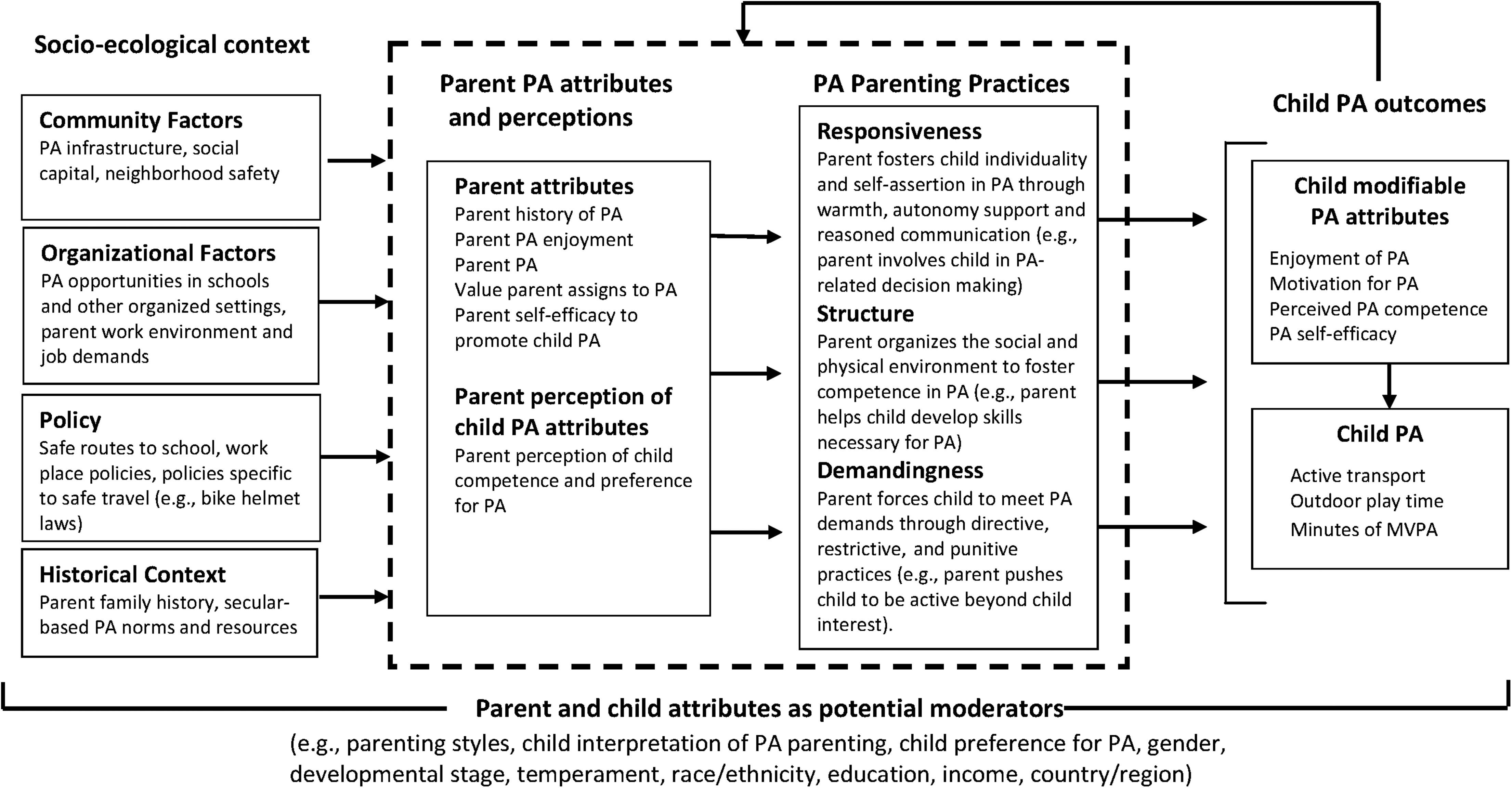
An Integrated Model of Physical Activity Parenting.
Building on Table 1, workgroup members developed the Integrated Model of PA Parenting to frame PA parenting research, link its fragmented components, and encourage exploration of new areas of inquiry. Looking first at the links between parenting dimensions and child PA outcomes, research supports positive effects of PA parenting practices indicative of responsiveness and structure on children's enjoyment of PA, 31 perceived competence, 32 self-efficacy and motivation for PA,5,33 active transport, 34 outdoor playtime 35 and minutes of moderate-to-vigorous PA (MVPA).2,31,32,35 In addition, there is preliminary evidence suggesting that PA parenting practices reflecting demandingness or control are linked with negative PA outcomes such as decreases in children's enjoyment of PA. 12
Moving to parent PA attributes and perceptions, research suggests that parents who are more active,
31
value and enjoy PA,31,36 and have high self-efficacy to promote child PA
5
are more likely to adopt PA parenting practices that promote child PA. Likewise, research suggests that parents who perceive that their child enjoys PA and is athletically competent report higher levels of positive PA parenting practices (
An ecological framework23,37 was added to the model to emphasize that families are embedded within contexts that have important implications for working with families to address PA parenting. While research on associations between ecological factors and PA parenting is in its infancy, a recent study found that parents' ratings of neighborhood social capital were associated with higher levels of positive PA parenting practices. In particular, higher parent-reported social capital predicted greater parent facilitation of PA, co-participation in PA, and promotion of community resources for PA. 35
Consistent with a life course perspective,
38
historical context was added to the model as a precursor to parents' PA attributes and PA parenting. Historical context includes parents' PA history and PA-related experiences within their family of origin. The life course perspective is also reflected through the inclusion of parent and child life stage as potential moderators of relationships between contextual factors, PA parenting, and child PA. Additional moderators outlined (
A complementary strategy to address current limitations in PA parenting research is to clearly prescribe and then promote rigorous standards of scale development. Trost and colleagues 8 recommend that investigators (1) only use measures that have evidence of validity and reliability in the population studied, (2) cite the original study outlining scale psychometrics rather than a previous study using the scale, and (3) comprehensively describe survey items and scale psychometric properties in the newly defined sample when developing a new scale or modifying an existing scale. We add to this list the need to employ theory to structure scale development, utilize a broad range of methods, including qualitative methods, throughout the scale development process, and report scale psychometric properties for the target sample. Furthermore, to avoid creating numerous scales with different definitions but overlapping content, it is important to involve the scientific community in the developmental stages to ensure scale endorsement.
Beyond rigorous standards for scale development, Mâsse and Watts
39
highlight the need to develop alternate methods for operationalizing PA parenting that avoid the common pitfalls of self-report surveys (
Finally, Mâsse and Watts
39
recommend the development of item banks that act as repositories of validated items that are calibrated with advanced psychometrics (
Conclusion
Interest in PA parenting research has increased precipitously since 2006,1–4,9 but methodological challenges inherent in this work limit its potential utility and impact. As recommended by the PA parenting workgroup, future research could address such concerns by establishing rigorous, theory-based scale development processes as well as objective measures of PA parenting and associated constructs. Workgroup members also highlighted the need to draw on existing theory, grounded in prior research, to structure contemporary research efforts. The Integrated Model of PA Parenting was developed as one example: It builds on prior research, integrates theory, and encourages exploration of the roles of gender, culture, context, and life stage. Moreover, the model will serve to link PA parenting and food parenting research through common constructs,29,42 which in turn will benefit family interventions targeting childhood obesity given links between children's diet, PA, and obesity risk.
The Integrated Model of PA Parenting is not intended as the only or the primary model structuring future research. Moreover, the alignment of the PA parenting practices presented in Table 1 with the higher-order dimensions of responsiveness, demandingness, and structure is hypothetical and has not been tested to date. The model illustrates one application of theory and prior research to inform a macro, or higher-order, representation of PA parenting and guide its future conceptualization, measurement, and research. Where existing theory provides a solid foundation, researchers are encouraged to employ and refine such theories and associated construct definitions for their application to PA parenting.
Footnotes
Acknowledgments
The preconference to the 2012 International Society for Behavioral Nutrition and Physical Activity (ISBNPA) annual meeting, “Parenting Measurement: Current Status and Consensus Reports” and resulting manuscripts were made possible due to funding from the United States Department of Agriculture/Agricultural Research Service (USDA/ARS 2012-68001-19285) and the National Heart, Lung, and Blood Institute of the National Institutes of Health (R13HL114262).
We wish to acknowledge and thank all individuals who participated in the physical activity workgroup, including Elva Arredondo, Laura Bellows, Anna Burrows, Kirsten Davison, Sara De Lepeleere, Marilyn Frenn, Erica Gobbi, Phillip Hanson, Angela Hilmers, John Hudec, Louise C. Mâsse, Jason Mendoza, Frank Perna (NCI), Anna Timperio, Julie Saunders, Katie Scheller, Michaela Schenkelberg, Stewart Trost, Kerri van der Ploeg, Dianne Ward, and Judith Warren.
Author Disclosure Statement
No competing financial interests exist for K.K.D., A.T., M.F., J.S., J.A.M., E.G., P.H., L.C.M., or S.T. L.M. received salary support from The Michael Smith Foundation for Health Research, the Child and Family Research Institute, and the Sunny Hill Foundation.