






Abstract
Biobanking is essential for advancing precision medicine. However, challenges persist in raising public awareness and addressing data protection concerns. This brief report outlines dissemination strategies by the Central Biobank Regensburg (Zentrale Biobank Regensburg—ZBR) and the BRoTHER (Biobank Research on Telemedical Approaches for Human Biobanks in a European Region) network to engage relevant target groups. In this context, five key recommendations are derived: (1) tailoring communication to audience needs, (2) using diverse outreach methods, (3) enhancing digital presence, (4) fostering cross-border collaboration, and (5) securing dedicated funding. These strategies aim to promote the social and scientific benefits of biobanking while ensuring its sustainability.
Keywords
Introduction
The storage and utilization of biospecimens as well as the related data in biobanks are fundamental to advancing translational research and precision medicine. 1 Despite their transformative potential, biobanks face significant challenges in building awareness and trust among diverse stakeholders. In fact, the public awareness of biobanking is low. For instance, Bossert et al. reported that only about 30% of Germans have heard of biobanking. However, a certain level of public awareness is necessary to enable knowledge building, opinion formation, and active engagement, 2 particularly when it comes to addressing data protection concerns related to DNA and other patient-sensitive information, patients hesitate to give their consent.3,4 Concurrently, biobanks must navigate the pressures of securing funding, building public support, and fostering collaborations with other organizations to ensure their sustainability. 5 Therefore, the Central Biobank Regensburg (Zentrale Biobank Regensburg—ZBR) and the Bavarian-Czech BRoTHER (Biobank Research on Telemedical Approaches for Human Biobanks in a European Region) network identified relevant target groups and outlined dissemination strategies that aim to actively communicate the public benefits of biobanks. This brief report highlights five recommendations to promote biobanking and precision medicine across various target groups.
Defining Target Groups to Tailor Dissemination Strategies
As shown in Figure 1, various target groups possess different levels of knowledge in biobanking, necessitating tailored communication channels to effectively engage each audience.
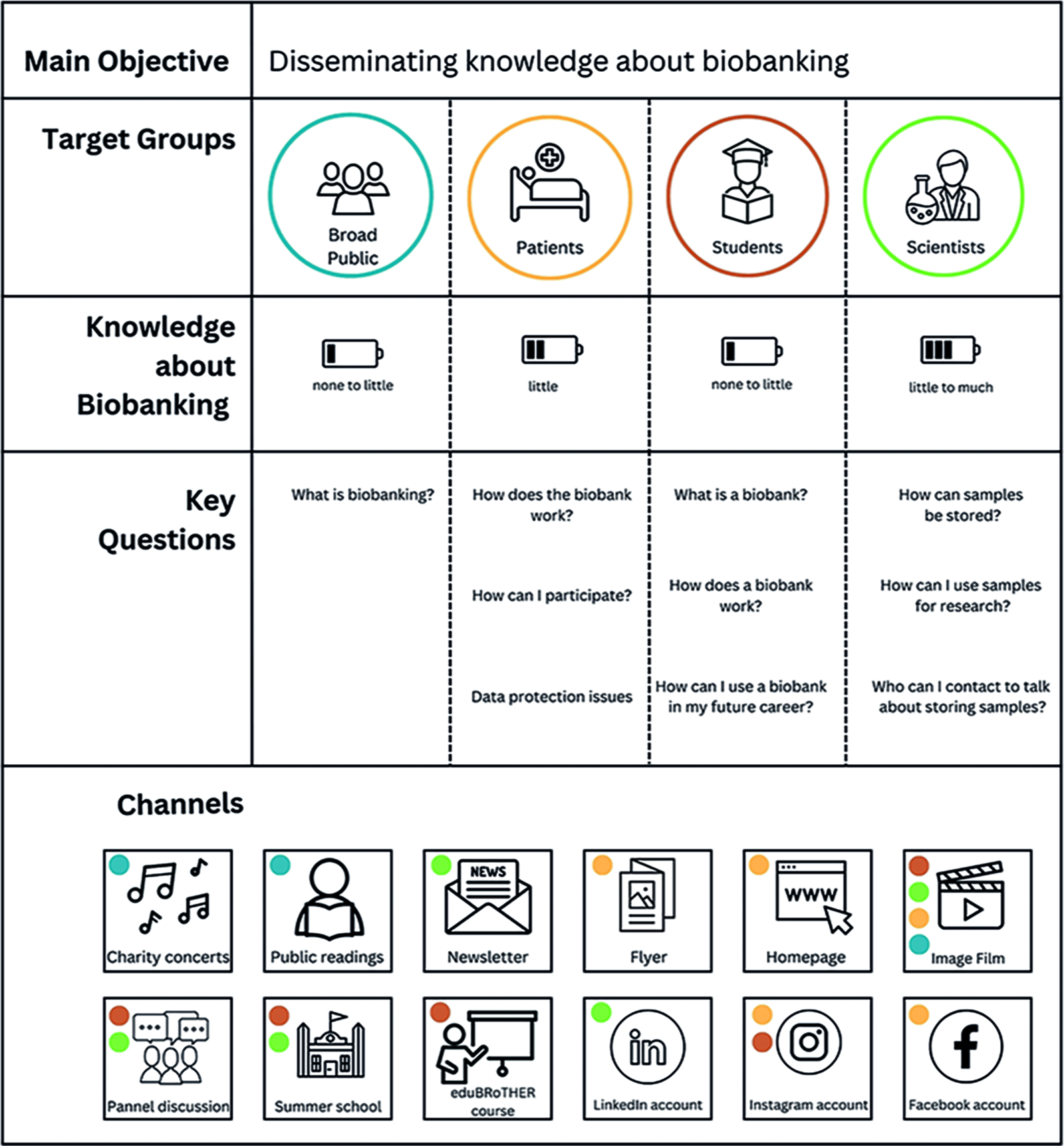
Relevant target groups based on their potential knowledge and interest and appropriate channels for communication. The
Addressing the public
The public, often unfamiliar with the concept of biobanking, requires low-threshold and relatable information. 6 Correspondingly, the ZBR organized public events, including a charity concert and two public readings with 780 participants, introducing the idea of biobanking in a nontechnical, engaging approach.7,8 Posters were exhibited, and flyers were distributed. These events served as platforms to trigger curiosity and initiate conversations about its social benefits. Hosting these events in accessible locations can further broaden their reach. Along with media coverage, these events can significantly enhance public understanding, interest, and the willingness to donate biomaterials. Small entrance fees or financial support by the university can help to cover the event costs. To ensure that these entrance fees do not become a barrier to participation, special attention must be paid to the attractiveness of the event. For example, our crime reading event featured a nationally renowned crime author followed by a wine tasting and catering. Since we held the event at our clinic, we avoided extra rental costs, which helped to make it a financial success. In fact, the event was sold out, and we generated a profit. The excess funds were used to cover the conference expenses for an employee who presented insights about one of the biobank’s projects, further raising the ZBR’s profile. Alternatively, the profits can be allocated to a fund for outreach projects to ensure that funding for the biobank’s operational activities remains secure.
Addressing the patients
For patients, education is crucial to demystify the biobanking process and its benefits. Addressing common concerns about privacy and consent is essential to building trust. 6 Even before written consent occurs in the outpatient clinic or at the hospital bedside, all patients should be informed about biobanking through accessible mediums such as flyers, websites, and social media channels like Facebook and Instagram. These channels provide clear and concise information about the biobank’s operations, the purpose of sample donations, and the protections in place to safeguard data privacy. Establishing transparent communication helps to alleviate anxieties and fosters a positive perception of biobanking.
Addressing medical students
As future health care professionals, medical students are a particularly important audience for biobank outreach. These students often lack foundational knowledge about biobanking and its potential relevance to their careers.9,10 Educational programs such as “Precision Medicine International (eduBRoTHER),” funded by the
Addressing the scientific community
The scientific community represents another crucial stakeholder group that is more familiar with the concept of biobanking. Outreach to scientists should emphasize how biobanks can support their research through sample storage and retrieval. This requires targeted initiatives such as academic workshops, regular newsletters, and collaborative events such as panel discussions or summer schools. For instance, the Europe Biobank Week 2022 Roadshow was organized by the ZBR, the ESBB, and BBMRI-ERIC to inform international attendees on biobanking quality management. 11 Furthermore, three BRoTHER Summer Schools addressed a total of 150 participants. Social media platforms such as LinkedIn can serve as effective tools for sharing research opportunities, fostering professional connections, and promoting events and publications. Through these efforts, biobanks can strengthen their integration into the academic and research landscape.
The Role of the Media in Disseminating Knowledge
In the era of “homo digitalis,” social media platforms have become essential components of scientists’ communication toolkit. 12 Social media campaigns tailored to specific target groups can sustain interest, engagement, and trust, while optimized websites provide comprehensive resources for those seeking detailed information.
As biobanks often lack experience in establishing sustainable outreach activities, the ZBR used the expertise of two social scientists to enhance its public relations efforts. The success of the outreach activities suggests that engaging external entities like press offices can be beneficial. Various media channels, such as flyers, e-mail newsletters, and social media accounts, including Instagram, Facebook, and LinkedIn, were used to promote ZBR’s work. Furthermore, two promotional videos enhanced outreach and engagement. Podcasts and videos, featuring expert discussions and storytelling, can be used to present complex scientific concepts in an engaging format. For example, BBMRI-ERIC’s podcast provides updates on the latest innovations from the biobanking landscape. These digital approaches extend global reach and scalability, making them indispensable in modern outreach efforts.
Joining Forces to Gain Outreach
Collaborative networks such as BRoTHER, which connect biobanks across regions, play a pivotal role in fostering knowledge exchange and joint outreach efforts. 5 Cross-border collaborations enhance visibility and resource sharing, enabling biobanks to implement larger-scale initiatives. Industrial partnerships with biotechnology companies and health care providers can further amplify the reach and impact of dissemination strategies.
Generating Sustainable Funding
Sustainable funding is essential for successful outreach initiatives. Securing grants tailored to educational or intercultural exchange projects has proven effective, as demonstrated by ZBR’s success in organizing events and producing educational materials. 5 However, biobanks must also advocate for dedicated funding within institutional and governmental frameworks. The organization and implementation of the outreach events were financially self-sustaining. Furthermore, they showed a clear connection between investment and success—the higher the financial investment, the greater the positive resonance from both sides, the public and the stakeholders. In addition, reinvesting funds strategically helped to maximize visibility. The higher the outreach, in terms of financial revenue and participant numbers, the stronger the support from stakeholders and their willingness to provide further funding. Although the generation of funding for the operating costs of a biobank is challenging, it might be of advantage to establish long-term investments in outreach activities that ensure continuity and scalability, addressing a significant barrier faced by smaller biobanks.
Strengthening the Reputation at a Regional Level
In general, public outreach concepts are highly context-specific, which makes it challenging to provide universally applicable concepts. Therefore, we recommend finding creative approaches, such as the setup of attractive events. In the planning process, we considered two factors as crucial: First, we strategically chose to focus on events around universally appealing and emotionally engaging themes, rather than directly on biobanking. This strategy enabled us to seamlessly integrate discussions of biobanking into the events, thereby increasing the audience’s awareness gradually. The events were held in cooperation with regional partners, such as wineries, breweries, caterers, and bookshops, highlighting the biobank’s role as a regional and community-focused institution. As faculty members and therefore potential decision-makers regarding financial issues were also present, our reputation, credibility, and standing on-site were strengthened in the long term. After experiencing successful events, the faculty’s willingness to further invest in biobanking activities also increased. Secondly, we paid attention to the financial success of the outreach activities. All profits were directly invested in other dissemination efforts. This strategy ensured that our events were not only self-sustaining but also supported further initiatives to raise awareness on biobanking.
Conclusion
It remains challenging to assess the impact of public events and scientific exchange. Metrics, such as attendance, social media follower numbers, and homepage clicks, might serve as indicators for an event’s impact. However, it is anticipated that the events will not directly influence biobanking participation rates immediately. Instead, our approach is to generate long-term knowledge, encouraging participants to consider tissue donation under appropriate circumstances. Future efforts will focus on improving assessment of awareness by identifying and analyzing both short- and long-term impact parameters prospectively.
Spreading awareness of biobanking and precision medicine necessitates tailored dissemination strategies. Through intensive efforts, the ZBR enhanced its social integration, increased public and professional trust, and solidified its role as a critical component of regional medical research.
This report emphasizes the necessity of diverse outreach strategies for the sustainability of biobanking. In this context, five key recommendations, based on the experiences of the BRoTHER network and the initiation of the ZBR, were formulated:
Define target groups to tailor communication. Utilize diverse and creative outreach methods supported by the expertise of social scientists. Enhance the digital presence of the biobank on social media channels. Foster cross-border and interdisciplinary collaboration. Secure sustainable funding for outreach activities.
Authors’ Contributions
D.S., T.N., C.B., and M.K. contributed to the project design. D.S., M.K., T.N., L.W., and M.S. were responsible for the project execution. D.S., L.W., T.N., and C.B. drafted the article. O.T., M.K., R.B., and M.S. critically revised the article. All authors read and approved the submitted article.
Footnotes
Author Disclosure Statement
No competing financial interests exist.
Funding Information
The course program “Precision Medicine International (eduBRoTHER)” was generously funded by the European Union, Ziel ETZ 2014–2020 (Ref.: Interreg 289). The BRoTHER Summer Schools and activities to promote the BRoTHER network on social media were supported via short-term projects by the Bavarian-Czech Academic Agency (Ref.: BTHA-AP-2021-17 and BTHA-SW-2022-5). Activities of partner Biobank Pilsen, Czech Republic, were funded by the project BBMRI.cz (reg. no. LM2023033).