






Abstract
The enantiomeric excess (ee) of
Introduction
Amino acids are the basic building blocks of proteins, featuring two optical isomers,
The detection of amino acids in the Murchison meteorite that has fallen in Australia in 1969 and the discovery of an amount of ee of
Indeed, in laboratory experiments, the CPL irradiation induces the asymmetric photosynthesis and decomposition of amino acids leading to nonzero ee (Bailey, 2000; Munoz Caro et al., 2002; Nuevo et al., 2007). From photolysis experiments and circular dichroism (CD) measurement of
In space, various light sources exist and are known to be responsible for different types of radiation field; however, the Kuhn–Condon zero-sum rule entails a cancelation of the CD contributions by summing over the entire wavelength range (Kuhn, 1930; Condon, 1937). Therefore, a nonzero ee cannot be originated by the irradiation of polychromatic CPL. This implies that a specific wavelength of CPL that gives the same sign of CD is required to promote the arising of ee of amino acids. In an early phase of the galactic evolution, the strongest emission in the pan-galactic light is Lyman-α (Lyα) line, an emission peaked at 10.2 eV due to a relaxation from the first excited state to the ground state of a hydrogen atom. This early phase is categorized as Lyα emitters (LAEs) (Shibuya et al., 2014).
In this study, we inspect the arising of amino acid ee up to the 11 eV light region covering the LAE spectra by resorting to a high accurate theoretical methodology. In particular, we focus on optical properties and photolysis-induced ee by the circularly polarized Lyα (CP-Lyα) for three key amino acids; alanine (Ala), Aba and Val. All these amino acids were found in the Murchison meteorite, and their %ee were reported to be 1.2, 0.4, and 2.2, respectively (Cronin and Pizzarello, 1999).
Methods
In our computational approach, we first searched for the most stable conformations of the three targeted amino acids (
All the calculations were performed using the Gaussian16 program package (Frisch et al., 2019). Molecular structures were illustrated by using the visual molecular dynamics program (Humphrey et al., 1996).
Results
The most stable conformations of the three L-amino acids considered are shown in Fig. 1A. In the zwitterionic form, amino acids take only one conformation, and their conformational flexibility is due to side chains. Therefore, the conformations of their most stable state are structurally very similar. Specifically, Ala has one conformer, while both Aba and Val have three different conformers. The relative energies of the Aba conformers are 0.436 and 1.182 kcal/mol, while those of Val are 1.185 and 1.789 kcal/mol as obtained at the B3LYP//6–311++G** theoretical level with zero-point energy correction included. The relative Aba energies of 0.436 and 1.182 kcal/mol contribute to the stability of the lowest energy conformer by 6.4% and 0.06% at the upper limit temperature of molecular clouds, 80 K. This suggests that the conformational contributions of these amino acids are minimal in molecular clouds. However, by comparing with the experimental CD spectra, observed at T = 298 K, their contribution ratios increase to 47.9% and 13.6%, respectively. Hence, we computed the CD spectra by including all the conformers. In the ongoing discussion, we first present the results obtained for the photoabsorption and CD features at 0 K, since this is a crucial reference temperature in molecular cloud conditions, and then we focus on these same spectra at higher temperatures up to 298 K providing an insightful comparison with experimental CD spectra.
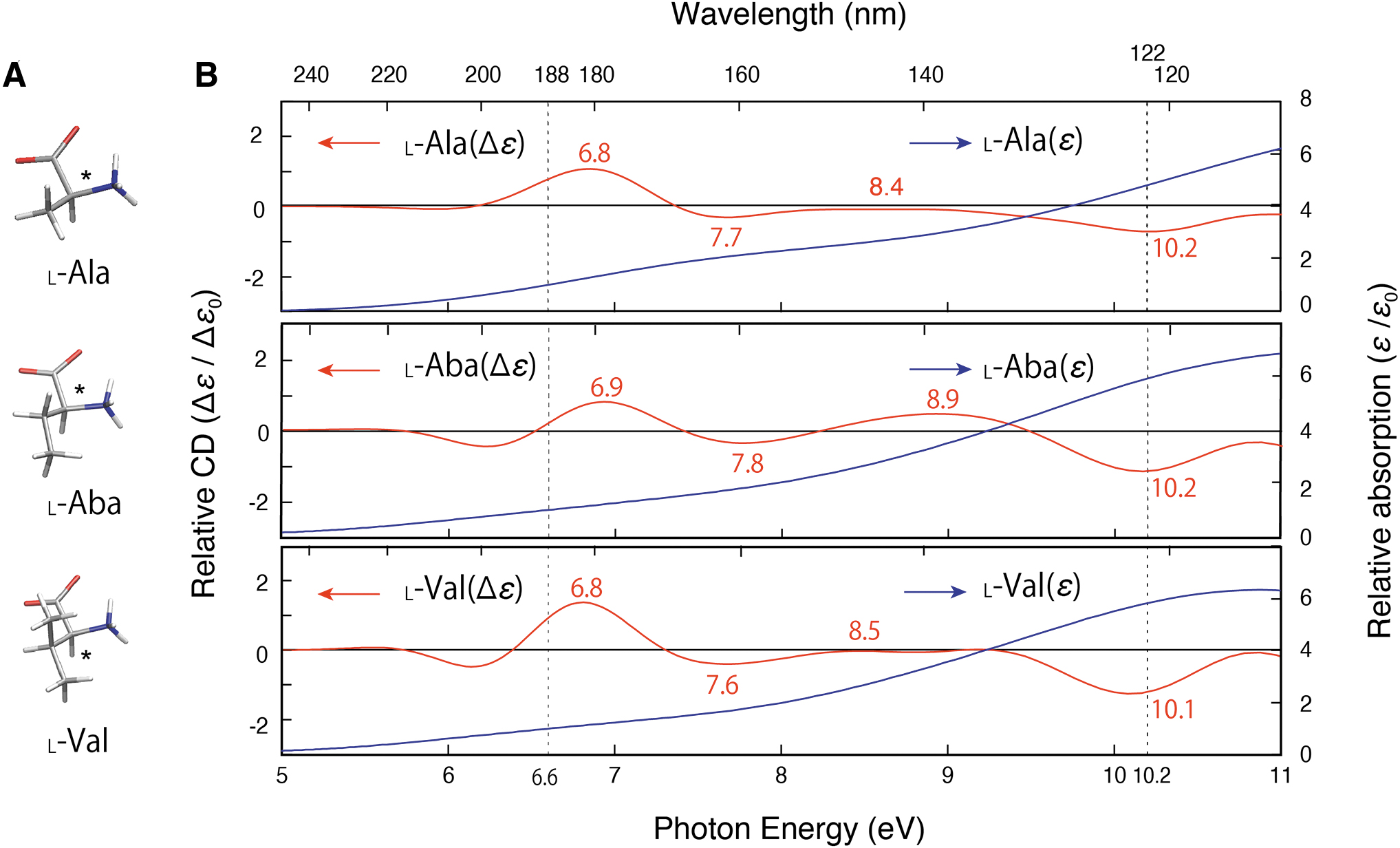
In the most stable conformers of Fig. 1A, the photoabsorption (ɛ) spectra and CD difference of molar absorptivity between left- and right-CPL; Δɛ = ɛ(L) − ɛ(R), were calculated at the SAC-CI/cc-pVTZ theoretical level. For
where x is the photon energy in eV unit before calibration, and y is the resulting scaled value. By applying Eq. 1, the peak positions of the calculated CD spectrum shift to 6.8 and 10.2 eV, thus becoming closer to the experimental values. In the following discussions, the Eq. 1 is applied to all calculations. The refined photoabsorption and CD spectra for
For a better comparison with the experimental data, the computed absorption and CD spectra at higher temperatures are reported in Fig. 2. For
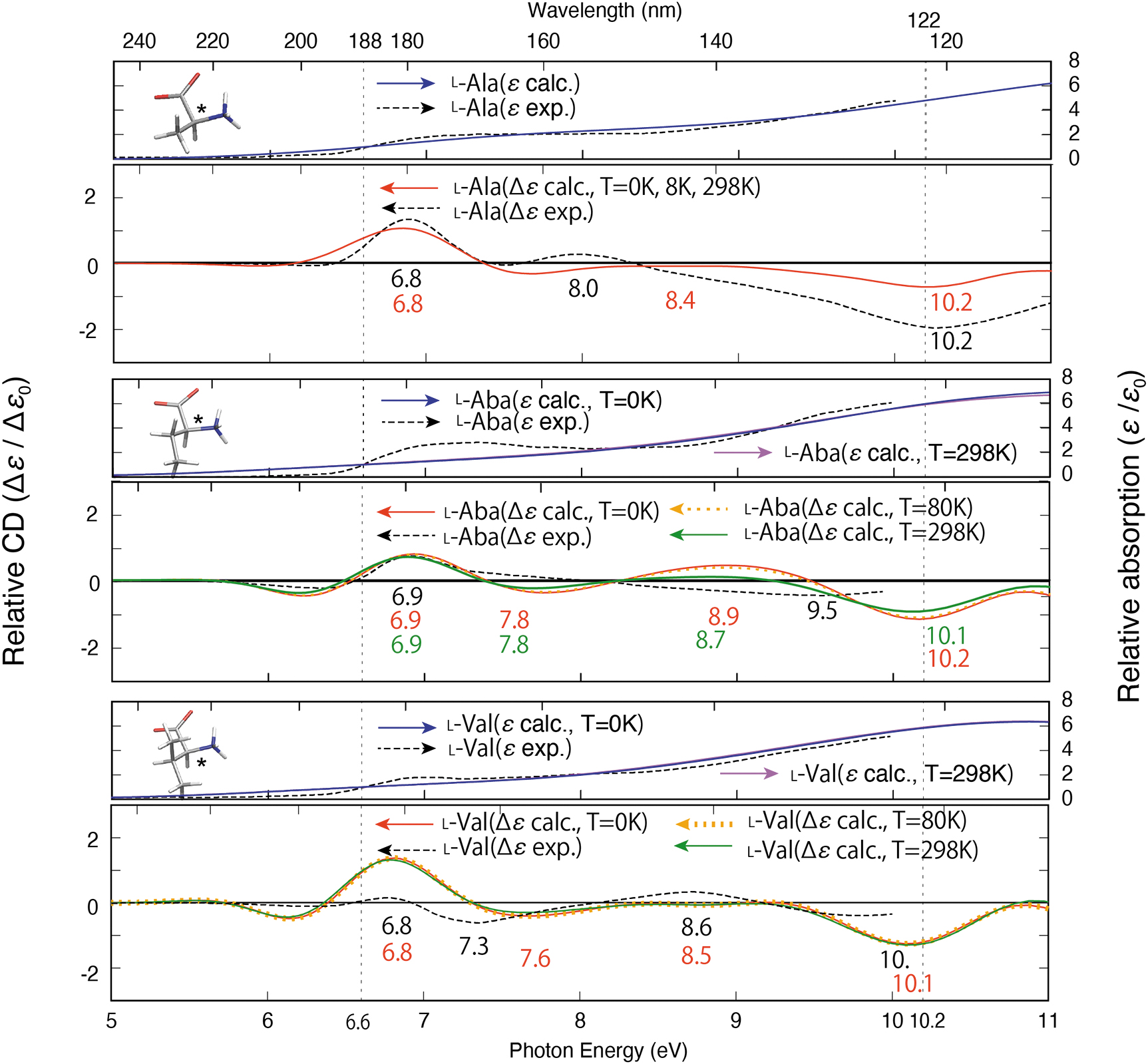
Relative absorption and CD spectra of the three
Under the enantioselective photolysis, %ee has been estimated from the molecular absorption coefficients as follows:
where ξ is the extent of reaction and g the anisotropy factor (Balavoine et al., 1974). Equation 2a indicates that %ee increases as the photolysis proceeds (ξ approaching the value of 1.0). By ξ = 0.9999, the computed %ee values (%eeg ) are plotted in Fig. 3 (green curves), and the g value is the only variable determining %ee. The g value is obtained by dividing Δɛ by ɛ as expressed by Eq. 2b. Therefore, photons characterized by small ɛ values give large %ee values. Given this situation, values of %ee of about 6.8 eV become dominant compared to other photon energies. Nonetheless, it seems that this argument does not hold for the wide photon range considered in this study. Indeed, in our case, ξ is expected to depend on ɛ(ν). By making use of the original derivation of ξ (Balavoine et al., 1974), we obtain
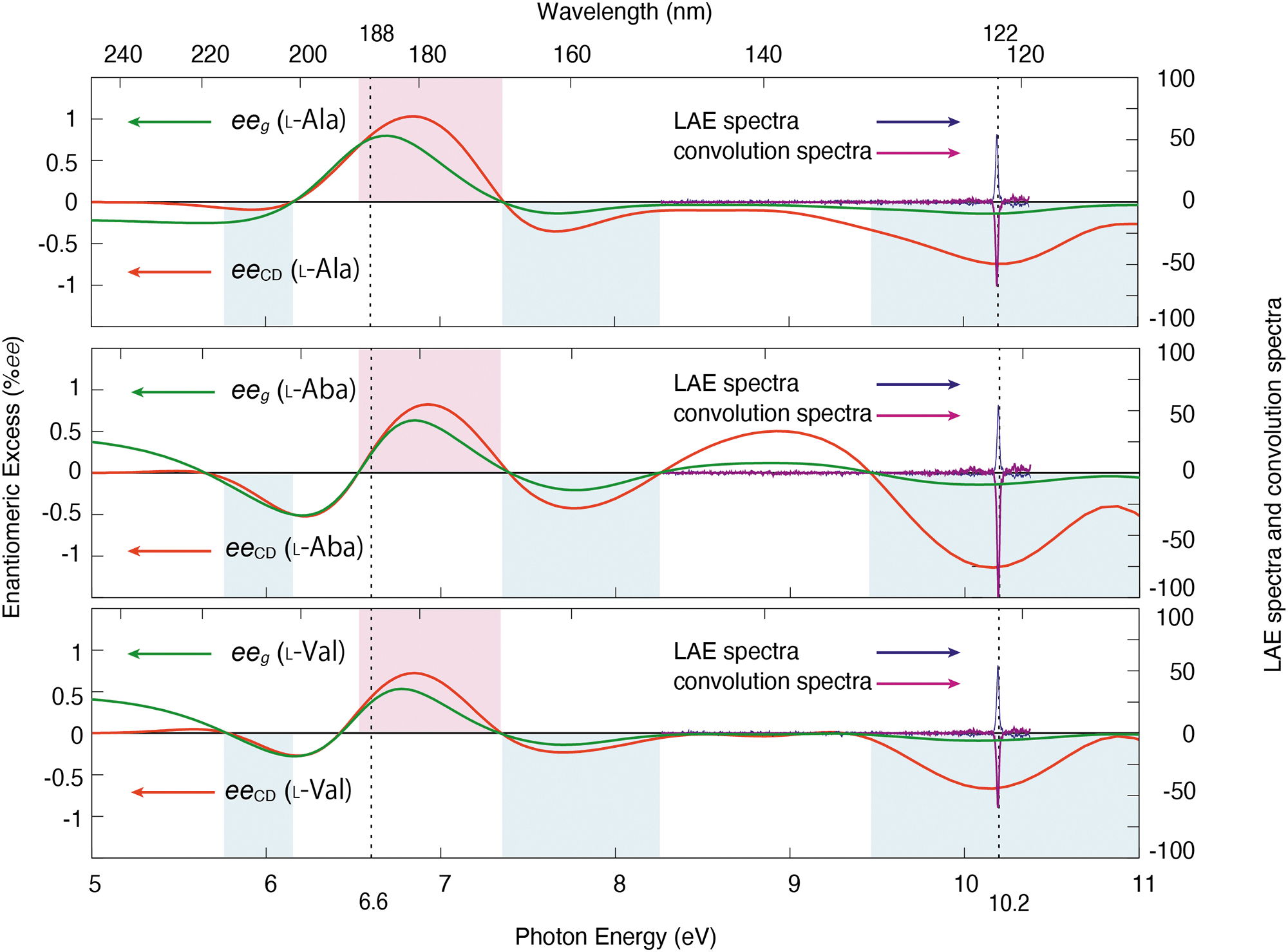
Enantiomeric excesses at 0 K (%eeg ) estimated by using Eq. 2a is shown in green and the analogous quantity %ee CD estimated by using Eq. 4 is in red color; LAE spectra and their convolution (LAE × %ee CD) are indicated in each panel. We recall that |%ee CD| predicts higher ee than |%eeg | in the Lyα region (10.2 eV) compared with the 6.6 eV region. Regions sharing positive and negative %ee values are colored in pink and cyan, respectively. The positive %ee region, in all the cases analyzed here, corresponds to the range 6.5–7.3 eV, whereas the negative %ee regions are located at 5.6–6.2, 7.4–8.3, and 9.5–11 eV. ee, enantiomeric excess; LAE, Lyman-α emitter; Lyα, Lyman-α.
where k is the reaction rate constant, proportional to the molar absorptivity (ɛ), and t′ is the scaled time. Substituting Eq. 3d into Eq. 2a, we obtain the following formula:
In Eq. 4, %ee depends on the time (t′) and Δɛ, but not on ɛ. Equation 4 indicates that for small values of ɛ, the photolysis proceeds slowly but large value of g determines the %ee progress, whereas for large values of ɛ, the photolysis proceeds faster, while smaller g values decrease substantially the %ee contribution. Consequently, ɛ does not influence directly %ee. Details of the simulation performed are provided in Supplementary Fig. S2 in the Supplementary Data. By making use of Eq. 4, the %ee values (%ee CD) have been calculated and graphically shown in Fig. 3 (red curves).
We made use of the newly derived ee formulation given by Eq. 4 (%ee
CD) by setting an appropriate t′ to generate a %ee value similar to the one given by the original formulation of Eq. 2a (%ee
g) in
To complete our analysis, we calculated the convolutions of the derived %ee CD spectra with an LAE spectrum to verify the generation of %ee by CP-Lyα (Fig. 3). To this aim, ee employed a spectrum composed of eight LAEs at a redshift near the value z = 2.2 of the luminosity z, as a typical average spectrum of LAEs (Shibuya et al., 2014). The background continuum component (hν < 10.17 eV and hν > 10.23 eV) far from the intense LAE peak at 10.19 eV (121.66 nm) were not integrated since the diffuse background continuum is expected to be nonpolarized. The computed %ee values, with the LAE spectrum integrated within the ∼0.0016 eV interval, are summarized in Table 1.
Calculated Enantiomeric Excesses of the Amino Acids (%ee g /%ee CD) Generated by Asymmetric Photo-Dissociation Reactions at the Photon Energies of 6.6 and 10.2 eV and Lyman-α Emitter Spectra
Aba = 2-aminobutyric acid; Ala = alanine; CD = circular dichroism; LAE = Lyman-α emitter; Val = valine.
The %ee values obtained by using the LAE spectrum compare very well with the %ee values estimated by 10.2 eV monochromatic light, as the LAE spectrum is considerably sharp with respect to the CD spectra of amino acids. All the three α-amino acids have in common an enhanced %ee not only at 6.8 eV but also at 10.2 eV region, and the signs of the induced %ee are inverted at 6.8 and 10.2 eV, respectively. By taking into consideration the fact that the CPL irradiation directly induces an amino acid excitation and its photo-dissociation, our results indicate that 10.2 eV left handed CPL (L-CPL) is responsible for the suppression of
Former studies reported that eeL is created by the right handed CPL (R-CPL) irradiation in the amino acid photosynthesis experiments (De Marcellus et al., 2011; Modica et al., 2014). Specifically, Modica et al. (2014) inferred that 10.2 eV R-CPL produces 1.04% ee L of Ala and 6.6 eV L-CPL produced 0.71%ee L, respectively. Although the signs they obtained for the ee from the photosynthesis experiments are inconsistent with our theoretical results, the spectral peaks of the experimental CD spectra show a high correlation with our theoretical results in the photon energy. We expect that the experimental CPL radiation may induce a compositive photosynthesis which generates not only the amino acids but also its derivative or even other chiral molecules that exist in interstellar environment. Generated chiral molecules may play a key role as the origin of chiral asymmetry of amino acids in the formation history. Amino acid precursors might be a solution to explain the origin of homochirality (Shoji et al., 2023). Hori et al. (2022) reported that propylene oxide, a sole chiral molecule detected in space, has a negative CD absorption in the Lyα region. To answer these questions, further understanding regarding the synthetic mechanisms of biomolecules (i.e., synthetic reactions via radical species [Sato et al., 2018]), molecular mechanisms of the enhancement of ee (Watanabe et al., 2023), and even kinetics of various interstellar molecules on interstellar dust surface are required. Our study proposes the proper direction as a starting point of insight into the origin of homochirality.
On a speculative basis, all galactic bulges including the one in the Milky Way are thought to undergo a process of the LAE phase (Mori and Umemura, 2006). The Lyα emission on the LAE phase is 105–106 times stronger than in an individual star-forming region. Moreover, the bulge on the LAE phase is thought to be composed of substantial dust contents (Hayes et al., 2013). Hence, the scattering and dichroic extinction by dust grains, aligned along a given direction of the interstellar magnetic field, can produce an intense CPL in the Lyα band. In an interstellar molecular cloud, ammonium, aldehyde, and hydrogen cyanide are created, and these react with each other to form biomolecules on icy dust upon ultraviolet (UV) irradiation (Nuevo et al., 2007). Amino acids are synthesized from predecessor molecules through a number of chemical evolutional processes occurring on icy dust surface in interstellar medium (Kayanuma et al., 2017; Sato et al., 2018). Regarding the observation data, CPL has been detected in star-forming regions in the Milky Way (Bailey, 1998; Fukue et al., 2010). In NGC6334 nebula, a strong circular polarization (CP) with a magnitude of 20% was found, and it was ascribed as the cause of dust scattering and dichroic extinction (Kwon et al., 2013). Although this CP is observed in the infrared range, an analogous signal in the UV region is expected. Fukushima et al. (2020) simulated the CP generation and resulted in the dependency of the CP degree on the relative distribution of dust grain in the forward position.
The LAE phase in the Milky Way might correspond to an early starburst phase that occurred several billion years ago in the bulge component (Mori and Umemura, 2006). Our solar system is located at 28,000 light-years away from the galactic center in the disk component. Therefore, the intense Lyα emission was likely to have reached our planet from the solid angle collimated toward the galactic center in the whole sky. Peaky Lyα radiation could have been circularly polarized by scattering and dichroic extinction by dust grains aligned to the interstellar magnetic field in the proto-solar system (Whitney and Wolff, 2002). As the CP-Lyα was sharp enough, it could act as a galactic waveband filter. We suggest that these studies support the idea that the ancient polarized UV may have a crucial role to generate enantiomeric excess on the early biomolecule (represented as amino acids). It may be the trigger to the breaking of racemic state and thus could be the origin of homochirality in the Solar System.
Conclusions
Our theoretical and computational approach has been shown to be able to reproduce with appreciable accuracy the experimental CD spectra of three amino acids,
Footnotes
Author Disclosure Statement
No competing financial interests exist for any of the authors.
Funding Information
This research has been supported by the research projects (1) JST, PRESTO grant number JPMJPR19G6, Japan, (2) TIA collaborative research program “Kakehashi” and (3) JSPS KAKENHI grant numbers JP19H00697, JP20H05453, JP20H05088, and JP22H04916. Computational resources were partially supported by the Multidisciplinary Cooperative Research Program in CCS, University of Tsukuba. M.B. thanks the HPC Center at the University of Strasbourg funded by the Equipex Equip@Meso project and the CPER Alsacalcul/Big Data, and the Grand Equipement National de Calcul Intensif (GENCI) under allocation DARI-A0120906092 and A0140906092.
Supplementary Material
Supplementary Data
Associate Editor: Christopher McKay
Abbreviations Used
References
Supplementary Material
Please find the following supplemental material available below.
For Open Access articles published under a Creative Commons License, all supplemental material carries the same license as the article it is associated with.
For non-Open Access articles published, all supplemental material carries a non-exclusive license, and permission requests for re-use of supplemental material or any part of supplemental material shall be sent directly to the copyright owner as specified in the copyright notice associated with the article.
